
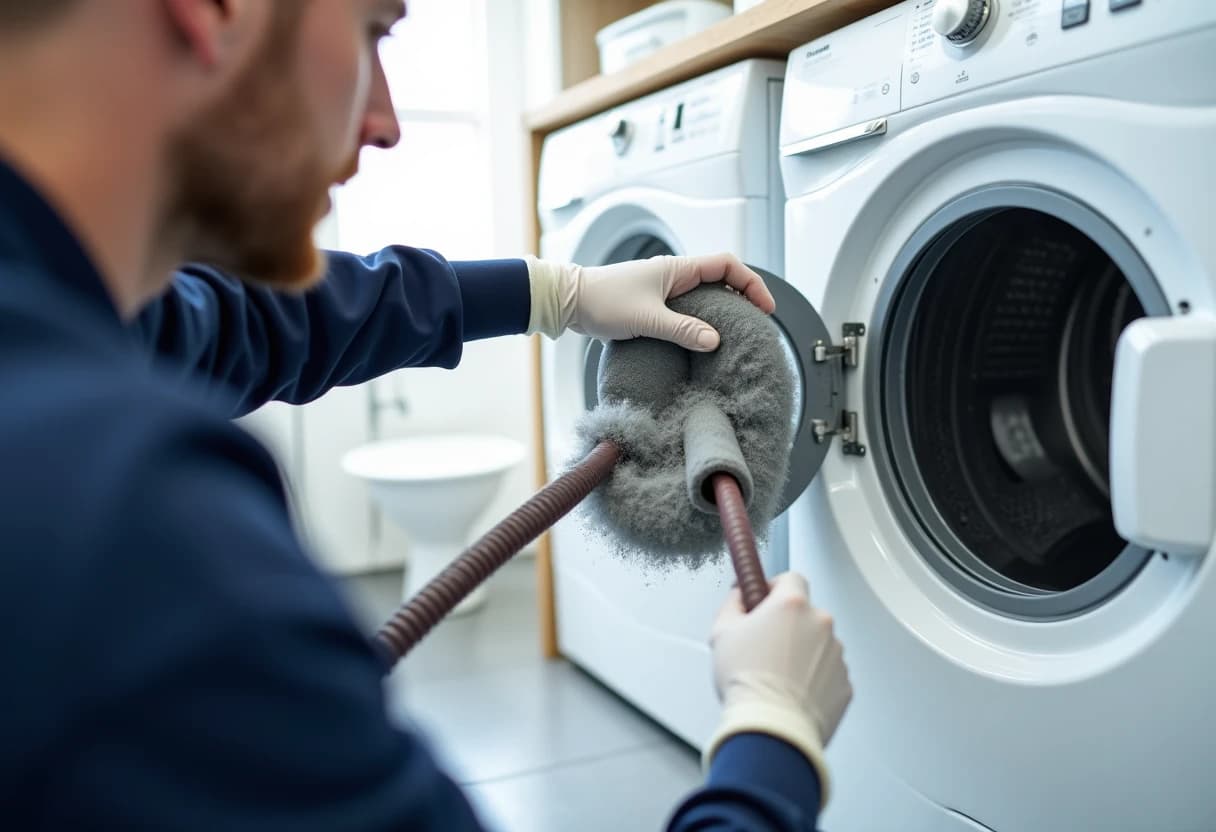
Every load of laundry sheds lint, and your dryer's lint screen catches only a fraction of it. The rest travels into the exhaust duct, where it snags on joints, elbows and screw tips and slowly packs the line shut. FEMA estimates around 2,900 home clothes dryer fires occur in the US every year, and failure to clean the vent is the leading contributing factor. Our Greater Boston dryer vent cleaning service removes that hazard completely: a rotary brush scrubs the full length of the duct while a HEPA vacuum captures the lint, and we clean from both the dryer side and the exterior termination so nothing is left behind.
That burning smell during a drying cycle, the laundry room that turns into a sauna, the clothes that come out damp after a full hour — these are all symptoms of one problem: a dryer vent choked with lint. Beyond the inconvenience, a blocked vent forces exhaust temperatures up and gives the resulting heat a duct full of fuel. We provide professional dryer vent cleaning throughout Greater Boston using the same source-removal principle as our duct cleaning: mechanical agitation with rotating brushes, simultaneous HEPA vacuum capture, and cleaning from both ends of the run. Most appointments take under ninety minutes, and the improvement is obvious on the very next load.
Why Dryer Vent Cleaning Matters
The fire statistics on clothes dryers deserve to be taken literally. FEMA's national estimates attribute roughly 2,900 residential fires per year to clothes dryers, causing an estimated five deaths, one hundred injuries and $35 million in property loss — and the leading factor, cited in about a third of these fires, is failure to clean. The mechanism is simple: lint escapes past the screen on every cycle, accumulates in the duct, restricts airflow, and drives exhaust temperatures upward until the lint itself — which ignites easily and burns fast — meets a hot enough surface or a stray spark from the dryer's heating element. A professional cleaning breaks every link in that chain at once. It removes the fuel, restores the airflow that keeps operating temperatures in the safe range, and gives a trained technician a look at the transition duct, joints and termination where problems concentrate. For $149 to $299, it is the cheapest fire prevention a homeowner can buy, and it pays part of itself back in energy savings immediately.
There are moments when dryer vent cleaning becomes urgent rather than routine. If you have just bought a home, you inherit a vent with an unknown history — quite possibly never cleaned since installation, and in older Massachusetts homes possibly lined with decades of lint. If your dryer is new, manufacturers require a clear vent for warranty coverage, and installers rarely clean the existing duct. If your vent terminates on the roof, wildlife may have added a nest to the lint; bird and rodent nesting in dryer terminations is one of the most common blockages we clear. And if you have ever smelled something burning during a cycle or had a load come out hot but wet, the vent needs attention now, not at the next convenient interval. In every one of these situations, a single professional cleaning re-establishes a known-clean baseline — after which an annual schedule keeps it that way for a modest, predictable cost.
How Our Dryer Vent Cleaning Process Works
1Inspect the Dryer, Transition Duct & Vent Path
We start behind the dryer: pulling the machine, examining the transition duct for crushing, kinks or foil accordion material, and tracing the vent's full path from connection to exterior termination. Mapping the run tells us its length, elbow count and materials — and lets us confirm your flat price before any cleaning begins.
2Protect the Laundry Area & Disconnect the Dryer
Before cleaning starts, we lay floor protection, carefully slide the dryer out without scarring floors, and disconnect the transition duct. Gas dryers are handled with proper care around the flexible gas connector — we never strain it. With the duct open at the appliance end, we have the access needed to clean the entire run.
3Rotary Brush the Full Length of the Duct
Our core cleaning tool is a motor-driven rotary brush on flexible rods, fed through the entire duct run. The spinning brush head scrubs lint off the duct walls through every elbow and vertical section, in runs up to 35 feet and beyond. Unlike hand brushes, it maintains full scrubbing force at the far end of the line — where the worst accumulation usually hides.
4Capture Everything With HEPA Vacuum Extraction
As the brush works, a HEPA-filtered vacuum runs simultaneously on the duct, pulling loosened lint into a sealed collection system instead of letting it blow into your laundry room or yard. The combination — agitate and extract at once — is what leaves the duct genuinely empty rather than redistributing the clog.
5Clean From the Exterior Termination Inward
We then work the line from the outside in — wall hood, soffit outlet or roof cap. Exterior terminations trap their own debris: lint mats behind the damper, bird and rodent nests, and screening clogged solid. Roof terminations get full ladder or roof access; we carry the gear, and steep or high work is included in the quoted price.
6Service the Transition Duct & Reconnect
The short duct connecting dryer to wall does more harm than its length suggests — crushed, kinked or made of plastic, it can choke an otherwise clean system. We clean it, or if it is damaged or made of hazardous foil or vinyl accordion material, we recommend replacement with a semi-rigid aluminum connector, usually installed on the spot for a small parts charge.
7Verify Airflow & Walk You Through the Results
The job ends with proof: we measure airflow at the exterior termination with the dryer running and compare it to the baseline reading from arrival. Strong, steady exhaust and a fully opening damper are the pass conditions. You get the before-and-after numbers, photos of what came out, and honest notes on the duct's condition.
Benefits You Can Expect
Dramatically Reduced Fire Risk
This is the benefit that matters most. Lint is extraordinarily flammable, and a clogged vent both supplies the fuel and creates the overheating that ignites it. Removing the accumulation removes the hazard — which is why fire departments, the NFPA and FEMA all urge annual dryer vent cleaning as basic home fire prevention.
Faster Drying Times
Airflow is what dries clothes; heat just helps. Restore full exhaust capacity and loads that limped through two cycles finish in one, towels stop coming out damp at the seams, and the dryer's moisture sensors — which many modern machines rely on — start reading accurately again. Most customers notice the difference on the first load after our visit.
Lower Energy Bills
Every minute of unnecessary drying time is metered energy. A restricted vent that doubles cycle times roughly doubles the dryer's share of your utility bill — often $10 to $20 a month for an average household. Annual cleaning typically pays for a large fraction of itself in the first year of restored efficiency.
Longer Dryer Lifespan & Fewer Repairs
Blocked vents kill dryers slowly: thermal fuses blow, heating elements burn out, belts and bearings log double hours, and moisture backing into the machine corrodes components. Appliance technicians confirm that vent restriction underlies a large share of dryer service calls. A clear vent lets the machine run within its design limits — and last accordingly.
Less Moisture, Mildew & Musty Odor
Each load exhausts about a gallon of water as vapor. When the vent is blocked, that moisture backs into the laundry room and the duct itself — condensing on walls, peeling paint, and feeding mildew. A clear vent sends the humidity outside, drying out the laundry area and eliminating the damp, musty smell that clings to blocked systems.
Safer Operation for Gas Dryers
Gas dryer exhaust carries combustion byproducts, including carbon monoxide, and the vent is the only path designed to remove them. A blocked line can force those gases back into living space. Cleaning restores the engineered exhaust path — a meaningful safety margin for any home with a gas appliance and a real necessity for homes with bedrooms near the laundry.
Documentation for Insurance, Condos & Peace of Mind
Every cleaning ends with a written record: date, scope, before-and-after photos, airflow verification and condition notes. Condo associations increasingly require proof of dryer vent maintenance, some insurers ask after claims, and home buyers appreciate the paper trail. One visit satisfies all three — and tells you exactly when the next service is due.
Warning Signs to Watch For
Clothes Take More Than One Cycle to Dry
The single most reliable symptom. A healthy dryer dries a standard load in 35 to 50 minutes; when towels need a second cycle or jeans come out damp at the waistband, exhaust airflow has dropped. The dryer has not gotten weaker — the vent has gotten narrower. Cleaning restores the original performance in one visit.
Dryer or Clothes Are Hot to the Touch
A dryer cabinet too hot to rest a hand on, or clothes that come out scorching, means exhaust heat is not leaving the machine. That heat is being absorbed by the dryer's components — and by the lint in the duct. This is the pre-ignition condition fire investigators describe; treat it as urgent, not cosmetic.
Burning Smell During a Cycle
A hot, singed odor while the dryer runs is lint beginning to scorch — on the heating element, in the internal ducting or in the exhaust line. It is the most serious warning sign on this list. Stop the dryer, let it cool, and do not run full loads again until the vent and machine interior have been cleaned.
The Exterior Vent Flap Barely Opens
Step outside during a drying cycle and look at the termination hood. The damper should stand fully open with a strong, warm airstream you can feel from a foot away. A flap that flutters weakly, opens halfway or stays shut is showing you the blockage directly — the cheapest diagnostic in home maintenance.
Laundry Room Gets Hot and Humid
A laundry area that turns tropical during dryer cycles — fogged windows, sweating pipes, damp walls — is receiving the heat and moisture the vent should be sending outdoors. Each blocked load pushes up to a gallon of water vapor into your home instead of out of it. The room is telling you what the duct cannot.
Lint Building Up Behind or Inside the Dryer
Lint accumulating behind the machine, around the transition hose or under the dryer means the exhaust path is leaking or backing up — lint should travel out, not settle in. It is both a symptom of restriction and a hazard in itself, since this lint sits nearest the heat source. A cleaning addresses the cause and clears the accumulation.
It Has Been More Than a Year
The NFPA, FEMA and every major dryer manufacturer converge on the same guidance: professional vent cleaning at least annually, more often for heavy use. If you cannot remember your last cleaning — or know there has never been one — the schedule alone says you are due, whatever the symptoms.
Dryer Vent Cleaning Cost in the Boston Area
Dryer vent cleaning in Greater Boston typically costs $149 to $299, and the honest drivers of price are the run itself: length, number of elbows, and where it terminates. A first-floor laundry with a short straight shot to a side wall sits at the low end near $149. A basement laundry venting up and across to a second-story wall, or any roof termination, sits toward $249 to $299 because of the added access work and ladder or roof time. Severely blocked ducts that need staged extraction, nest removal from the termination, or cleaning from both ends of a very long run can add modestly, and we tell you before proceeding. What never changes: our quote covers the complete line — dryer connection to exterior hood, elbows included — plus transition duct inspection, exterior damper service and airflow verification. Beware pricing that covers 'the first six feet' with per-foot charges after; a dryer vent is only clean if all of it is clean.
A note on the low end of the market: you will see dryer vent cleaning advertised for $69 to $99, and occasionally it is legitimate — a short run, a quick brush, done. More often the price assumes ideal conditions that Greater Boston homes rarely offer, and the invoice grows on site with 'extra footage,' 'additional elbows' and 'blockage fees' until it exceeds a transparent quote. Our flat pricing of $149 to $299 is set for real local conditions: 15-to-35-foot runs, three or four elbows, basement laundries, and hoods that have not been opened in a decade. It includes the rotary brush cleaning of the entire duct, HEPA vacuum extraction, exterior termination service, transition duct inspection and a final airflow verification with photos. When comparing quotes, ask one question: does the price cover the complete run and the termination, whatever it takes? Ours does.
Seasonal Considerations in New England
Winter is when Greater Boston dryer vents fail. Cold stiffens exterior damper flaps, snow drifts block grade-level hoods, and warm moist exhaust hitting a freezing duct section condenses — turning loose lint into dense, damp mats that can plug a marginal vent in weeks. Meanwhile laundry loads peak: heavy sweaters, extra blankets, snow-soaked layers. It is no coincidence that dryer fires are most frequent in winter, with January the peak month in federal fire data. The smart schedule is a fall cleaning — clear the system before the heavy season — but if winter has already exposed a problem, we keep cold-month availability across Greater Boston precisely because these calls cannot wait.
Why Boston Air Duct Cleaners
We built this company around the jobs other duct cleaners do badly: the 130-year-old Victorian with panned-joist returns, the Greater Boston condo with a 60-foot dryer run to the roof, the post-renovation house full of drywall dust. Our crews see Greater Boston's hardest systems every week, and the experience shows in the details — floor protection on the way in, sealed registers during the work, HEPA-vacuumed work areas on the way out, and imagery that proves the ducts are actually clean. Call (617) 390-7145 and judge the difference from the first conversation.