
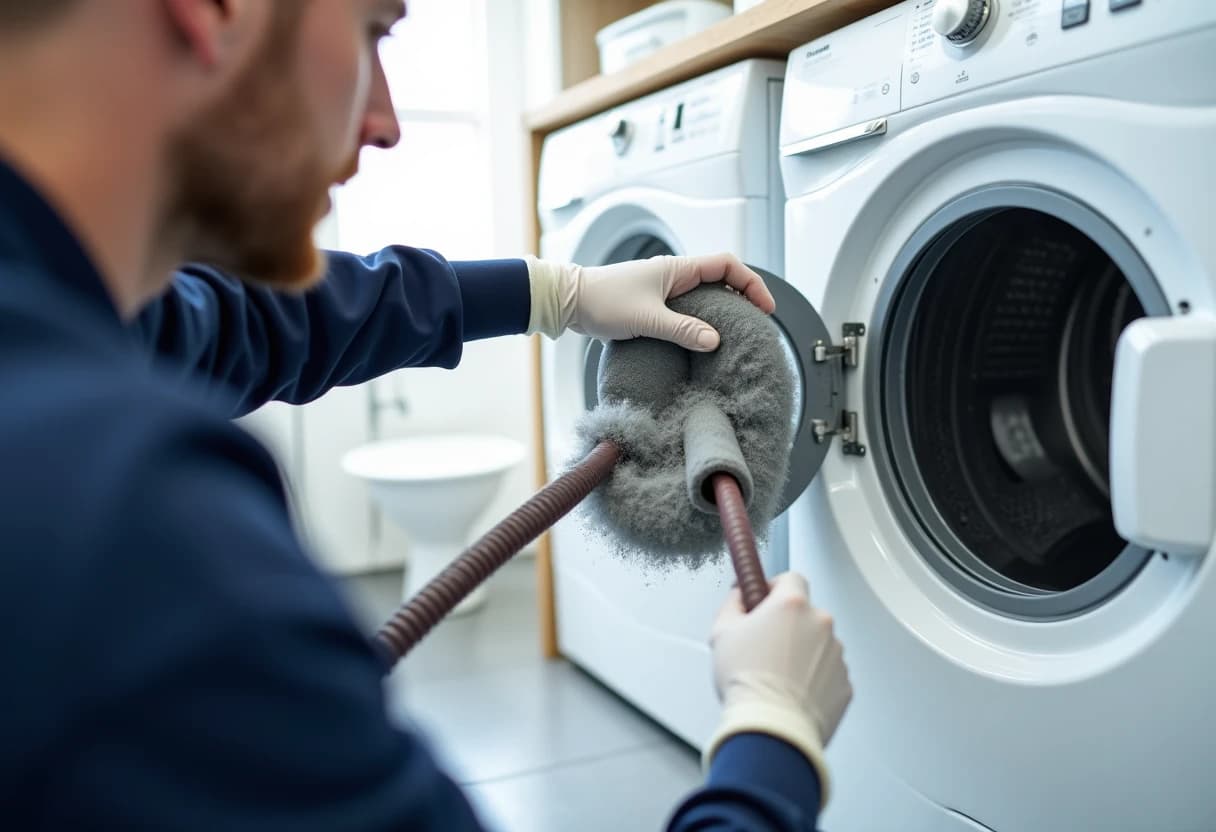
Most homeowners clean the lint screen every load and assume the job is done. But dryer manufacturers, the NFPA and the US Fire Administration all say the same thing: the vent duct itself needs professional cleaning at least once a year. Lint bypasses the screen constantly, and in Greater Boston homes — where vents commonly run twenty feet or more through basements, up wall cavities and across roofs — the accumulation happens out of sight. Our Manchester-by-the-Sea technicians use full-length rotary brushes driven through the entire run while a HEPA vacuum collects everything, then verify airflow at the termination before we leave.
Why Dryer Vent Cleaning Matters for Manchester-by-the-Sea Homes
Some homeowners ask whether they can just clean the vent themselves with a leaf blower or a hardware-store brush kit — and for a short, straight, first-floor vent, a diligent DIY cleaning is better than nothing. The trouble is that most Greater Boston vents are not short or straight. Runs from basement or interior laundry rooms commonly stretch 15 to 35 feet with three or four elbows, and consumer brush kits lose effectiveness with every bend, often compacting lint into a plug instead of removing it. Leaf blowers can blow a soft clog into a dense one, or blow the exterior damper shut. Professional equipment is different in kind: motor-driven rotary brushes that maintain scrubbing force through every elbow, HEPA vacuums that capture lint at the same time, inspection of the transition duct and termination, and an airflow measurement that verifies the result. We also spot the problems a brush cannot fix — crushed duct, disconnected joints, illegal flex materials — before they turn a maintenance visit into an emergency.
Condo and multi-family living around Coolidge Reservation adds its own dryer vent challenges: shared walls that force long horizontal runs, roof terminations three stories up, and condo associations that require insured, documented service. Manchester-by-the-Sea's stock leans historic and high-end: shingle-style summer cottages turned year-round homes, antique captains' houses near the harbor and gracious estates along the Smith's Point shoreline. Many have been meticulously renovated with modern forced-air and high-velocity systems threaded through old post-and-beam framing, creating long concealed duct paths that are easy to forget about. We handle all of it — our Manchester-by-the-Sea crews carry roof access equipment, provide certificates of insurance on request, and leave written service records that satisfy association and insurance requirements. Singing Beach fog and constant salt spray make Manchester one of the harshest corrosion environments we service - exterior dryer vent hoods and flappers here fail years earlier than inland. Ocean humidity also works into duct runs of older shorefront homes, so we check coastal systems closely for moisture and microbial growth. For triple-deckers and converted multi-families, we can clean all units' vents in one visit at bundled pricing, which is the most cost-effective way to protect the whole building.
Our Dryer Vent Cleaning Process in Manchester-by-the-Sea
1Inspect the Dryer, Transition Duct & Vent Path
Every job opens with a walkthrough of the complete exhaust path. The technician checks the lint screen housing, inspects the transition hose behind the dryer, locates every accessible section of duct, and finds the termination — wall hood, soffit outlet or roof cap. Photos document the starting condition so you can compare against the finished result.
2Protect the Laundry Area & Disconnect the Dryer
Before cleaning starts, we lay floor protection, carefully slide the dryer out without scarring floors, and disconnect the transition duct. Gas dryers are handled with proper care around the flexible gas connector — we never strain it. With the duct open at the appliance end, we have the access needed to clean the entire run.
3Rotary Brush the Full Length of the Duct
Our core cleaning tool is a motor-driven rotary brush on flexible rods, fed through the entire duct run. The spinning brush head scrubs lint off the duct walls through every elbow and vertical section, in runs up to 35 feet and beyond. Unlike hand brushes, it maintains full scrubbing force at the far end of the line — where the worst accumulation usually hides.
4Capture Everything With HEPA Vacuum Extraction
As the brush works, a HEPA-filtered vacuum runs simultaneously on the duct, pulling loosened lint into a sealed collection system instead of letting it blow into your laundry room or yard. The combination — agitate and extract at once — is what leaves the duct genuinely empty rather than redistributing the clog.
5Clean From the Exterior Termination Inward
We then work the line from the outside in — wall hood, soffit outlet or roof cap. Exterior terminations trap their own debris: lint mats behind the damper, bird and rodent nests, and screening clogged solid. Roof terminations get full ladder or roof access; we carry the gear, and steep or high work is included in the quoted price.
6Service the Transition Duct & Reconnect
The short duct connecting dryer to wall does more harm than its length suggests — crushed, kinked or made of plastic, it can choke an otherwise clean system. We clean it, or if it is damaged or made of hazardous foil or vinyl accordion material, we recommend replacement with a semi-rigid aluminum connector, usually installed on the spot for a small parts charge.
7Verify Airflow & Walk You Through the Results
The job ends with proof: we measure airflow at the exterior termination with the dryer running and compare it to the baseline reading from arrival. Strong, steady exhaust and a fully opening damper are the pass conditions. You get the before-and-after numbers, photos of what came out, and honest notes on the duct's condition.
Benefits of Professional Dryer Vent Cleaning in Manchester-by-the-Sea
Safer Operation for Gas Dryers
Massachusetts homes rely heavily on natural gas, and gas dryers are common across Greater Boston's housing stock. If yours vents through a long or aging duct, annual cleaning plus an airflow check is the standard of care fire and gas utilities recommend. It takes an hour and removes an entire category of risk.
Documentation for Insurance, Condos & Peace of Mind
The quiet benefit is simply knowing. A dryer vent is invisible infrastructure that most homeowners have never once seen inside — and after our visit, you have photos, airflow numbers and a professional's assessment on file. That certainty, renewed once a year, is worth the modest price by itself.
Dramatically Reduced Fire Risk
After cleaning, your dryer's exhaust runs cool and free, its high-temperature safety switches stop cycling, and the duct holds no fuel load waiting for a spark. For households that run daily laundry — big families, home businesses, multi-generational homes — that risk reduction compounds with every load.
Less Moisture, Mildew & Musty Odor
Basement laundry areas in New England fight humidity even on good days; a restricted dryer vent turns them into swamp rooms. Post-cleaning, customers consistently report the laundry area feels drier, smells cleaner, and stops fogging windows and sweating pipes during dryer cycles.
Faster Drying Times
Airflow is what dries clothes; heat just helps. Restore full exhaust capacity and loads that limped through two cycles finish in one, towels stop coming out damp at the seams, and the dryer's moisture sensors — which many modern machines rely on — start reading accurately again. Most customers notice the difference on the first load after our visit.
Longer Dryer Lifespan & Fewer Repairs
The high-limit safety switch in your dryer is not meant to cycle constantly; when a blocked vent makes it do so, the switch and the heating element both wear prematurely. A $149 to $299 annual cleaning routinely prevents $200 to $400 repair visits, and postpones the eventual $800 to $1,200 replacement by years.
Signs Your Manchester-by-the-Sea Home Needs Dryer Vent Cleaning
The Exterior Vent Flap Barely Opens
Lint visible around the exterior hood, on the siding or in the shrubs below means the duct is shedding overflow. Paradoxically, a completely lint-free hood on an older system can be worse news: it may mean nothing is reaching the exit at all. Either extreme warrants a cleaning and airflow check.
Laundry Room Gets Hot and Humid
Watch for secondary evidence: peeling paint near the dryer, mildew spots on the ceiling above it, a musty smell that lingers after laundry day, rust on shelf brackets. All are condensation footprints from exhaust escaping into the room through a restricted or leaking duct rather than exiting the house.
Burning Smell During a Cycle
That 'hot lint' smell is exactly what it seems: fibers reaching their scorching point somewhere in the airflow path. Sometimes it is a sock against the element; usually it is accumulation. Either way, the difference between a smell and a fire can be one overloaded cycle. We prioritize these calls for same-week service.
Clothes Take More Than One Cycle to Dry
The single most reliable symptom. A healthy dryer dries a standard load in 35 to 50 minutes; when towels need a second cycle or jeans come out damp at the waistband, exhaust airflow has dropped. The dryer has not gotten weaker — the vent has gotten narrower. Cleaning restores the original performance in one visit.
Lint Building Up Behind or Inside the Dryer
Visible lint at any joint, seam or connection is a flag worth acting on. It usually indicates positive pressure in the duct from a downstream blockage forcing air out through gaps — or a partially disconnected duct dumping exhaust into the wall cavity, which our inspection will catch.
Dryer or Clothes Are Hot to the Touch
Some heat is normal; radiating heat is not. When the exhaust cannot escape, the drum, cabinet and surrounding wall absorb it instead. Homes where we measure the highest cabinet temperatures reliably produce the fullest lint bags — the correlation between heat and blockage is nearly one to one.
Dryer Vent Cleaning Cost in Manchester-by-the-Sea, MA
It helps to weigh the price against the alternatives. A $149 to $299 annual cleaning stands against: $10 to $20 a month in energy waste from a restricted vent; $150 to $400 appliance repair visits for blown thermal fuses and burned elements that blocked vents cause; $800 to $1,200 for the dryer replacement that chronic overheating hastens; and the uncapped cost of a lint fire, which averages five figures in property damage even when contained quickly. Insurance data and FEMA's fire statistics make dryer vent cleaning one of the highest-return maintenance dollars in the home. We keep the pricing flat and published because the service only works as prevention if people actually book it annually — surprise invoices are how homeowners talk themselves into skipping years, and skipped years are how blockages happen.
Want the full pricing picture? See our complete Boston-area cost guide or call (617) 390-7145 for an exact flat quote for your Manchester-by-the-Sea home.
Local Knowledge: Manchester-by-the-Sea, Essex County
Serving Manchester-by-the-Sea means knowing Manchester-by-the-Sea. Manchester-by-the-Sea's stock leans historic and high-end: shingle-style summer cottages turned year-round homes, antique captains' houses near the harbor and gracious estates along the Smith's Point shoreline. Many have been meticulously renovated with modern forced-air and high-velocity systems threaded through old post-and-beam framing, creating long concealed duct paths that are easy to forget about. Singing Beach fog and constant salt spray make Manchester one of the harshest corrosion environments we service - exterior dryer vent hoods and flappers here fail years earlier than inland. Ocean humidity also works into duct runs of older shorefront homes, so we check coastal systems closely for moisture and microbial growth. Those conditions shape how we work here: which brush heads come off the truck, how we protect finishes in older interiors, and what we expect to find when the camera goes into a 01944 duct system. Our crews are in and around Manchester-by-the-Sea nearly every week — often for neighbors of past customers — so scheduling is fast and our arrival windows hold.
The Best Time of Year in Manchester-by-the-Sea
Winter is when Greater Boston dryer vents fail. Cold stiffens exterior damper flaps, snow drifts block grade-level hoods, and warm moist exhaust hitting a freezing duct section condenses — turning loose lint into dense, damp mats that can plug a marginal vent in weeks. Meanwhile laundry loads peak: heavy sweaters, extra blankets, snow-soaked layers. It is no coincidence that dryer fires are most frequent in winter, with January the peak month in federal fire data. The smart schedule is a fall cleaning — clear the system before the heavy season — but if winter has already exposed a problem, we keep cold-month availability across Essex County precisely because these calls cannot wait.
Why Choose Boston Air Duct Cleaners
Homeowners across Essex County choose Boston Air Duct Cleaners for three reasons. First, honesty: our inspection camera tells you whether your system actually needs cleaning — and sometimes the answer is no. Second, capability: truck-grade negative-air machines, rotary brush systems and HEPA filtration handle everything from antique gravity-furnace conversions to brand-new high-velocity systems. Third, accountability: flat quoted pricing, before-and-after photos, insured technicians, and a real local office you can call at (617) 390-7145. That combination is rarer in this industry than it should be.
Serving Manchester-by-the-Sea and Surrounding Communities
Beyond Manchester-by-the-Sea, our crews cover the surrounding communities daily — including Gloucester, Essex, Beverly, Hamilton, Wenham, Salem. Because routes cluster geographically, booking alongside a neighboring appointment often unlocks same-day service and combined-visit savings. Wherever you are in Essex County, the same flat-rate pricing, insured technicians and photo-documented process applies.