
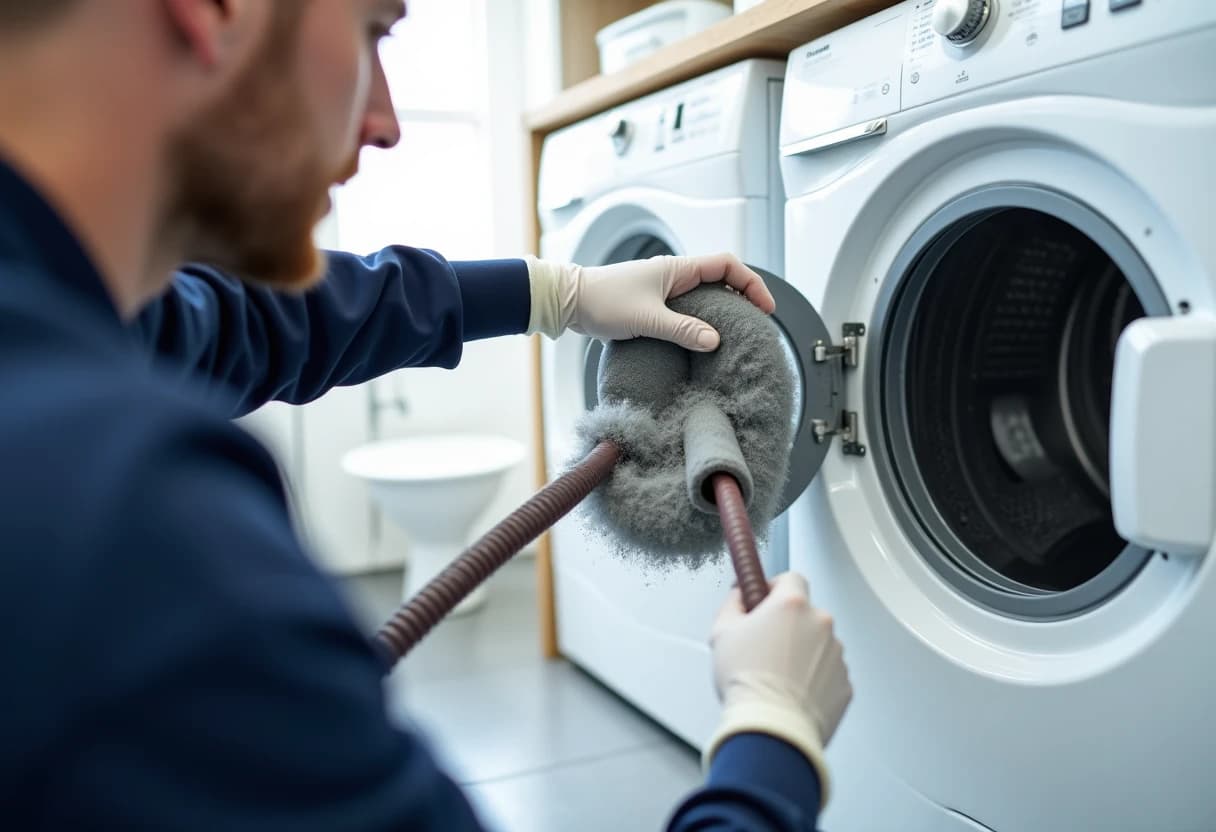
Homeowners in Georgetown typically call us for dryer vent cleaning after one of three moments: a load that will not dry, a burning odor from the laundry area, or a repair technician who condemned the vent while servicing the dryer. All three trace to the same lint accumulation that builds silently for years. Our service removes it completely — rotary brush agitation through the full duct length, HEPA vacuum extraction, exterior hood cleaning, and a check of the transition duct behind the dryer where crushing and kinks hide. We are local, insured, and we quote flat pricing that covers the entire run, roof terminations included.
Why Dryer Vent Cleaning Matters for Georgetown Homes
A restricted dryer vent quietly becomes one of the most expensive small problems in the house. When exhaust airflow drops, drying times stretch — a 45-minute load becomes 90 minutes, then two full cycles. Every extra minute burns electricity or gas, and a dryer running double cycles can add $10 to $20 a month to utility bills while wearing out its own components. Heating elements cycle harder against high-limit switches, thermal fuses blow, drum bearings and belts log twice the hours, and moisture-laden exhaust backs up into the machine and the laundry room. Appliance technicians will tell you a large share of 'broken dryer' service calls are actually blocked vents — and many charge you the visit fee to tell you so. Annual professional cleaning keeps airflow at design capacity, which means shorter cycles, lower bills, longer appliance life and clothes that suffer less heat damage. It is maintenance that shows a measurable return on the very next load of laundry.
From the multi-family blocks near Brocklebank Museum to the single-families out toward Georgetown Town Common, Georgetown laundry setups share a common risk profile: dryers pushed far from exterior walls, vents extended during renovations, and terminations no one has looked at in years. Georgetown pairs antique center-chimney Colonials and Victorians clustered around the town common with large 1990s and 2000s Colonial subdivisions carved out of former woodland along its rural roads. The newer homes run big - often 2,500 square feet and up - with long duct runs to bonus rooms over garages that are notorious for weak airflow and dust accumulation at the far ends of the system. That combination is how lint blockages build unnoticed. Many Georgetown properties sit on well water and are surrounded by woods and hayfields, so seasonal pollen and fine organic debris load up return grilles quickly here. The oversized colonials common in town also mean second-floor duct branches that have often never been cleaned since the house was built. Because our shop is in West Newton, about 36 miles away, we can usually offer Georgetown same-week appointments — and because we clean from both the appliance side and the exterior hood, blockages at either end of the run are fully removed, not pushed deeper.
Our Dryer Vent Cleaning Process in Georgetown
1Inspect the Dryer, Transition Duct & Vent Path
First we establish what we are cleaning: duct material, run length, number of bends, and termination type. We also measure baseline airflow at the exterior hood with the dryer running. That number matters — it is how we prove, at the end of the visit, that the cleaning actually restored the exhaust capacity your dryer needs.
2Protect the Laundry Area & Disconnect the Dryer
We treat laundry rooms — often tight, finished spaces — with the same care as any living area: drop cloths down, dryer walked out on protective sliders, and the work zone contained. Disconnecting at the appliance gives us a clean entry point into the duct and a chance to inspect the connection hardware that so often leaks lint into the wall cavity.
3Rotary Brush the Full Length of the Duct
We feed flexible rotary rods through the duct, adding sections until the brush has traveled the complete run from the dryer connection to the exterior hood. The rotating head dislodges packed lint, bird nesting material and debris from every interior surface, including the elbow throats where lint mats form first. Nothing is bypassed; the brush touches every foot of the line.
4Capture Everything With HEPA Vacuum Extraction
Loosened lint has to go somewhere, and we make sure that somewhere is our vacuum. HEPA filtration captures the fine fiber dust that ordinary shop vacs exhaust straight back into the air — important in tight laundry areas and essential for allergy-sensitive households. Most cleanings fill a startling bag; we are happy to show you the haul.
5Clean From the Exterior Termination Inward
Cleaning from both ends is non-negotiable on longer runs. The last few feet before the termination, and the hood itself, accumulate the densest lint — it is where moist exhaust meets cold outdoor air and fibers mat together. We open the hood, clear the damper, remove nesting if present, and brush the final duct section back toward the vacuum.
6Service the Transition Duct & Reconnect
Reassembly is done to code and to the appliance manual: UL-listed transition duct, proper clamps, no more than the listed connector length, and the dryer set far enough from the wall that the duct keeps its shape. We level the machine, verify the gas connection is undisturbed on gas units, and run a test cycle before calling the mechanical work done.
7Verify Airflow & Walk You Through the Results
Final checks: test cycle run, exhaust verified at the hood, laundry area vacuumed and everything returned to place. If we found issues cleaning cannot fix — overlong runs, crushed sections, illegal materials — you get straight documentation and a separate quote, never pressure. Most vents simply need this cleaning, once a year, and nothing more.
Benefits of Professional Dryer Vent Cleaning in Georgetown
Longer Dryer Lifespan & Fewer Repairs
Blocked vents kill dryers slowly: thermal fuses blow, heating elements burn out, belts and bearings log double hours, and moisture backing into the machine corrodes components. Appliance technicians confirm that vent restriction underlies a large share of dryer service calls. A clear vent lets the machine run within its design limits — and last accordingly.
Documentation for Insurance, Condos & Peace of Mind
The quiet benefit is simply knowing. A dryer vent is invisible infrastructure that most homeowners have never once seen inside — and after our visit, you have photos, airflow numbers and a professional's assessment on file. That certainty, renewed once a year, is worth the modest price by itself.
Less Moisture, Mildew & Musty Odor
Damp lint inside a restricted duct becomes a mold and bacteria medium — the source of the sour smell some dryers push into freshly washed clothes. Removing the lint removes the colony. If your 'clean' laundry has ever come out smelling worse than it went in, the vent is the likeliest culprit.
Faster Drying Times
If laundry has become an all-day affair, the fix is rarely a new dryer. We regularly clean vents for customers who were quoted $1,000+ appliance replacements, and the old machine performs like new once it can breathe. Try the $149 to $299 solution before the four-figure one.
Safer Operation for Gas Dryers
Massachusetts homes rely heavily on natural gas, and gas dryers are common across Greater Boston's housing stock. If yours vents through a long or aging duct, annual cleaning plus an airflow check is the standard of care fire and gas utilities recommend. It takes an hour and removes an entire category of risk.
Lower Energy Bills
Dryers are among the most energy-hungry appliances in the home, and a clogged vent makes every load cost more. Restoring design airflow means the heating element runs at intended temperatures for intended durations. The savings recur with every cycle, quietly, for as long as the vent stays clear.
Signs Your Georgetown Home Needs Dryer Vent Cleaning
Burning Smell During a Cycle
Never normalize a burning odor from a dryer. Investigators repeatedly find that households smelled scorching lint for weeks before an ignition. A cleaning visit resolves the source in about an hour and includes vacuuming the dryer's internal lint paths near the element — where the smell most often starts.
The Exterior Vent Flap Barely Opens
Lint visible around the exterior hood, on the siding or in the shrubs below means the duct is shedding overflow. Paradoxically, a completely lint-free hood on an older system can be worse news: it may mean nothing is reaching the exit at all. Either extreme warrants a cleaning and airflow check.
Dryer or Clothes Are Hot to the Touch
Some heat is normal; radiating heat is not. When the exhaust cannot escape, the drum, cabinet and surrounding wall absorb it instead. Homes where we measure the highest cabinet temperatures reliably produce the fullest lint bags — the correlation between heat and blockage is nearly one to one.
Laundry Room Gets Hot and Humid
A laundry area that turns tropical during dryer cycles — fogged windows, sweating pipes, damp walls — is receiving the heat and moisture the vent should be sending outdoors. Each blocked load pushes up to a gallon of water vapor into your home instead of out of it. The room is telling you what the duct cannot.
Clothes Take More Than One Cycle to Dry
Homeowners adapt to slow drying so gradually they stop noticing, until they use a laundromat or a friend's machine and remember what one-cycle drying feels like. If your definition of a drying cycle has quietly stretched past an hour, the vent is overdue for inspection and almost certainly for cleaning.
It Has Been More Than a Year
Households that run a load daily, dry pet bedding, or share laundry across a multi-family building accumulate lint at two to three times the average rate and should clean every six to twelve months. A quiet couple doing weekly laundry can stretch toward the annual mark, but rarely safely beyond it.
Dryer Vent Cleaning Cost in Georgetown, MA
A note on the low end of the market: you will see dryer vent cleaning advertised for $69 to $99, and occasionally it is legitimate — a short run, a quick brush, done. More often the price assumes ideal conditions that Greater Boston homes rarely offer, and the invoice grows on site with 'extra footage,' 'additional elbows' and 'blockage fees' until it exceeds a transparent quote. Our flat pricing of $149 to $299 is set for real local conditions: 15-to-35-foot runs, three or four elbows, basement laundries, and hoods that have not been opened in a decade. It includes the rotary brush cleaning of the entire duct, HEPA vacuum extraction, exterior termination service, transition duct inspection and a final airflow verification with photos. When comparing quotes, ask one question: does the price cover the complete run and the termination, whatever it takes? Ours does.
Want the full pricing picture? See our complete Boston-area cost guide or call (617) 390-7145 for an exact flat quote for your Georgetown home.
Local Knowledge: Georgetown, Essex County
Every town's ductwork tells the story of its housing. Georgetown pairs antique center-chimney Colonials and Victorians clustered around the town common with large 1990s and 2000s Colonial subdivisions carved out of former woodland along its rural roads. The newer homes run big - often 2,500 square feet and up - with long duct runs to bonus rooms over garages that are notorious for weak airflow and dust accumulation at the far ends of the system. Many Georgetown properties sit on well water and are surrounded by woods and hayfields, so seasonal pollen and fine organic debris load up return grilles quickly here. The oversized colonials common in town also mean second-floor duct branches that have often never been cleaned since the house was built. We plan Georgetown jobs around those realities, from equipment selection to time on site, and it shows in the results. If you live near Georgetown Town Common or anywhere across Georgetown's 01833 area, we have almost certainly cleaned a system like yours before — and we can tell you exactly what to expect before we arrive.
The Best Time of Year in Georgetown
The region's old housing stock gives dryer venting a seasonal twist all its own. Many Massachusetts laundry hookups were retrofitted into basements and back halls generations after the house was built, producing long runs through unheated spaces — crawl areas, garages, exterior wall cavities. In winter, those cold sections become condensation zones where exhaust moisture freezes into lint ice; in the spring thaw, the melt soaks the accumulation into a paste. Homes near the coast add salt-air corrosion at the termination, seizing dampers and rusting hoods. Annual cleaning with a termination inspection catches all of this on a schedule, rather than during a February failure with a full laundry basket waiting.
Why Choose Boston Air Duct Cleaners
We built this company around the jobs other duct cleaners do badly: the 130-year-old Victorian with panned-joist returns, the Georgetown condo with a 60-foot dryer run to the roof, the post-renovation house full of drywall dust. Our crews see Greater Boston's hardest systems every week, and the experience shows in the details — floor protection on the way in, sealed registers during the work, HEPA-vacuumed work areas on the way out, and imagery that proves the ducts are actually clean. Call (617) 390-7145 and judge the difference from the first conversation.
Serving Georgetown and Surrounding Communities
Beyond Georgetown, our crews cover the surrounding communities daily — including Rowley, Topsfield, North Andover, Ipswich, Middleton, Andover. Because routes cluster geographically, booking alongside a neighboring appointment often unlocks same-day service and combined-visit savings. Wherever you are in Essex County, the same flat-rate pricing, insured technicians and photo-documented process applies.