
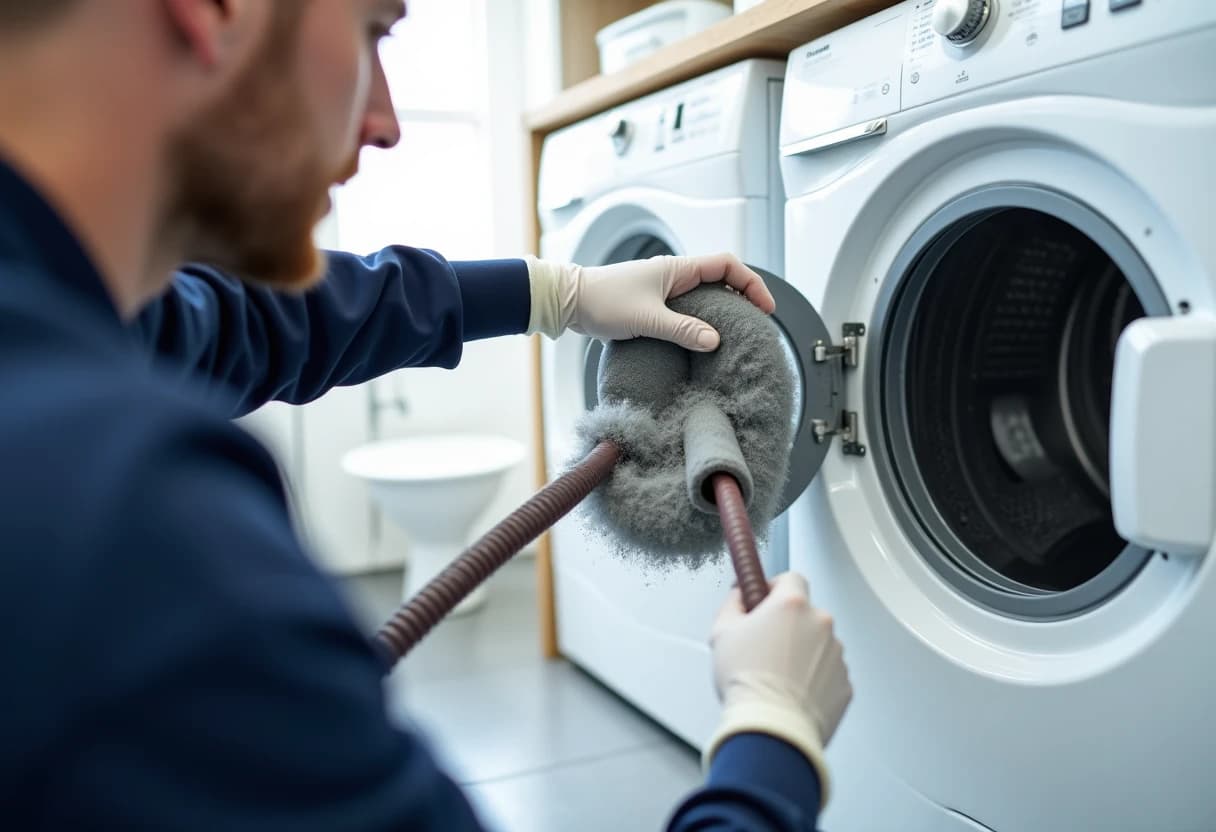
If your dryer takes two cycles to dry a load that used to take one, the problem is almost never the dryer — it is the vent. A lint-restricted exhaust line traps hot, moist air in the drum, stretching drying times, wasting electricity or gas, and overheating the very lint that lines the duct. Our certified technicians clean Peabody dryer vents end to end with flexible rotary brush systems and HEPA-filtered vacuums, restoring full airflow in about an hour. The result is a dryer that works like new, utility bills that drop, and a fire hazard removed from the middle of your home.
Why Dryer Vent Cleaning Matters for Peabody Homes
There are moments when dryer vent cleaning becomes urgent rather than routine. If you have just bought a home, you inherit a vent with an unknown history — quite possibly never cleaned since installation, and in older Massachusetts homes possibly lined with decades of lint. If your dryer is new, manufacturers require a clear vent for warranty coverage, and installers rarely clean the existing duct. If your vent terminates on the roof, wildlife may have added a nest to the lint; bird and rodent nesting in dryer terminations is one of the most common blockages we clear. And if you have ever smelled something burning during a cycle or had a load come out hot but wet, the vent needs attention now, not at the next convenient interval. In every one of these situations, a single professional cleaning re-establishes a known-clean baseline — after which an annual schedule keeps it that way for a modest, predictable cost.
Ask around Salem Country Club and you will find neighbors who learned about dryer vent fires the hard way — a scorched load, a melted transition hose, a fire department visit. Peabody's postwar ranches carry some of the oldest original ductwork we open up anywhere on the North Shore, often with decades of compacted dust behind supply registers. Downtown's converted tannery-era buildings and two-families add their own mix of aging shared chases and hard-to-reach dryer runs. Peabody's downtown wards hold tight streets of leather-industry-era two-families and workers' cottages from the early 1900s, while West Peabody is a sea of 1950s-70s ranches, splits and Colonials built during the city's postwar boom. The West Peabody tracts were among the region's early adopters of forced-air heat, which means original ductwork in many homes is now sixty-plus years old. Newer condo complexes near the Northshore Mall corridor round out the stock. Those local conditions are why we treat Peabody dryer vent cleaning as a safety service, not a courtesy add-on: full-length rotary brush cleaning, HEPA capture, termination and damper service, transition duct inspection, and an airflow check at the end that proves the line is clear. Residents of Salem and Danvers book the same service, which is why our trucks are in this part of Essex County nearly every week.
Our Dryer Vent Cleaning Process in Peabody
1Inspect the Dryer, Transition Duct & Vent Path
We start behind the dryer: pulling the machine, examining the transition duct for crushing, kinks or foil accordion material, and tracing the vent's full path from connection to exterior termination. Mapping the run tells us its length, elbow count and materials — and lets us confirm your flat price before any cleaning begins.
2Protect the Laundry Area & Disconnect the Dryer
We treat laundry rooms — often tight, finished spaces — with the same care as any living area: drop cloths down, dryer walked out on protective sliders, and the work zone contained. Disconnecting at the appliance gives us a clean entry point into the duct and a chance to inspect the connection hardware that so often leaks lint into the wall cavity.
3Rotary Brush the Full Length of the Duct
We feed flexible rotary rods through the duct, adding sections until the brush has traveled the complete run from the dryer connection to the exterior hood. The rotating head dislodges packed lint, bird nesting material and debris from every interior surface, including the elbow throats where lint mats form first. Nothing is bypassed; the brush touches every foot of the line.
4Capture Everything With HEPA Vacuum Extraction
As the brush works, a HEPA-filtered vacuum runs simultaneously on the duct, pulling loosened lint into a sealed collection system instead of letting it blow into your laundry room or yard. The combination — agitate and extract at once — is what leaves the duct genuinely empty rather than redistributing the clog.
5Clean From the Exterior Termination Inward
Cleaning from both ends is non-negotiable on longer runs. The last few feet before the termination, and the hood itself, accumulate the densest lint — it is where moist exhaust meets cold outdoor air and fibers mat together. We open the hood, clear the damper, remove nesting if present, and brush the final duct section back toward the vacuum.
6Service the Transition Duct & Reconnect
Reassembly is done to code and to the appliance manual: UL-listed transition duct, proper clamps, no more than the listed connector length, and the dryer set far enough from the wall that the duct keeps its shape. We level the machine, verify the gas connection is undisturbed on gas units, and run a test cycle before calling the mechanical work done.
7Verify Airflow & Walk You Through the Results
We run the dryer and inspect the termination together — you should see the damper flap standing open under confident airflow, something many homeowners have literally never observed on their own vent. Your technician reviews photos, flags any code or condition issues for future attention, and records your service date for an annual reminder.
Benefits of Professional Dryer Vent Cleaning in Peabody
Lower Energy Bills
Energy waste from blocked dryer vents is invisible on any single bill but substantial over a year — hundreds of extra kilowatt-hours or therms for a heavy-laundry household. Cleaning converts that waste back into performance. It is one of the few home services with a direct, same-month payback mechanism.
Dramatically Reduced Fire Risk
This is the benefit that matters most. Lint is extraordinarily flammable, and a clogged vent both supplies the fuel and creates the overheating that ignites it. Removing the accumulation removes the hazard — which is why fire departments, the NFPA and FEMA all urge annual dryer vent cleaning as basic home fire prevention.
Safer Operation for Gas Dryers
For gas dryers, vent cleaning is combustion safety, not just lint management. Backdrafting exhaust is odorless and invisible; the protection is a clear duct and a working CO detector. We verify complete, strong exhaust at the exterior termination on every gas dryer job — the confirmation that byproducts are leaving the house.
Less Moisture, Mildew & Musty Odor
Basement laundry areas in New England fight humidity even on good days; a restricted dryer vent turns them into swamp rooms. Post-cleaning, customers consistently report the laundry area feels drier, smells cleaner, and stops fogging windows and sweating pipes during dryer cycles.
Longer Dryer Lifespan & Fewer Repairs
New dryers deserve clean vents from day one — manufacturers require adequate exhaust airflow for warranty coverage, and delivery crews almost never clean the existing duct. If you have recently replaced your dryer and skipped the vent, you have connected a new engine to a clogged tailpipe.
Documentation for Insurance, Condos & Peace of Mind
Every cleaning ends with a written record: date, scope, before-and-after photos, airflow verification and condition notes. Condo associations increasingly require proof of dryer vent maintenance, some insurers ask after claims, and home buyers appreciate the paper trail. One visit satisfies all three — and tells you exactly when the next service is due.
Signs Your Peabody Home Needs Dryer Vent Cleaning
Burning Smell During a Cycle
A hot, singed odor while the dryer runs is lint beginning to scorch — on the heating element, in the internal ducting or in the exhaust line. It is the most serious warning sign on this list. Stop the dryer, let it cool, and do not run full loads again until the vent and machine interior have been cleaned.
Dryer or Clothes Are Hot to the Touch
Excess heat is the fire chain's first visible link: restricted airflow, rising temperatures, and a duct lined with fuel. If the top of your dryer doubles as a hand warmer or the laundry room bakes during cycles, stop using the machine for long runs and have the vent cleaned promptly.
Lint Building Up Behind or Inside the Dryer
Lint accumulating behind the machine, around the transition hose or under the dryer means the exhaust path is leaking or backing up — lint should travel out, not settle in. It is both a symptom of restriction and a hazard in itself, since this lint sits nearest the heat source. A cleaning addresses the cause and clears the accumulation.
Clothes Take More Than One Cycle to Dry
The single most reliable symptom. A healthy dryer dries a standard load in 35 to 50 minutes; when towels need a second cycle or jeans come out damp at the waistband, exhaust airflow has dropped. The dryer has not gotten weaker — the vent has gotten narrower. Cleaning restores the original performance in one visit.
Laundry Room Gets Hot and Humid
In winter, backed-up dryer moisture migrates to the coldest nearby surfaces — window frames, exterior-wall corners, basement sills — and condenses there, feeding mold New England homes already fight. If winter condensation spikes on laundry days, your vent is contributing and a cleaning will subtract it.
The Exterior Vent Flap Barely Opens
Many Peabody-area vents terminate on roofs or high walls where owners never look — which is exactly why blockages there grow uninterrupted for years. If you cannot see your termination or have never checked it, assume it needs inspection. We check and clean terminations, roof-mounted included, on every visit.
Dryer Vent Cleaning Cost in Peabody, MA
For budgeting across property types: single-family homes run $149 to $299 as described; condos are usually $149 to $199 unless the unit vents to the roof; and multi-family buildings get per-unit rates that drop meaningfully when we clean all units in one visit — the arrangement most triple-decker owners and condo associations choose, both for cost and for the single insurance-ready service record covering the building. Commercial laundry and shared-venting systems are quoted after a walkthrough. Frequency matters to lifetime cost too: an annual cleaning is quick and inexpensive because accumulation is light, while a vent neglected for five years often needs blockage-level work at the top of the range, and sometimes reveals damage requiring repair. The cheapest way to own a dryer vent, year over year, is to clean it on schedule — which is why we log your service date and send a reminder when the next one is due.
Want the full pricing picture? See our complete Boston-area cost guide or call (617) 390-7145 for an exact flat quote for your Peabody home.
Local Knowledge: Peabody, Essex County
What makes Peabody different? Peabody's downtown wards hold tight streets of leather-industry-era two-families and workers' cottages from the early 1900s, while West Peabody is a sea of 1950s-70s ranches, splits and Colonials built during the city's postwar boom. The West Peabody tracts were among the region's early adopters of forced-air heat, which means original ductwork in many homes is now sixty-plus years old. Newer condo complexes near the Northshore Mall corridor round out the stock. Peabody's postwar ranches carry some of the oldest original ductwork we open up anywhere on the North Shore, often with decades of compacted dust behind supply registers. Downtown's converted tannery-era buildings and two-families add their own mix of aging shared chases and hard-to-reach dryer runs. For duct and dryer vent systems, those local factors translate into specific, predictable problems — and predictable problems are the ones we solve fastest. Call (617) 390-7145, tell us your street and home style, and we will quote the job accurately the first time, usually in under five minutes.
The Best Time of Year in Peabody
Winter is when Greater Boston dryer vents fail. Cold stiffens exterior damper flaps, snow drifts block grade-level hoods, and warm moist exhaust hitting a freezing duct section condenses — turning loose lint into dense, damp mats that can plug a marginal vent in weeks. Meanwhile laundry loads peak: heavy sweaters, extra blankets, snow-soaked layers. It is no coincidence that dryer fires are most frequent in winter, with January the peak month in federal fire data. The smart schedule is a fall cleaning — clear the system before the heavy season — but if winter has already exposed a problem, we keep cold-month availability across Essex County precisely because these calls cannot wait.
Why Choose Boston Air Duct Cleaners
Boston Air Duct Cleaners is a local, owner-operated company based at 1121 Washington St in West Newton — not a national franchise dispatching subcontractors. Every crew is our own: background-checked, factory-trained on commercial negative-pressure equipment, and fully insured. We quote flat prices before work begins, document every job with before-and-after photos, and follow NADCA-standard source-removal methods on every system we touch. That is why so much of our work comes from repeat customers, property managers and word-of-mouth referrals across Essex County.
Serving Peabody and Surrounding Communities
Peabody sits in the heart of our service area, and neighboring Salem, Danvers, Lynnfield, Lynn, Beverly, Middleton appointments share the same routes. That density is why our response times in this part of Essex County are among our fastest — and why you will see our trucks in the area week after week.