
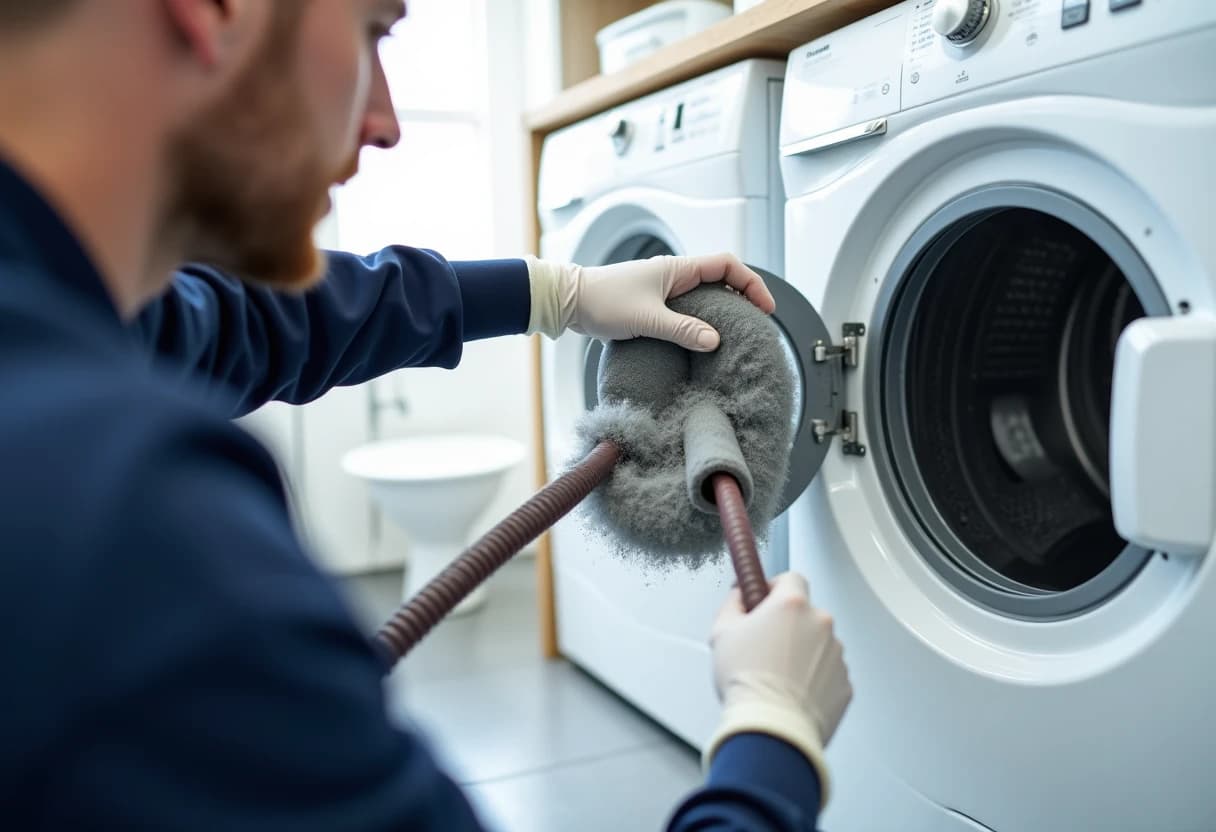
Most homeowners clean the lint screen every load and assume the job is done. But dryer manufacturers, the NFPA and the US Fire Administration all say the same thing: the vent duct itself needs professional cleaning at least once a year. Lint bypasses the screen constantly, and in Greater Boston homes — where vents commonly run twenty feet or more through basements, up wall cavities and across roofs — the accumulation happens out of sight. Our Hull technicians use full-length rotary brushes driven through the entire run while a HEPA vacuum collects everything, then verify airflow at the termination before we leave.
Why Dryer Vent Cleaning Matters for Hull Homes
There are moments when dryer vent cleaning becomes urgent rather than routine. If you have just bought a home, you inherit a vent with an unknown history — quite possibly never cleaned since installation, and in older Massachusetts homes possibly lined with decades of lint. If your dryer is new, manufacturers require a clear vent for warranty coverage, and installers rarely clean the existing duct. If your vent terminates on the roof, wildlife may have added a nest to the lint; bird and rodent nesting in dryer terminations is one of the most common blockages we clear. And if you have ever smelled something burning during a cycle or had a load come out hot but wet, the vent needs attention now, not at the next convenient interval. In every one of these situations, a single professional cleaning re-establishes a known-clean baseline — after which an annual schedule keeps it that way for a modest, predictable cost.
In Hull's older housing stock, we regularly find dryer vents that violate every modern guideline — vinyl flex duct sagging through a basement, screws catching lint at every joint, runs far past the 35-foot code maximum. Hull occupies a narrow peninsula where nearly every home feels the ocean: the stock is a dense mix of converted summer cottages, shingled beach houses and modest year-round homes packed along the boulevard from Nantasket to Pemberton Point. Many were winterized decades after construction, so heating systems and ductwork were squeezed into buildings never designed for them, often in shallow crawlspaces just above the water table. These systems clog two or three times faster than a code-compliant rigid duct, which makes annual cleaning genuinely important rather than merely advisable. No town we serve takes more salt spray than Hull - homes here are surrounded by water on both sides of the peninsula, and exterior dryer vent hoods, dampers and duct components corrode remarkably fast. Constant coastal wind also drives fine sand and salt into vent terminations facing the beach. We clean what is there, document what we find with photos, and tell you honestly whether the duct itself needs repair or replacement — a judgment call our crews make in Hull homes every week.
Our Dryer Vent Cleaning Process in Hull
1Inspect the Dryer, Transition Duct & Vent Path
First we establish what we are cleaning: duct material, run length, number of bends, and termination type. We also measure baseline airflow at the exterior hood with the dryer running. That number matters — it is how we prove, at the end of the visit, that the cleaning actually restored the exhaust capacity your dryer needs.
2Protect the Laundry Area & Disconnect the Dryer
We treat laundry rooms — often tight, finished spaces — with the same care as any living area: drop cloths down, dryer walked out on protective sliders, and the work zone contained. Disconnecting at the appliance gives us a clean entry point into the duct and a chance to inspect the connection hardware that so often leaks lint into the wall cavity.
3Rotary Brush the Full Length of the Duct
Mechanical agitation is what separates professional cleaning from blow-through methods. The rotary brush physically breaks up compacted lint that air pressure alone would only compress further. We select brush heads sized to your duct — standard 4-inch for code-compliant lines, alternates for older oversized or reduced runs — so the bristles actually contact the duct wall the whole way.
4Capture Everything With HEPA Vacuum Extraction
Extraction runs continuously during brushing so debris moves in one controlled direction. On long or heavily blocked runs we alternate: brush a section, extract, advance. This staged approach clears even fully plugged ducts — the ones where the exterior damper has not opened in years — without compacting the blockage deeper.
5Clean From the Exterior Termination Inward
Cleaning from both ends is non-negotiable on longer runs. The last few feet before the termination, and the hood itself, accumulate the densest lint — it is where moist exhaust meets cold outdoor air and fibers mat together. We open the hood, clear the damper, remove nesting if present, and brush the final duct section back toward the vacuum.
6Service the Transition Duct & Reconnect
Reassembly is done to code and to the appliance manual: UL-listed transition duct, proper clamps, no more than the listed connector length, and the dryer set far enough from the wall that the duct keeps its shape. We level the machine, verify the gas connection is undisturbed on gas units, and run a test cycle before calling the mechanical work done.
7Verify Airflow & Walk You Through the Results
Final checks: test cycle run, exhaust verified at the hood, laundry area vacuumed and everything returned to place. If we found issues cleaning cannot fix — overlong runs, crushed sections, illegal materials — you get straight documentation and a separate quote, never pressure. Most vents simply need this cleaning, once a year, and nothing more.
Benefits of Professional Dryer Vent Cleaning in Hull
Faster Drying Times
If laundry has become an all-day affair, the fix is rarely a new dryer. We regularly clean vents for customers who were quoted $1,000+ appliance replacements, and the old machine performs like new once it can breathe. Try the $149 to $299 solution before the four-figure one.
Lower Energy Bills
Dryers are among the most energy-hungry appliances in the home, and a clogged vent makes every load cost more. Restoring design airflow means the heating element runs at intended temperatures for intended durations. The savings recur with every cycle, quietly, for as long as the vent stays clear.
Safer Operation for Gas Dryers
For gas dryers, vent cleaning is combustion safety, not just lint management. Backdrafting exhaust is odorless and invisible; the protection is a clear duct and a working CO detector. We verify complete, strong exhaust at the exterior termination on every gas dryer job — the confirmation that byproducts are leaving the house.
Less Moisture, Mildew & Musty Odor
Basement laundry areas in New England fight humidity even on good days; a restricted dryer vent turns them into swamp rooms. Post-cleaning, customers consistently report the laundry area feels drier, smells cleaner, and stops fogging windows and sweating pipes during dryer cycles.
Dramatically Reduced Fire Risk
After cleaning, your dryer's exhaust runs cool and free, its high-temperature safety switches stop cycling, and the duct holds no fuel load waiting for a spark. For households that run daily laundry — big families, home businesses, multi-generational homes — that risk reduction compounds with every load.
Documentation for Insurance, Condos & Peace of Mind
For landlords and multi-family owners, documented dryer vent service is due-diligence gold: it demonstrates fire-safety maintenance across units in a single record. We service whole buildings in one visit with per-unit documentation, which is why property managers across Greater Boston keep us on an annual rotation.
Signs Your Hull Home Needs Dryer Vent Cleaning
Dryer or Clothes Are Hot to the Touch
Some heat is normal; radiating heat is not. When the exhaust cannot escape, the drum, cabinet and surrounding wall absorb it instead. Homes where we measure the highest cabinet temperatures reliably produce the fullest lint bags — the correlation between heat and blockage is nearly one to one.
It Has Been More Than a Year
Households that run a load daily, dry pet bedding, or share laundry across a multi-family building accumulate lint at two to three times the average rate and should clean every six to twelve months. A quiet couple doing weekly laundry can stretch toward the annual mark, but rarely safely beyond it.
Burning Smell During a Cycle
A hot, singed odor while the dryer runs is lint beginning to scorch — on the heating element, in the internal ducting or in the exhaust line. It is the most serious warning sign on this list. Stop the dryer, let it cool, and do not run full loads again until the vent and machine interior have been cleaned.
Clothes Take More Than One Cycle to Dry
Homeowners adapt to slow drying so gradually they stop noticing, until they use a laundromat or a friend's machine and remember what one-cycle drying feels like. If your definition of a drying cycle has quietly stretched past an hour, the vent is overdue for inspection and almost certainly for cleaning.
Laundry Room Gets Hot and Humid
In winter, backed-up dryer moisture migrates to the coldest nearby surfaces — window frames, exterior-wall corners, basement sills — and condenses there, feeding mold New England homes already fight. If winter condensation spikes on laundry days, your vent is contributing and a cleaning will subtract it.
Lint Building Up Behind or Inside the Dryer
Check your lint screen pattern too: if the screen suddenly catches less than usual, lint is bypassing it into the machine and duct — often because backpressure from a blocked vent is redirecting airflow. Less lint on the screen frequently means more in the duct, not cleaner laundry.
Dryer Vent Cleaning Cost in Hull, MA
It helps to weigh the price against the alternatives. A $149 to $299 annual cleaning stands against: $10 to $20 a month in energy waste from a restricted vent; $150 to $400 appliance repair visits for blown thermal fuses and burned elements that blocked vents cause; $800 to $1,200 for the dryer replacement that chronic overheating hastens; and the uncapped cost of a lint fire, which averages five figures in property damage even when contained quickly. Insurance data and FEMA's fire statistics make dryer vent cleaning one of the highest-return maintenance dollars in the home. We keep the pricing flat and published because the service only works as prevention if people actually book it annually — surprise invoices are how homeowners talk themselves into skipping years, and skipped years are how blockages happen.
Want the full pricing picture? See our complete Boston-area cost guide or call (617) 390-7145 for an exact flat quote for your Hull home.
Local Knowledge: Hull, Plymouth County
What makes Hull different? Hull occupies a narrow peninsula where nearly every home feels the ocean: the stock is a dense mix of converted summer cottages, shingled beach houses and modest year-round homes packed along the boulevard from Nantasket to Pemberton Point. Many were winterized decades after construction, so heating systems and ductwork were squeezed into buildings never designed for them, often in shallow crawlspaces just above the water table. No town we serve takes more salt spray than Hull - homes here are surrounded by water on both sides of the peninsula, and exterior dryer vent hoods, dampers and duct components corrode remarkably fast. Constant coastal wind also drives fine sand and salt into vent terminations facing the beach. For duct and dryer vent systems, those local factors translate into specific, predictable problems — and predictable problems are the ones we solve fastest. Call (617) 390-7145, tell us your street and home style, and we will quote the job accurately the first time, usually in under five minutes.
The Best Time of Year in Hull
Think of the laundry calendar itself: spring brings pollen-heavy loads and washed winter bedding; summer adds beach towels and daily shirt changes through humid stretches; fall means sweaters, blankets and back-to-school volume; winter piles on the heaviest fabrics of the year while the vent works at its coldest. A Massachusetts dryer rarely gets an off-season — which is why the annual cleaning interval is a floor, not a ceiling, for busy households here. Families running daily loads, multi-family buildings with shared laundry patterns, and anyone drying pet bedding through shedding seasons should consider a six-to-nine-month schedule. We track your interval and remind you, so the vent stays ahead of the laundry rather than behind it.
Why Choose Boston Air Duct Cleaners
Homeowners across Plymouth County choose Boston Air Duct Cleaners for three reasons. First, honesty: our inspection camera tells you whether your system actually needs cleaning — and sometimes the answer is no. Second, capability: truck-grade negative-air machines, rotary brush systems and HEPA filtration handle everything from antique gravity-furnace conversions to brand-new high-velocity systems. Third, accountability: flat quoted pricing, before-and-after photos, insured technicians, and a real local office you can call at (617) 390-7145. That combination is rarer in this industry than it should be.
Serving Hull and Surrounding Communities
Hull sits in the heart of our service area, and neighboring Hingham, Cohasset, Weymouth, Scituate, Quincy, Braintree appointments share the same routes. That density is why our response times in this part of Plymouth County are among our fastest — and why you will see our trucks in the area week after week.