
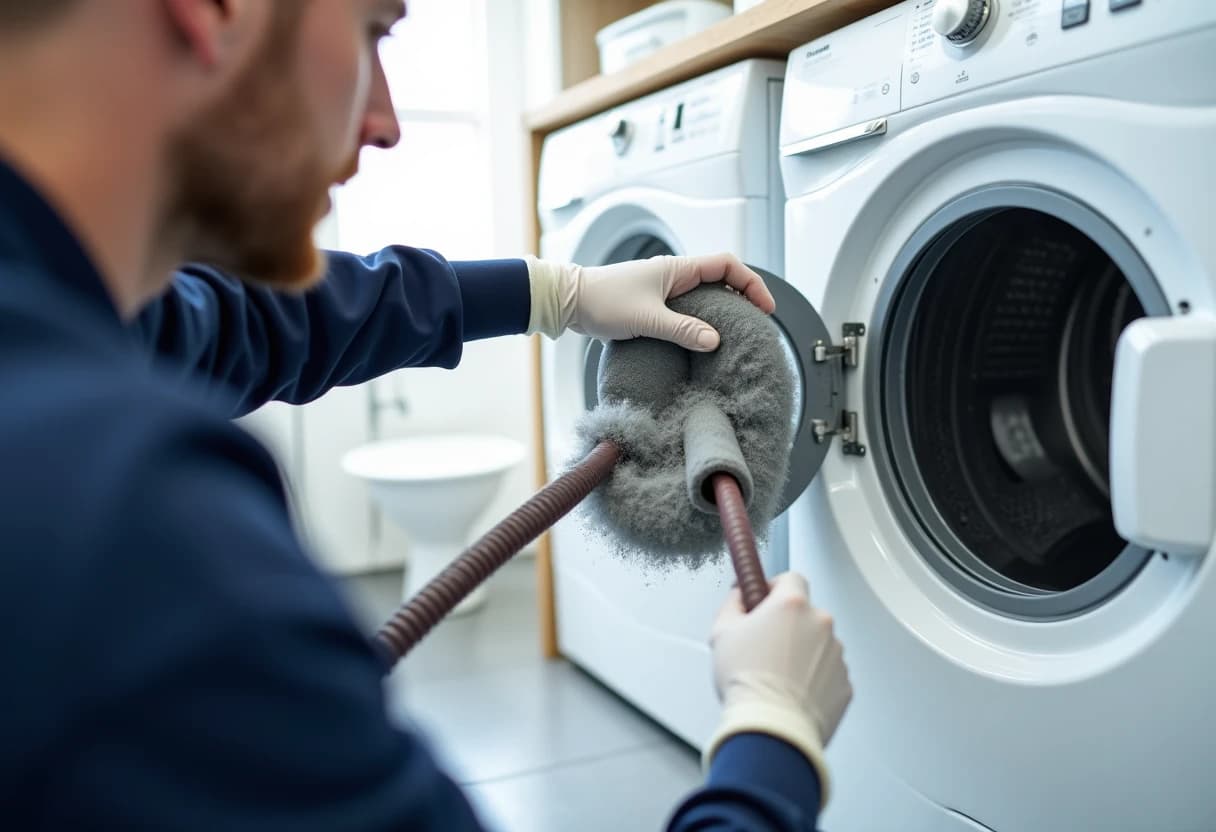
If your dryer takes two cycles to dry a load that used to take one, the problem is almost never the dryer — it is the vent. A lint-restricted exhaust line traps hot, moist air in the drum, stretching drying times, wasting electricity or gas, and overheating the very lint that lines the duct. Our certified technicians clean Boston dryer vents end to end with flexible rotary brush systems and HEPA-filtered vacuums, restoring full airflow in about an hour. The result is a dryer that works like new, utility bills that drop, and a fire hazard removed from the middle of your home.
Why Dryer Vent Cleaning Matters for Boston Homes
Dryer vents fail invisibly. The duct runs through wall cavities, basement ceilings, soffits and attics — places no one looks — and lint accumulation is gradual enough that homeowners adapt to the symptoms without noticing. Loads take a little longer each year. The laundry room gets a little more humid. The exterior flap opens a little less. By the time a vent is fully blocked, it has usually been dangerously restricted for two or three years. This is why the NFPA and dryer manufacturers recommend professional cleaning at least annually rather than waiting for symptoms: the schedule catches restriction before it becomes blockage, and blockage before it becomes ignition. Greater Boston's housing stock compounds the problem — long vent runs from basement laundry rooms, multiple elbows navigating old framing, and terminations high on walls or roofs that homeowners cannot inspect. A yearly cleaning with airflow verification is the only way to actually know the state of a duct you cannot see.
Condo and multi-family living around Fenway Park adds its own dryer vent challenges: shared walls that force long horizontal runs, roof terminations three stories up, and condo associations that require insured, documented service. Boston's housing runs the full spectrum of American urban building: 1800s brownstones and brick rowhouses in Back Bay, Beacon Hill and the South End, wood-frame triple-deckers across Dorchester and the streetcar neighborhoods, mid-rise brick apartment blocks near the universities, and glass condo towers downtown and along the harbor. Countless older buildings have been carved into condos with each unit given its own furnace or heat pump, so ductwork is often squeezed through 19th-century joist bays, chases and dropped ceilings never designed for it. The result is a city full of long, tight, hard-to-reach duct runs that trap decades of dust. We handle all of it — our Boston crews carry roof access equipment, provide certificates of insurance on request, and leave written service records that satisfy association and insurance requirements. We work in Boston every week, from rowhouse condos on gas-fired forced air to triple-decker units with attic air handlers. City-specific issues come up constantly: shared-wall dust migration in rowhouse blocks, renovation debris left in ducts after condo conversions, and dryer vent runs that snake thirty-plus feet to reach an outside wall - a genuine fire risk we flag on nearly every Boston visit. For triple-deckers and converted multi-families, we can clean all units' vents in one visit at bundled pricing, which is the most cost-effective way to protect the whole building.
Our Dryer Vent Cleaning Process in Boston
1Inspect the Dryer, Transition Duct & Vent Path
First we establish what we are cleaning: duct material, run length, number of bends, and termination type. We also measure baseline airflow at the exterior hood with the dryer running. That number matters — it is how we prove, at the end of the visit, that the cleaning actually restored the exhaust capacity your dryer needs.
2Protect the Laundry Area & Disconnect the Dryer
We treat laundry rooms — often tight, finished spaces — with the same care as any living area: drop cloths down, dryer walked out on protective sliders, and the work zone contained. Disconnecting at the appliance gives us a clean entry point into the duct and a chance to inspect the connection hardware that so often leaks lint into the wall cavity.
3Rotary Brush the Full Length of the Duct
We feed flexible rotary rods through the duct, adding sections until the brush has traveled the complete run from the dryer connection to the exterior hood. The rotating head dislodges packed lint, bird nesting material and debris from every interior surface, including the elbow throats where lint mats form first. Nothing is bypassed; the brush touches every foot of the line.
4Capture Everything With HEPA Vacuum Extraction
As the brush works, a HEPA-filtered vacuum runs simultaneously on the duct, pulling loosened lint into a sealed collection system instead of letting it blow into your laundry room or yard. The combination — agitate and extract at once — is what leaves the duct genuinely empty rather than redistributing the clog.
5Clean From the Exterior Termination Inward
Cleaning from both ends is non-negotiable on longer runs. The last few feet before the termination, and the hood itself, accumulate the densest lint — it is where moist exhaust meets cold outdoor air and fibers mat together. We open the hood, clear the damper, remove nesting if present, and brush the final duct section back toward the vacuum.
6Service the Transition Duct & Reconnect
Reassembly is done to code and to the appliance manual: UL-listed transition duct, proper clamps, no more than the listed connector length, and the dryer set far enough from the wall that the duct keeps its shape. We level the machine, verify the gas connection is undisturbed on gas units, and run a test cycle before calling the mechanical work done.
7Verify Airflow & Walk You Through the Results
Final checks: test cycle run, exhaust verified at the hood, laundry area vacuumed and everything returned to place. If we found issues cleaning cannot fix — overlong runs, crushed sections, illegal materials — you get straight documentation and a separate quote, never pressure. Most vents simply need this cleaning, once a year, and nothing more.
Benefits of Professional Dryer Vent Cleaning in Boston
Documentation for Insurance, Condos & Peace of Mind
For landlords and multi-family owners, documented dryer vent service is due-diligence gold: it demonstrates fire-safety maintenance across units in a single record. We service whole buildings in one visit with per-unit documentation, which is why property managers across Greater Boston keep us on an annual rotation.
Dramatically Reduced Fire Risk
This is the benefit that matters most. Lint is extraordinarily flammable, and a clogged vent both supplies the fuel and creates the overheating that ignites it. Removing the accumulation removes the hazard — which is why fire departments, the NFPA and FEMA all urge annual dryer vent cleaning as basic home fire prevention.
Lower Energy Bills
Energy waste from blocked dryer vents is invisible on any single bill but substantial over a year — hundreds of extra kilowatt-hours or therms for a heavy-laundry household. Cleaning converts that waste back into performance. It is one of the few home services with a direct, same-month payback mechanism.
Less Moisture, Mildew & Musty Odor
Damp lint inside a restricted duct becomes a mold and bacteria medium — the source of the sour smell some dryers push into freshly washed clothes. Removing the lint removes the colony. If your 'clean' laundry has ever come out smelling worse than it went in, the vent is the likeliest culprit.
Safer Operation for Gas Dryers
For gas dryers, vent cleaning is combustion safety, not just lint management. Backdrafting exhaust is odorless and invisible; the protection is a clear duct and a working CO detector. We verify complete, strong exhaust at the exterior termination on every gas dryer job — the confirmation that byproducts are leaving the house.
Faster Drying Times
If laundry has become an all-day affair, the fix is rarely a new dryer. We regularly clean vents for customers who were quoted $1,000+ appliance replacements, and the old machine performs like new once it can breathe. Try the $149 to $299 solution before the four-figure one.
Signs Your Boston Home Needs Dryer Vent Cleaning
Burning Smell During a Cycle
That 'hot lint' smell is exactly what it seems: fibers reaching their scorching point somewhere in the airflow path. Sometimes it is a sock against the element; usually it is accumulation. Either way, the difference between a smell and a fire can be one overloaded cycle. We prioritize these calls for same-week service.
It Has Been More Than a Year
Households that run a load daily, dry pet bedding, or share laundry across a multi-family building accumulate lint at two to three times the average rate and should clean every six to twelve months. A quiet couple doing weekly laundry can stretch toward the annual mark, but rarely safely beyond it.
Dryer or Clothes Are Hot to the Touch
Some heat is normal; radiating heat is not. When the exhaust cannot escape, the drum, cabinet and surrounding wall absorb it instead. Homes where we measure the highest cabinet temperatures reliably produce the fullest lint bags — the correlation between heat and blockage is nearly one to one.
Lint Building Up Behind or Inside the Dryer
Lint accumulating behind the machine, around the transition hose or under the dryer means the exhaust path is leaking or backing up — lint should travel out, not settle in. It is both a symptom of restriction and a hazard in itself, since this lint sits nearest the heat source. A cleaning addresses the cause and clears the accumulation.
The Exterior Vent Flap Barely Opens
Step outside during a drying cycle and look at the termination hood. The damper should stand fully open with a strong, warm airstream you can feel from a foot away. A flap that flutters weakly, opens halfway or stays shut is showing you the blockage directly — the cheapest diagnostic in home maintenance.
Laundry Room Gets Hot and Humid
Watch for secondary evidence: peeling paint near the dryer, mildew spots on the ceiling above it, a musty smell that lingers after laundry day, rust on shelf brackets. All are condensation footprints from exhaust escaping into the room through a restricted or leaking duct rather than exiting the house.
Dryer Vent Cleaning Cost in Boston, MA
Dryer vent cleaning in Greater Boston typically costs $149 to $299, and the honest drivers of price are the run itself: length, number of elbows, and where it terminates. A first-floor laundry with a short straight shot to a side wall sits at the low end near $149. A basement laundry venting up and across to a second-story wall, or any roof termination, sits toward $249 to $299 because of the added access work and ladder or roof time. Severely blocked ducts that need staged extraction, nest removal from the termination, or cleaning from both ends of a very long run can add modestly, and we tell you before proceeding. What never changes: our quote covers the complete line — dryer connection to exterior hood, elbows included — plus transition duct inspection, exterior damper service and airflow verification. Beware pricing that covers 'the first six feet' with per-foot charges after; a dryer vent is only clean if all of it is clean.
Want the full pricing picture? See our complete Boston-area cost guide or call (617) 390-7145 for an exact flat quote for your Boston home.
Local Knowledge: Boston, Suffolk County
What makes Boston different? Boston's housing runs the full spectrum of American urban building: 1800s brownstones and brick rowhouses in Back Bay, Beacon Hill and the South End, wood-frame triple-deckers across Dorchester and the streetcar neighborhoods, mid-rise brick apartment blocks near the universities, and glass condo towers downtown and along the harbor. Countless older buildings have been carved into condos with each unit given its own furnace or heat pump, so ductwork is often squeezed through 19th-century joist bays, chases and dropped ceilings never designed for it. The result is a city full of long, tight, hard-to-reach duct runs that trap decades of dust. We work in Boston every week, from rowhouse condos on gas-fired forced air to triple-decker units with attic air handlers. City-specific issues come up constantly: shared-wall dust migration in rowhouse blocks, renovation debris left in ducts after condo conversions, and dryer vent runs that snake thirty-plus feet to reach an outside wall - a genuine fire risk we flag on nearly every Boston visit. For duct and dryer vent systems, those local factors translate into specific, predictable problems — and predictable problems are the ones we solve fastest. Call (617) 390-7145, tell us your street and home style, and we will quote the job accurately the first time, usually in under five minutes.
The Best Time of Year in Boston
New England's humid summers work on dryer vents from the other direction. High dew points mean exhaust moisture lingers in the duct instead of flashing away, and damp lint packs harder and grips duct walls tighter than dry lint ever does. Basement laundry areas — the Massachusetts default — add their own ambient humidity to the mix. By September, a vent that entered summer marginal is often matted solid. Summer is also nesting season at the other end of the line: birds and squirrels find an unscreened, warm, sheltered dryer termination irresistible, and a spring nest becomes a fall blockage. Our cleanings clear both problems and note whether your termination needs a code-compliant guard.
Why Choose Boston Air Duct Cleaners
What separates us from the coupon crowd is simple: we do the whole job, we prove it, and we charge what we quoted. Our technicians clean supplies, returns, trunks and blower compartments on every visit — never a cosmetic vent wipe. Photo documentation comes standard, pricing is flat and confirmed up front, and our trucks carry true commercial vacuum equipment, not rented shop-vacs. Based in West Newton and serving Boston year-round, we answer our own phone at (617) 390-7145 and stand behind every cleaning with a satisfaction guarantee.
Serving Boston and Surrounding Communities
Boston sits in the heart of our service area, and neighboring Back Bay, South End, Cambridge, Brookline, Somerville, Dorchester appointments share the same routes. That density is why our response times in this part of Suffolk County are among our fastest — and why you will see our trucks in the area week after week.