
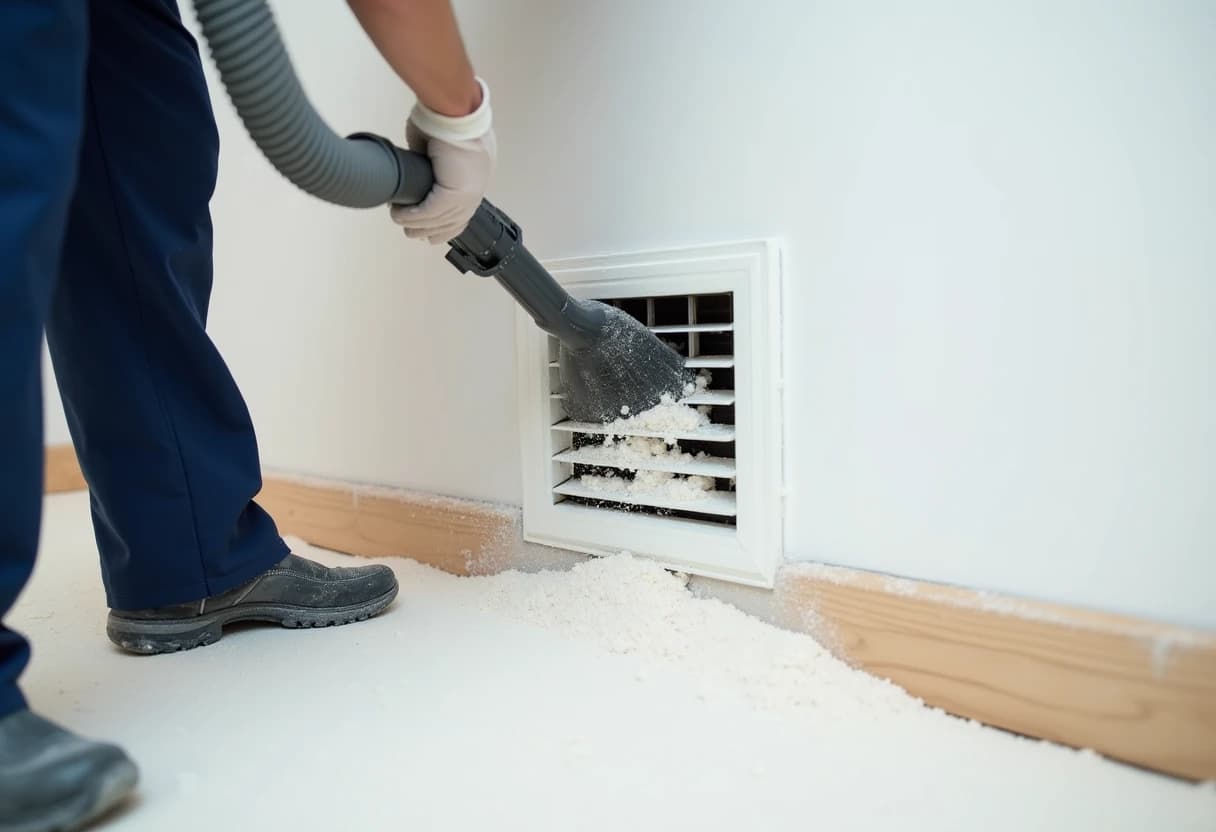
Renovation dust does not leave when the contractors do. Drywall sanding, tile cutting, demolition and floor refinishing generate microscopic gypsum, silica and wood particles that infiltrate every open register and return grille — and once inside the ductwork, they recirculate through your Greater Boston home for months every time the blower runs. Contractors' final cleanup stops at the register cover; the duct network behind it inhaled the entire project. Our post-renovation cleaning is a full source-removal service tuned for construction debris: negative pressure, mechanical agitation sized for heavy particulate loads, HEPA filtration, and camera verification that the system is genuinely clear before your family breathes through it all winter.
Homeowners in Greater Boston call us at three moments: mid-project, when dust is escaping into finished rooms and they want the ducts protected or triaged; project's end, when the punch list is done but the air still tastes like drywall; and months later, when unexplained grit, dust and scratchy throats trace back to a renovation everyone thought was cleaned up. All three calls end the same way — with a complete source-removal cleaning that empties the duct network of construction debris and gives the system a clean baseline. We photograph the before and after, we clean the blower and plenums the project fouled, and we leave you with documentation your contractor's broom could never provide.
Why Post-Renovation & Construction Dust Duct Cleaning Matters
Every renovation turns the HVAC system into an unpaid, unfiltered shop vacuum. Return grilles pull air continuously from the work zone whenever the system runs — and even when it does not, open registers collect falling dust while pressure differences push fine particles through the network. Drywall sanding alone generates pounds of gypsum dust per room, with particles fine enough to remain suspended for hours and travel the full length of a duct system. Tile, stone and concrete work adds crystalline silica, a particulate regulated on job sites precisely because inhaling it is harmful. Framing and trim contribute sawdust and wood fines. Builder-grade filters catch the coarse fraction and clog; the fine fraction passes straight through to coat duct walls, the blower wheel and the evaporator coil. None of this is removed by the cleanup that ends a construction project, because contractors' scope stops at surfaces you can see and touch. The duct interior is the largest surface in the house nobody looks at — and after a renovation it is reliably the dirtiest. A post-construction source-removal cleaning is the only step that actually ends the project, because until the ducts are empty, the blower re-runs the job site through your rooms daily.
Skeptics ask whether the ducts really caught that much — and the camera answers in seconds. In a typical post-renovation inspection we find drifts of white gypsum dust in supply boots, a gray-beige coating down the trunk lines, sawdust collected at elbows, and a blower wheel whose blades have grown a crust that visibly changes their shape. In new construction we routinely pull out debris by the handful: insulation batting, cardboard, wrappers, offcut lumber. The EPA's general guidance on duct cleaning is measured — clean when there is visible excessive debris releasing into the home — and post-construction systems are the textbook example of exactly that condition. This is also the scenario where cheap cleanings fail worst: construction particulate is heavier, more compacted and more electrostatically bonded than household dust, and dislodging it takes true negative pressure with repeated mechanical agitation passes, not a vacuum wand at the register. We bring the same truck-grade equipment to every post-renovation job that we use on our most contaminated restoration work, because that is what the debris load actually demands — and we prove the result with imaging, not assurances.
How Our Post-Renovation & Construction Dust Duct Cleaning Process Works
1Post-Construction Assessment & Debris Mapping
We start by scoping what the project left behind: camera inspection of representative supply and return runs, a look at the filter and blower compartment, and a walk-through of which rooms saw the heaviest work. Construction debris distributes unevenly — the runs nearest the sanding get the worst of it — and mapping the load lets us plan agitation passes where they are needed most.
2Protect Finished Surfaces & Seal the System
Your home was just finished — we treat it that way. Floor protection goes down along every hose path, corner guards protect fresh paint on tight turns, and technicians wear boot covers throughout. Then every register and grille is sealed so the system becomes a closed vacuum circuit: once cleaning starts, debris moves only toward our collection equipment, never into your new rooms.
3Establish Negative Pressure
A HEPA-filtered negative-air machine connects to the main supply and return trunks through sealed access ports, placing the full network under continuous vacuum. For construction loads this step is non-negotiable: gypsum fines are exactly the kind of particulate that escapes half-measures, and only whole-system vacuum guarantees they travel into collection rather than back into your rooms.
4Heavy-Debris Agitation, Run by Run
Construction debris bonds to duct walls harder than household dust — gypsum cakes, silica clings electrostatically, and sawdust drifts pack into elbows. We work every supply and return individually with rotary brushes and compressed-air whips, making repeat passes on the runs the debris map flagged, until camera checks show clean surfaces down the full length.
5Blower, Plenums & Coil-Area Cleaning
The air handler took the project as hard as the ducts did. We open the blower compartment and clean the wheel, housing and cabinet interior — gypsum crust on blower blades measurably steals airflow — plus the supply and return plenums. If the evaporator coil shows construction fouling, we document it with photos and quote coil cleaning as a clearly priced option.
6Optional Post-Construction Sanitizing
Where a project involved water damage repair, mold discovery or heavy demolition of old materials, we can finish with an EPA-registered antimicrobial fog through the freshly cleaned system. It is optional and honestly scoped: most straightforward remodels do not need it, and we say so. Where conditions justify it, it neutralizes what demolition stirred up.
7Verification Imaging & Project Handoff
The job closes with proof: after-images matched to the before-images from the same runs, registers reinstalled, a new filter in place, and the system running for a live airflow check at every register. You receive the full photo documentation — increasingly requested by GCs as the project's final closeout record and by buyers as move-in evidence.
Benefits You Can Expect
The Renovation Is Finally, Actually Over
A remodel is not finished while the HVAC system is still distributing it. Removing the duct-borne debris load ends the gritty film on surfaces, the mineral taste in the air and the white dust at register edges — the lingering symptoms that make finished projects feel unfinished for months. One visit closes the last open item.
Removal of Respiratory Irritants at the Source
Gypsum, crystalline silica and fine wood dust are mechanical irritants to airways — the reason job sites regulate exposure to them. Post-renovation cleaning removes the reservoir feeding your home's airborne levels, which is why the scratchy throats and morning congestion that follow remodels typically resolve within days of the service.
Protection for New HVAC Equipment
Renovations frequently include new furnaces, heat pumps or air handlers — and then feed them construction dust from day one. Gypsum on a new blower wheel and debris on a new coil age premium equipment prematurely and can complicate warranty conversations. Cleaning the ducts protects the investment the project just made.
Restored Airflow & Efficiency
Construction dust is heavy, and it settles where airflow is weakest — narrowing runs, blanketing coils and loading filters. Removing it restores the system's designed airflow, which shows up as stronger registers, faster heat-up and cool-down, and shorter cycles on every heating and cooling day that follows.
A Verified Clean Baseline for Move-In
For buyers of new construction, flips or freshly renovated homes, the cleaning establishes something you otherwise never get: a documented starting point. From move-in day forward, the ducts carry only your household's air — not the builder's job site or the previous owners' projects — and the imaging proves it.
Fewer Contractor Callbacks & Cleaner Closeouts
For GCs and builders, lingering dust is the callback that will not die: the client keeps finding grit, the crew keeps returning to wipe surfaces, and the real source is the one place nobody's scope covered. Adding our cleaning as the final trade ends the cycle and closes projects clean.
Odor Removal From the Work Itself
Renovations leave a scent signature — cut lumber, adhesives, joint compound, paint off-gassing — that duct dust absorbs and re-releases for months, keeping the house smelling like a project long after it looks finished. Removing the saturated dust layer removes the broadcast medium, and the new-space smell finally fades to neutral.
Warning Signs to Watch For
Gritty Film Keeps Returning After the Project
You wipe the counters, and within days a fine, slightly abrasive film is back — often pale, unlike ordinary gray house dust. That is construction particulate cycling between the ducts and your surfaces, and it will continue until the duct interior is mechanically cleaned. No amount of surface cleaning ends it, because the surfaces are the destination, not the source.
White Dust Streaks at Registers & Filter Clogging Fast
Pale streaking on walls and ceilings around supply registers is duct-borne gypsum being filtered by your paint. Pair it with a filter that turns gray-white in two or three weeks instead of three months, and the diagnosis is complete: the system is loaded with renovation debris and actively shedding it.
Scratchy Throats or Allergies Since the Remodel
If household members developed morning congestion, throat irritation or allergy-like symptoms that began around the renovation and persist after it, suspect the air path. Gypsum, silica and wood fines are mechanical irritants, and the blower re-doses the house with them on every cycle until the reservoir is removed.
You Renovated Without Sealing the Registers
If registers and returns stayed open during demolition, sanding or floor refinishing, the system inhaled the project — full stop. Running the HVAC during dusty phases accelerates it, but even an idle system collects debris through open grilles and pressure-driven infiltration. Assume contamination and let a camera confirm the extent.
You Just Bought New Construction or a Flip
Registers go on at the end of a build, sealing months of drywall dust, sawdust and site debris inside runs no punch-list vacuum ever entered. If your new home came with no documentation of a real duct cleaning — and almost none do — assume the system holds the construction it came from.
Debris Visible Inside Boots & Behind Registers
Lift a floor register and look with a flashlight: drifts of pale dust, chips of drywall, sawdust or construction trash in the boot mean the runs beyond hold more of the same. What is visible in the first reachable foot is a sample of thirty feet you cannot see — and cannot reach with a shop vacuum.
The System Struggled Since the Project Ended
Weaker airflow at registers, longer heating and cooling cycles, or rooms that balanced fine before the remodel and poorly after — all point to debris loading in runs, filter and blower. Construction dust is heavy enough to measurably restrict a system, and the restriction arrived exactly when the project did.
Post-Renovation & Construction Dust Duct Cleaning Cost in the Boston Area
Post-renovation duct cleaning in Greater Boston typically runs $450 to $900 — a premium of roughly 20 to 40 percent over routine duct cleaning, reflecting what the work actually involves: heavier debris requiring repeat agitation passes, mandatory blower compartment detailing, more collection filter changes on our equipment, and the imaging documentation the job should always include. The honest price drivers are system size (vent and return count, number of air handlers), the scale of the project (a bathroom refresh loads a system far less than a gut renovation or new build), accessibility, and whether larger construction debris must be physically retrieved from runs. Optional add-ons are quoted separately and only when the assessment justifies them: evaporator coil cleaning ($150–$350) when the project fouled it, and EPA-registered sanitizing ($75–$200) where demolition opened moisture-damaged or moldy cavities. We quote flat before work begins — the number you approve is the number you pay, regardless of how much debris the system surrenders.
For contractors and builders, per-project pricing improves with partnership. GCs who add us as the standing final trade on their schedule get contractor rates, direct coordination with the site supervisor on timing, certificates of insurance on file, and a documentation package delivered to the project file for closeout — typically $450–$750 per average residential project depending on system size. Builders handing over new construction use the same structure per unit, with multi-unit and subdivision work priced on volume. The economics favor everyone: the cleaning costs the project less than one dust callback costs the contractor, and the buyer receives a home that is finished behind the walls. Homeowners whose contractors did not include duct cleaning in scope pay standard rates — $450–$900 — and should budget it as part of the renovation's real cost from the start. A four-figure-percent of a six-figure remodel is what it takes to make the whole investment breathable.
Seasonal Considerations in New England
Greater Boston's renovation calendar creates a duct cleaning calendar. Construction season peaks spring through fall, which means finished projects — and the debris their duct systems inhaled — pile up just before the heating season locks the windows shut. A system cleaned in October carries clean air through five closed-up months; one left loaded circulates gypsum and silica through the tightest-sealed, longest-occupied stretch of the year, which is exactly when families notice the scratchy throats and relentless dust. If your project wraps in late summer or fall, book the cleaning between the final finish work and the first serious furnace run. It is the highest-leverage air quality timing New England offers, and our autumn schedule fills with exactly these jobs.
Why Boston Air Duct Cleaners
Choosing a duct cleaner is really a trust decision — you are letting a crew work inside the system that feeds air to your family. We make that decision easy: a local West Newton company with insured, uniformed technicians, transparent flat-rate quotes, NADCA-standard equipment and methods, and photographic proof of the finished work. No door-to-door sales, no bait-and-switch coupons, no invented 'mold emergencies.' Just honest mechanical cleaning done properly the first time, backed by a written guarantee.