
In a typical home, 20 to 30 percent of the air moving through the duct system never reaches the rooms it was conditioned for — it escapes through leaky joints, failed tape, disconnected takeoffs and crushed runs, according to ENERGY STAR. In practical terms, your furnace heats the basement joist bays and your air conditioner cools the attic while the bedroom above the garage stays stubborn year-round. Our Greater Boston duct sealing and repair service finds those losses and closes them: pressure-informed leak diagnosis, mastic sealing of accessible joints and seams, mechanical repair of damaged and separated runs, and re-supported sagging duct — so the air you pay to condition actually arrives where you live.
The Department of Energy and ENERGY STAR consistently rank duct sealing among the highest-payback improvements a homeowner can make — typical systems leak 20 to 30 percent of their airflow, and in older Greater Boston housing we routinely measure worse. The remedy is neither exotic nor disruptive: accessible leaks in basements, attics and crawlspaces are sealed with fiber-reinforced mastic that outlasts any tape, separated joints are refastened mechanically before sealing, crushed sections are replaced, and the whole system is re-tested. Many Greater Boston customers pair sealing with a duct cleaning in one visit — clean the air path, then close it — and see the difference on the next utility bill and in the far bedrooms the same week.
Why Duct Sealing & Repair Matters
ENERGY STAR's headline figure deserves a moment of honest math: in a typical house, about 20 to 30 percent of the air that moves through the duct system is lost to leaks, holes and poorly connected sections. Apply that to a Massachusetts heating season — five-plus months of near-daily furnace or heat pump operation at some of the country's highest energy prices — and duct leakage becomes one of the largest single line items of pure waste in the household budget. The physics is simple: supply leaks dump heated or cooled air into basements, attics, wall cavities and crawlspaces that need none of it, while the rooms at the ends of the runs get whatever survives the trip. The system compensates the only way it can — longer run times — so you pay twice: once for the lost air, again for the extra cycles. Sealing accessible leaks with mastic and repairing failed sections recovers that delivery. It is why the Department of Energy lists duct sealing among the most cost-effective efficiency improvements available, with payback periods measured in a few heating seasons rather than decades — and why the fix, unlike most efficiency work, is something you also feel immediately in the far rooms.
Greater Boston's housing stock makes duct problems near-universal. Systems in pre-war homes were often adapted from gravity furnaces or added during mid-century conversions, then extended piecemeal through every renovation since — each era contributing its own joints, materials and shortcuts. Cloth-backed duct tape from the 1960s through the 1990s has long since dried, cracked and peeled; it was never a sealing material with a service life, despite the name. Basement runs have been bumped by decades of storage and strung with wiring; flex duct added in the 1980s sags between straps and kinks at every bend; panned joist returns — using the floor cavity itself as a duct — leak by design at every seam. Unconditioned attics and crawlspaces, standard in New England construction, put ducts in the harshest thermal environments the house has, where every leak costs the most. None of this is exotic damage; it is the normal aging of systems that were assembled, not engineered, and it is why we find meaningful, fixable leakage in nearly every duct system we inspect that is more than fifteen years old. The encouraging part: the worst leaks are usually the most accessible ones, and mastic-sealing a basement's worth of joints is a single-visit project.
How Our Duct Sealing & Repair Process Works
1Leak Diagnosis & System Inspection
We start by finding the losses, not assuming them. Your technician measures airflow at the registers — weak readings map directly to compromised runs — then physically walks every accessible duct in the basement, attic and crawlspace, checking joints, seams, takeoffs and supports. Problem rooms get their full supply path traced from trunk to boot.
2Written Scope: Seal, Repair or Replace
Findings become a tiered written scope before any work starts: joints and seams that need mastic sealing, sections needing mechanical repair — refastening, re-supporting, straightening — and any runs damaged enough to warrant replacement. Each item is priced individually, so you approve exactly the work your system needs and nothing packaged.
3Mechanical Repairs First
Sealing a joint that is physically separated wastes mastic, so repairs precede sealant. Disconnected takeoffs and boots are refastened with screws and collars, separated trunk joints drawn back together and mechanically secured, and every reconnection made airtight-ready before the sealing pass. Order of operations is half the durability.
4Crushed & Damaged Run Restoration
Crushed duct chokes a room as effectively as a leak starves it. Flex runs flattened under storage or foot traffic are cut back and replaced with properly sized new sections; kinked bends are re-formed or re-routed; and sagging runs — which add resistance with every unsupported dip — are re-strapped to manufacturer spacing to restore full diameter.
5Mastic Sealing of Joints, Seams & Takeoffs
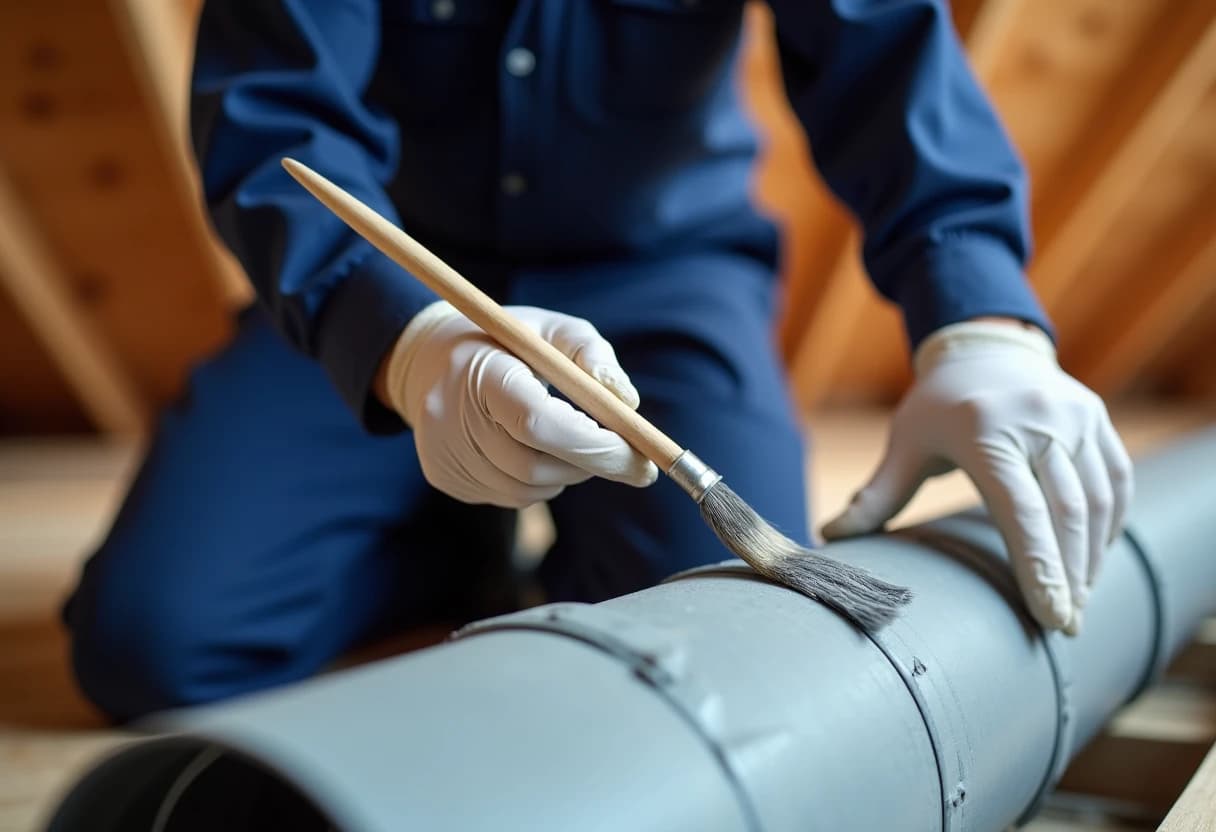
The sealing pass covers every accessible connection: fiber-reinforced mastic brushed over trunk joints, branch takeoffs, seam lines, boot connections and plenum junctions. Mastic stays flexible through thermal cycling and lasts decades — the reason codes and efficiency programs specify it over any tape. Larger gaps get fiberglass mesh embedded in the mastic for strength.
6Return-Side & Panned-Joist Sealing
Returns get equal treatment, because their leaks flow inward: seams and joints sealed with mastic, panned joist returns — where the floor cavity itself carries air — sealed along their edges to stop them inhaling basement air, and the return plenum and filter rack sealed so unfiltered air cannot bypass the filter entirely.
7Verification, Documentation & Recommendations
The job closes with re-measurement: register airflow readings compared against the diagnostic baseline — problem rooms usually show their improvement immediately — plus photos of every repair and sealed section. You receive the full record: scope completed, before-and-after imagery, and readings, useful for energy program paperwork and resale alike.
Benefits You Can Expect
Recover the 20-30% You Already Paid For
ENERGY STAR's typical-home figure — 20 to 30 percent of conditioned air lost to duct leaks — is the benefit case in one number. Sealing accessible leaks redirects that air from basement joists and attic cavities back into living space, which shows up as shorter run times and a visibly calmer utility bill through a Massachusetts heating season.
The Cold Room Finally Warms Up
The bedroom that needed a space heater every January, the office that summer exiles you from — these rooms sit at the ends of compromised runs, receiving a fraction of design airflow. Repairing and sealing their delivery path restores the air the system always intended to send them, often transforming a decades-old complaint in one visit.
Cleaner Air From a Sealed Return
Leaky returns inhale from the spaces they pass through — musty basements, dusty attics, damp crawlspaces — and deliver that air to every room, unfiltered. Sealing the return side closes the pathway, which is why homeowners so often report the musty edge disappearing from their air within days of the work.
Longer Equipment Life, Fewer Repairs
Leaky, restricted ductwork punishes equipment: blowers fight abnormal static pressure, heat exchangers cycle against poor airflow, coils freeze or overheat at the margins, and everything logs extra hours compensating for lost delivery. Sealing and repair return the system to the operating conditions its components were engineered for.
A Duct System Ready for a Heat Pump
Heat pumps deliver comfort through airflow more than temperature, which makes duct leakage proportionally more damaging than it was to the furnace being replaced. Sealing first protects the rated performance a Mass Save conversion is paying for — and prevents the 'our new heat pump can't keep up' complaint that leaky ducts manufacture.
Durable Fixes, Not Another Layer of Tape
Mastic is the difference between sealing and re-taping. Brush-applied and fiber-reinforced, it bonds to the joint, flexes with thermal cycling and lasts decades — the reason codes and efficiency programs specify it. The peeling cloth tape we remove from your joints is the cautionary tale; we do not install the sequel.
Documented Work With Measurable Results
The service ends with numbers, not adjectives: register airflow readings before and after, photos of every repair and sealed section, and a written scope of completed work. The improvement in the problem rooms is visible in the readings the same day — and the record serves energy program paperwork and future resale alike.
Warning Signs to Watch For
Rooms That Never Heat or Cool Properly
A room chronically colder or hotter than the rest of the house is the classic delivery failure: the run serving it is leaking, crushed, disconnected or undersized. If the register in that room barely whispers while others blow strong, the diagnosis is nearly complete before we arrive — the air is escaping somewhere between the trunk and that boot.
Utility Bills Climbing Without Explanation
When usage rises year over year with no change in equipment, habits or rates, duct leakage is a prime suspect — tape fails progressively, joints work looser each season, and the system compensates with ever-longer run times. The 20-to-30-percent typical loss ENERGY STAR cites did not happen overnight; it accumulated exactly this way.
Visible Damage, Dangling Tape or Separated Joints
Walk your basement with a flashlight: cloth tape peeling off joints in dry curls, gaps you can see light or feel air through, flex duct flattened under boxes, a branch line hanging loose from the trunk. Visible failures are the honest tip of the system — for every leak you can see, the inaccessible sections usually hold more.
Musty or Basement Smells From the Registers
When supply air carries the smell of the basement, the return side is leaking — inhaling from the damp, musty spaces it passes through and distributing that air house-wide. The odor is the marker; the underlying issue is unfiltered, spore-carrying air entering the system your family breathes from all day.
Excessive Dust Despite Filter Changes
If good filters, changed on schedule, never seem to reduce the dust, air may be bypassing the filter entirely — through unsealed gaps at the filter rack and return plenum — or the return may be inhaling dust from basement and cavity spaces downstream of any filtration. Both are sealing problems wearing a housekeeping disguise.
Whistling, Hissing or Noisy Ductwork
Air escaping under pressure is audible: hissing at supply joints, whistling at gaps and register edges, a flutter where loose tape vibrates in the stream. New noises from the duct system are new failures announcing themselves — and each one marks a spot where your conditioned air is leaving early.
Planning a Heat Pump or Equipment Upgrade
If a Mass Save assessment, an installer's quote or your own planning has a heat pump conversion on the horizon, duct condition belongs at the front of the sequence. Heat pumps are more sensitive to delivery losses than the furnaces they replace, and sealing first protects the performance the incentives are paying for.
Duct Sealing & Repair Cost in the Boston Area
Duct sealing and repair in Greater Boston typically runs $300 to $1,200, and the spread reflects genuinely different scopes. At the low end, $300–$500 covers targeted work: mastic-sealing the accessible joints of a modest basement system, or repairing a specific failure — a disconnected takeoff, a crushed flex run, a separated boot — often to fix one problem room. Mid-range projects at $500–$900 combine comprehensive accessible sealing with multiple mechanical repairs: refastening and sealing a full basement's worth of trunk and branch joints, re-strapping sagging runs, sealing panned joist returns and the filter rack. The $900–$1,200 tier adds section replacement — deteriorated flex swapped for new, rusted or unsalvageable rigid runs rebuilt — or difficult access like tight crawlspaces and finished-basement ceilings. Aerosol-based interior sealing (the Aeroseal approach) for systems whose leakage hides in walls and chases is quoted separately and typically runs $2,000–$3,500 in this market; we assess honestly whether your leakage profile justifies it or whether accessible mastic work captures most of the benefit for a fraction of the price. Every quote is itemized and flat before work begins.
A pricing note on the seal-versus-replace decision, because it is where homeowners most need an honest broker. Wholesale duct replacement in this market runs many thousands of dollars, and some contractors reach for it reflexively — every aging system 'really should be redone.' The truth from inside the inspection: most systems more than fifteen years old need sealing everywhere, repair in places and replacement almost nowhere. Galvanized trunk lines last generations; it is their joints, tape and connections that fail, and those are repairable at a tenth of replacement cost. Replacement earns its price in specific conditions — rusted-through sections, early flex duct with failed liners, runs so poorly routed they choke airflow by design — and when we find them, you get photos and a per-section price, not a whole-system ultimatum. The same honesty applies in the other direction: when a system genuinely is past economical repair, we say so rather than selling mastic on a lost cause. The itemized scope format exists precisely so the decision stays yours, with evidence.
Seasonal Considerations in New England
Duct leaks bill you hardest in a Massachusetts winter. From November into April the blower runs nearly every hour, and every joint leaking into a 50-degree basement or a 20-degree attic leaks the entire time — the season converts small gaps into large gas bills. Winter is also when the comfort symptoms peak: the far bedroom's chronic chill, the second floor lagging the thermostat, the space heater making its annual return. The scheduling logic follows: sealing done in early fall captures the whole heating season's savings, and it is our busiest window for exactly that reason. But winter itself is fine working weather for this service — basements are heated enough to work in, mastic cures indoors regardless of the calendar, and a January diagnosis has the advantage of catching the system at full stress, when every failure is performing loudly.
Why Boston Air Duct Cleaners
Boston Air Duct Cleaners is a local, owner-operated company based at 1121 Washington St in West Newton — not a national franchise dispatching subcontractors. Every crew is our own: background-checked, factory-trained on commercial negative-pressure equipment, and fully insured. We quote flat prices before work begins, document every job with before-and-after photos, and follow NADCA-standard source-removal methods on every system we touch. That is why so much of our work comes from repeat customers, property managers and word-of-mouth referrals across Greater Boston.