
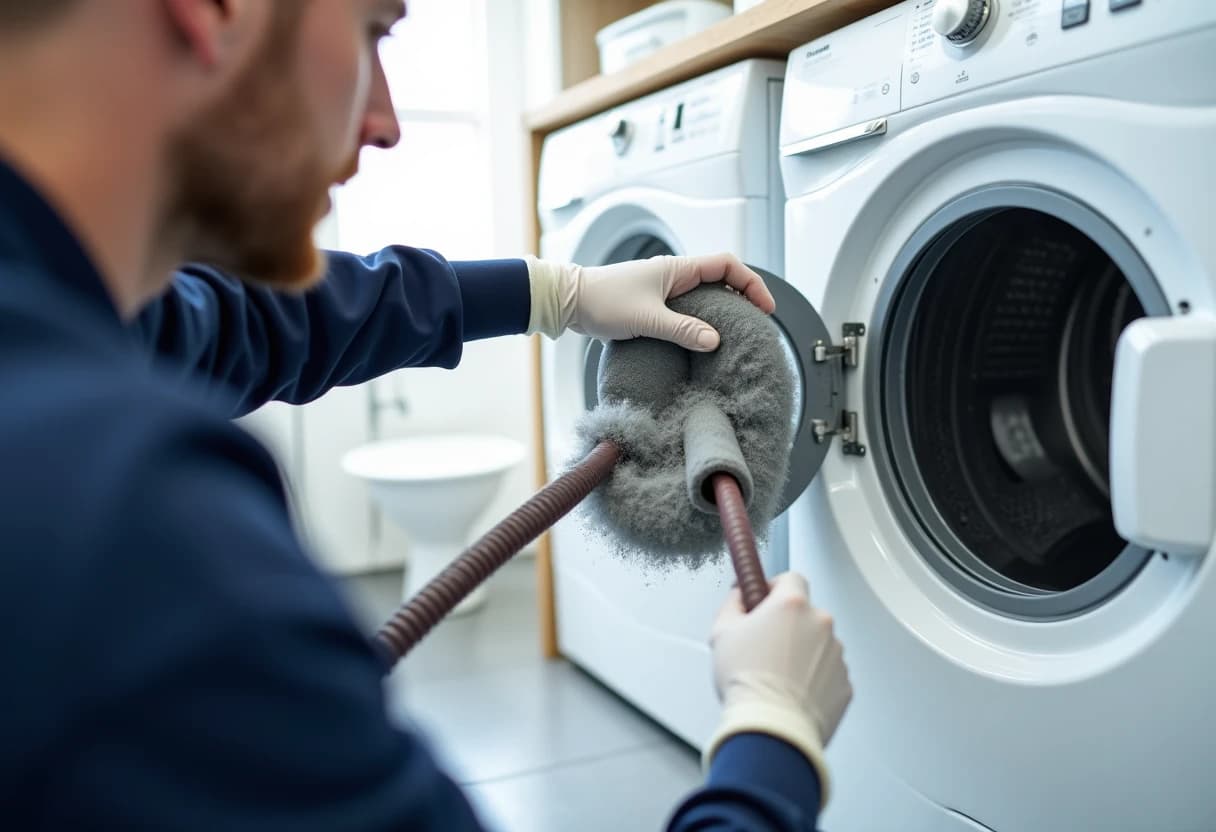
If your dryer takes two cycles to dry a load that used to take one, the problem is almost never the dryer — it is the vent. A lint-restricted exhaust line traps hot, moist air in the drum, stretching drying times, wasting electricity or gas, and overheating the very lint that lines the duct. Our certified technicians clean Westwood dryer vents end to end with flexible rotary brush systems and HEPA-filtered vacuums, restoring full airflow in about an hour. The result is a dryer that works like new, utility bills that drop, and a fire hazard removed from the middle of your home.
Why Dryer Vent Cleaning Matters for Westwood Homes
Dryer vents fail invisibly. The duct runs through wall cavities, basement ceilings, soffits and attics — places no one looks — and lint accumulation is gradual enough that homeowners adapt to the symptoms without noticing. Loads take a little longer each year. The laundry room gets a little more humid. The exterior flap opens a little less. By the time a vent is fully blocked, it has usually been dangerously restricted for two or three years. This is why the NFPA and dryer manufacturers recommend professional cleaning at least annually rather than waiting for symptoms: the schedule catches restriction before it becomes blockage, and blockage before it becomes ignition. Greater Boston's housing stock compounds the problem — long vent runs from basement laundry rooms, multiple elbows navigating old framing, and terminations high on walls or roofs that homeowners cannot inspect. A yearly cleaning with airflow verification is the only way to actually know the state of a duct you cannot see.
From the multi-family blocks near Buckmaster Pond to the single-families out toward Route 128 Station, Westwood laundry setups share a common risk profile: dryers pushed far from exterior walls, vents extended during renovations, and terminations no one has looked at in years. Westwood splits between the tighter prewar and postwar streets of Islington near the Dedham line and larger colonials on wooded lots toward Hale Reservation, with an infusion of new townhouses and apartments around University Station. Postwar capes and ranches here often run original sheet-metal ductwork, while the newer builds carry multi-zone systems with long flex-duct branches. That combination is how lint blockages build unnoticed. Westwood's teardown-and-expand renovation wave leaves many homes with hybrid duct systems - original trunks serving one wing and new flex runs serving an addition - and the junctions between old and new are where we find the worst debris. Homes backing up to Hale's 1,200 wooded acres also pull in notable pollen and leaf-mold loads every season. Because our shop is in West Newton, about 13 miles away, we can usually offer Westwood same-week appointments — and because we clean from both the appliance side and the exterior hood, blockages at either end of the run are fully removed, not pushed deeper.
Our Dryer Vent Cleaning Process in Westwood
1Inspect the Dryer, Transition Duct & Vent Path
Every job opens with a walkthrough of the complete exhaust path. The technician checks the lint screen housing, inspects the transition hose behind the dryer, locates every accessible section of duct, and finds the termination — wall hood, soffit outlet or roof cap. Photos document the starting condition so you can compare against the finished result.
2Protect the Laundry Area & Disconnect the Dryer
The dryer comes away from the wall and off the duct so we can clean the whole line, not just what a stub brush reaches. This is also when hidden problems surface: lint packed behind the machine, transition hoses crushed flat by the dryer being pushed back too far, and disconnected joints quietly venting into the wall.
3Rotary Brush the Full Length of the Duct
Our core cleaning tool is a motor-driven rotary brush on flexible rods, fed through the entire duct run. The spinning brush head scrubs lint off the duct walls through every elbow and vertical section, in runs up to 35 feet and beyond. Unlike hand brushes, it maintains full scrubbing force at the far end of the line — where the worst accumulation usually hides.
4Capture Everything With HEPA Vacuum Extraction
As the brush works, a HEPA-filtered vacuum runs simultaneously on the duct, pulling loosened lint into a sealed collection system instead of letting it blow into your laundry room or yard. The combination — agitate and extract at once — is what leaves the duct genuinely empty rather than redistributing the clog.
5Clean From the Exterior Termination Inward
We then work the line from the outside in — wall hood, soffit outlet or roof cap. Exterior terminations trap their own debris: lint mats behind the damper, bird and rodent nests, and screening clogged solid. Roof terminations get full ladder or roof access; we carry the gear, and steep or high work is included in the quoted price.
6Service the Transition Duct & Reconnect
Before reconnecting, we vacuum the dryer's own lint trap housing and accessible internal ducting, where years of screen bypass collects near the heating element. Then the transition duct is cleaned or replaced, clamped properly — never screwed, since screw tips inside the airstream snag lint — and the dryer is positioned to leave the duct an easy, unkinked path.
7Verify Airflow & Walk You Through the Results
We run the dryer and inspect the termination together — you should see the damper flap standing open under confident airflow, something many homeowners have literally never observed on their own vent. Your technician reviews photos, flags any code or condition issues for future attention, and records your service date for an annual reminder.
Benefits of Professional Dryer Vent Cleaning in Westwood
Lower Energy Bills
Energy waste from blocked dryer vents is invisible on any single bill but substantial over a year — hundreds of extra kilowatt-hours or therms for a heavy-laundry household. Cleaning converts that waste back into performance. It is one of the few home services with a direct, same-month payback mechanism.
Safer Operation for Gas Dryers
Massachusetts homes rely heavily on natural gas, and gas dryers are common across Greater Boston's housing stock. If yours vents through a long or aging duct, annual cleaning plus an airflow check is the standard of care fire and gas utilities recommend. It takes an hour and removes an entire category of risk.
Longer Dryer Lifespan & Fewer Repairs
New dryers deserve clean vents from day one — manufacturers require adequate exhaust airflow for warranty coverage, and delivery crews almost never clean the existing duct. If you have recently replaced your dryer and skipped the vent, you have connected a new engine to a clogged tailpipe.
Faster Drying Times
Airflow is what dries clothes; heat just helps. Restore full exhaust capacity and loads that limped through two cycles finish in one, towels stop coming out damp at the seams, and the dryer's moisture sensors — which many modern machines rely on — start reading accurately again. Most customers notice the difference on the first load after our visit.
Dramatically Reduced Fire Risk
This is the benefit that matters most. Lint is extraordinarily flammable, and a clogged vent both supplies the fuel and creates the overheating that ignites it. Removing the accumulation removes the hazard — which is why fire departments, the NFPA and FEMA all urge annual dryer vent cleaning as basic home fire prevention.
Less Moisture, Mildew & Musty Odor
Each load exhausts about a gallon of water as vapor. When the vent is blocked, that moisture backs into the laundry room and the duct itself — condensing on walls, peeling paint, and feeding mildew. A clear vent sends the humidity outside, drying out the laundry area and eliminating the damp, musty smell that clings to blocked systems.
Signs Your Westwood Home Needs Dryer Vent Cleaning
The Exterior Vent Flap Barely Opens
Many Westwood-area vents terminate on roofs or high walls where owners never look — which is exactly why blockages there grow uninterrupted for years. If you cannot see your termination or have never checked it, assume it needs inspection. We check and clean terminations, roof-mounted included, on every visit.
Clothes Take More Than One Cycle to Dry
Homeowners adapt to slow drying so gradually they stop noticing, until they use a laundromat or a friend's machine and remember what one-cycle drying feels like. If your definition of a drying cycle has quietly stretched past an hour, the vent is overdue for inspection and almost certainly for cleaning.
It Has Been More Than a Year
Households that run a load daily, dry pet bedding, or share laundry across a multi-family building accumulate lint at two to three times the average rate and should clean every six to twelve months. A quiet couple doing weekly laundry can stretch toward the annual mark, but rarely safely beyond it.
Dryer or Clothes Are Hot to the Touch
Excess heat is the fire chain's first visible link: restricted airflow, rising temperatures, and a duct lined with fuel. If the top of your dryer doubles as a hand warmer or the laundry room bakes during cycles, stop using the machine for long runs and have the vent cleaned promptly.
Lint Building Up Behind or Inside the Dryer
Lint accumulating behind the machine, around the transition hose or under the dryer means the exhaust path is leaking or backing up — lint should travel out, not settle in. It is both a symptom of restriction and a hazard in itself, since this lint sits nearest the heat source. A cleaning addresses the cause and clears the accumulation.
Burning Smell During a Cycle
Never normalize a burning odor from a dryer. Investigators repeatedly find that households smelled scorching lint for weeks before an ignition. A cleaning visit resolves the source in about an hour and includes vacuuming the dryer's internal lint paths near the element — where the smell most often starts.
Dryer Vent Cleaning Cost in Westwood, MA
It helps to weigh the price against the alternatives. A $149 to $299 annual cleaning stands against: $10 to $20 a month in energy waste from a restricted vent; $150 to $400 appliance repair visits for blown thermal fuses and burned elements that blocked vents cause; $800 to $1,200 for the dryer replacement that chronic overheating hastens; and the uncapped cost of a lint fire, which averages five figures in property damage even when contained quickly. Insurance data and FEMA's fire statistics make dryer vent cleaning one of the highest-return maintenance dollars in the home. We keep the pricing flat and published because the service only works as prevention if people actually book it annually — surprise invoices are how homeowners talk themselves into skipping years, and skipped years are how blockages happen.
Want the full pricing picture? See our complete Boston-area cost guide or call (617) 390-7145 for an exact flat quote for your Westwood home.
Local Knowledge: Westwood, Norfolk County
What makes Westwood different? Westwood splits between the tighter prewar and postwar streets of Islington near the Dedham line and larger colonials on wooded lots toward Hale Reservation, with an infusion of new townhouses and apartments around University Station. Postwar capes and ranches here often run original sheet-metal ductwork, while the newer builds carry multi-zone systems with long flex-duct branches. Westwood's teardown-and-expand renovation wave leaves many homes with hybrid duct systems - original trunks serving one wing and new flex runs serving an addition - and the junctions between old and new are where we find the worst debris. Homes backing up to Hale's 1,200 wooded acres also pull in notable pollen and leaf-mold loads every season. For duct and dryer vent systems, those local factors translate into specific, predictable problems — and predictable problems are the ones we solve fastest. Call (617) 390-7145, tell us your street and home style, and we will quote the job accurately the first time, usually in under five minutes.
The Best Time of Year in Westwood
Fall is the strategic season for dryer vent cleaning in Massachusetts, and not only because winter laundry is coming. Fall is when heating systems seal the house — windows shut, mechanical ventilation doing all the work — which raises the stakes on any appliance that exhausts into, rather than out of, the building envelope. A restricted or leaking dryer vent in a closed-up house pushes moisture and, for gas dryers, combustion byproducts into air that will not be refreshed until April. An October cleaning means the vent enters the closed-window months verified clear, the damper moves freely before the first freeze, and holiday-season laundry marathons run on full airflow.
Why Choose Boston Air Duct Cleaners
Boston Air Duct Cleaners is a local, owner-operated company based at 1121 Washington St in West Newton — not a national franchise dispatching subcontractors. Every crew is our own: background-checked, factory-trained on commercial negative-pressure equipment, and fully insured. We quote flat prices before work begins, document every job with before-and-after photos, and follow NADCA-standard source-removal methods on every system we touch. That is why so much of our work comes from repeat customers, property managers and word-of-mouth referrals across Norfolk County.
Serving Westwood and Surrounding Communities
Beyond Westwood, our crews cover the surrounding communities daily — including Dedham, Norwood, Canton, Walpole, Dover, Medfield. Because routes cluster geographically, booking alongside a neighboring appointment often unlocks same-day service and combined-visit savings. Wherever you are in Norfolk County, the same flat-rate pricing, insured technicians and photo-documented process applies.