
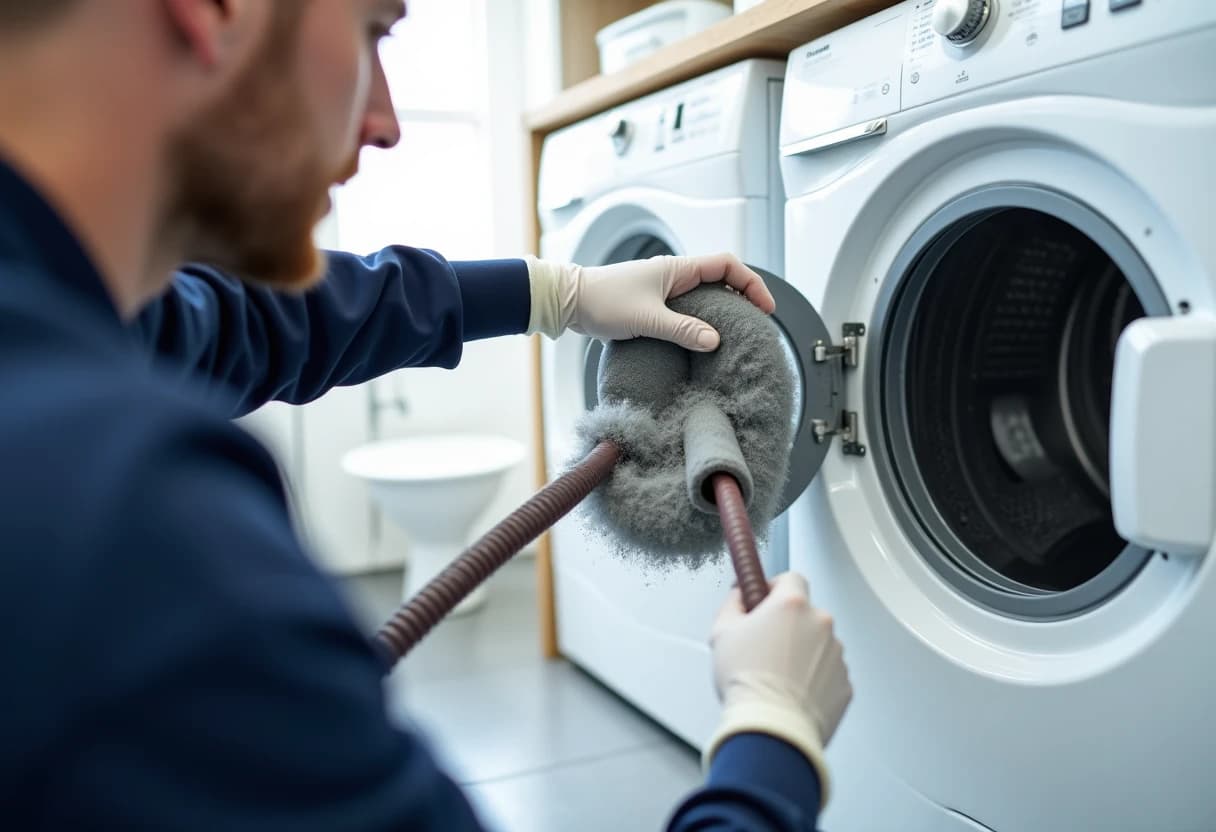
Most homeowners clean the lint screen every load and assume the job is done. But dryer manufacturers, the NFPA and the US Fire Administration all say the same thing: the vent duct itself needs professional cleaning at least once a year. Lint bypasses the screen constantly, and in Greater Boston homes — where vents commonly run twenty feet or more through basements, up wall cavities and across roofs — the accumulation happens out of sight. Our North Andover technicians use full-length rotary brushes driven through the entire run while a HEPA vacuum collects everything, then verify airflow at the termination before we leave.
Why Dryer Vent Cleaning Matters for North Andover Homes
The fire statistics on clothes dryers deserve to be taken literally. FEMA's national estimates attribute roughly 2,900 residential fires per year to clothes dryers, causing an estimated five deaths, one hundred injuries and $35 million in property loss — and the leading factor, cited in about a third of these fires, is failure to clean. The mechanism is simple: lint escapes past the screen on every cycle, accumulates in the duct, restricts airflow, and drives exhaust temperatures upward until the lint itself — which ignites easily and burns fast — meets a hot enough surface or a stray spark from the dryer's heating element. A professional cleaning breaks every link in that chain at once. It removes the fuel, restores the airflow that keeps operating temperatures in the safe range, and gives a trained technician a look at the transition duct, joints and termination where problems concentrate. For $149 to $299, it is the cheapest fire prevention a homeowner can buy, and it pays part of itself back in energy savings immediately.
North Andover homeowners tend to discover their dryer vent problem in winter, when a marginal vent finally fails: cold-stiffened exterior dampers stick, moist exhaust meets freezing duct sections and condenses into lint cement, and holiday laundry loads push the system past its limit. North Andover ranges from the antique homes ringing the Old Center common and the mill-worker housing of Machine Shop Village to sprawling 1990s and 2000s Colonials in the hills near Lake Cochichewick. The converted mill buildings downtown now hold condos with shared mechanical systems, while the newer estates run multiple forced-air zones with long attic and basement duct runs. Older village homes often hide retrofit ductwork behind original plaster. North Andover's mill-to-condo conversions come with decades-old shared duct chases that few owners have ever seen inside, and we regularly find original construction debris still sitting in them. Out by Lake Cochichewick, wooded lots deliver heavy pollen seasons that load up returns and filters fast. We keep winter availability across Essex County precisely because blocked-vent calls spike from December through February. Booking a fall cleaning is the smarter move — but whenever you call, our North Andover route coverage means fast scheduling and a flat price that includes the full run, elbows, and the exterior termination.
Our Dryer Vent Cleaning Process in North Andover
1Inspect the Dryer, Transition Duct & Vent Path
First we establish what we are cleaning: duct material, run length, number of bends, and termination type. We also measure baseline airflow at the exterior hood with the dryer running. That number matters — it is how we prove, at the end of the visit, that the cleaning actually restored the exhaust capacity your dryer needs.
2Protect the Laundry Area & Disconnect the Dryer
Before cleaning starts, we lay floor protection, carefully slide the dryer out without scarring floors, and disconnect the transition duct. Gas dryers are handled with proper care around the flexible gas connector — we never strain it. With the duct open at the appliance end, we have the access needed to clean the entire run.
3Rotary Brush the Full Length of the Duct
We feed flexible rotary rods through the duct, adding sections until the brush has traveled the complete run from the dryer connection to the exterior hood. The rotating head dislodges packed lint, bird nesting material and debris from every interior surface, including the elbow throats where lint mats form first. Nothing is bypassed; the brush touches every foot of the line.
4Capture Everything With HEPA Vacuum Extraction
Loosened lint has to go somewhere, and we make sure that somewhere is our vacuum. HEPA filtration captures the fine fiber dust that ordinary shop vacs exhaust straight back into the air — important in tight laundry areas and essential for allergy-sensitive households. Most cleanings fill a startling bag; we are happy to show you the haul.
5Clean From the Exterior Termination Inward
Cleaning from both ends is non-negotiable on longer runs. The last few feet before the termination, and the hood itself, accumulate the densest lint — it is where moist exhaust meets cold outdoor air and fibers mat together. We open the hood, clear the damper, remove nesting if present, and brush the final duct section back toward the vacuum.
6Service the Transition Duct & Reconnect
Reassembly is done to code and to the appliance manual: UL-listed transition duct, proper clamps, no more than the listed connector length, and the dryer set far enough from the wall that the duct keeps its shape. We level the machine, verify the gas connection is undisturbed on gas units, and run a test cycle before calling the mechanical work done.
7Verify Airflow & Walk You Through the Results
The job ends with proof: we measure airflow at the exterior termination with the dryer running and compare it to the baseline reading from arrival. Strong, steady exhaust and a fully opening damper are the pass conditions. You get the before-and-after numbers, photos of what came out, and honest notes on the duct's condition.
Benefits of Professional Dryer Vent Cleaning in North Andover
Safer Operation for Gas Dryers
Gas dryer exhaust carries combustion byproducts, including carbon monoxide, and the vent is the only path designed to remove them. A blocked line can force those gases back into living space. Cleaning restores the engineered exhaust path — a meaningful safety margin for any home with a gas appliance and a real necessity for homes with bedrooms near the laundry.
Lower Energy Bills
Every minute of unnecessary drying time is metered energy. A restricted vent that doubles cycle times roughly doubles the dryer's share of your utility bill — often $10 to $20 a month for an average household. Annual cleaning typically pays for a large fraction of itself in the first year of restored efficiency.
Dramatically Reduced Fire Risk
After cleaning, your dryer's exhaust runs cool and free, its high-temperature safety switches stop cycling, and the duct holds no fuel load waiting for a spark. For households that run daily laundry — big families, home businesses, multi-generational homes — that risk reduction compounds with every load.
Faster Drying Times
Airflow is what dries clothes; heat just helps. Restore full exhaust capacity and loads that limped through two cycles finish in one, towels stop coming out damp at the seams, and the dryer's moisture sensors — which many modern machines rely on — start reading accurately again. Most customers notice the difference on the first load after our visit.
Documentation for Insurance, Condos & Peace of Mind
For landlords and multi-family owners, documented dryer vent service is due-diligence gold: it demonstrates fire-safety maintenance across units in a single record. We service whole buildings in one visit with per-unit documentation, which is why property managers across Greater Boston keep us on an annual rotation.
Less Moisture, Mildew & Musty Odor
Basement laundry areas in New England fight humidity even on good days; a restricted dryer vent turns them into swamp rooms. Post-cleaning, customers consistently report the laundry area feels drier, smells cleaner, and stops fogging windows and sweating pipes during dryer cycles.
Signs Your North Andover Home Needs Dryer Vent Cleaning
Clothes Take More Than One Cycle to Dry
Modern sensor-dry machines mask the problem by simply running longer, so watch total time rather than dampness. A sensor cycle that used to finish in 45 minutes and now runs 75 is reporting a restricted vent the only way it can. Believe it before the thermal fuse makes the point more expensively.
Laundry Room Gets Hot and Humid
Watch for secondary evidence: peeling paint near the dryer, mildew spots on the ceiling above it, a musty smell that lingers after laundry day, rust on shelf brackets. All are condensation footprints from exhaust escaping into the room through a restricted or leaking duct rather than exiting the house.
It Has Been More Than a Year
Households that run a load daily, dry pet bedding, or share laundry across a multi-family building accumulate lint at two to three times the average rate and should clean every six to twelve months. A quiet couple doing weekly laundry can stretch toward the annual mark, but rarely safely beyond it.
The Exterior Vent Flap Barely Opens
Step outside during a drying cycle and look at the termination hood. The damper should stand fully open with a strong, warm airstream you can feel from a foot away. A flap that flutters weakly, opens halfway or stays shut is showing you the blockage directly — the cheapest diagnostic in home maintenance.
Burning Smell During a Cycle
Never normalize a burning odor from a dryer. Investigators repeatedly find that households smelled scorching lint for weeks before an ignition. A cleaning visit resolves the source in about an hour and includes vacuuming the dryer's internal lint paths near the element — where the smell most often starts.
Lint Building Up Behind or Inside the Dryer
Lint accumulating behind the machine, around the transition hose or under the dryer means the exhaust path is leaking or backing up — lint should travel out, not settle in. It is both a symptom of restriction and a hazard in itself, since this lint sits nearest the heat source. A cleaning addresses the cause and clears the accumulation.
Dryer Vent Cleaning Cost in North Andover, MA
For budgeting across property types: single-family homes run $149 to $299 as described; condos are usually $149 to $199 unless the unit vents to the roof; and multi-family buildings get per-unit rates that drop meaningfully when we clean all units in one visit — the arrangement most triple-decker owners and condo associations choose, both for cost and for the single insurance-ready service record covering the building. Commercial laundry and shared-venting systems are quoted after a walkthrough. Frequency matters to lifetime cost too: an annual cleaning is quick and inexpensive because accumulation is light, while a vent neglected for five years often needs blockage-level work at the top of the range, and sometimes reveals damage requiring repair. The cheapest way to own a dryer vent, year over year, is to clean it on schedule — which is why we log your service date and send a reminder when the next one is due.
Want the full pricing picture? See our complete Boston-area cost guide or call (617) 390-7145 for an exact flat quote for your North Andover home.
Local Knowledge: North Andover, Essex County
What makes North Andover different? North Andover ranges from the antique homes ringing the Old Center common and the mill-worker housing of Machine Shop Village to sprawling 1990s and 2000s Colonials in the hills near Lake Cochichewick. The converted mill buildings downtown now hold condos with shared mechanical systems, while the newer estates run multiple forced-air zones with long attic and basement duct runs. Older village homes often hide retrofit ductwork behind original plaster. North Andover's mill-to-condo conversions come with decades-old shared duct chases that few owners have ever seen inside, and we regularly find original construction debris still sitting in them. Out by Lake Cochichewick, wooded lots deliver heavy pollen seasons that load up returns and filters fast. For duct and dryer vent systems, those local factors translate into specific, predictable problems — and predictable problems are the ones we solve fastest. Call (617) 390-7145, tell us your street and home style, and we will quote the job accurately the first time, usually in under five minutes.
The Best Time of Year in North Andover
Think of the laundry calendar itself: spring brings pollen-heavy loads and washed winter bedding; summer adds beach towels and daily shirt changes through humid stretches; fall means sweaters, blankets and back-to-school volume; winter piles on the heaviest fabrics of the year while the vent works at its coldest. A Massachusetts dryer rarely gets an off-season — which is why the annual cleaning interval is a floor, not a ceiling, for busy households here. Families running daily loads, multi-family buildings with shared laundry patterns, and anyone drying pet bedding through shedding seasons should consider a six-to-nine-month schedule. We track your interval and remind you, so the vent stays ahead of the laundry rather than behind it.
Why Choose Boston Air Duct Cleaners
Choosing a duct cleaner is really a trust decision — you are letting a crew work inside the system that feeds air to your family. We make that decision easy: a local West Newton company with insured, uniformed technicians, transparent flat-rate quotes, NADCA-standard equipment and methods, and photographic proof of the finished work. No door-to-door sales, no bait-and-switch coupons, no invented 'mold emergencies.' Just honest mechanical cleaning done properly the first time, backed by a written guarantee.
Serving North Andover and Surrounding Communities
Beyond North Andover, our crews cover the surrounding communities daily — including Andover, Lawrence, Methuen, Middleton, North Reading, Georgetown. Because routes cluster geographically, booking alongside a neighboring appointment often unlocks same-day service and combined-visit savings. Wherever you are in Essex County, the same flat-rate pricing, insured technicians and photo-documented process applies.