
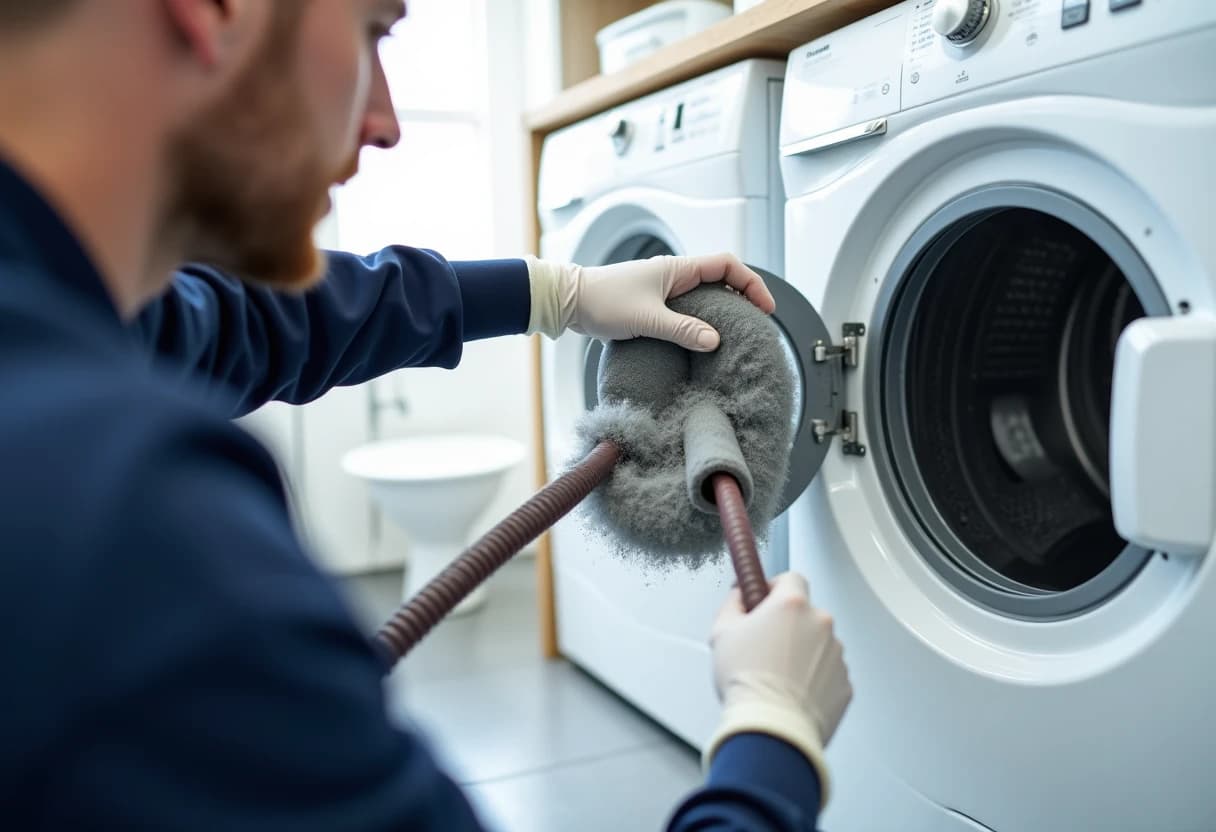
Most homeowners clean the lint screen every load and assume the job is done. But dryer manufacturers, the NFPA and the US Fire Administration all say the same thing: the vent duct itself needs professional cleaning at least once a year. Lint bypasses the screen constantly, and in Greater Boston homes — where vents commonly run twenty feet or more through basements, up wall cavities and across roofs — the accumulation happens out of sight. Our Essex technicians use full-length rotary brushes driven through the entire run while a HEPA vacuum collects everything, then verify airflow at the termination before we leave.
Why Dryer Vent Cleaning Matters for Essex Homes
The fire statistics on clothes dryers deserve to be taken literally. FEMA's national estimates attribute roughly 2,900 residential fires per year to clothes dryers, causing an estimated five deaths, one hundred injuries and $35 million in property loss — and the leading factor, cited in about a third of these fires, is failure to clean. The mechanism is simple: lint escapes past the screen on every cycle, accumulates in the duct, restricts airflow, and drives exhaust temperatures upward until the lint itself — which ignites easily and burns fast — meets a hot enough surface or a stray spark from the dryer's heating element. A professional cleaning breaks every link in that chain at once. It removes the fuel, restores the airflow that keeps operating temperatures in the safe range, and gives a trained technician a look at the transition duct, joints and termination where problems concentrate. For $149 to $299, it is the cheapest fire prevention a homeowner can buy, and it pays part of itself back in energy savings immediately.
In Essex's older housing stock, we regularly find dryer vents that violate every modern guideline — vinyl flex duct sagging through a basement, screws catching lint at every joint, runs far past the 35-foot code maximum. Essex is a compact shipbuilding town whose Main Street is lined with 18th- and 19th-century capes and shipwright's colonials, joined by summer cottages at Conomo Point and a modest number of newer homes on the wooded uplands. Central air is usually a retrofit here, squeezed into low-ceilinged antique frames with short basement or attic duct runs. These systems clog two or three times faster than a code-compliant rigid duct, which makes annual cleaning genuinely important rather than merely advisable. The Essex River's vast salt marsh wraps the town in briny, humid air that corrodes vent hoods and keeps antique basements damp, so we inspect coastal homes' ductwork for rust and microbial growth as a matter of course. The famous clam-shack and restaurant strip along Route 133 also brings us regular commercial kitchen ventilation work. We clean what is there, document what we find with photos, and tell you honestly whether the duct itself needs repair or replacement — a judgment call our crews make in Essex homes every week.
Our Dryer Vent Cleaning Process in Essex
1Inspect the Dryer, Transition Duct & Vent Path
First we establish what we are cleaning: duct material, run length, number of bends, and termination type. We also measure baseline airflow at the exterior hood with the dryer running. That number matters — it is how we prove, at the end of the visit, that the cleaning actually restored the exhaust capacity your dryer needs.
2Protect the Laundry Area & Disconnect the Dryer
Before cleaning starts, we lay floor protection, carefully slide the dryer out without scarring floors, and disconnect the transition duct. Gas dryers are handled with proper care around the flexible gas connector — we never strain it. With the duct open at the appliance end, we have the access needed to clean the entire run.
3Rotary Brush the Full Length of the Duct
Mechanical agitation is what separates professional cleaning from blow-through methods. The rotary brush physically breaks up compacted lint that air pressure alone would only compress further. We select brush heads sized to your duct — standard 4-inch for code-compliant lines, alternates for older oversized or reduced runs — so the bristles actually contact the duct wall the whole way.
4Capture Everything With HEPA Vacuum Extraction
Extraction runs continuously during brushing so debris moves in one controlled direction. On long or heavily blocked runs we alternate: brush a section, extract, advance. This staged approach clears even fully plugged ducts — the ones where the exterior damper has not opened in years — without compacting the blockage deeper.
5Clean From the Exterior Termination Inward
We then work the line from the outside in — wall hood, soffit outlet or roof cap. Exterior terminations trap their own debris: lint mats behind the damper, bird and rodent nests, and screening clogged solid. Roof terminations get full ladder or roof access; we carry the gear, and steep or high work is included in the quoted price.
6Service the Transition Duct & Reconnect
Before reconnecting, we vacuum the dryer's own lint trap housing and accessible internal ducting, where years of screen bypass collects near the heating element. Then the transition duct is cleaned or replaced, clamped properly — never screwed, since screw tips inside the airstream snag lint — and the dryer is positioned to leave the duct an easy, unkinked path.
7Verify Airflow & Walk You Through the Results
The job ends with proof: we measure airflow at the exterior termination with the dryer running and compare it to the baseline reading from arrival. Strong, steady exhaust and a fully opening damper are the pass conditions. You get the before-and-after numbers, photos of what came out, and honest notes on the duct's condition.
Benefits of Professional Dryer Vent Cleaning in Essex
Documentation for Insurance, Condos & Peace of Mind
Every cleaning ends with a written record: date, scope, before-and-after photos, airflow verification and condition notes. Condo associations increasingly require proof of dryer vent maintenance, some insurers ask after claims, and home buyers appreciate the paper trail. One visit satisfies all three — and tells you exactly when the next service is due.
Less Moisture, Mildew & Musty Odor
Each load exhausts about a gallon of water as vapor. When the vent is blocked, that moisture backs into the laundry room and the duct itself — condensing on walls, peeling paint, and feeding mildew. A clear vent sends the humidity outside, drying out the laundry area and eliminating the damp, musty smell that clings to blocked systems.
Dramatically Reduced Fire Risk
This is the benefit that matters most. Lint is extraordinarily flammable, and a clogged vent both supplies the fuel and creates the overheating that ignites it. Removing the accumulation removes the hazard — which is why fire departments, the NFPA and FEMA all urge annual dryer vent cleaning as basic home fire prevention.
Lower Energy Bills
Dryers are among the most energy-hungry appliances in the home, and a clogged vent makes every load cost more. Restoring design airflow means the heating element runs at intended temperatures for intended durations. The savings recur with every cycle, quietly, for as long as the vent stays clear.
Safer Operation for Gas Dryers
Massachusetts homes rely heavily on natural gas, and gas dryers are common across Greater Boston's housing stock. If yours vents through a long or aging duct, annual cleaning plus an airflow check is the standard of care fire and gas utilities recommend. It takes an hour and removes an entire category of risk.
Faster Drying Times
Airflow is what dries clothes; heat just helps. Restore full exhaust capacity and loads that limped through two cycles finish in one, towels stop coming out damp at the seams, and the dryer's moisture sensors — which many modern machines rely on — start reading accurately again. Most customers notice the difference on the first load after our visit.
Signs Your Essex Home Needs Dryer Vent Cleaning
Lint Building Up Behind or Inside the Dryer
Lint accumulating behind the machine, around the transition hose or under the dryer means the exhaust path is leaking or backing up — lint should travel out, not settle in. It is both a symptom of restriction and a hazard in itself, since this lint sits nearest the heat source. A cleaning addresses the cause and clears the accumulation.
It Has Been More Than a Year
New homeowners: assume the vent has never been cleaned unless the sellers documented otherwise. It is one of the most neglected systems in any real-estate transaction. A move-in cleaning costs $149 to $299, establishes your baseline, and starts the annual clock at a date you actually know.
Burning Smell During a Cycle
A hot, singed odor while the dryer runs is lint beginning to scorch — on the heating element, in the internal ducting or in the exhaust line. It is the most serious warning sign on this list. Stop the dryer, let it cool, and do not run full loads again until the vent and machine interior have been cleaned.
Dryer or Clothes Are Hot to the Touch
Excess heat is the fire chain's first visible link: restricted airflow, rising temperatures, and a duct lined with fuel. If the top of your dryer doubles as a hand warmer or the laundry room bakes during cycles, stop using the machine for long runs and have the vent cleaned promptly.
Clothes Take More Than One Cycle to Dry
Homeowners adapt to slow drying so gradually they stop noticing, until they use a laundromat or a friend's machine and remember what one-cycle drying feels like. If your definition of a drying cycle has quietly stretched past an hour, the vent is overdue for inspection and almost certainly for cleaning.
Laundry Room Gets Hot and Humid
In winter, backed-up dryer moisture migrates to the coldest nearby surfaces — window frames, exterior-wall corners, basement sills — and condenses there, feeding mold New England homes already fight. If winter condensation spikes on laundry days, your vent is contributing and a cleaning will subtract it.
Dryer Vent Cleaning Cost in Essex, MA
Expect to pay $149 to $299 for a professional cleaning in Eastern Massachusetts, with most single-family homes landing near the middle. Three questions set your exact price: Where is the dryer (first floor, basement, or interior room far from an outside wall)? Where does the vent exit (grade-level wall, high wall, soffit or roof)? And when was it last cleaned (routine maintenance versus a full blockage)? Roof terminations carry the largest premium — safe roof access takes equipment and time — and fully plugged runs take staged brushing rather than a single pass. Optional add-ons are few and honest: replacing a damaged or non-compliant transition hose runs $30 to $60 installed, and a new exterior hood, if yours is broken or screened, is quoted flat. Bundling dryer vent cleaning with air duct cleaning is our most popular package and typically saves $50 to $75 versus booking separately.
Want the full pricing picture? See our complete Boston-area cost guide or call (617) 390-7145 for an exact flat quote for your Essex home.
Local Knowledge: Essex, Essex County
What makes Essex different? Essex is a compact shipbuilding town whose Main Street is lined with 18th- and 19th-century capes and shipwright's colonials, joined by summer cottages at Conomo Point and a modest number of newer homes on the wooded uplands. Central air is usually a retrofit here, squeezed into low-ceilinged antique frames with short basement or attic duct runs. The Essex River's vast salt marsh wraps the town in briny, humid air that corrodes vent hoods and keeps antique basements damp, so we inspect coastal homes' ductwork for rust and microbial growth as a matter of course. The famous clam-shack and restaurant strip along Route 133 also brings us regular commercial kitchen ventilation work. For duct and dryer vent systems, those local factors translate into specific, predictable problems — and predictable problems are the ones we solve fastest. Call (617) 390-7145, tell us your street and home style, and we will quote the job accurately the first time, usually in under five minutes.
The Best Time of Year in Essex
Think of the laundry calendar itself: spring brings pollen-heavy loads and washed winter bedding; summer adds beach towels and daily shirt changes through humid stretches; fall means sweaters, blankets and back-to-school volume; winter piles on the heaviest fabrics of the year while the vent works at its coldest. A Massachusetts dryer rarely gets an off-season — which is why the annual cleaning interval is a floor, not a ceiling, for busy households here. Families running daily loads, multi-family buildings with shared laundry patterns, and anyone drying pet bedding through shedding seasons should consider a six-to-nine-month schedule. We track your interval and remind you, so the vent stays ahead of the laundry rather than behind it.
Why Choose Boston Air Duct Cleaners
Choosing a duct cleaner is really a trust decision — you are letting a crew work inside the system that feeds air to your family. We make that decision easy: a local West Newton company with insured, uniformed technicians, transparent flat-rate quotes, NADCA-standard equipment and methods, and photographic proof of the finished work. No door-to-door sales, no bait-and-switch coupons, no invented 'mold emergencies.' Just honest mechanical cleaning done properly the first time, backed by a written guarantee.
Serving Essex and Surrounding Communities
We serve every community around Essex as well: Gloucester, Ipswich, Manchester-by-the-Sea, Hamilton, Wenham, Rowley all fall inside our regular service routes. If you have a second property, a rental, or family nearby, ask about multi-home scheduling — grouped appointments on the same route are our most requested discount.