
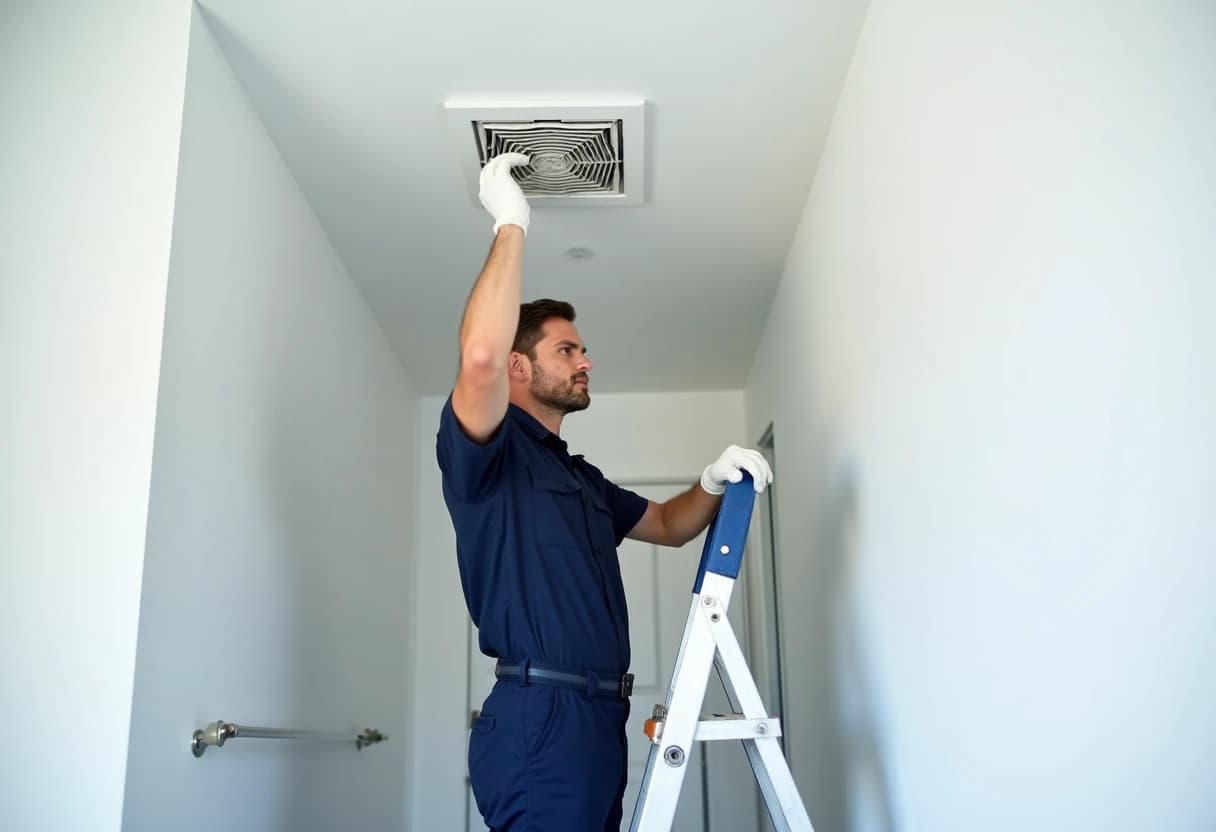
Your bathroom exhaust fan has one job: move moist air out of the house before it condenses into mold, peeling paint and rotting trim. Most fans in Greater Boston homes have not been able to do that job properly in years — the grille is furred with dust, the blades are caked, the motor is straining, and the duct to the roof or soffit is narrowed with lint-like buildup. Our cleaning service restores the whole system: grille degreased and washed, fan blades and motor housing cleaned, the complete duct run cleaned to its termination, and airflow verified before we leave. Most bathrooms take under an hour, and the difference — in noise, in mirror fog, in how fast the room dries — is immediate.
That gray fuzz on your bathroom fan grille is the visible edge of a system-wide problem. Behind the grille, the same humid-air dust has coated the fan blades, packed the motor housing, and lined the duct that carries moisture to the outdoors — and every layer steals airflow. In New England's long heating season, weak bathroom exhaust also means condensation: moist air lingering in cold duct runs through attics, dripping back onto the ceiling, staining drywall and, in the worst cases, soaking attic insulation. Our Greater Boston crews clean and verify the full exhaust path, and we regularly pair the service with air duct or dryer vent visits — same trip, bundled pricing, every exhaust system in the house handled at once.
Why Bathroom Exhaust Fan Cleaning Matters
Bathroom exhaust fans fail slowly and invisibly, and the consequences land on the house rather than the fan. The physics are simple: a typical bathroom needs its air replaced several times over during and after a shower, and a fan choked with dust cannot do it. The moisture that should have been exhausted instead condenses on the coldest surfaces available — mirrors first, then ceilings, window frames and grout lines, and eventually surfaces inside the walls and attic where nobody sees the damage until it is expensive. The EPA's core guidance on residential mold control is moisture control, and in bathrooms that means working ventilation above all else. Cleaning is what keeps ventilation working. Dust that accumulates on grilles, blades and duct walls in a humid environment does not sit loosely the way dry household dust does; it bonds into a dense felt that narrows the air path and unbalances the fan. A thorough cleaning of the full system — not just a vacuumed grille — routinely doubles or triples delivered airflow, which is the difference between a bathroom that dries in twenty minutes and one that stays damp for hours.
The part of the system nobody thinks about is the duct — and in Greater Boston housing, the duct is usually the biggest problem. Bathroom fans here typically exhaust through a run of flexible or rigid duct crossing an unconditioned attic to a roof cap, or snaking through framing to a soffit or gable termination. Those runs accumulate the same humid-air felt as the fan, and they add failure modes of their own: sagging flex duct that collects condensation in its low spots, terminations whose dampers stick shut or whose screens mat over with lint and dust, and disconnected joints quietly dumping shower moisture straight into the attic insulation. That last one is the silent disaster — a bathroom fan venting into the attic saturates insulation, breeds mold on roof sheathing, and in winter contributes to the frost-and-ice-dam cycle New England roofs suffer. Our cleaning covers the complete path and inspects it as we go, so a hidden disconnection or an attic-venting fan gets caught and flagged instead of festering for another decade.
How Our Bathroom Exhaust Fan Cleaning Process Works
1Airflow Test & System Assessment
We start by measuring what the fan actually moves — the tissue test at minimum, an anemometer reading when precision helps — and by asking about symptoms: fog that lingers, ceiling spots, noise, odors. The before-reading gives us a baseline, and your answers usually predict what the duct will show.
2Protect the Bathroom & Drop the Grille
Bathrooms are finished spaces, so we treat them that way: drop cloth below the fan, fixtures covered, careful hands on grilles that may not have moved in decades. The grille comes down for a full wash — soaking and scrubbing away the bonded dust fur that no in-place vacuuming can remove.
3Clean the Fan Blades, Motor & Housing
With the housing open, we clean what actually moves the air: blades or blower wheel cleared of their bonded buildup, motor exterior and mounts cleaned, and the housing interior vacuumed and wiped. An unbalanced, dust-loaded wheel is why old fans rattle — cleaned and rebalanced, most run noticeably quieter immediately.
4Clean the Full Duct Run
From the fan housing, we clean the duct itself — brush and vacuum for rigid runs, gentler methods for flexible duct that tears easily — working toward the termination. This is where most of the lost airflow lives: years of humid-air dust lining every inch of a duct only a few inches across.
5Check the Roof or Soffit Termination
Every bathroom duct ends somewhere — a roof cap, a soffit vent, a wall hood — and that termination is a common failure point. We verify the damper opens freely and closes fully, clear any matted screen or debris, and confirm exhaust actually exits the building rather than dead-ending in the attic.
6Verify Airflow & Reassemble
With the path clean, we run the fan and measure again. The after-reading gets compared to the baseline — improvements of two to three times are routine on neglected systems. The washed grille goes back up, the work area is cleaned, and the bathroom is back in service immediately.
7Report, Recommendations & Maintenance Notes
You get a plain summary of what we found and did: before-and-after airflow, condition of the fan and duct, photos of anything notable, and honest recommendations — which for most customers is simply 'repeat in two to three years.' Fans nearing end of life or ducts needing repair get flat-rate quotes, never surprise add-ons.
Benefits You Can Expect
Mold Prevention at the Source
Bathroom mold is a moisture symptom, and moisture is an airflow symptom. A cleaned, verified exhaust system removes shower humidity before it can condense on ceilings, grout and window frames — cutting off the water supply mold depends on. It is the fix that makes the scrubbing finally stick.
A Bathroom That Actually Dries
The everyday difference is immediate and obvious: mirrors clear while you are still in the room, towels dry between uses instead of souring, and that lingering post-shower dampness disappears. A bathroom that dries fast is more pleasant every single day — and far cheaper to maintain over the years.
A Quieter, Longer-Lived Fan
The rattle and drone of an old bathroom fan is usually dirt, not age: dust-loaded blades run out of balance, and buildup around the motor makes it labor. Cleaned and rebalanced, most fans run dramatically quieter — customers regularly assume we replaced the unit.
Protection for the Attic & Structure
The exhaust duct's hidden failures — sagging runs, separated joints, terminations that never worked — send shower moisture into attics and wall cavities, where it wets insulation, breeds mold on sheathing and feeds winter ice-dam cycles. Our full-path cleaning finds and flags these problems before they become structural bills.
Lower Whole-Home Humidity
Bathrooms are the largest humidity source in most homes, and a failed fan shares that humidity with every adjacent room. Restoring exhaust performance measurably lowers whole-home moisture — less window condensation in winter, less summer mugginess, less work for dehumidifiers and air conditioners alike.
Fresher Air & Odor Control
Odor removal is the fan's second job, and a choked fan fails at it just as thoroughly. Restored airflow clears the room in minutes instead of lingering half the morning — a small daily quality-of-life upgrade every member of the household notices immediately.
Cheap Insurance Bundled Conveniently
At $99–$199 per bathroom — less when bundled with air duct or dryer vent service — this is among the least expensive preventive services in home maintenance, weighed against what chronic bathroom moisture costs: remediation, repainting, regrouting, fan replacement, attic repairs. The economics are not close.
Warning Signs to Watch For
The Tissue Test Fails
Hold a single square of toilet paper against the running fan's grille: a healthy fan pins it firmly in place; a failing fan lets it fall. It is the simplest diagnostic in home maintenance, takes ten seconds, and if your fan fails it, the exhaust path needs cleaning.
Mirrors Stay Fogged Long After Showers
A working exhaust fan should clear mirror fog within minutes of shower's end. Fog that lingers a half hour is humidity with nowhere to go — the fan is running but not exhausting, which is the signature of a blocked duct or a dust-choked fan assembly.
Mold Keeps Returning on Ceiling or Grout
Scrub-recur, scrub-recur: when the same speckling returns to the same spots every few weeks, the bathroom's moisture budget is broken, and the fan system is almost always why. Cleaning restores the airflow that keeps surfaces below the moisture threshold mold needs.
The Fan Has Grown Loud, Rattly or Labored
Fans do not naturally get louder with age — they get louder with dirt. Dust bonds unevenly to blades, unbalancing the wheel; buildup around the motor makes it labor. The rattle, hum or grind you have learned to ignore is the sound of a system asking to be cleaned.
Visible Dust Fur on the Grille
The grille is the system's tell: gray fuzz on the louvers means the fan has been straining humid air through accumulating dust for years, and the buildup you can see continues into the blades, housing and duct you cannot. A furred grille has never once meant a clean duct behind it.
Musty Smells When the Fan Runs
A fan that makes the bathroom smell worse is contaminating rather than ventilating: the damp felt on its blades and housing hosts microbial growth, and running the fan aerosolizes it. Cleaning removes the growth medium — the smell leaves with the dirt.
Ceiling Stains or Winter Drips Around the Fan
Brown rings around a bathroom fan are usually condensation, not roof leaks: humid air cooling in a dirty, restricted duct condenses and drips back through the housing. Restoring brisk airflow lets exhaust clear the duct before condensing — which is why cleaning, not roofing, fixes most of these stains.
Bathroom Exhaust Fan Cleaning Cost in the Boston Area
Bathroom exhaust fan cleaning in Greater Boston runs $99 to $199 per fan as a standalone visit, with the price driven by access and duct complexity rather than the fan itself. A first-floor fan with a short, reachable duct run sits at the low end; a top-floor fan ducted across an attic to a roof cap — requiring attic access or ladder work at the termination — sits at the top. Every visit includes the full scope: grille removal and washing, fan blade and motor housing cleaning, cleaning of the complete duct run, termination and damper check, and before-and-after airflow verification. Multiple fans in the same home are discounted steeply — the second and third bathrooms typically add $59–$89 each, since setup and travel are already covered. The most economical booking of all is the bundle: added to an air duct or dryer vent appointment, bathroom fans slot in at reduced per-fan rates because the crew and equipment are already on site. Ask about the combined price when you book; most customers find the bundle makes cleaning every fan in the house an easy decision.
Three factors set your exact price. First, termination type: soffit and wall terminations are quick to access and verify; roof caps require ladder or roof work that adds cost, especially on steep New England rooflines. Second, duct length and material: a four-foot rigid run cleans quickly, while twenty feet of aging flex duct across an attic takes time and care — flexible duct tears if cleaned aggressively, so it is slower by necessity. Third, fan condition: a unit serviced within recent memory cleans faster than one untouched since installation, where bonded buildup needs soaking and hand work. What does not change the price: surprises we find along the way. Discovered problems — disconnected joints, failed dampers, fans venting into the attic — get photographed and quoted separately as flat-rate repairs, never folded into the cleaning bill or performed without approval. And if a fan proves to be at genuine end of life, we say so plainly; charging full cleaning price for a motor with months to live helps nobody, and we would rather quote the replacement honestly.
Seasonal Considerations in New England
Fall is the strategic season for bathroom fan cleaning in New England, for the same reason it is furnace season: the system is about to face its hardest months. From November through April, every shower sends humid air into ducts crossing freezing attics, and only brisk airflow clears the run before condensation forms. A fan cleaned in October enters winter at full capacity — mirrors clear, ceilings dry, ducts moving air fast enough to beat the dew point. A dirty fan enters the same winter already losing the race, and the losses compound: condensate wets the duct's dust lining, the wet lining blocks more flow, and by February the bathroom is growing its annual crop of ceiling spots.
Why Boston Air Duct Cleaners
As a West Newton-based company, we treat Greater Boston like the neighborhood it is — because for us, it is. Our reputation lives or dies on local referrals, so every job gets the full process: complete system cleaning under negative pressure, mechanical agitation of every run, blower compartment service, and a documented walkthrough before we leave. We are licensed and insured, our estimates are free and flat, and our schedule holds same-day slots for urgent calls. One visit and you will understand why neighbors keep our magnet on the fridge.