
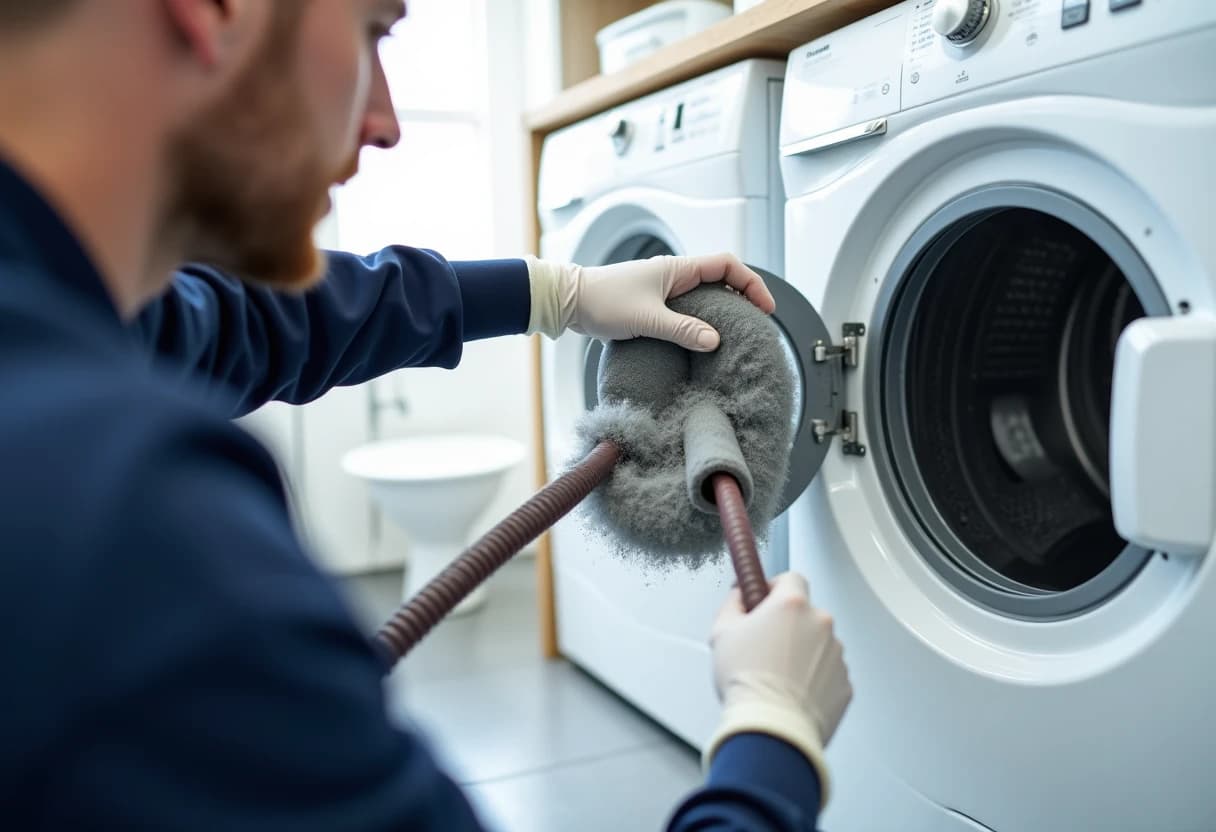
That burning smell during a drying cycle, the laundry room that turns into a sauna, the clothes that come out damp after a full hour — these are all symptoms of one problem: a dryer vent choked with lint. Beyond the inconvenience, a blocked vent forces exhaust temperatures up and gives the resulting heat a duct full of fuel. We provide professional dryer vent cleaning throughout Everett using the same source-removal principle as our duct cleaning: mechanical agitation with rotating brushes, simultaneous HEPA vacuum capture, and cleaning from both ends of the run. Most appointments take under ninety minutes, and the improvement is obvious on the very next load.
Why Dryer Vent Cleaning Matters for Everett Homes
There are moments when dryer vent cleaning becomes urgent rather than routine. If you have just bought a home, you inherit a vent with an unknown history — quite possibly never cleaned since installation, and in older Massachusetts homes possibly lined with decades of lint. If your dryer is new, manufacturers require a clear vent for warranty coverage, and installers rarely clean the existing duct. If your vent terminates on the roof, wildlife may have added a nest to the lint; bird and rodent nesting in dryer terminations is one of the most common blockages we clear. And if you have ever smelled something burning during a cycle or had a load come out hot but wet, the vent needs attention now, not at the next convenient interval. In every one of these situations, a single professional cleaning re-establishes a known-clean baseline — after which an annual schedule keeps it that way for a modest, predictable cost.
From the multi-family blocks near Village district breweries to the single-families out toward Encore Boston Harbor, Everett laundry setups share a common risk profile: dryers pushed far from exterior walls, vents extended during renovations, and terminations no one has looked at in years. Everett is wall-to-wall early-1900s triple-deckers and two-families on narrow lots, now punctuated by large new apartment buildings rising along lower Broadway and the Mystic waterfront near Encore. Unit-by-unit heating conversions are the norm in the older multifamilies, producing stacked, mismatched duct systems of very different ages inside a single building. That combination is how lint blockages build unnoticed. Everett's industrial waterfront past and its position beside Route 16 and Route 99 traffic mean fine soot accumulates quickly in duct systems here. Landlords with multiple triple-decker units are among our steadiest Everett customers, often booking all floors of a building in one visit. Because our shop is in West Newton, about 12 miles away, we can usually offer Everett same-week appointments — and because we clean from both the appliance side and the exterior hood, blockages at either end of the run are fully removed, not pushed deeper.
Our Dryer Vent Cleaning Process in Everett
1Inspect the Dryer, Transition Duct & Vent Path
First we establish what we are cleaning: duct material, run length, number of bends, and termination type. We also measure baseline airflow at the exterior hood with the dryer running. That number matters — it is how we prove, at the end of the visit, that the cleaning actually restored the exhaust capacity your dryer needs.
2Protect the Laundry Area & Disconnect the Dryer
The dryer comes away from the wall and off the duct so we can clean the whole line, not just what a stub brush reaches. This is also when hidden problems surface: lint packed behind the machine, transition hoses crushed flat by the dryer being pushed back too far, and disconnected joints quietly venting into the wall.
3Rotary Brush the Full Length of the Duct
Our core cleaning tool is a motor-driven rotary brush on flexible rods, fed through the entire duct run. The spinning brush head scrubs lint off the duct walls through every elbow and vertical section, in runs up to 35 feet and beyond. Unlike hand brushes, it maintains full scrubbing force at the far end of the line — where the worst accumulation usually hides.
4Capture Everything With HEPA Vacuum Extraction
As the brush works, a HEPA-filtered vacuum runs simultaneously on the duct, pulling loosened lint into a sealed collection system instead of letting it blow into your laundry room or yard. The combination — agitate and extract at once — is what leaves the duct genuinely empty rather than redistributing the clog.
5Clean From the Exterior Termination Inward
Cleaning from both ends is non-negotiable on longer runs. The last few feet before the termination, and the hood itself, accumulate the densest lint — it is where moist exhaust meets cold outdoor air and fibers mat together. We open the hood, clear the damper, remove nesting if present, and brush the final duct section back toward the vacuum.
6Service the Transition Duct & Reconnect
The short duct connecting dryer to wall does more harm than its length suggests — crushed, kinked or made of plastic, it can choke an otherwise clean system. We clean it, or if it is damaged or made of hazardous foil or vinyl accordion material, we recommend replacement with a semi-rigid aluminum connector, usually installed on the spot for a small parts charge.
7Verify Airflow & Walk You Through the Results
Final checks: test cycle run, exhaust verified at the hood, laundry area vacuumed and everything returned to place. If we found issues cleaning cannot fix — overlong runs, crushed sections, illegal materials — you get straight documentation and a separate quote, never pressure. Most vents simply need this cleaning, once a year, and nothing more.
Benefits of Professional Dryer Vent Cleaning in Everett
Less Moisture, Mildew & Musty Odor
Basement laundry areas in New England fight humidity even on good days; a restricted dryer vent turns them into swamp rooms. Post-cleaning, customers consistently report the laundry area feels drier, smells cleaner, and stops fogging windows and sweating pipes during dryer cycles.
Faster Drying Times
Airflow is what dries clothes; heat just helps. Restore full exhaust capacity and loads that limped through two cycles finish in one, towels stop coming out damp at the seams, and the dryer's moisture sensors — which many modern machines rely on — start reading accurately again. Most customers notice the difference on the first load after our visit.
Lower Energy Bills
Dryers are among the most energy-hungry appliances in the home, and a clogged vent makes every load cost more. Restoring design airflow means the heating element runs at intended temperatures for intended durations. The savings recur with every cycle, quietly, for as long as the vent stays clear.
Longer Dryer Lifespan & Fewer Repairs
New dryers deserve clean vents from day one — manufacturers require adequate exhaust airflow for warranty coverage, and delivery crews almost never clean the existing duct. If you have recently replaced your dryer and skipped the vent, you have connected a new engine to a clogged tailpipe.
Safer Operation for Gas Dryers
Massachusetts homes rely heavily on natural gas, and gas dryers are common across Greater Boston's housing stock. If yours vents through a long or aging duct, annual cleaning plus an airflow check is the standard of care fire and gas utilities recommend. It takes an hour and removes an entire category of risk.
Dramatically Reduced Fire Risk
After cleaning, your dryer's exhaust runs cool and free, its high-temperature safety switches stop cycling, and the duct holds no fuel load waiting for a spark. For households that run daily laundry — big families, home businesses, multi-generational homes — that risk reduction compounds with every load.
Signs Your Everett Home Needs Dryer Vent Cleaning
Burning Smell During a Cycle
That 'hot lint' smell is exactly what it seems: fibers reaching their scorching point somewhere in the airflow path. Sometimes it is a sock against the element; usually it is accumulation. Either way, the difference between a smell and a fire can be one overloaded cycle. We prioritize these calls for same-week service.
Dryer or Clothes Are Hot to the Touch
Some heat is normal; radiating heat is not. When the exhaust cannot escape, the drum, cabinet and surrounding wall absorb it instead. Homes where we measure the highest cabinet temperatures reliably produce the fullest lint bags — the correlation between heat and blockage is nearly one to one.
It Has Been More Than a Year
Households that run a load daily, dry pet bedding, or share laundry across a multi-family building accumulate lint at two to three times the average rate and should clean every six to twelve months. A quiet couple doing weekly laundry can stretch toward the annual mark, but rarely safely beyond it.
Lint Building Up Behind or Inside the Dryer
Check your lint screen pattern too: if the screen suddenly catches less than usual, lint is bypassing it into the machine and duct — often because backpressure from a blocked vent is redirecting airflow. Less lint on the screen frequently means more in the duct, not cleaner laundry.
The Exterior Vent Flap Barely Opens
Step outside during a drying cycle and look at the termination hood. The damper should stand fully open with a strong, warm airstream you can feel from a foot away. A flap that flutters weakly, opens halfway or stays shut is showing you the blockage directly — the cheapest diagnostic in home maintenance.
Laundry Room Gets Hot and Humid
In winter, backed-up dryer moisture migrates to the coldest nearby surfaces — window frames, exterior-wall corners, basement sills — and condenses there, feeding mold New England homes already fight. If winter condensation spikes on laundry days, your vent is contributing and a cleaning will subtract it.
Dryer Vent Cleaning Cost in Everett, MA
For budgeting across property types: single-family homes run $149 to $299 as described; condos are usually $149 to $199 unless the unit vents to the roof; and multi-family buildings get per-unit rates that drop meaningfully when we clean all units in one visit — the arrangement most triple-decker owners and condo associations choose, both for cost and for the single insurance-ready service record covering the building. Commercial laundry and shared-venting systems are quoted after a walkthrough. Frequency matters to lifetime cost too: an annual cleaning is quick and inexpensive because accumulation is light, while a vent neglected for five years often needs blockage-level work at the top of the range, and sometimes reveals damage requiring repair. The cheapest way to own a dryer vent, year over year, is to clean it on schedule — which is why we log your service date and send a reminder when the next one is due.
Want the full pricing picture? See our complete Boston-area cost guide or call (617) 390-7145 for an exact flat quote for your Everett home.
Local Knowledge: Everett, Middlesex County
What makes Everett different? Everett is wall-to-wall early-1900s triple-deckers and two-families on narrow lots, now punctuated by large new apartment buildings rising along lower Broadway and the Mystic waterfront near Encore. Unit-by-unit heating conversions are the norm in the older multifamilies, producing stacked, mismatched duct systems of very different ages inside a single building. Everett's industrial waterfront past and its position beside Route 16 and Route 99 traffic mean fine soot accumulates quickly in duct systems here. Landlords with multiple triple-decker units are among our steadiest Everett customers, often booking all floors of a building in one visit. For duct and dryer vent systems, those local factors translate into specific, predictable problems — and predictable problems are the ones we solve fastest. Call (617) 390-7145, tell us your street and home style, and we will quote the job accurately the first time, usually in under five minutes.
The Best Time of Year in Everett
Winter is when Greater Boston dryer vents fail. Cold stiffens exterior damper flaps, snow drifts block grade-level hoods, and warm moist exhaust hitting a freezing duct section condenses — turning loose lint into dense, damp mats that can plug a marginal vent in weeks. Meanwhile laundry loads peak: heavy sweaters, extra blankets, snow-soaked layers. It is no coincidence that dryer fires are most frequent in winter, with January the peak month in federal fire data. The smart schedule is a fall cleaning — clear the system before the heavy season — but if winter has already exposed a problem, we keep cold-month availability across Middlesex County precisely because these calls cannot wait.
Why Choose Boston Air Duct Cleaners
Boston Air Duct Cleaners is a local, owner-operated company based at 1121 Washington St in West Newton — not a national franchise dispatching subcontractors. Every crew is our own: background-checked, factory-trained on commercial negative-pressure equipment, and fully insured. We quote flat prices before work begins, document every job with before-and-after photos, and follow NADCA-standard source-removal methods on every system we touch. That is why so much of our work comes from repeat customers, property managers and word-of-mouth referrals across Middlesex County.
Serving Everett and Surrounding Communities
We serve every community around Everett as well: Chelsea, Malden, Medford, Somerville, Revere, Charlestown all fall inside our regular service routes. If you have a second property, a rental, or family nearby, ask about multi-home scheduling — grouped appointments on the same route are our most requested discount.