
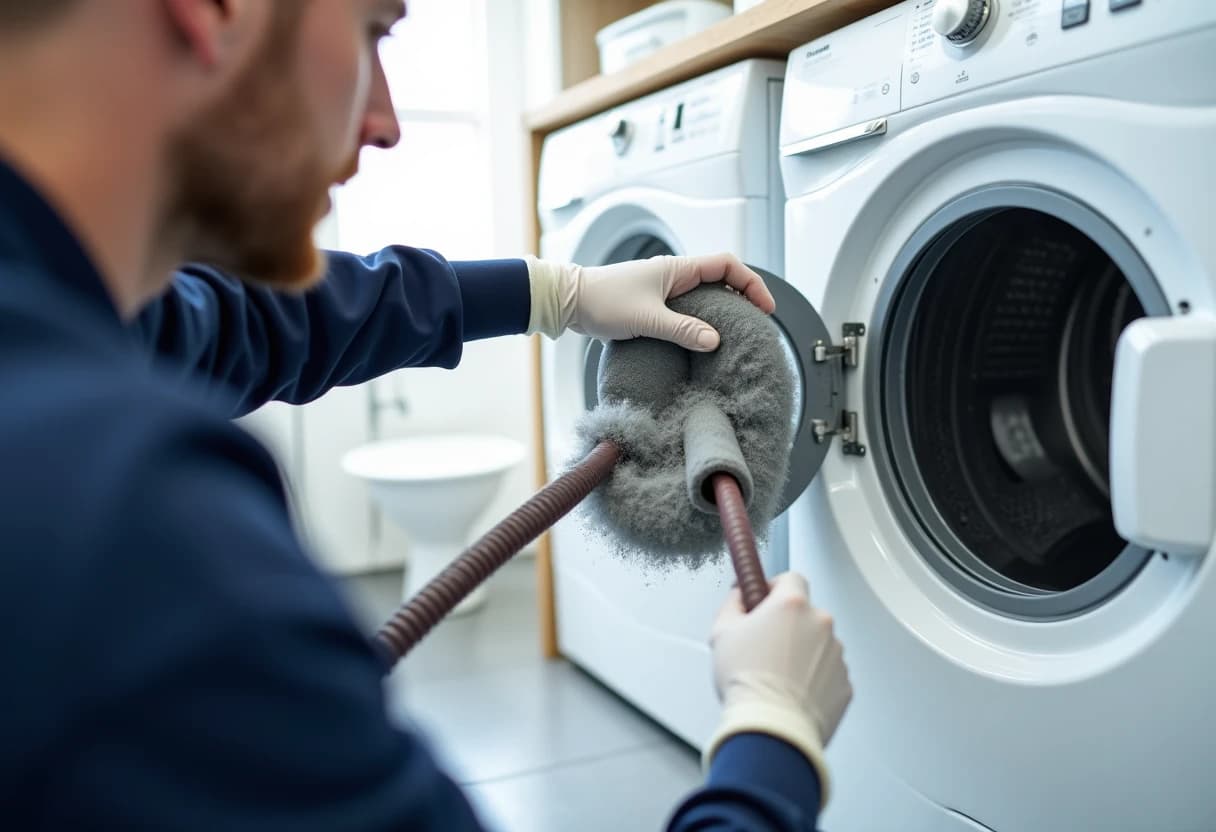
Most homeowners clean the lint screen every load and assume the job is done. But dryer manufacturers, the NFPA and the US Fire Administration all say the same thing: the vent duct itself needs professional cleaning at least once a year. Lint bypasses the screen constantly, and in Greater Boston homes — where vents commonly run twenty feet or more through basements, up wall cavities and across roofs — the accumulation happens out of sight. Our Wellesley technicians use full-length rotary brushes driven through the entire run while a HEPA vacuum collects everything, then verify airflow at the termination before we leave.
Why Dryer Vent Cleaning Matters for Wellesley Homes
Some homeowners ask whether they can just clean the vent themselves with a leaf blower or a hardware-store brush kit — and for a short, straight, first-floor vent, a diligent DIY cleaning is better than nothing. The trouble is that most Greater Boston vents are not short or straight. Runs from basement or interior laundry rooms commonly stretch 15 to 35 feet with three or four elbows, and consumer brush kits lose effectiveness with every bend, often compacting lint into a plug instead of removing it. Leaf blowers can blow a soft clog into a dense one, or blow the exterior damper shut. Professional equipment is different in kind: motor-driven rotary brushes that maintain scrubbing force through every elbow, HEPA vacuums that capture lint at the same time, inspection of the transition duct and termination, and an airflow measurement that verifies the result. We also spot the problems a brush cannot fix — crushed duct, disconnected joints, illegal flex materials — before they turn a maintenance visit into an emergency.
Condo and multi-family living around Lake Waban adds its own dryer vent challenges: shared walls that force long horizontal runs, roof terminations three stories up, and condo associations that require insured, documented service. Wellesley's streets mix stately 1900-1940 colonials, Tudors and shingle-style homes with a relentless teardown-and-rebuild market that has filled the town with large new construction carrying two- and three-zone ducted systems. Even the surviving older homes have usually been gut-renovated at least once, often with ducted central air added into radiator-era floor plans. We handle all of it — our Wellesley crews carry roof access equipment, provide certificates of insurance on request, and leave written service records that satisfy association and insurance requirements. Wellesley is one of our busiest post-renovation markets - nearly every street has an active rebuild, and construction dust migrates into the systems of neighboring homes as well as the new builds themselves. The large multi-zone systems common here also mean long runs and multiple air handlers in attics and basements, each of which needs attention for the house to breathe evenly. For triple-deckers and converted multi-families, we can clean all units' vents in one visit at bundled pricing, which is the most cost-effective way to protect the whole building.
Our Dryer Vent Cleaning Process in Wellesley
1Inspect the Dryer, Transition Duct & Vent Path
We start behind the dryer: pulling the machine, examining the transition duct for crushing, kinks or foil accordion material, and tracing the vent's full path from connection to exterior termination. Mapping the run tells us its length, elbow count and materials — and lets us confirm your flat price before any cleaning begins.
2Protect the Laundry Area & Disconnect the Dryer
We treat laundry rooms — often tight, finished spaces — with the same care as any living area: drop cloths down, dryer walked out on protective sliders, and the work zone contained. Disconnecting at the appliance gives us a clean entry point into the duct and a chance to inspect the connection hardware that so often leaks lint into the wall cavity.
3Rotary Brush the Full Length of the Duct
Our core cleaning tool is a motor-driven rotary brush on flexible rods, fed through the entire duct run. The spinning brush head scrubs lint off the duct walls through every elbow and vertical section, in runs up to 35 feet and beyond. Unlike hand brushes, it maintains full scrubbing force at the far end of the line — where the worst accumulation usually hides.
4Capture Everything With HEPA Vacuum Extraction
Extraction runs continuously during brushing so debris moves in one controlled direction. On long or heavily blocked runs we alternate: brush a section, extract, advance. This staged approach clears even fully plugged ducts — the ones where the exterior damper has not opened in years — without compacting the blockage deeper.
5Clean From the Exterior Termination Inward
The exterior hood gets hands-on service: damper flap cleaned and checked for free movement, cage or screen cleared (or removal recommended — screens on dryer terminations trap lint and violate most codes), and the visible duct section brushed. A damper that cannot close invites drafts and pests; one that cannot open blocks the entire system.
6Service the Transition Duct & Reconnect
Reassembly is done to code and to the appliance manual: UL-listed transition duct, proper clamps, no more than the listed connector length, and the dryer set far enough from the wall that the duct keeps its shape. We level the machine, verify the gas connection is undisturbed on gas units, and run a test cycle before calling the mechanical work done.
7Verify Airflow & Walk You Through the Results
Final checks: test cycle run, exhaust verified at the hood, laundry area vacuumed and everything returned to place. If we found issues cleaning cannot fix — overlong runs, crushed sections, illegal materials — you get straight documentation and a separate quote, never pressure. Most vents simply need this cleaning, once a year, and nothing more.
Benefits of Professional Dryer Vent Cleaning in Wellesley
Dramatically Reduced Fire Risk
Roughly 2,900 home dryer fires occur each year in the US, and the leading factor is simply failure to clean. An annual professional cleaning takes that statistic off your list of worries for about the cost of a dinner out. Few home services offer a clearer safety return on such a modest price.
Lower Energy Bills
Every minute of unnecessary drying time is metered energy. A restricted vent that doubles cycle times roughly doubles the dryer's share of your utility bill — often $10 to $20 a month for an average household. Annual cleaning typically pays for a large fraction of itself in the first year of restored efficiency.
Faster Drying Times
A blocked vent traps humid air in the drum, so the dryer tumbles wet clothes in wet air. Clearing the line lets each cycle actually exhaust the gallon of water a typical load releases. Drying times commonly drop 30 to 50 percent after cleaning a significantly restricted vent — time you get back every laundry day.
Less Moisture, Mildew & Musty Odor
Basement laundry areas in New England fight humidity even on good days; a restricted dryer vent turns them into swamp rooms. Post-cleaning, customers consistently report the laundry area feels drier, smells cleaner, and stops fogging windows and sweating pipes during dryer cycles.
Longer Dryer Lifespan & Fewer Repairs
Blocked vents kill dryers slowly: thermal fuses blow, heating elements burn out, belts and bearings log double hours, and moisture backing into the machine corrodes components. Appliance technicians confirm that vent restriction underlies a large share of dryer service calls. A clear vent lets the machine run within its design limits — and last accordingly.
Documentation for Insurance, Condos & Peace of Mind
Every cleaning ends with a written record: date, scope, before-and-after photos, airflow verification and condition notes. Condo associations increasingly require proof of dryer vent maintenance, some insurers ask after claims, and home buyers appreciate the paper trail. One visit satisfies all three — and tells you exactly when the next service is due.
Signs Your Wellesley Home Needs Dryer Vent Cleaning
Lint Building Up Behind or Inside the Dryer
Lint accumulating behind the machine, around the transition hose or under the dryer means the exhaust path is leaking or backing up — lint should travel out, not settle in. It is both a symptom of restriction and a hazard in itself, since this lint sits nearest the heat source. A cleaning addresses the cause and clears the accumulation.
The Exterior Vent Flap Barely Opens
Step outside during a drying cycle and look at the termination hood. The damper should stand fully open with a strong, warm airstream you can feel from a foot away. A flap that flutters weakly, opens halfway or stays shut is showing you the blockage directly — the cheapest diagnostic in home maintenance.
Laundry Room Gets Hot and Humid
A laundry area that turns tropical during dryer cycles — fogged windows, sweating pipes, damp walls — is receiving the heat and moisture the vent should be sending outdoors. Each blocked load pushes up to a gallon of water vapor into your home instead of out of it. The room is telling you what the duct cannot.
Burning Smell During a Cycle
Never normalize a burning odor from a dryer. Investigators repeatedly find that households smelled scorching lint for weeks before an ignition. A cleaning visit resolves the source in about an hour and includes vacuuming the dryer's internal lint paths near the element — where the smell most often starts.
Clothes Take More Than One Cycle to Dry
The single most reliable symptom. A healthy dryer dries a standard load in 35 to 50 minutes; when towels need a second cycle or jeans come out damp at the waistband, exhaust airflow has dropped. The dryer has not gotten weaker — the vent has gotten narrower. Cleaning restores the original performance in one visit.
It Has Been More Than a Year
New homeowners: assume the vent has never been cleaned unless the sellers documented otherwise. It is one of the most neglected systems in any real-estate transaction. A move-in cleaning costs $149 to $299, establishes your baseline, and starts the annual clock at a date you actually know.
Dryer Vent Cleaning Cost in Wellesley, MA
Expect to pay $149 to $299 for a professional cleaning in Eastern Massachusetts, with most single-family homes landing near the middle. Three questions set your exact price: Where is the dryer (first floor, basement, or interior room far from an outside wall)? Where does the vent exit (grade-level wall, high wall, soffit or roof)? And when was it last cleaned (routine maintenance versus a full blockage)? Roof terminations carry the largest premium — safe roof access takes equipment and time — and fully plugged runs take staged brushing rather than a single pass. Optional add-ons are few and honest: replacing a damaged or non-compliant transition hose runs $30 to $60 installed, and a new exterior hood, if yours is broken or screened, is quoted flat. Bundling dryer vent cleaning with air duct cleaning is our most popular package and typically saves $50 to $75 versus booking separately.
Want the full pricing picture? See our complete Boston-area cost guide or call (617) 390-7145 for an exact flat quote for your Wellesley home.
Local Knowledge: Wellesley, Norfolk County
Every town's ductwork tells the story of its housing. Wellesley's streets mix stately 1900-1940 colonials, Tudors and shingle-style homes with a relentless teardown-and-rebuild market that has filled the town with large new construction carrying two- and three-zone ducted systems. Even the surviving older homes have usually been gut-renovated at least once, often with ducted central air added into radiator-era floor plans. Wellesley is one of our busiest post-renovation markets - nearly every street has an active rebuild, and construction dust migrates into the systems of neighboring homes as well as the new builds themselves. The large multi-zone systems common here also mean long runs and multiple air handlers in attics and basements, each of which needs attention for the house to breathe evenly. We plan Wellesley jobs around those realities, from equipment selection to time on site, and it shows in the results. If you live near Babson College or anywhere across Wellesley's 02481 area, we have almost certainly cleaned a system like yours before — and we can tell you exactly what to expect before we arrive.
The Best Time of Year in Wellesley
Fall is the strategic season for dryer vent cleaning in Massachusetts, and not only because winter laundry is coming. Fall is when heating systems seal the house — windows shut, mechanical ventilation doing all the work — which raises the stakes on any appliance that exhausts into, rather than out of, the building envelope. A restricted or leaking dryer vent in a closed-up house pushes moisture and, for gas dryers, combustion byproducts into air that will not be refreshed until April. An October cleaning means the vent enters the closed-window months verified clear, the damper moves freely before the first freeze, and holiday-season laundry marathons run on full airflow.
Why Choose Boston Air Duct Cleaners
Boston Air Duct Cleaners is a local, owner-operated company based at 1121 Washington St in West Newton — not a national franchise dispatching subcontractors. Every crew is our own: background-checked, factory-trained on commercial negative-pressure equipment, and fully insured. We quote flat prices before work begins, document every job with before-and-after photos, and follow NADCA-standard source-removal methods on every system we touch. That is why so much of our work comes from repeat customers, property managers and word-of-mouth referrals across Norfolk County.
Serving Wellesley and Surrounding Communities
We serve every community around Wellesley as well: Newton, Needham, Natick, Weston, Dover, Wayland all fall inside our regular service routes. If you have a second property, a rental, or family nearby, ask about multi-home scheduling — grouped appointments on the same route are our most requested discount.