
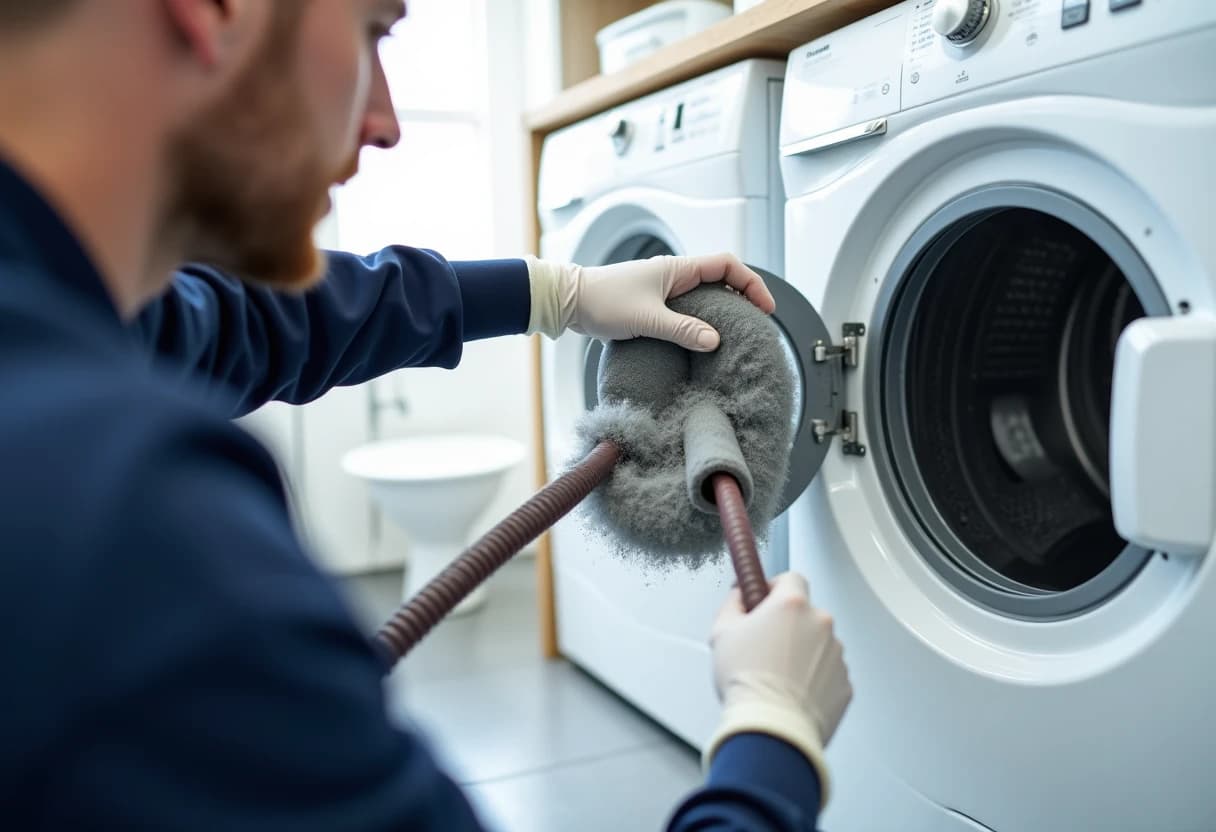
Every load of laundry sheds lint, and your dryer's lint screen catches only a fraction of it. The rest travels into the exhaust duct, where it snags on joints, elbows and screw tips and slowly packs the line shut. FEMA estimates around 2,900 home clothes dryer fires occur in the US every year, and failure to clean the vent is the leading contributing factor. Our Seaport District dryer vent cleaning service removes that hazard completely: a rotary brush scrubs the full length of the duct while a HEPA vacuum captures the lint, and we clean from both the dryer side and the exterior termination so nothing is left behind.
Why Dryer Vent Cleaning Matters for Seaport District Homes
The fire statistics on clothes dryers deserve to be taken literally. FEMA's national estimates attribute roughly 2,900 residential fires per year to clothes dryers, causing an estimated five deaths, one hundred injuries and $35 million in property loss — and the leading factor, cited in about a third of these fires, is failure to clean. The mechanism is simple: lint escapes past the screen on every cycle, accumulates in the duct, restricts airflow, and drives exhaust temperatures upward until the lint itself — which ignites easily and burns fast — meets a hot enough surface or a stray spark from the dryer's heating element. A professional cleaning breaks every link in that chain at once. It removes the fuel, restores the airflow that keeps operating temperatures in the safe range, and gives a trained technician a look at the transition duct, joints and termination where problems concentrate. For $149 to $299, it is the cheapest fire prevention a homeowner can buy, and it pays part of itself back in energy savings immediately.
Seaport District homeowners tend to discover their dryer vent problem in winter, when a marginal vent finally fails: cold-stiffened exterior dampers stick, moist exhaust meets freezing duct sections and condenses into lint cement, and holiday laundry loads push the system past its limit. The Seaport is Boston's newest neighborhood, dominated by glass luxury high-rises built almost entirely since 2010, with the Fort Point fringe adding century-old brick-and-beam warehouse lofts converted to condos. The towers run sophisticated central systems - vertical risers, unit-level fan coils and heat pumps, and shared corridor ventilation - where individual condo ductwork is compact but works hard year-round. Fort Point lofts feature long exposed spiral duct runs strung across timber ceilings. New construction is no guarantee of clean ducts: Seaport units routinely carry construction debris from their own build-out, and the towers' sealed windows mean residents breathe only what the mechanical systems deliver. Harbor humidity and salt air are hard on rooftop equipment and vent terminations, and in-unit washer-dryer setups with long concealed vent runs to the building exterior are a lint problem we service throughout the district. We keep winter availability across Suffolk County precisely because blocked-vent calls spike from December through February. Booking a fall cleaning is the smarter move — but whenever you call, our Seaport District route coverage means fast scheduling and a flat price that includes the full run, elbows, and the exterior termination.
Our Dryer Vent Cleaning Process in Seaport District
1Inspect the Dryer, Transition Duct & Vent Path
Every job opens with a walkthrough of the complete exhaust path. The technician checks the lint screen housing, inspects the transition hose behind the dryer, locates every accessible section of duct, and finds the termination — wall hood, soffit outlet or roof cap. Photos document the starting condition so you can compare against the finished result.
2Protect the Laundry Area & Disconnect the Dryer
Before cleaning starts, we lay floor protection, carefully slide the dryer out without scarring floors, and disconnect the transition duct. Gas dryers are handled with proper care around the flexible gas connector — we never strain it. With the duct open at the appliance end, we have the access needed to clean the entire run.
3Rotary Brush the Full Length of the Duct
Mechanical agitation is what separates professional cleaning from blow-through methods. The rotary brush physically breaks up compacted lint that air pressure alone would only compress further. We select brush heads sized to your duct — standard 4-inch for code-compliant lines, alternates for older oversized or reduced runs — so the bristles actually contact the duct wall the whole way.
4Capture Everything With HEPA Vacuum Extraction
Loosened lint has to go somewhere, and we make sure that somewhere is our vacuum. HEPA filtration captures the fine fiber dust that ordinary shop vacs exhaust straight back into the air — important in tight laundry areas and essential for allergy-sensitive households. Most cleanings fill a startling bag; we are happy to show you the haul.
5Clean From the Exterior Termination Inward
We then work the line from the outside in — wall hood, soffit outlet or roof cap. Exterior terminations trap their own debris: lint mats behind the damper, bird and rodent nests, and screening clogged solid. Roof terminations get full ladder or roof access; we carry the gear, and steep or high work is included in the quoted price.
6Service the Transition Duct & Reconnect
Reassembly is done to code and to the appliance manual: UL-listed transition duct, proper clamps, no more than the listed connector length, and the dryer set far enough from the wall that the duct keeps its shape. We level the machine, verify the gas connection is undisturbed on gas units, and run a test cycle before calling the mechanical work done.
7Verify Airflow & Walk You Through the Results
Final checks: test cycle run, exhaust verified at the hood, laundry area vacuumed and everything returned to place. If we found issues cleaning cannot fix — overlong runs, crushed sections, illegal materials — you get straight documentation and a separate quote, never pressure. Most vents simply need this cleaning, once a year, and nothing more.
Benefits of Professional Dryer Vent Cleaning in Seaport District
Documentation for Insurance, Condos & Peace of Mind
For landlords and multi-family owners, documented dryer vent service is due-diligence gold: it demonstrates fire-safety maintenance across units in a single record. We service whole buildings in one visit with per-unit documentation, which is why property managers across Greater Boston keep us on an annual rotation.
Faster Drying Times
If laundry has become an all-day affair, the fix is rarely a new dryer. We regularly clean vents for customers who were quoted $1,000+ appliance replacements, and the old machine performs like new once it can breathe. Try the $149 to $299 solution before the four-figure one.
Less Moisture, Mildew & Musty Odor
Damp lint inside a restricted duct becomes a mold and bacteria medium — the source of the sour smell some dryers push into freshly washed clothes. Removing the lint removes the colony. If your 'clean' laundry has ever come out smelling worse than it went in, the vent is the likeliest culprit.
Dramatically Reduced Fire Risk
This is the benefit that matters most. Lint is extraordinarily flammable, and a clogged vent both supplies the fuel and creates the overheating that ignites it. Removing the accumulation removes the hazard — which is why fire departments, the NFPA and FEMA all urge annual dryer vent cleaning as basic home fire prevention.
Lower Energy Bills
Dryers are among the most energy-hungry appliances in the home, and a clogged vent makes every load cost more. Restoring design airflow means the heating element runs at intended temperatures for intended durations. The savings recur with every cycle, quietly, for as long as the vent stays clear.
Longer Dryer Lifespan & Fewer Repairs
The high-limit safety switch in your dryer is not meant to cycle constantly; when a blocked vent makes it do so, the switch and the heating element both wear prematurely. A $149 to $299 annual cleaning routinely prevents $200 to $400 repair visits, and postpones the eventual $800 to $1,200 replacement by years.
Signs Your Seaport District Home Needs Dryer Vent Cleaning
It Has Been More Than a Year
New homeowners: assume the vent has never been cleaned unless the sellers documented otherwise. It is one of the most neglected systems in any real-estate transaction. A move-in cleaning costs $149 to $299, establishes your baseline, and starts the annual clock at a date you actually know.
Dryer or Clothes Are Hot to the Touch
Excess heat is the fire chain's first visible link: restricted airflow, rising temperatures, and a duct lined with fuel. If the top of your dryer doubles as a hand warmer or the laundry room bakes during cycles, stop using the machine for long runs and have the vent cleaned promptly.
Clothes Take More Than One Cycle to Dry
Homeowners adapt to slow drying so gradually they stop noticing, until they use a laundromat or a friend's machine and remember what one-cycle drying feels like. If your definition of a drying cycle has quietly stretched past an hour, the vent is overdue for inspection and almost certainly for cleaning.
Lint Building Up Behind or Inside the Dryer
Visible lint at any joint, seam or connection is a flag worth acting on. It usually indicates positive pressure in the duct from a downstream blockage forcing air out through gaps — or a partially disconnected duct dumping exhaust into the wall cavity, which our inspection will catch.
Laundry Room Gets Hot and Humid
Watch for secondary evidence: peeling paint near the dryer, mildew spots on the ceiling above it, a musty smell that lingers after laundry day, rust on shelf brackets. All are condensation footprints from exhaust escaping into the room through a restricted or leaking duct rather than exiting the house.
The Exterior Vent Flap Barely Opens
Lint visible around the exterior hood, on the siding or in the shrubs below means the duct is shedding overflow. Paradoxically, a completely lint-free hood on an older system can be worse news: it may mean nothing is reaching the exit at all. Either extreme warrants a cleaning and airflow check.
Dryer Vent Cleaning Cost in Seaport District, MA
For budgeting across property types: single-family homes run $149 to $299 as described; condos are usually $149 to $199 unless the unit vents to the roof; and multi-family buildings get per-unit rates that drop meaningfully when we clean all units in one visit — the arrangement most triple-decker owners and condo associations choose, both for cost and for the single insurance-ready service record covering the building. Commercial laundry and shared-venting systems are quoted after a walkthrough. Frequency matters to lifetime cost too: an annual cleaning is quick and inexpensive because accumulation is light, while a vent neglected for five years often needs blockage-level work at the top of the range, and sometimes reveals damage requiring repair. The cheapest way to own a dryer vent, year over year, is to clean it on schedule — which is why we log your service date and send a reminder when the next one is due.
Want the full pricing picture? See our complete Boston-area cost guide or call (617) 390-7145 for an exact flat quote for your Seaport District home.
Local Knowledge: Seaport District, Suffolk County
Serving Seaport District means knowing Seaport District. The Seaport is Boston's newest neighborhood, dominated by glass luxury high-rises built almost entirely since 2010, with the Fort Point fringe adding century-old brick-and-beam warehouse lofts converted to condos. The towers run sophisticated central systems - vertical risers, unit-level fan coils and heat pumps, and shared corridor ventilation - where individual condo ductwork is compact but works hard year-round. Fort Point lofts feature long exposed spiral duct runs strung across timber ceilings. New construction is no guarantee of clean ducts: Seaport units routinely carry construction debris from their own build-out, and the towers' sealed windows mean residents breathe only what the mechanical systems deliver. Harbor humidity and salt air are hard on rooftop equipment and vent terminations, and in-unit washer-dryer setups with long concealed vent runs to the building exterior are a lint problem we service throughout the district. Those conditions shape how we work here: which brush heads come off the truck, how we protect finishes in older interiors, and what we expect to find when the camera goes into a 02210 duct system. Our crews are in and around Seaport District nearly every week — often for neighbors of past customers — so scheduling is fast and our arrival windows hold.
The Best Time of Year in Seaport District
Winter is when Greater Boston dryer vents fail. Cold stiffens exterior damper flaps, snow drifts block grade-level hoods, and warm moist exhaust hitting a freezing duct section condenses — turning loose lint into dense, damp mats that can plug a marginal vent in weeks. Meanwhile laundry loads peak: heavy sweaters, extra blankets, snow-soaked layers. It is no coincidence that dryer fires are most frequent in winter, with January the peak month in federal fire data. The smart schedule is a fall cleaning — clear the system before the heavy season — but if winter has already exposed a problem, we keep cold-month availability across Suffolk County precisely because these calls cannot wait.
Why Choose Boston Air Duct Cleaners
Boston Air Duct Cleaners is a local, owner-operated company based at 1121 Washington St in West Newton — not a national franchise dispatching subcontractors. Every crew is our own: background-checked, factory-trained on commercial negative-pressure equipment, and fully insured. We quote flat prices before work begins, document every job with before-and-after photos, and follow NADCA-standard source-removal methods on every system we touch. That is why so much of our work comes from repeat customers, property managers and word-of-mouth referrals across Suffolk County.
Serving Seaport District and Surrounding Communities
Seaport District sits in the heart of our service area, and neighboring South Boston, Boston, Back Bay, South End, East Boston, Dorchester appointments share the same routes. That density is why our response times in this part of Suffolk County are among our fastest — and why you will see our trucks in the area week after week.