
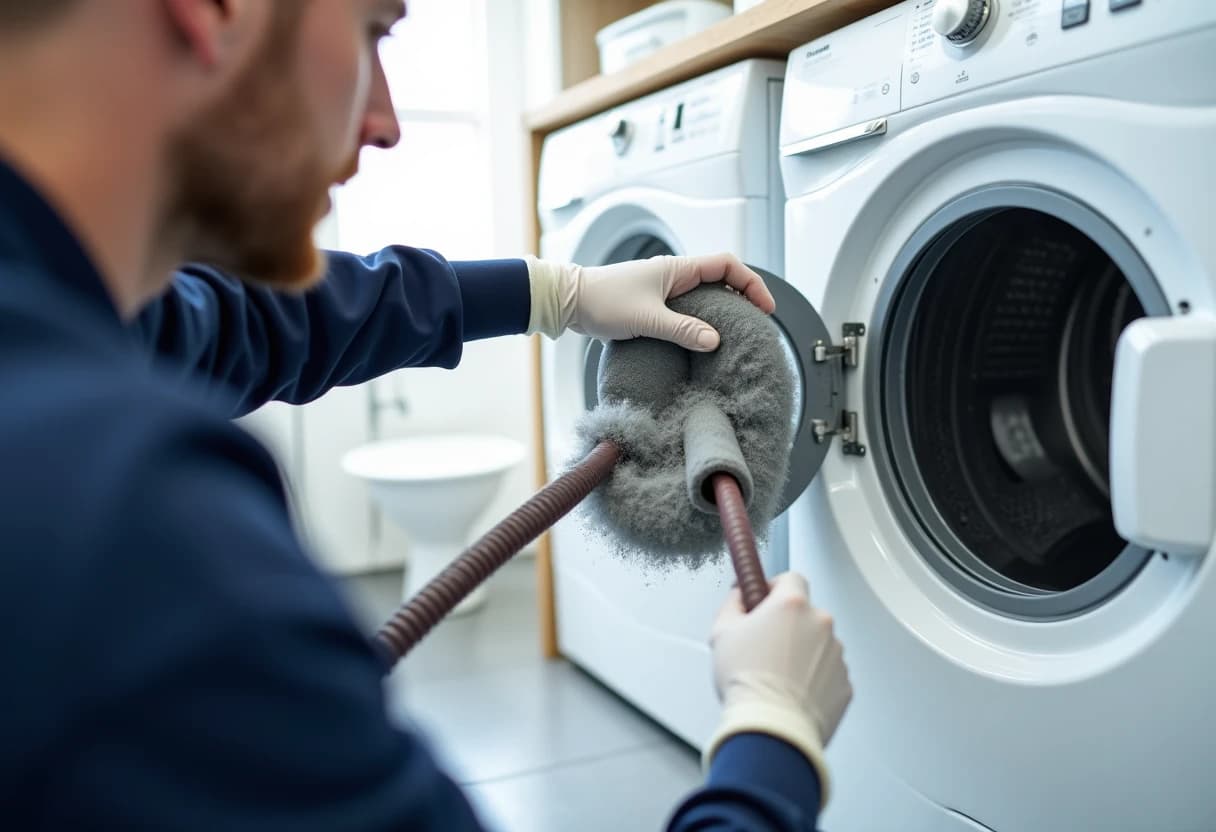
Homeowners in Quincy typically call us for dryer vent cleaning after one of three moments: a load that will not dry, a burning odor from the laundry area, or a repair technician who condemned the vent while servicing the dryer. All three trace to the same lint accumulation that builds silently for years. Our service removes it completely — rotary brush agitation through the full duct length, HEPA vacuum extraction, exterior hood cleaning, and a check of the transition duct behind the dryer where crushing and kinks hide. We are local, insured, and we quote flat pricing that covers the entire run, roof terminations included.
Why Dryer Vent Cleaning Matters for Quincy Homes
Some homeowners ask whether they can just clean the vent themselves with a leaf blower or a hardware-store brush kit — and for a short, straight, first-floor vent, a diligent DIY cleaning is better than nothing. The trouble is that most Greater Boston vents are not short or straight. Runs from basement or interior laundry rooms commonly stretch 15 to 35 feet with three or four elbows, and consumer brush kits lose effectiveness with every bend, often compacting lint into a plug instead of removing it. Leaf blowers can blow a soft clog into a dense one, or blow the exterior damper shut. Professional equipment is different in kind: motor-driven rotary brushes that maintain scrubbing force through every elbow, HEPA vacuums that capture lint at the same time, inspection of the transition duct and termination, and an airflow measurement that verifies the result. We also spot the problems a brush cannot fix — crushed duct, disconnected joints, illegal flex materials — before they turn a maintenance visit into an emergency.
Quincy homeowners tend to discover their dryer vent problem in winter, when a marginal vent finally fails: cold-stiffened exterior dampers stick, moist exhaust meets freezing duct sections and condenses into lint cement, and holiday laundry loads push the system past its limit. Quincy mixes early-1900s two-families and triple-deckers in Wollaston and North Quincy with post-war capes in Merrymount, granite-era Victorians near the Center, and a wave of new luxury towers around Quincy Center and Marina Bay. Many of the older two-family homes run shared basement ductwork or converted gravity furnaces, while the new high-rises depend on individual air handlers and long vertical dryer vent runs. Quincy's shoreline neighborhoods like Houghs Neck and Squantum sit directly on Boston Harbor, so salt air and marine humidity work into basements and duct systems year-round. Add the constant condo construction around Quincy Center and we see everything here from drywall dust in brand-new systems to decades of buildup in Wollaston two-families. We keep winter availability across Norfolk County precisely because blocked-vent calls spike from December through February. Booking a fall cleaning is the smarter move — but whenever you call, our Quincy route coverage means fast scheduling and a flat price that includes the full run, elbows, and the exterior termination.
Our Dryer Vent Cleaning Process in Quincy
1Inspect the Dryer, Transition Duct & Vent Path
First we establish what we are cleaning: duct material, run length, number of bends, and termination type. We also measure baseline airflow at the exterior hood with the dryer running. That number matters — it is how we prove, at the end of the visit, that the cleaning actually restored the exhaust capacity your dryer needs.
2Protect the Laundry Area & Disconnect the Dryer
Before cleaning starts, we lay floor protection, carefully slide the dryer out without scarring floors, and disconnect the transition duct. Gas dryers are handled with proper care around the flexible gas connector — we never strain it. With the duct open at the appliance end, we have the access needed to clean the entire run.
3Rotary Brush the Full Length of the Duct
Mechanical agitation is what separates professional cleaning from blow-through methods. The rotary brush physically breaks up compacted lint that air pressure alone would only compress further. We select brush heads sized to your duct — standard 4-inch for code-compliant lines, alternates for older oversized or reduced runs — so the bristles actually contact the duct wall the whole way.
4Capture Everything With HEPA Vacuum Extraction
As the brush works, a HEPA-filtered vacuum runs simultaneously on the duct, pulling loosened lint into a sealed collection system instead of letting it blow into your laundry room or yard. The combination — agitate and extract at once — is what leaves the duct genuinely empty rather than redistributing the clog.
5Clean From the Exterior Termination Inward
Cleaning from both ends is non-negotiable on longer runs. The last few feet before the termination, and the hood itself, accumulate the densest lint — it is where moist exhaust meets cold outdoor air and fibers mat together. We open the hood, clear the damper, remove nesting if present, and brush the final duct section back toward the vacuum.
6Service the Transition Duct & Reconnect
The short duct connecting dryer to wall does more harm than its length suggests — crushed, kinked or made of plastic, it can choke an otherwise clean system. We clean it, or if it is damaged or made of hazardous foil or vinyl accordion material, we recommend replacement with a semi-rigid aluminum connector, usually installed on the spot for a small parts charge.
7Verify Airflow & Walk You Through the Results
We run the dryer and inspect the termination together — you should see the damper flap standing open under confident airflow, something many homeowners have literally never observed on their own vent. Your technician reviews photos, flags any code or condition issues for future attention, and records your service date for an annual reminder.
Benefits of Professional Dryer Vent Cleaning in Quincy
Lower Energy Bills
Energy waste from blocked dryer vents is invisible on any single bill but substantial over a year — hundreds of extra kilowatt-hours or therms for a heavy-laundry household. Cleaning converts that waste back into performance. It is one of the few home services with a direct, same-month payback mechanism.
Safer Operation for Gas Dryers
Massachusetts homes rely heavily on natural gas, and gas dryers are common across Greater Boston's housing stock. If yours vents through a long or aging duct, annual cleaning plus an airflow check is the standard of care fire and gas utilities recommend. It takes an hour and removes an entire category of risk.
Dramatically Reduced Fire Risk
This is the benefit that matters most. Lint is extraordinarily flammable, and a clogged vent both supplies the fuel and creates the overheating that ignites it. Removing the accumulation removes the hazard — which is why fire departments, the NFPA and FEMA all urge annual dryer vent cleaning as basic home fire prevention.
Less Moisture, Mildew & Musty Odor
Damp lint inside a restricted duct becomes a mold and bacteria medium — the source of the sour smell some dryers push into freshly washed clothes. Removing the lint removes the colony. If your 'clean' laundry has ever come out smelling worse than it went in, the vent is the likeliest culprit.
Longer Dryer Lifespan & Fewer Repairs
New dryers deserve clean vents from day one — manufacturers require adequate exhaust airflow for warranty coverage, and delivery crews almost never clean the existing duct. If you have recently replaced your dryer and skipped the vent, you have connected a new engine to a clogged tailpipe.
Documentation for Insurance, Condos & Peace of Mind
Every cleaning ends with a written record: date, scope, before-and-after photos, airflow verification and condition notes. Condo associations increasingly require proof of dryer vent maintenance, some insurers ask after claims, and home buyers appreciate the paper trail. One visit satisfies all three — and tells you exactly when the next service is due.
Signs Your Quincy Home Needs Dryer Vent Cleaning
Burning Smell During a Cycle
That 'hot lint' smell is exactly what it seems: fibers reaching their scorching point somewhere in the airflow path. Sometimes it is a sock against the element; usually it is accumulation. Either way, the difference between a smell and a fire can be one overloaded cycle. We prioritize these calls for same-week service.
Clothes Take More Than One Cycle to Dry
Modern sensor-dry machines mask the problem by simply running longer, so watch total time rather than dampness. A sensor cycle that used to finish in 45 minutes and now runs 75 is reporting a restricted vent the only way it can. Believe it before the thermal fuse makes the point more expensively.
It Has Been More Than a Year
New homeowners: assume the vent has never been cleaned unless the sellers documented otherwise. It is one of the most neglected systems in any real-estate transaction. A move-in cleaning costs $149 to $299, establishes your baseline, and starts the annual clock at a date you actually know.
The Exterior Vent Flap Barely Opens
Step outside during a drying cycle and look at the termination hood. The damper should stand fully open with a strong, warm airstream you can feel from a foot away. A flap that flutters weakly, opens halfway or stays shut is showing you the blockage directly — the cheapest diagnostic in home maintenance.
Lint Building Up Behind or Inside the Dryer
Visible lint at any joint, seam or connection is a flag worth acting on. It usually indicates positive pressure in the duct from a downstream blockage forcing air out through gaps — or a partially disconnected duct dumping exhaust into the wall cavity, which our inspection will catch.
Laundry Room Gets Hot and Humid
In winter, backed-up dryer moisture migrates to the coldest nearby surfaces — window frames, exterior-wall corners, basement sills — and condenses there, feeding mold New England homes already fight. If winter condensation spikes on laundry days, your vent is contributing and a cleaning will subtract it.
Dryer Vent Cleaning Cost in Quincy, MA
Expect to pay $149 to $299 for a professional cleaning in Eastern Massachusetts, with most single-family homes landing near the middle. Three questions set your exact price: Where is the dryer (first floor, basement, or interior room far from an outside wall)? Where does the vent exit (grade-level wall, high wall, soffit or roof)? And when was it last cleaned (routine maintenance versus a full blockage)? Roof terminations carry the largest premium — safe roof access takes equipment and time — and fully plugged runs take staged brushing rather than a single pass. Optional add-ons are few and honest: replacing a damaged or non-compliant transition hose runs $30 to $60 installed, and a new exterior hood, if yours is broken or screened, is quoted flat. Bundling dryer vent cleaning with air duct cleaning is our most popular package and typically saves $50 to $75 versus booking separately.
Want the full pricing picture? See our complete Boston-area cost guide or call (617) 390-7145 for an exact flat quote for your Quincy home.
Local Knowledge: Quincy, Norfolk County
Every town's ductwork tells the story of its housing. Quincy mixes early-1900s two-families and triple-deckers in Wollaston and North Quincy with post-war capes in Merrymount, granite-era Victorians near the Center, and a wave of new luxury towers around Quincy Center and Marina Bay. Many of the older two-family homes run shared basement ductwork or converted gravity furnaces, while the new high-rises depend on individual air handlers and long vertical dryer vent runs. Quincy's shoreline neighborhoods like Houghs Neck and Squantum sit directly on Boston Harbor, so salt air and marine humidity work into basements and duct systems year-round. Add the constant condo construction around Quincy Center and we see everything here from drywall dust in brand-new systems to decades of buildup in Wollaston two-families. We plan Quincy jobs around those realities, from equipment selection to time on site, and it shows in the results. If you live near Marina Bay or anywhere across Quincy's 02169 area, we have almost certainly cleaned a system like yours before — and we can tell you exactly what to expect before we arrive.
The Best Time of Year in Quincy
The region's old housing stock gives dryer venting a seasonal twist all its own. Many Massachusetts laundry hookups were retrofitted into basements and back halls generations after the house was built, producing long runs through unheated spaces — crawl areas, garages, exterior wall cavities. In winter, those cold sections become condensation zones where exhaust moisture freezes into lint ice; in the spring thaw, the melt soaks the accumulation into a paste. Homes near the coast add salt-air corrosion at the termination, seizing dampers and rusting hoods. Annual cleaning with a termination inspection catches all of this on a schedule, rather than during a February failure with a full laundry basket waiting.
Why Choose Boston Air Duct Cleaners
What separates us from the coupon crowd is simple: we do the whole job, we prove it, and we charge what we quoted. Our technicians clean supplies, returns, trunks and blower compartments on every visit — never a cosmetic vent wipe. Photo documentation comes standard, pricing is flat and confirmed up front, and our trucks carry true commercial vacuum equipment, not rented shop-vacs. Based in West Newton and serving Quincy year-round, we answer our own phone at (617) 390-7145 and stand behind every cleaning with a satisfaction guarantee.
Serving Quincy and Surrounding Communities
Quincy sits in the heart of our service area, and neighboring Milton, Braintree, Weymouth, Dorchester, Randolph, Holbrook appointments share the same routes. That density is why our response times in this part of Norfolk County are among our fastest — and why you will see our trucks in the area week after week.