
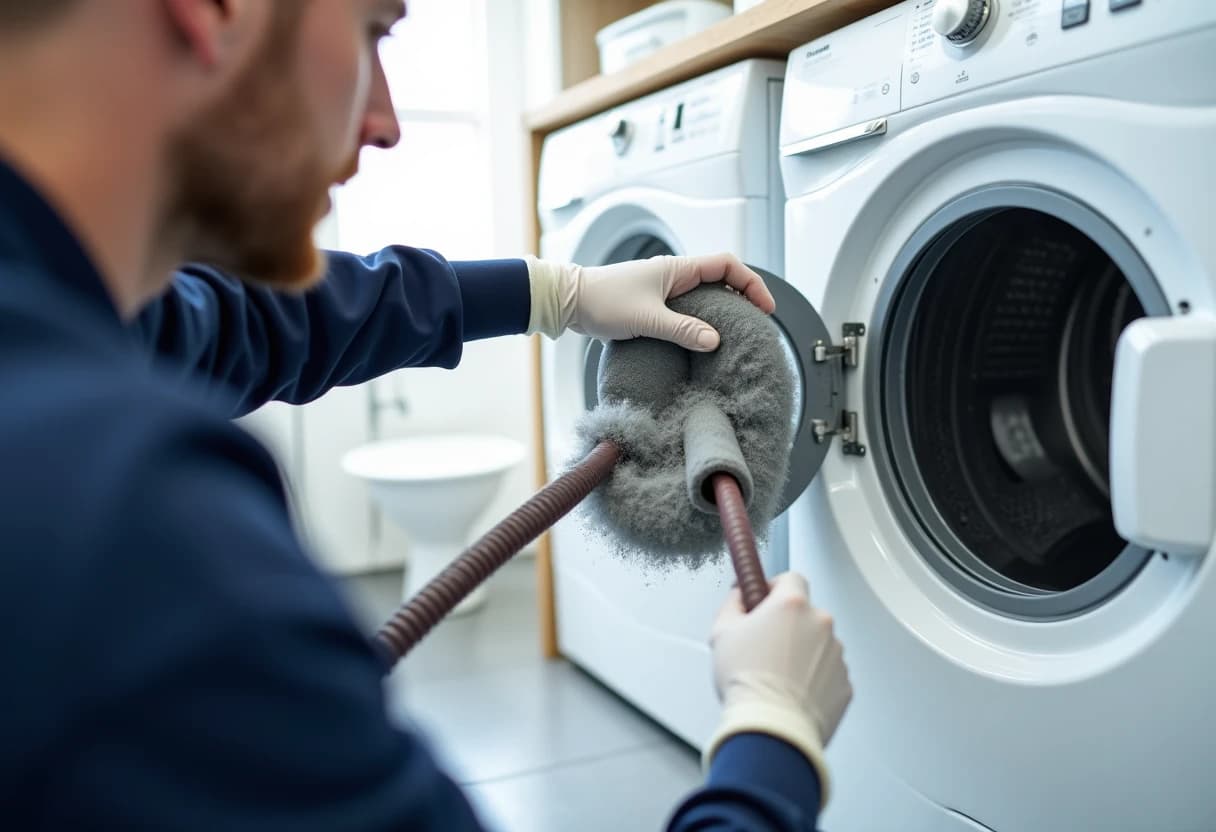
If your dryer takes two cycles to dry a load that used to take one, the problem is almost never the dryer — it is the vent. A lint-restricted exhaust line traps hot, moist air in the drum, stretching drying times, wasting electricity or gas, and overheating the very lint that lines the duct. Our certified technicians clean Sharon dryer vents end to end with flexible rotary brush systems and HEPA-filtered vacuums, restoring full airflow in about an hour. The result is a dryer that works like new, utility bills that drop, and a fire hazard removed from the middle of your home.
Why Dryer Vent Cleaning Matters for Sharon Homes
Beyond fire risk, a clogged dryer vent is a moisture and air-quality problem. Each load of laundry releases roughly a gallon of water as vapor, and all of it is supposed to leave the house through the vent. When lint restricts the line, that moisture lingers in the duct — turning lint into damp mats that block further — and backs up into the laundry area, where it condenses on cold surfaces, peels paint, and feeds mold and mildew growth. Gas dryers raise the stakes further: their exhaust carries combustion byproducts including carbon monoxide, and a blocked vent can push those gases back into living space. The EPA's guidance on indoor moisture and mold is blunt — control the moisture source and you control the growth. For laundry areas, the vent is the moisture source control, and keeping it clear is not optional. Our cleaning restores the full exhaust path so water vapor, heat and combustion byproducts go where they were designed to go: outside.
Sharon homeowners tend to discover their dryer vent problem in winter, when a marginal vent finally fails: cold-stiffened exterior dampers stick, moist exhaust meets freezing duct sections and condenses into lint cement, and holiday laundry loads push the system past its limit. Sharon's housing ranges from early-1900s homes around Post Office Square and summer-cottage conversions near Lake Massapoag to large mid-century and 1980s-2000s colonials set into the town's heavily wooded lots. The lake-area cottages that became year-round homes often carry pieced-together heating systems, while the bigger colonials run long duct networks across multiple zones. Sharon is one of the most wooded towns we serve, and the tree canopy around Moose Hill and Lake Massapoag delivers intense spring pollen and autumn leaf-mold loads that end up in return ducts. Lakeside homes add summer humidity to the mix, a combination that makes regular duct cleaning noticeably improve allergy seasons here. We keep winter availability across Norfolk County precisely because blocked-vent calls spike from December through February. Booking a fall cleaning is the smarter move — but whenever you call, our Sharon route coverage means fast scheduling and a flat price that includes the full run, elbows, and the exterior termination.
Our Dryer Vent Cleaning Process in Sharon
1Inspect the Dryer, Transition Duct & Vent Path
We start behind the dryer: pulling the machine, examining the transition duct for crushing, kinks or foil accordion material, and tracing the vent's full path from connection to exterior termination. Mapping the run tells us its length, elbow count and materials — and lets us confirm your flat price before any cleaning begins.
2Protect the Laundry Area & Disconnect the Dryer
We treat laundry rooms — often tight, finished spaces — with the same care as any living area: drop cloths down, dryer walked out on protective sliders, and the work zone contained. Disconnecting at the appliance gives us a clean entry point into the duct and a chance to inspect the connection hardware that so often leaks lint into the wall cavity.
3Rotary Brush the Full Length of the Duct
Our core cleaning tool is a motor-driven rotary brush on flexible rods, fed through the entire duct run. The spinning brush head scrubs lint off the duct walls through every elbow and vertical section, in runs up to 35 feet and beyond. Unlike hand brushes, it maintains full scrubbing force at the far end of the line — where the worst accumulation usually hides.
4Capture Everything With HEPA Vacuum Extraction
Loosened lint has to go somewhere, and we make sure that somewhere is our vacuum. HEPA filtration captures the fine fiber dust that ordinary shop vacs exhaust straight back into the air — important in tight laundry areas and essential for allergy-sensitive households. Most cleanings fill a startling bag; we are happy to show you the haul.
5Clean From the Exterior Termination Inward
Cleaning from both ends is non-negotiable on longer runs. The last few feet before the termination, and the hood itself, accumulate the densest lint — it is where moist exhaust meets cold outdoor air and fibers mat together. We open the hood, clear the damper, remove nesting if present, and brush the final duct section back toward the vacuum.
6Service the Transition Duct & Reconnect
Before reconnecting, we vacuum the dryer's own lint trap housing and accessible internal ducting, where years of screen bypass collects near the heating element. Then the transition duct is cleaned or replaced, clamped properly — never screwed, since screw tips inside the airstream snag lint — and the dryer is positioned to leave the duct an easy, unkinked path.
7Verify Airflow & Walk You Through the Results
The job ends with proof: we measure airflow at the exterior termination with the dryer running and compare it to the baseline reading from arrival. Strong, steady exhaust and a fully opening damper are the pass conditions. You get the before-and-after numbers, photos of what came out, and honest notes on the duct's condition.
Benefits of Professional Dryer Vent Cleaning in Sharon
Longer Dryer Lifespan & Fewer Repairs
New dryers deserve clean vents from day one — manufacturers require adequate exhaust airflow for warranty coverage, and delivery crews almost never clean the existing duct. If you have recently replaced your dryer and skipped the vent, you have connected a new engine to a clogged tailpipe.
Dramatically Reduced Fire Risk
This is the benefit that matters most. Lint is extraordinarily flammable, and a clogged vent both supplies the fuel and creates the overheating that ignites it. Removing the accumulation removes the hazard — which is why fire departments, the NFPA and FEMA all urge annual dryer vent cleaning as basic home fire prevention.
Safer Operation for Gas Dryers
For gas dryers, vent cleaning is combustion safety, not just lint management. Backdrafting exhaust is odorless and invisible; the protection is a clear duct and a working CO detector. We verify complete, strong exhaust at the exterior termination on every gas dryer job — the confirmation that byproducts are leaving the house.
Lower Energy Bills
Energy waste from blocked dryer vents is invisible on any single bill but substantial over a year — hundreds of extra kilowatt-hours or therms for a heavy-laundry household. Cleaning converts that waste back into performance. It is one of the few home services with a direct, same-month payback mechanism.
Less Moisture, Mildew & Musty Odor
Each load exhausts about a gallon of water as vapor. When the vent is blocked, that moisture backs into the laundry room and the duct itself — condensing on walls, peeling paint, and feeding mildew. A clear vent sends the humidity outside, drying out the laundry area and eliminating the damp, musty smell that clings to blocked systems.
Documentation for Insurance, Condos & Peace of Mind
For landlords and multi-family owners, documented dryer vent service is due-diligence gold: it demonstrates fire-safety maintenance across units in a single record. We service whole buildings in one visit with per-unit documentation, which is why property managers across Greater Boston keep us on an annual rotation.
Signs Your Sharon Home Needs Dryer Vent Cleaning
The Exterior Vent Flap Barely Opens
Many Sharon-area vents terminate on roofs or high walls where owners never look — which is exactly why blockages there grow uninterrupted for years. If you cannot see your termination or have never checked it, assume it needs inspection. We check and clean terminations, roof-mounted included, on every visit.
Clothes Take More Than One Cycle to Dry
Homeowners adapt to slow drying so gradually they stop noticing, until they use a laundromat or a friend's machine and remember what one-cycle drying feels like. If your definition of a drying cycle has quietly stretched past an hour, the vent is overdue for inspection and almost certainly for cleaning.
Laundry Room Gets Hot and Humid
In winter, backed-up dryer moisture migrates to the coldest nearby surfaces — window frames, exterior-wall corners, basement sills — and condenses there, feeding mold New England homes already fight. If winter condensation spikes on laundry days, your vent is contributing and a cleaning will subtract it.
Dryer or Clothes Are Hot to the Touch
A dryer cabinet too hot to rest a hand on, or clothes that come out scorching, means exhaust heat is not leaving the machine. That heat is being absorbed by the dryer's components — and by the lint in the duct. This is the pre-ignition condition fire investigators describe; treat it as urgent, not cosmetic.
Lint Building Up Behind or Inside the Dryer
Lint accumulating behind the machine, around the transition hose or under the dryer means the exhaust path is leaking or backing up — lint should travel out, not settle in. It is both a symptom of restriction and a hazard in itself, since this lint sits nearest the heat source. A cleaning addresses the cause and clears the accumulation.
It Has Been More Than a Year
The NFPA, FEMA and every major dryer manufacturer converge on the same guidance: professional vent cleaning at least annually, more often for heavy use. If you cannot remember your last cleaning — or know there has never been one — the schedule alone says you are due, whatever the symptoms.
Dryer Vent Cleaning Cost in Sharon, MA
A note on the low end of the market: you will see dryer vent cleaning advertised for $69 to $99, and occasionally it is legitimate — a short run, a quick brush, done. More often the price assumes ideal conditions that Greater Boston homes rarely offer, and the invoice grows on site with 'extra footage,' 'additional elbows' and 'blockage fees' until it exceeds a transparent quote. Our flat pricing of $149 to $299 is set for real local conditions: 15-to-35-foot runs, three or four elbows, basement laundries, and hoods that have not been opened in a decade. It includes the rotary brush cleaning of the entire duct, HEPA vacuum extraction, exterior termination service, transition duct inspection and a final airflow verification with photos. When comparing quotes, ask one question: does the price cover the complete run and the termination, whatever it takes? Ours does.
Want the full pricing picture? See our complete Boston-area cost guide or call (617) 390-7145 for an exact flat quote for your Sharon home.
Local Knowledge: Sharon, Norfolk County
Serving Sharon means knowing Sharon. Sharon's housing ranges from early-1900s homes around Post Office Square and summer-cottage conversions near Lake Massapoag to large mid-century and 1980s-2000s colonials set into the town's heavily wooded lots. The lake-area cottages that became year-round homes often carry pieced-together heating systems, while the bigger colonials run long duct networks across multiple zones. Sharon is one of the most wooded towns we serve, and the tree canopy around Moose Hill and Lake Massapoag delivers intense spring pollen and autumn leaf-mold loads that end up in return ducts. Lakeside homes add summer humidity to the mix, a combination that makes regular duct cleaning noticeably improve allergy seasons here. Those conditions shape how we work here: which brush heads come off the truck, how we protect finishes in older interiors, and what we expect to find when the camera goes into a 02067 duct system. Our crews are in and around Sharon nearly every week — often for neighbors of past customers — so scheduling is fast and our arrival windows hold.
The Best Time of Year in Sharon
Winter is when Greater Boston dryer vents fail. Cold stiffens exterior damper flaps, snow drifts block grade-level hoods, and warm moist exhaust hitting a freezing duct section condenses — turning loose lint into dense, damp mats that can plug a marginal vent in weeks. Meanwhile laundry loads peak: heavy sweaters, extra blankets, snow-soaked layers. It is no coincidence that dryer fires are most frequent in winter, with January the peak month in federal fire data. The smart schedule is a fall cleaning — clear the system before the heavy season — but if winter has already exposed a problem, we keep cold-month availability across Norfolk County precisely because these calls cannot wait.
Why Choose Boston Air Duct Cleaners
What separates us from the coupon crowd is simple: we do the whole job, we prove it, and we charge what we quoted. Our technicians clean supplies, returns, trunks and blower compartments on every visit — never a cosmetic vent wipe. Photo documentation comes standard, pricing is flat and confirmed up front, and our trucks carry true commercial vacuum equipment, not rented shop-vacs. Based in West Newton and serving Sharon year-round, we answer our own phone at (617) 390-7145 and stand behind every cleaning with a satisfaction guarantee.
Serving Sharon and Surrounding Communities
Sharon sits in the heart of our service area, and neighboring Canton, Stoughton, Foxborough, Easton, Walpole, Norwood appointments share the same routes. That density is why our response times in this part of Norfolk County are among our fastest — and why you will see our trucks in the area week after week.