
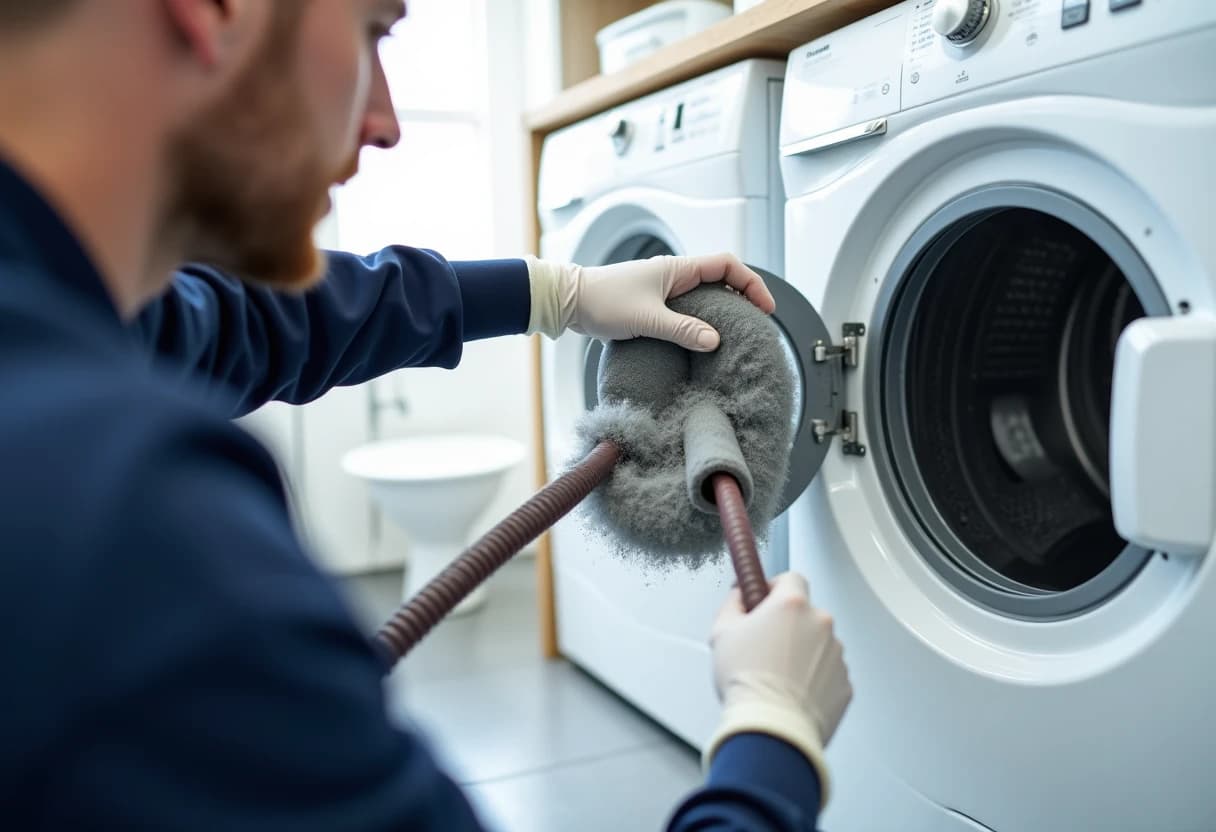
Most homeowners clean the lint screen every load and assume the job is done. But dryer manufacturers, the NFPA and the US Fire Administration all say the same thing: the vent duct itself needs professional cleaning at least once a year. Lint bypasses the screen constantly, and in Greater Boston homes — where vents commonly run twenty feet or more through basements, up wall cavities and across roofs — the accumulation happens out of sight. Our Wakefield technicians use full-length rotary brushes driven through the entire run while a HEPA vacuum collects everything, then verify airflow at the termination before we leave.
Why Dryer Vent Cleaning Matters for Wakefield Homes
Some homeowners ask whether they can just clean the vent themselves with a leaf blower or a hardware-store brush kit — and for a short, straight, first-floor vent, a diligent DIY cleaning is better than nothing. The trouble is that most Greater Boston vents are not short or straight. Runs from basement or interior laundry rooms commonly stretch 15 to 35 feet with three or four elbows, and consumer brush kits lose effectiveness with every bend, often compacting lint into a plug instead of removing it. Leaf blowers can blow a soft clog into a dense one, or blow the exterior damper shut. Professional equipment is different in kind: motor-driven rotary brushes that maintain scrubbing force through every elbow, HEPA vacuums that capture lint at the same time, inspection of the transition duct and termination, and an airflow measurement that verifies the result. We also spot the problems a brush cannot fix — crushed duct, disconnected joints, illegal flex materials — before they turn a maintenance visit into an emergency.
In Wakefield's older housing stock, we regularly find dryer vents that violate every modern guideline — vinyl flex duct sagging through a basement, screws catching lint at every joint, runs far past the 35-foot code maximum. Wakefield's blocks around Lake Quannapowitt and the Upper Common are lined with Queen Anne Victorians and roomy 1900s-1920s colonials, while Greenwood and Montrose fill in with capes, bungalows and postwar ranches. Many of the older homes began life with steam or hot-water heat and have since gained forced-air or ducted AC threaded through tight balloon-framed walls. These systems clog two or three times faster than a code-compliant rigid duct, which makes annual cleaning genuinely important rather than merely advisable. Homes near Lake Quannapowitt and Crystal Lake sit in a noticeably damp microclimate, and we frequently find condensation and musty odors in basement duct runs on the lake side of town. Wakefield's older housing also hides a lot of century-old framing cavities used as makeshift return paths, which pull attic and wall dust straight into the airstream. We clean what is there, document what we find with photos, and tell you honestly whether the duct itself needs repair or replacement — a judgment call our crews make in Wakefield homes every week.
Our Dryer Vent Cleaning Process in Wakefield
1Inspect the Dryer, Transition Duct & Vent Path
First we establish what we are cleaning: duct material, run length, number of bends, and termination type. We also measure baseline airflow at the exterior hood with the dryer running. That number matters — it is how we prove, at the end of the visit, that the cleaning actually restored the exhaust capacity your dryer needs.
2Protect the Laundry Area & Disconnect the Dryer
The dryer comes away from the wall and off the duct so we can clean the whole line, not just what a stub brush reaches. This is also when hidden problems surface: lint packed behind the machine, transition hoses crushed flat by the dryer being pushed back too far, and disconnected joints quietly venting into the wall.
3Rotary Brush the Full Length of the Duct
Our core cleaning tool is a motor-driven rotary brush on flexible rods, fed through the entire duct run. The spinning brush head scrubs lint off the duct walls through every elbow and vertical section, in runs up to 35 feet and beyond. Unlike hand brushes, it maintains full scrubbing force at the far end of the line — where the worst accumulation usually hides.
4Capture Everything With HEPA Vacuum Extraction
Loosened lint has to go somewhere, and we make sure that somewhere is our vacuum. HEPA filtration captures the fine fiber dust that ordinary shop vacs exhaust straight back into the air — important in tight laundry areas and essential for allergy-sensitive households. Most cleanings fill a startling bag; we are happy to show you the haul.
5Clean From the Exterior Termination Inward
The exterior hood gets hands-on service: damper flap cleaned and checked for free movement, cage or screen cleared (or removal recommended — screens on dryer terminations trap lint and violate most codes), and the visible duct section brushed. A damper that cannot close invites drafts and pests; one that cannot open blocks the entire system.
6Service the Transition Duct & Reconnect
Before reconnecting, we vacuum the dryer's own lint trap housing and accessible internal ducting, where years of screen bypass collects near the heating element. Then the transition duct is cleaned or replaced, clamped properly — never screwed, since screw tips inside the airstream snag lint — and the dryer is positioned to leave the duct an easy, unkinked path.
7Verify Airflow & Walk You Through the Results
Final checks: test cycle run, exhaust verified at the hood, laundry area vacuumed and everything returned to place. If we found issues cleaning cannot fix — overlong runs, crushed sections, illegal materials — you get straight documentation and a separate quote, never pressure. Most vents simply need this cleaning, once a year, and nothing more.
Benefits of Professional Dryer Vent Cleaning in Wakefield
Dramatically Reduced Fire Risk
After cleaning, your dryer's exhaust runs cool and free, its high-temperature safety switches stop cycling, and the duct holds no fuel load waiting for a spark. For households that run daily laundry — big families, home businesses, multi-generational homes — that risk reduction compounds with every load.
Faster Drying Times
If laundry has become an all-day affair, the fix is rarely a new dryer. We regularly clean vents for customers who were quoted $1,000+ appliance replacements, and the old machine performs like new once it can breathe. Try the $149 to $299 solution before the four-figure one.
Documentation for Insurance, Condos & Peace of Mind
Every cleaning ends with a written record: date, scope, before-and-after photos, airflow verification and condition notes. Condo associations increasingly require proof of dryer vent maintenance, some insurers ask after claims, and home buyers appreciate the paper trail. One visit satisfies all three — and tells you exactly when the next service is due.
Safer Operation for Gas Dryers
Gas dryer exhaust carries combustion byproducts, including carbon monoxide, and the vent is the only path designed to remove them. A blocked line can force those gases back into living space. Cleaning restores the engineered exhaust path — a meaningful safety margin for any home with a gas appliance and a real necessity for homes with bedrooms near the laundry.
Less Moisture, Mildew & Musty Odor
Basement laundry areas in New England fight humidity even on good days; a restricted dryer vent turns them into swamp rooms. Post-cleaning, customers consistently report the laundry area feels drier, smells cleaner, and stops fogging windows and sweating pipes during dryer cycles.
Lower Energy Bills
Dryers are among the most energy-hungry appliances in the home, and a clogged vent makes every load cost more. Restoring design airflow means the heating element runs at intended temperatures for intended durations. The savings recur with every cycle, quietly, for as long as the vent stays clear.
Signs Your Wakefield Home Needs Dryer Vent Cleaning
Burning Smell During a Cycle
Never normalize a burning odor from a dryer. Investigators repeatedly find that households smelled scorching lint for weeks before an ignition. A cleaning visit resolves the source in about an hour and includes vacuuming the dryer's internal lint paths near the element — where the smell most often starts.
Dryer or Clothes Are Hot to the Touch
Some heat is normal; radiating heat is not. When the exhaust cannot escape, the drum, cabinet and surrounding wall absorb it instead. Homes where we measure the highest cabinet temperatures reliably produce the fullest lint bags — the correlation between heat and blockage is nearly one to one.
Laundry Room Gets Hot and Humid
Watch for secondary evidence: peeling paint near the dryer, mildew spots on the ceiling above it, a musty smell that lingers after laundry day, rust on shelf brackets. All are condensation footprints from exhaust escaping into the room through a restricted or leaking duct rather than exiting the house.
The Exterior Vent Flap Barely Opens
Step outside during a drying cycle and look at the termination hood. The damper should stand fully open with a strong, warm airstream you can feel from a foot away. A flap that flutters weakly, opens halfway or stays shut is showing you the blockage directly — the cheapest diagnostic in home maintenance.
Lint Building Up Behind or Inside the Dryer
Lint accumulating behind the machine, around the transition hose or under the dryer means the exhaust path is leaking or backing up — lint should travel out, not settle in. It is both a symptom of restriction and a hazard in itself, since this lint sits nearest the heat source. A cleaning addresses the cause and clears the accumulation.
It Has Been More Than a Year
Households that run a load daily, dry pet bedding, or share laundry across a multi-family building accumulate lint at two to three times the average rate and should clean every six to twelve months. A quiet couple doing weekly laundry can stretch toward the annual mark, but rarely safely beyond it.
Dryer Vent Cleaning Cost in Wakefield, MA
For budgeting across property types: single-family homes run $149 to $299 as described; condos are usually $149 to $199 unless the unit vents to the roof; and multi-family buildings get per-unit rates that drop meaningfully when we clean all units in one visit — the arrangement most triple-decker owners and condo associations choose, both for cost and for the single insurance-ready service record covering the building. Commercial laundry and shared-venting systems are quoted after a walkthrough. Frequency matters to lifetime cost too: an annual cleaning is quick and inexpensive because accumulation is light, while a vent neglected for five years often needs blockage-level work at the top of the range, and sometimes reveals damage requiring repair. The cheapest way to own a dryer vent, year over year, is to clean it on schedule — which is why we log your service date and send a reminder when the next one is due.
Want the full pricing picture? See our complete Boston-area cost guide or call (617) 390-7145 for an exact flat quote for your Wakefield home.
Local Knowledge: Wakefield, Middlesex County
Serving Wakefield means knowing Wakefield. Wakefield's blocks around Lake Quannapowitt and the Upper Common are lined with Queen Anne Victorians and roomy 1900s-1920s colonials, while Greenwood and Montrose fill in with capes, bungalows and postwar ranches. Many of the older homes began life with steam or hot-water heat and have since gained forced-air or ducted AC threaded through tight balloon-framed walls. Homes near Lake Quannapowitt and Crystal Lake sit in a noticeably damp microclimate, and we frequently find condensation and musty odors in basement duct runs on the lake side of town. Wakefield's older housing also hides a lot of century-old framing cavities used as makeshift return paths, which pull attic and wall dust straight into the airstream. Those conditions shape how we work here: which brush heads come off the truck, how we protect finishes in older interiors, and what we expect to find when the camera goes into a 01880 duct system. Our crews are in and around Wakefield nearly every week — often for neighbors of past customers — so scheduling is fast and our arrival windows hold.
The Best Time of Year in Wakefield
Think of the laundry calendar itself: spring brings pollen-heavy loads and washed winter bedding; summer adds beach towels and daily shirt changes through humid stretches; fall means sweaters, blankets and back-to-school volume; winter piles on the heaviest fabrics of the year while the vent works at its coldest. A Massachusetts dryer rarely gets an off-season — which is why the annual cleaning interval is a floor, not a ceiling, for busy households here. Families running daily loads, multi-family buildings with shared laundry patterns, and anyone drying pet bedding through shedding seasons should consider a six-to-nine-month schedule. We track your interval and remind you, so the vent stays ahead of the laundry rather than behind it.
Why Choose Boston Air Duct Cleaners
Homeowners across Middlesex County choose Boston Air Duct Cleaners for three reasons. First, honesty: our inspection camera tells you whether your system actually needs cleaning — and sometimes the answer is no. Second, capability: truck-grade negative-air machines, rotary brush systems and HEPA filtration handle everything from antique gravity-furnace conversions to brand-new high-velocity systems. Third, accountability: flat quoted pricing, before-and-after photos, insured technicians, and a real local office you can call at (617) 390-7145. That combination is rarer in this industry than it should be.
Serving Wakefield and Surrounding Communities
We serve every community around Wakefield as well: Stoneham, Melrose, Reading, Lynnfield, Saugus, North Reading all fall inside our regular service routes. If you have a second property, a rental, or family nearby, ask about multi-home scheduling — grouped appointments on the same route are our most requested discount.