
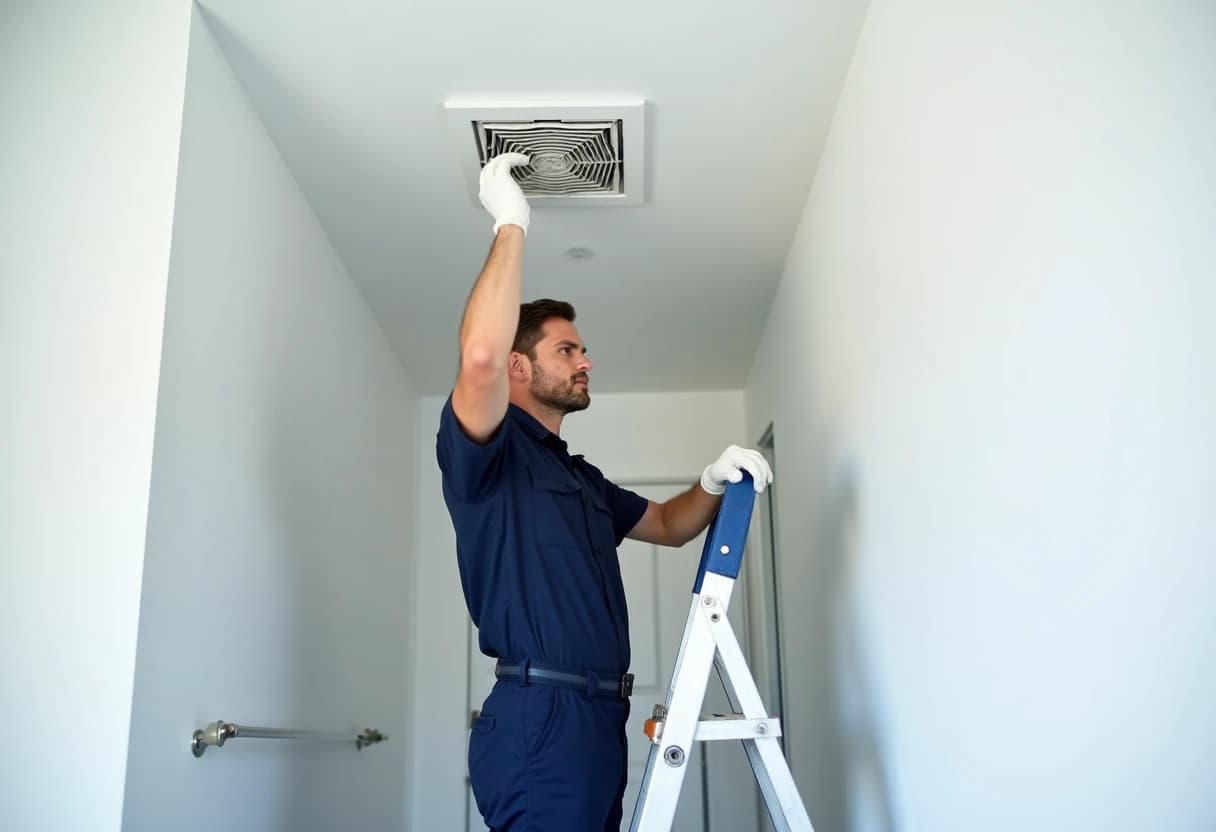
The bathroom exhaust fan is the hardest-working, least-maintained appliance in the house. It runs daily in the dampest room you own, its grille strains humid air like a filter, and nobody touches it until it rattles, stinks or stops. Our Beacon Hill cleaning service is the maintenance it has been missing: we drop the grille and wash it, clean the fan blades and motor housing so the motor stops fighting its own dirt, clean the duct run all the way to the roof cap or soffit vent, check the damper and termination, and measure airflow before and after. Fans routinely leave our visit moving two to three times the air they arrived with — quieter, too.
Why Bathroom Exhaust Fan Cleaning Matters for Beacon Hill Homes
Winter is when weak bathroom exhaust does its most expensive damage in Massachusetts. Through the long heating season, every duct run passing through a cold attic becomes a condensation trap: humid shower air enters the duct, cools below its dew point before reaching the termination, and the resulting water either drips back through the fan onto the ceiling — those mysterious brown rings around bathroom fans — or pools in flex-duct sags where it soaks accumulated dust into a blocking sludge. A clean, smooth, well-flowing duct moves air fast enough to clear before condensing; a dirty, restricted one guarantees the condensation cycle repeats with every shower from November to April. This is why bathroom ceiling stains and recurring winter mold are overwhelmingly ventilation problems rather than roof leaks, and why cleaning the exhaust path — often paired with correcting duct sags and stuck dampers found along the way — fixes bathrooms that repainting never could. If your bathroom grows spots every winter and recovers every summer, the fan system is telling you exactly what it needs.
Humid summers give Beacon Hill bathrooms no off-season. Beacon Hill's Federal and Greek Revival rowhouses date to the early 1800s, making them some of the oldest continuously occupied homes we service anywhere. Behind the brick facades and original shutters, owners have shoehorned modern HVAC into buildings that predate central heating entirely - slim-duct systems in closets, air handlers in former servant stairs, and condensers hidden on rear decks to satisfy the historic commission. Nearly every duct run here is a custom retrofit with tight bends that collect dust aggressively. July and August dew points mean bathrooms start damp before the first shower, and a weak fan cannot clear what the day's air keeps replacing — which is why musty odors and mildew flare locally every summer even in bathrooms that survived the winter. Two-hundred-year-old plaster, horsehair insulation and crumbling brick party walls shed fine mineral dust that ends up circulating through Beacon Hill's retrofit duct systems. Exterior work requires Beacon Hill Architectural Commission approval, so dryer vents and exhaust terminations are often routed to rear elevations through long concealed runs - exactly the kind of vent that quietly packs with lint. We clean these buildings with the care their age demands. Our summer visits pair well with air duct cleaning appointments, when the whole ventilation picture gets addressed at once. Whatever the season, the service is the same: grille, fan, motor housing and complete duct run cleaned to the termination, damper checked, airflow verified, and honest notes on anything the cleaning uncovered.
Our Bathroom Exhaust Fan Cleaning Process in Beacon Hill
1Airflow Test & System Assessment
First, a diagnosis: the fan runs while we check draw at the grille and note the sound signature — a healthy hum versus the rattle of caked blades or the groan of a straining motor. We locate where the duct goes and where it terminates, because the fix must cover the full path, not just the visible fixture.
2Protect the Bathroom & Drop the Grille
Bathrooms are finished spaces, so we treat them that way: drop cloth below the fan, fixtures covered, careful hands on grilles that may not have moved in decades. The grille comes down for a full wash — soaking and scrubbing away the bonded dust fur that no in-place vacuuming can remove.
3Clean the Fan Blades, Motor & Housing
This step returns the fan to its rated performance. Dust on blades changes their shape and steals capacity; dust packed around motors traps heat and shortens their lives. We clean both thoroughly, check that the wheel spins free and true, and inspect wiring and mounts while the housing is open — problems get photographed and flagged.
4Clean the Full Duct Run
The duct gets cleaned end to end, not just where it meets the fan. In attic runs we follow the duct physically where access allows, correcting sags that trap condensation and verifying every joint is still connected — a surprising number are not, and a disconnected bathroom duct is quietly raining moisture into the insulation.
5Check the Roof or Soffit Termination
Every bathroom duct ends somewhere — a roof cap, a soffit vent, a wall hood — and that termination is a common failure point. We verify the damper opens freely and closes fully, clear any matted screen or debris, and confirm exhaust actually exits the building rather than dead-ending in the attic.
6Verify Airflow & Reassemble
With the path clean, we run the fan and measure again. The after-reading gets compared to the baseline — improvements of two to three times are routine on neglected systems. The washed grille goes back up, the work area is cleaned, and the bathroom is back in service immediately.
7Report, Recommendations & Maintenance Notes
The visit closes with a walkthrough: what the duct looked like, what the termination needed, how the numbers changed. We note the fan's make and condition for your records, recommend a realistic recleaning interval based on household use, and leave grille-vacuuming tips that stretch the interval further.
Benefits of Professional Bathroom Exhaust Fan Cleaning in Beacon Hill
Protection for the Attic & Structure
Ceiling stains around bathroom fans are usually condensation dripping back from cold, dirty ducts — not roof leaks. Cleaning restores the airflow that outruns condensation, and our inspection of the run corrects the sags and gaps that let water collect. The stain stops growing because its source is gone.
A Quieter, Longer-Lived Fan
The rattle and drone of an old bathroom fan is usually dirt, not age: dust-loaded blades run out of balance, and buildup around the motor makes it labor. Cleaned and rebalanced, most fans run dramatically quieter — customers regularly assume we replaced the unit.
Lower Whole-Home Humidity
Dust mites and mold throughout the house track indoor humidity, and indoor humidity tracks bathroom ventilation more than most owners realize. Fixing the exhaust path is one of the cheapest whole-home humidity interventions available — a fraction of the purchase and running cost of the dehumidifier it often replaces.
Mold Prevention at the Source
EPA mold guidance is blunt: control the moisture and you control the mold. In a bathroom, the exhaust fan is the moisture control, and cleaning is what keeps it working. Customers who fought recurring ceiling spots for years consistently report the spots simply stop returning once real airflow is restored.
Cheap Insurance Bundled Conveniently
At $99–$199 per bathroom — less when bundled with air duct or dryer vent service — this is among the least expensive preventive services in home maintenance, weighed against what chronic bathroom moisture costs: remediation, repainting, regrouting, fan replacement, attic repairs. The economics are not close.
Fresher Air & Odor Control
A dirty fan can actually smell: the damp felt coating its blades and housing hosts microbial growth, and running the fan distributes the mustiness it was supposed to remove. Cleaning eliminates the fan-as-source problem, which is the answer to bathrooms that smell worse with the fan on.
Signs Your Beacon Hill Home Needs Bathroom Exhaust Fan Cleaning
Mirrors Stay Fogged Long After Showers
If you have started cracking the bathroom window in January because the fan cannot cope, the workaround is telling you the system has failed — and the open window is pouring heated air out of the house all winter. Cleaning the exhaust path is cheaper than the habit.
The Fan Has Grown Loud, Rattly or Labored
A change in sound is a change in condition. Grinding suggests a failing bearing running hot under its dust blanket; rhythmic ticking suggests debris contacting the wheel; a strained drone suggests a motor fighting resistance. Cleaning resolves most of these — and identifies the fans genuinely near end of life.
Mold Keeps Returning on Ceiling or Grout
Scrub-recur, scrub-recur: when the same speckling returns to the same spots every few weeks, the bathroom's moisture budget is broken, and the fan system is almost always why. Cleaning restores the airflow that keeps surfaces below the moisture threshold mold needs.
Visible Dust Fur on the Grille
The grille is the system's tell: gray fuzz on the louvers means the fan has been straining humid air through accumulating dust for years, and the buildup you can see continues into the blades, housing and duct you cannot. A furred grille has never once meant a clean duct behind it.
The Tissue Test Fails
Hold a single square of toilet paper against the running fan's grille: a healthy fan pins it firmly in place; a failing fan lets it fall. It is the simplest diagnostic in home maintenance, takes ten seconds, and if your fan fails it, the exhaust path needs cleaning.
Ceiling Stains or Winter Drips Around the Fan
Brown rings around a bathroom fan are usually condensation, not roof leaks: humid air cooling in a dirty, restricted duct condenses and drips back through the housing. Restoring brisk airflow lets exhaust clear the duct before condensing — which is why cleaning, not roofing, fixes most of these stains.
Bathroom Exhaust Fan Cleaning Cost in Beacon Hill, MA
Three factors set your exact price. First, termination type: soffit and wall terminations are quick to access and verify; roof caps require ladder or roof work that adds cost, especially on steep New England rooflines. Second, duct length and material: a four-foot rigid run cleans quickly, while twenty feet of aging flex duct across an attic takes time and care — flexible duct tears if cleaned aggressively, so it is slower by necessity. Third, fan condition: a unit serviced within recent memory cleans faster than one untouched since installation, where bonded buildup needs soaking and hand work. What does not change the price: surprises we find along the way. Discovered problems — disconnected joints, failed dampers, fans venting into the attic — get photographed and quoted separately as flat-rate repairs, never folded into the cleaning bill or performed without approval. And if a fan proves to be at genuine end of life, we say so plainly; charging full cleaning price for a motor with months to live helps nobody, and we would rather quote the replacement honestly.
Want the full pricing picture? See our complete Boston-area cost guide or call (617) 390-7145 for an exact flat quote for your Beacon Hill home.
Local Knowledge: Beacon Hill, Suffolk County
Serving Beacon Hill means knowing Beacon Hill. Beacon Hill's Federal and Greek Revival rowhouses date to the early 1800s, making them some of the oldest continuously occupied homes we service anywhere. Behind the brick facades and original shutters, owners have shoehorned modern HVAC into buildings that predate central heating entirely - slim-duct systems in closets, air handlers in former servant stairs, and condensers hidden on rear decks to satisfy the historic commission. Nearly every duct run here is a custom retrofit with tight bends that collect dust aggressively. Two-hundred-year-old plaster, horsehair insulation and crumbling brick party walls shed fine mineral dust that ends up circulating through Beacon Hill's retrofit duct systems. Exterior work requires Beacon Hill Architectural Commission approval, so dryer vents and exhaust terminations are often routed to rear elevations through long concealed runs - exactly the kind of vent that quietly packs with lint. We clean these buildings with the care their age demands. Those conditions shape how we work here: which brush heads come off the truck, how we protect finishes in older interiors, and what we expect to find when the camera goes into a 02108 duct system. Our crews are in and around Beacon Hill nearly every week — often for neighbors of past customers — so scheduling is fast and our arrival windows hold.
The Best Time of Year in Beacon Hill
New England's old housing stock writes its history into its bathroom ventilation. In the region's Victorians, triple-deckers and pre-war capes, bathroom fans are almost always retrofits — added decades after construction, ducted along whatever path an installer could find, terminated wherever the outside was reachable. Those improvised runs age poorly: flex duct sags into condensation traps, joints pull apart as old framing moves seasonally, and terminations disappear under subsequent roofing and siding projects. Layer the region's long heating season and humid summers over that infrastructure and the case for periodic cleaning-plus-inspection makes itself. Our visits treat the duct path as seriously as the fan because in this housing stock, the path is usually the problem — and every season leaves its mark on it.
Why Choose Boston Air Duct Cleaners
We built this company around the jobs other duct cleaners do badly: the 130-year-old Victorian with panned-joist returns, the Beacon Hill condo with a 60-foot dryer run to the roof, the post-renovation house full of drywall dust. Our crews see Greater Boston's hardest systems every week, and the experience shows in the details — floor protection on the way in, sealed registers during the work, HEPA-vacuumed work areas on the way out, and imagery that proves the ducts are actually clean. Call (617) 390-7145 and judge the difference from the first conversation.
Serving Beacon Hill and Surrounding Communities
Beacon Hill sits in the heart of our service area, and neighboring Back Bay, Boston, Charlestown, Cambridge, South End, Somerville appointments share the same routes. That density is why our response times in this part of Suffolk County are among our fastest — and why you will see our trucks in the area week after week.