
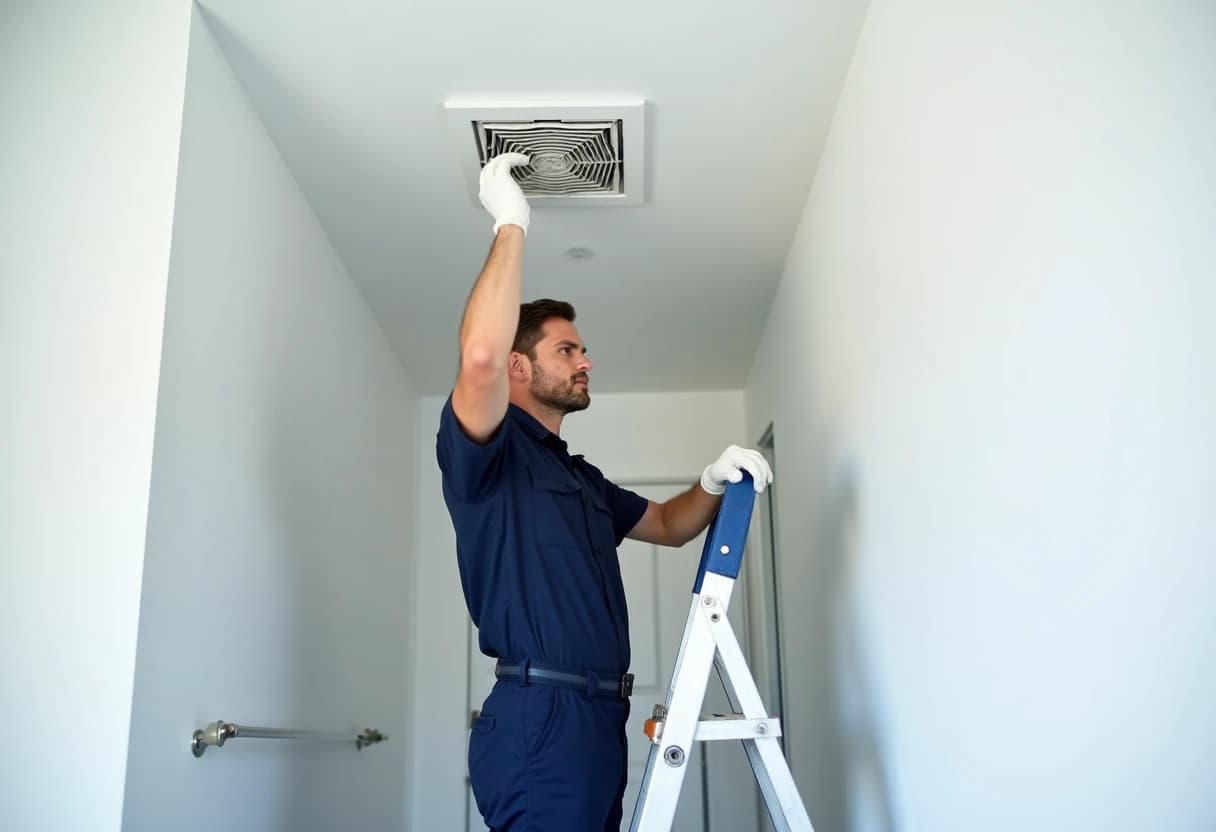
The bathroom exhaust fan is the hardest-working, least-maintained appliance in the house. It runs daily in the dampest room you own, its grille strains humid air like a filter, and nobody touches it until it rattles, stinks or stops. Our Charlestown cleaning service is the maintenance it has been missing: we drop the grille and wash it, clean the fan blades and motor housing so the motor stops fighting its own dirt, clean the duct run all the way to the roof cap or soffit vent, check the damper and termination, and measure airflow before and after. Fans routinely leave our visit moving two to three times the air they arrived with — quieter, too.
Why Bathroom Exhaust Fan Cleaning Matters for Charlestown Homes
There is also a health and air-quality case that goes beyond the bathroom walls. Bathrooms are the primary humidity source in most homes, and humidity is the master variable for indoor biological growth — dust mites, mold and bacteria all track it. When bathroom exhaust fails, that humidity migrates: into hallways, bedrooms and closets, raising whole-house moisture levels and feeding allergen loads far from the shower. Families notice it as musty odors in adjacent rooms, condensation on winter windows throughout the house, and allergy symptoms that resist bedroom-level fixes. Restoring bathroom exhaust is one of the highest-leverage whole-home humidity interventions available, and it costs a fraction of what dehumidifiers cost to buy and run. It matters even more in the tight quarters of condos and triple-deckers, where one bathroom's failed ventilation raises humidity for the whole unit and, in stacked buildings, contributes to moisture complaints in neighboring units. Many Massachusetts condo associations now include exhaust fan verification in unit maintenance requirements for precisely this reason.
Bathroom ventilation problems in Charlestown are written right into the housing stock. Charlestown pairs some of Boston's oldest brick and clapboard rowhouses - many predating the Civil War on the slopes around Monument Square - with converted Navy Yard warehouse lofts and newer waterfront condo buildings. The rowhouses have seen generations of heating retrofits, from coal to steam to gas forced air, leaving abandoned chases and improvised duct paths behind old walls. Navy Yard conversions feature exposed industrial ductwork with huge interior surface area that shows dust plainly. Many of these bathrooms either predate exhaust fans entirely — retrofitted with whatever unit and duct path a later owner could improvise — or carry original builder-grade fans that have run for decades without service. Charlestown sits on a peninsula between the Mystic and Charles rivers, and that maritime humidity works its way into basements and duct systems, encouraging musty odors in the neighborhood's antique housing. In the Navy Yard lofts, the exposed spiral ductwork that gives units their character also makes accumulated dust visible to everyone at a dinner party - a surprisingly common reason we get called across the bridge. Our technicians see the local patterns weekly: long flex runs sagging through attic bays, wall fans in masonry buildings furred solid, terminations buried under later siding or roofing work. We clean the full path, flag what cleaning alone cannot fix, and verify the airflow before we leave — the same standard on a Charlestown triple-decker as on a new build.
Our Bathroom Exhaust Fan Cleaning Process in Charlestown
1Airflow Test & System Assessment
We start by measuring what the fan actually moves — the tissue test at minimum, an anemometer reading when precision helps — and by asking about symptoms: fog that lingers, ceiling spots, noise, odors. The before-reading gives us a baseline, and your answers usually predict what the duct will show.
2Protect the Bathroom & Drop the Grille
We lay protection over the vanity, tub and floor before touching anything overhead. The grille is released — gently, since aging plastic clips grow brittle — and taken down for degreasing and washing. A grille that strains humid air daily accumulates a felt that must be soaked off, not dusted off.
3Clean the Fan Blades, Motor & Housing
This step returns the fan to its rated performance. Dust on blades changes their shape and steals capacity; dust packed around motors traps heat and shortens their lives. We clean both thoroughly, check that the wheel spins free and true, and inspect wiring and mounts while the housing is open — problems get photographed and flagged.
4Clean the Full Duct Run
The duct gets cleaned end to end, not just where it meets the fan. In attic runs we follow the duct physically where access allows, correcting sags that trap condensation and verifying every joint is still connected — a surprising number are not, and a disconnected bathroom duct is quietly raining moisture into the insulation.
5Check the Roof or Soffit Termination
Every bathroom duct ends somewhere — a roof cap, a soffit vent, a wall hood — and that termination is a common failure point. We verify the damper opens freely and closes fully, clear any matted screen or debris, and confirm exhaust actually exits the building rather than dead-ending in the attic.
6Verify Airflow & Reassemble
Proof beats promises: the same tissue or anemometer test from the start of the visit is repeated at the end, and you see the difference yourself. Reassembly is careful — grille seated properly, no rattles, damper motion confirmed one more time — and every surface we covered is uncovered and wiped.
7Report, Recommendations & Maintenance Notes
Documentation comes standard because bathroom fans intersect with real decisions: condo compliance requests, mold remediation follow-ups, pre-sale punch lists. Our summary — findings, photos, airflow figures — slots into all of them. And if we spotted anything beyond our scope, like active mold in the surrounding drywall, you will hear it straight, with referral guidance rather than an upsell.
Benefits of Professional Bathroom Exhaust Fan Cleaning in Charlestown
A Bathroom That Actually Dries
Paint, caulk, grout and trim all fail early in chronically damp bathrooms — peeling, cracking, blackening on a schedule set by humidity. Fixing the exhaust extends the life of every finished surface in the room, which is why a $99–$199 cleaning routinely postpones a four-figure repaint or regrout.
Fresher Air & Odor Control
Odor removal is the fan's second job, and a choked fan fails at it just as thoroughly. Restored airflow clears the room in minutes instead of lingering half the morning — a small daily quality-of-life upgrade every member of the household notices immediately.
Lower Whole-Home Humidity
In condos and triple-deckers, one bathroom's moisture becomes the unit's moisture and sometimes the neighbor's. Restored exhaust keeps humidity where it can be removed, which is why associations increasingly treat working bathroom fans as building infrastructure rather than a private convenience.
A Quieter, Longer-Lived Fan
The rattle and drone of an old bathroom fan is usually dirt, not age: dust-loaded blades run out of balance, and buildup around the motor makes it labor. Cleaned and rebalanced, most fans run dramatically quieter — customers regularly assume we replaced the unit.
Protection for the Attic & Structure
The exhaust duct's hidden failures — sagging runs, separated joints, terminations that never worked — send shower moisture into attics and wall cavities, where it wets insulation, breeds mold on sheathing and feeds winter ice-dam cycles. Our full-path cleaning finds and flags these problems before they become structural bills.
Cheap Insurance Bundled Conveniently
At $99–$199 per bathroom — less when bundled with air duct or dryer vent service — this is among the least expensive preventive services in home maintenance, weighed against what chronic bathroom moisture costs: remediation, repainting, regrouting, fan replacement, attic repairs. The economics are not close.
Signs Your Charlestown Home Needs Bathroom Exhaust Fan Cleaning
Mold Keeps Returning on Ceiling or Grout
Recurring mold in a bathroom with a running fan is a contradiction that points straight at the duct: the fan spins, but blockage means little air actually leaves. The EPA's moisture-first guidance applies exactly here — no amount of surface treatment outperforms restored ventilation.
Mirrors Stay Fogged Long After Showers
A working exhaust fan should clear mirror fog within minutes of shower's end. Fog that lingers a half hour is humidity with nowhere to go — the fan is running but not exhausting, which is the signature of a blocked duct or a dust-choked fan assembly.
The Fan Has Grown Loud, Rattly or Labored
A change in sound is a change in condition. Grinding suggests a failing bearing running hot under its dust blanket; rhythmic ticking suggests debris contacting the wheel; a strained drone suggests a motor fighting resistance. Cleaning resolves most of these — and identifies the fans genuinely near end of life.
Musty Smells When the Fan Runs
A fan that makes the bathroom smell worse is contaminating rather than ventilating: the damp felt on its blades and housing hosts microbial growth, and running the fan aerosolizes it. Cleaning removes the growth medium — the smell leaves with the dirt.
Visible Dust Fur on the Grille
The grille is the system's tell: gray fuzz on the louvers means the fan has been straining humid air through accumulating dust for years, and the buildup you can see continues into the blades, housing and duct you cannot. A furred grille has never once meant a clean duct behind it.
Ceiling Stains or Winter Drips Around the Fan
If stains reappear after every repaint, stop repainting and check the exhaust path. Paint hides the symptom for a season; airflow removes the cause permanently. We photograph the duct conditions behind chronic stains, so you finally see what the ceiling has been protesting about.
Bathroom Exhaust Fan Cleaning Cost in Charlestown, MA
A note on what you should not pay for. Bathroom fan cleaning does not require replacement parts in most visits, does not require chemical treatments as a default, and does not require a new fan nearly as often as some operators suggest — a cleaned and rebalanced fan frequently performs like new, and we treat replacement as the last resort it should be. Be wary of trip-fee-plus-hourly pricing that cannot be pinned down in advance, and of quotes that cover only the grille and visible housing: the duct run and termination are where most lost airflow lives, and any price that excludes them buys an incomplete job. Our quotes are flat, stated before work begins, and inclusive of the full path from grille to termination. If a repair need surfaces — a new roof cap, a damper, a section of crushed duct replaced — it is photographed, explained and priced separately for your decision. The cleaning stands on its own, and the airflow verification at the end is the receipt.
Want the full pricing picture? See our complete Boston-area cost guide or call (617) 390-7145 for an exact flat quote for your Charlestown home.
Local Knowledge: Charlestown, Suffolk County
Every town's ductwork tells the story of its housing. Charlestown pairs some of Boston's oldest brick and clapboard rowhouses - many predating the Civil War on the slopes around Monument Square - with converted Navy Yard warehouse lofts and newer waterfront condo buildings. The rowhouses have seen generations of heating retrofits, from coal to steam to gas forced air, leaving abandoned chases and improvised duct paths behind old walls. Navy Yard conversions feature exposed industrial ductwork with huge interior surface area that shows dust plainly. Charlestown sits on a peninsula between the Mystic and Charles rivers, and that maritime humidity works its way into basements and duct systems, encouraging musty odors in the neighborhood's antique housing. In the Navy Yard lofts, the exposed spiral ductwork that gives units their character also makes accumulated dust visible to everyone at a dinner party - a surprisingly common reason we get called across the bridge. We plan Charlestown jobs around those realities, from equipment selection to time on site, and it shows in the results. If you live near Bunker Hill Monument or anywhere across Charlestown's 02129 area, we have almost certainly cleaned a system like yours before — and we can tell you exactly what to expect before we arrive.
The Best Time of Year in Charlestown
Fall is the strategic season for bathroom fan cleaning in New England, for the same reason it is furnace season: the system is about to face its hardest months. From November through April, every shower sends humid air into ducts crossing freezing attics, and only brisk airflow clears the run before condensation forms. A fan cleaned in October enters winter at full capacity — mirrors clear, ceilings dry, ducts moving air fast enough to beat the dew point. A dirty fan enters the same winter already losing the race, and the losses compound: condensate wets the duct's dust lining, the wet lining blocks more flow, and by February the bathroom is growing its annual crop of ceiling spots.
Why Choose Boston Air Duct Cleaners
We built this company around the jobs other duct cleaners do badly: the 130-year-old Victorian with panned-joist returns, the Charlestown condo with a 60-foot dryer run to the roof, the post-renovation house full of drywall dust. Our crews see Greater Boston's hardest systems every week, and the experience shows in the details — floor protection on the way in, sealed registers during the work, HEPA-vacuumed work areas on the way out, and imagery that proves the ducts are actually clean. Call (617) 390-7145 and judge the difference from the first conversation.
Serving Charlestown and Surrounding Communities
Beyond Charlestown, our crews cover the surrounding communities daily — including Boston, Somerville, Everett, East Boston, Cambridge, Chelsea. Because routes cluster geographically, booking alongside a neighboring appointment often unlocks same-day service and combined-visit savings. Wherever you are in Suffolk County, the same flat-rate pricing, insured technicians and photo-documented process applies.