
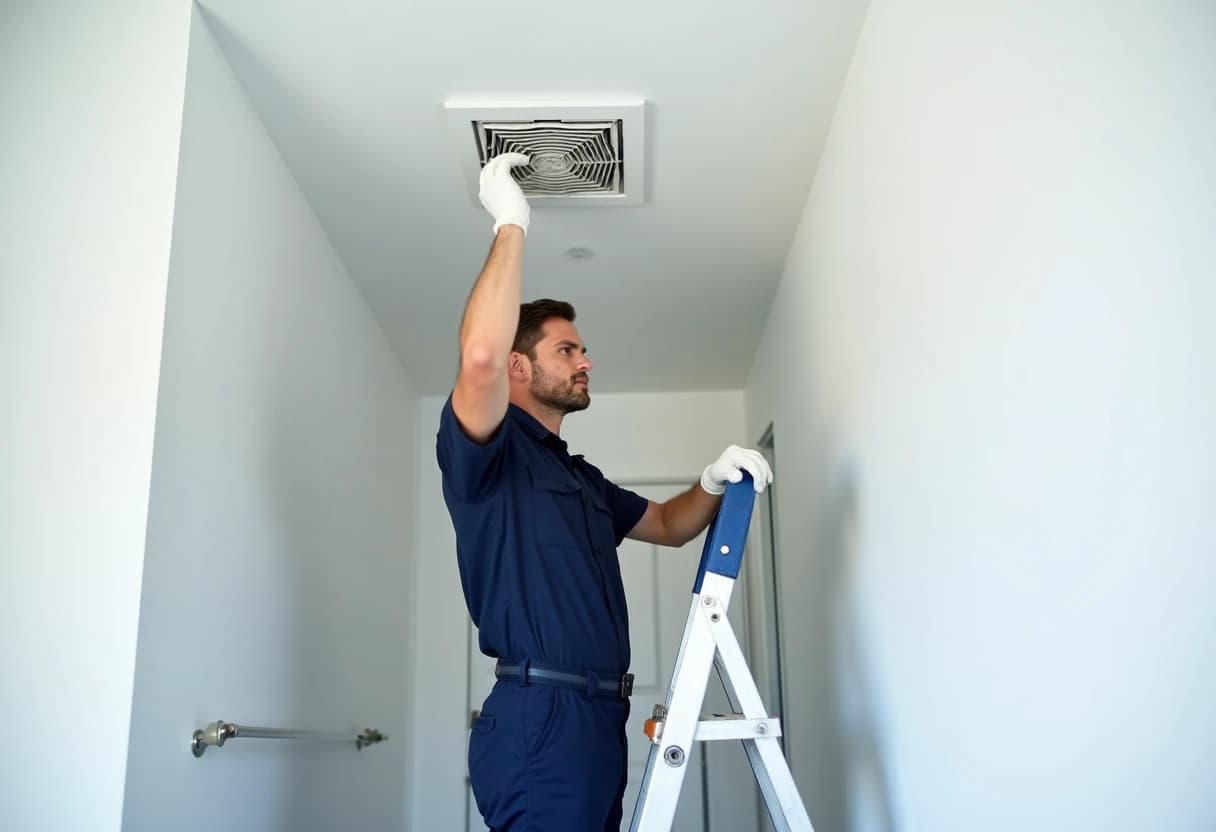
Hold a square of toilet paper up to your running bathroom fan. If the fan cannot pin it against the grille, it is not moving enough air to protect the room — and in our experience across Lexington, most fans fail that test. The cause is almost always accumulation: dust bonds to moist surfaces inside the fan and duct, layer by layer, until a fan rated to clear the room in minutes can barely stir it. Our service is a true deep clean of the entire exhaust path, from the grille you can see to the roof or soffit termination you cannot, finishing with an airflow check that proves the fix. It is one of the least expensive, highest-impact moisture-control services a homeowner can buy.
Why Bathroom Exhaust Fan Cleaning Matters for Lexington Homes
The part of the system nobody thinks about is the duct — and in Greater Boston housing, the duct is usually the biggest problem. Bathroom fans here typically exhaust through a run of flexible or rigid duct crossing an unconditioned attic to a roof cap, or snaking through framing to a soffit or gable termination. Those runs accumulate the same humid-air felt as the fan, and they add failure modes of their own: sagging flex duct that collects condensation in its low spots, terminations whose dampers stick shut or whose screens mat over with lint and dust, and disconnected joints quietly dumping shower moisture straight into the attic insulation. That last one is the silent disaster — a bathroom fan venting into the attic saturates insulation, breeds mold on roof sheathing, and in winter contributes to the frost-and-ice-dam cycle New England roofs suffer. Our cleaning covers the complete path and inspects it as we go, so a hidden disconnection or an attic-venting fan gets caught and flagged instead of festering for another decade.
Ask anyone renovating near Munroe Tavern what they found when the bathroom ceiling came down: the fan duct tells the story of the house. The birthplace of the American Revolution mixes colonial-era landmarks near the Battle Green with an unusually deep stock of mid-century modern and 1950s-60s ranch and split-level neighborhoods - and, increasingly, large new homes replacing them through the town's active teardown-rebuild market. The mid-century houses were early adopters of forced-air heat, so original sixty-plus-year-old ductwork is common, while the new builds carry tightly sealed envelopes that make duct hygiene matter even more. We regularly find original fans wired decades ago, ducts of every improvised material, and terminations that stopped functioning years back — all still running daily against total blockage. Lexington's teardown-and-rebuild wave means many streets host active construction, and neighboring homes routinely pull that airborne dust into their return ducts for months. In the town's cherished mid-century modern homes, slab-level and ceiling-mounted duct runs are original equipment that has often gone half a century without cleaning. A cleaning visit is the inexpensive way to learn what your own bathroom is hiding: we open the system, clean it end to end, photograph anything that needs attention, and restore the airflow that keeps Lexington bathrooms dry through the heating season. Most visits finish inside an hour per fan.
Our Bathroom Exhaust Fan Cleaning Process in Lexington
1Airflow Test & System Assessment
We start by measuring what the fan actually moves — the tissue test at minimum, an anemometer reading when precision helps — and by asking about symptoms: fog that lingers, ceiling spots, noise, odors. The before-reading gives us a baseline, and your answers usually predict what the duct will show.
2Protect the Bathroom & Drop the Grille
Bathrooms are finished spaces, so we treat them that way: drop cloth below the fan, fixtures covered, careful hands on grilles that may not have moved in decades. The grille comes down for a full wash — soaking and scrubbing away the bonded dust fur that no in-place vacuuming can remove.
3Clean the Fan Blades, Motor & Housing
With the housing open, we clean what actually moves the air: blades or blower wheel cleared of their bonded buildup, motor exterior and mounts cleaned, and the housing interior vacuumed and wiped. An unbalanced, dust-loaded wheel is why old fans rattle — cleaned and rebalanced, most run noticeably quieter immediately.
4Clean the Full Duct Run
From the fan housing, we clean the duct itself — brush and vacuum for rigid runs, gentler methods for flexible duct that tears easily — working toward the termination. This is where most of the lost airflow lives: years of humid-air dust lining every inch of a duct only a few inches across.
5Check the Roof or Soffit Termination
Terminations take the weather for the whole system: dampers stick with corrosion and paint, caps crack, screens mat over into felt pads, and soffit terminations get blocked by later insulation work. We check and clear the exit point, because a perfectly cleaned duct still fails if its door will not open.
6Verify Airflow & Reassemble
Proof beats promises: the same tissue or anemometer test from the start of the visit is repeated at the end, and you see the difference yourself. Reassembly is careful — grille seated properly, no rattles, damper motion confirmed one more time — and every surface we covered is uncovered and wiped.
7Report, Recommendations & Maintenance Notes
The visit closes with a walkthrough: what the duct looked like, what the termination needed, how the numbers changed. We note the fan's make and condition for your records, recommend a realistic recleaning interval based on household use, and leave grille-vacuuming tips that stretch the interval further.
Benefits of Professional Bathroom Exhaust Fan Cleaning in Lexington
Cheap Insurance Bundled Conveniently
Most customers add bathroom fans to an existing appointment: the crew is already in the house, the equipment is on the truck, and the per-fan price drops accordingly. One visit covers every exhaust system you own — HVAC ducts, dryer vent, bathroom fans — which is how whole-house air maintenance should work.
Lower Whole-Home Humidity
Dust mites and mold throughout the house track indoor humidity, and indoor humidity tracks bathroom ventilation more than most owners realize. Fixing the exhaust path is one of the cheapest whole-home humidity interventions available — a fraction of the purchase and running cost of the dehumidifier it often replaces.
Mold Prevention at the Source
EPA mold guidance is blunt: control the moisture and you control the mold. In a bathroom, the exhaust fan is the moisture control, and cleaning is what keeps it working. Customers who fought recurring ceiling spots for years consistently report the spots simply stop returning once real airflow is restored.
A Quieter, Longer-Lived Fan
The rattle and drone of an old bathroom fan is usually dirt, not age: dust-loaded blades run out of balance, and buildup around the motor makes it labor. Cleaned and rebalanced, most fans run dramatically quieter — customers regularly assume we replaced the unit.
Protection for the Attic & Structure
Ceiling stains around bathroom fans are usually condensation dripping back from cold, dirty ducts — not roof leaks. Cleaning restores the airflow that outruns condensation, and our inspection of the run corrects the sags and gaps that let water collect. The stain stops growing because its source is gone.
Fresher Air & Odor Control
Guest bathrooms, powder rooms, rental units: anywhere odors and freshness matter to people beyond the household, a properly exhausting fan is the difference between a bathroom that resets itself and one that broadcasts its history. Landlords bundle this service across units for exactly that reason.
Signs Your Lexington Home Needs Bathroom Exhaust Fan Cleaning
Mirrors Stay Fogged Long After Showers
If you have started cracking the bathroom window in January because the fan cannot cope, the workaround is telling you the system has failed — and the open window is pouring heated air out of the house all winter. Cleaning the exhaust path is cheaper than the habit.
Mold Keeps Returning on Ceiling or Grout
Recurring mold in a bathroom with a running fan is a contradiction that points straight at the duct: the fan spins, but blockage means little air actually leaves. The EPA's moisture-first guidance applies exactly here — no amount of surface treatment outperforms restored ventilation.
Visible Dust Fur on the Grille
The grille is the system's tell: gray fuzz on the louvers means the fan has been straining humid air through accumulating dust for years, and the buildup you can see continues into the blades, housing and duct you cannot. A furred grille has never once meant a clean duct behind it.
The Tissue Test Fails
Hold a single square of toilet paper against the running fan's grille: a healthy fan pins it firmly in place; a failing fan lets it fall. It is the simplest diagnostic in home maintenance, takes ten seconds, and if your fan fails it, the exhaust path needs cleaning.
Ceiling Stains or Winter Drips Around the Fan
Brown rings around a bathroom fan are usually condensation, not roof leaks: humid air cooling in a dirty, restricted duct condenses and drips back through the housing. Restoring brisk airflow lets exhaust clear the duct before condensing — which is why cleaning, not roofing, fixes most of these stains.
Musty Smells When the Fan Runs
Musty odor from the grille can also signal trouble upstream: condensation pooling in a sagging duct run, or moisture problems at a failed termination. Either way the nose knows before the eyes do, and a full-path cleaning with duct inspection identifies which problem you have.
Bathroom Exhaust Fan Cleaning Cost in Lexington, MA
It is worth pricing this service against what it prevents, because the prevention math is lopsided. Recurring bathroom mold that finally spreads into drywall means remediation billed in the thousands; chronic humidity peels paint and blackens grout on a repeating cycle of four-figure refinishing; a fan motor cooked by years of dust-blanket operation means replacement — the unit, the electrician, the ceiling patching — at several times the cost of the cleaning that would have prevented it. The hidden failures are costlier still: a duct quietly venting into the attic wets insulation and sheathing for years before discovery, and the repair bill reflects every one of those years. Against that list, $99–$199 per fan every two to three years is one of the cheapest insurance policies in home maintenance. The bathrooms where it matters most are exactly the ones where the service is most neglected: rentals, guest baths, and the hardworking family bathroom that runs four showers a day against a duct that has not been touched since installation.
Want the full pricing picture? See our complete Boston-area cost guide or call (617) 390-7145 for an exact flat quote for your Lexington home.
Local Knowledge: Lexington, Middlesex County
What makes Lexington different? The birthplace of the American Revolution mixes colonial-era landmarks near the Battle Green with an unusually deep stock of mid-century modern and 1950s-60s ranch and split-level neighborhoods - and, increasingly, large new homes replacing them through the town's active teardown-rebuild market. The mid-century houses were early adopters of forced-air heat, so original sixty-plus-year-old ductwork is common, while the new builds carry tightly sealed envelopes that make duct hygiene matter even more. Lexington's teardown-and-rebuild wave means many streets host active construction, and neighboring homes routinely pull that airborne dust into their return ducts for months. In the town's cherished mid-century modern homes, slab-level and ceiling-mounted duct runs are original equipment that has often gone half a century without cleaning. For duct and dryer vent systems, those local factors translate into specific, predictable problems — and predictable problems are the ones we solve fastest. Call (617) 390-7145, tell us your street and home style, and we will quote the job accurately the first time, usually in under five minutes.
The Best Time of Year in Lexington
Fall is the strategic season for bathroom fan cleaning in New England, for the same reason it is furnace season: the system is about to face its hardest months. From November through April, every shower sends humid air into ducts crossing freezing attics, and only brisk airflow clears the run before condensation forms. A fan cleaned in October enters winter at full capacity — mirrors clear, ceilings dry, ducts moving air fast enough to beat the dew point. A dirty fan enters the same winter already losing the race, and the losses compound: condensate wets the duct's dust lining, the wet lining blocks more flow, and by February the bathroom is growing its annual crop of ceiling spots.
Why Choose Boston Air Duct Cleaners
We built this company around the jobs other duct cleaners do badly: the 130-year-old Victorian with panned-joist returns, the Lexington condo with a 60-foot dryer run to the roof, the post-renovation house full of drywall dust. Our crews see Greater Boston's hardest systems every week, and the experience shows in the details — floor protection on the way in, sealed registers during the work, HEPA-vacuumed work areas on the way out, and imagery that proves the ducts are actually clean. Call (617) 390-7145 and judge the difference from the first conversation.
Serving Lexington and Surrounding Communities
Beyond Lexington, our crews cover the surrounding communities daily — including Arlington, Belmont, Bedford, Burlington, Waltham, Lincoln. Because routes cluster geographically, booking alongside a neighboring appointment often unlocks same-day service and combined-visit savings. Wherever you are in Middlesex County, the same flat-rate pricing, insured technicians and photo-documented process applies.