
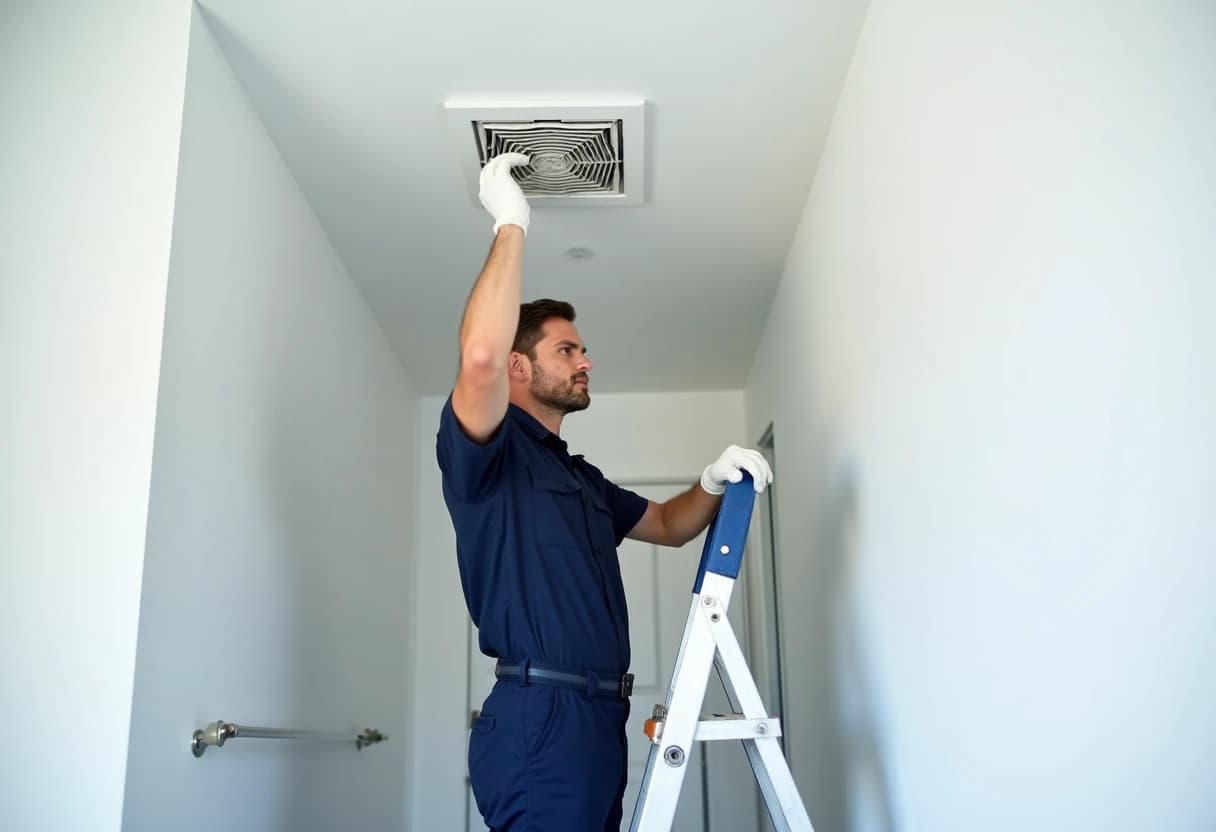
Mold in a bathroom is rarely a cleaning-product problem — it is an airflow problem. Every shower releases moisture that must leave the room through one small duct, and when that duct and its fan are choked with years of dust, the moisture stays: fogging mirrors long after the shower ends, feeding the black speckling on ceilings and grout, and condensing inside walls where you cannot see it. Our Pembroke technicians clean the complete system — grille, blades, motor housing, and the full duct run to its exterior termination — then verify the restored airflow. EPA guidance on mold control starts with ventilation for a reason: fix the airflow and the bathroom finally dries the way it was designed to.
Why Bathroom Exhaust Fan Cleaning Matters for Pembroke Homes
The grille test tells the story: pull the cover off any bathroom fan that has run for a few years without service and you will find the blades wearing fur coats and the housing packed with damp gray felt. That accumulation does three kinds of damage. It blocks airflow, so moisture stays in the room and feeds mold on every surface it touches. It loads and unbalances the motor, which is why neglected fans hum, rattle and grind — and why their motors burn out years early, often seizing in a way that presents a genuine overheating hazard in an appliance mounted against attic framing. And it makes the fan itself a contamination source: a dust-caked fan in a moist room grows its own microbial load, then blows it around the bathroom every time it runs. Cleaning reverses all three at once. It is dramatically cheaper than the alternatives people end up paying for instead — repeated mold remediation of the same ceiling, premature fan replacement, or repainting a bathroom every other year because the paint keeps failing from trapped humidity.
From the older streets near North River to the newer condos toward Pembroke Town Green, Pembroke bathrooms share a common enemy: a long, humid heating season that punishes any weakness in exhaust ventilation. Pembroke grew fastest in the 1960s through 1990s, filling in around its ponds with capes, ranches and Colonials, many originally built as summer cottages on Oldham and Furnace Ponds and later winterized. Those converted cottages carry improvised heating systems with short, awkward duct runs, while the later subdivision homes run standard forced-air setups now reaching the age of failing joints. Newer developments off Route 53 add fresh construction with attic-based systems. When fans and ducts are dirty, winter showers become condensation events — fogged mirrors, ceiling spots, moldy grout that keeps returning no matter the scrubbing. Pembroke's pond-cottage heritage means we regularly work in winterized summer homes where ductwork was squeezed into crawlspaces never meant to hold it, and pond-side humidity keeps those runs damp. Wood stoves remain popular backup heat here, and their fine ash finds its way into return ducts all over town. We clean and verify the complete exhaust path, and because our shop is about 32 miles away in West Newton, Pembroke appointments are easy route stops — often same-week, and frequently bundled with air duct or dryer vent service at a reduced combined rate.
Our Bathroom Exhaust Fan Cleaning Process in Pembroke
1Airflow Test & System Assessment
We start by measuring what the fan actually moves — the tissue test at minimum, an anemometer reading when precision helps — and by asking about symptoms: fog that lingers, ceiling spots, noise, odors. The before-reading gives us a baseline, and your answers usually predict what the duct will show.
2Protect the Bathroom & Drop the Grille
We lay protection over the vanity, tub and floor before touching anything overhead. The grille is released — gently, since aging plastic clips grow brittle — and taken down for degreasing and washing. A grille that strains humid air daily accumulates a felt that must be soaked off, not dusted off.
3Clean the Fan Blades, Motor & Housing
The fan assembly gets detailed by hand: every blade surface cleared, the motor housing cleaned so the motor stops running hot under its dust blanket, and the interior of the unit HEPA-vacuumed. Where the assembly is designed to drop out, we remove it for a more thorough bench cleaning at the site.
4Clean the Full Duct Run
From the fan housing, we clean the duct itself — brush and vacuum for rigid runs, gentler methods for flexible duct that tears easily — working toward the termination. This is where most of the lost airflow lives: years of humid-air dust lining every inch of a duct only a few inches across.
5Check the Roof or Soffit Termination
Terminations take the weather for the whole system: dampers stick with corrosion and paint, caps crack, screens mat over into felt pads, and soffit terminations get blocked by later insulation work. We check and clear the exit point, because a perfectly cleaned duct still fails if its door will not open.
6Verify Airflow & Reassemble
The final test is the point of the whole visit: does the fan now clear the room? We verify strong draw at the grille, confirm smooth and quiet operation, and reinstall the cleaned grille. If measured airflow remains weak after a full cleaning, the cause is mechanical or structural — and we tell you exactly what and what it would cost, rather than declaring victory.
7Report, Recommendations & Maintenance Notes
Documentation comes standard because bathroom fans intersect with real decisions: condo compliance requests, mold remediation follow-ups, pre-sale punch lists. Our summary — findings, photos, airflow figures — slots into all of them. And if we spotted anything beyond our scope, like active mold in the surrounding drywall, you will hear it straight, with referral guidance rather than an upsell.
Benefits of Professional Bathroom Exhaust Fan Cleaning in Pembroke
A Quieter, Longer-Lived Fan
The rattle and drone of an old bathroom fan is usually dirt, not age: dust-loaded blades run out of balance, and buildup around the motor makes it labor. Cleaned and rebalanced, most fans run dramatically quieter — customers regularly assume we replaced the unit.
A Bathroom That Actually Dries
Weak exhaust makes a bathroom feel older than it is: perpetually damp air, sticky surfaces, fog that outlasts the shower by an hour. Restored airflow reverses the feel of the room the first day. Many customers tell us it is the most noticeable result of any service we offer, per dollar spent.
Mold Prevention at the Source
EPA mold guidance is blunt: control the moisture and you control the mold. In a bathroom, the exhaust fan is the moisture control, and cleaning is what keeps it working. Customers who fought recurring ceiling spots for years consistently report the spots simply stop returning once real airflow is restored.
Protection for the Attic & Structure
Ceiling stains around bathroom fans are usually condensation dripping back from cold, dirty ducts — not roof leaks. Cleaning restores the airflow that outruns condensation, and our inspection of the run corrects the sags and gaps that let water collect. The stain stops growing because its source is gone.
Lower Whole-Home Humidity
Dust mites and mold throughout the house track indoor humidity, and indoor humidity tracks bathroom ventilation more than most owners realize. Fixing the exhaust path is one of the cheapest whole-home humidity interventions available — a fraction of the purchase and running cost of the dehumidifier it often replaces.
Fresher Air & Odor Control
A dirty fan can actually smell: the damp felt coating its blades and housing hosts microbial growth, and running the fan distributes the mustiness it was supposed to remove. Cleaning eliminates the fan-as-source problem, which is the answer to bathrooms that smell worse with the fan on.
Signs Your Pembroke Home Needs Bathroom Exhaust Fan Cleaning
Mirrors Stay Fogged Long After Showers
If you have started cracking the bathroom window in January because the fan cannot cope, the workaround is telling you the system has failed — and the open window is pouring heated air out of the house all winter. Cleaning the exhaust path is cheaper than the habit.
The Tissue Test Fails
Try the test in every bathroom; the comparison is telling. Households often find one fan holds the tissue firmly while another drops it instantly — same house, same habits, different duct conditions. The failing one is not older or worse; it is dirtier, and cleaning restores it.
Ceiling Stains or Winter Drips Around the Fan
Actual dripping from the fan on cold mornings is the same condensation cycle at full strength, and it deserves prompt attention: the water is also soaking the duct's low spots and the ceiling cavity. Cleaning plus correcting duct sags typically resolves it in one visit.
Musty Smells When the Fan Runs
A fan that makes the bathroom smell worse is contaminating rather than ventilating: the damp felt on its blades and housing hosts microbial growth, and running the fan aerosolizes it. Cleaning removes the growth medium — the smell leaves with the dirt.
The Fan Has Grown Loud, Rattly or Labored
Fans do not naturally get louder with age — they get louder with dirt. Dust bonds unevenly to blades, unbalancing the wheel; buildup around the motor makes it labor. The rattle, hum or grind you have learned to ignore is the sound of a system asking to be cleaned.
Visible Dust Fur on the Grille
Vacuuming the grille and calling it done is the most common bathroom fan mistake. The visible fur is the shallow end of the accumulation — the airflow-killing buildup lives on the blades and duct walls, bonded by humidity, and only a full-system cleaning reaches it.
Bathroom Exhaust Fan Cleaning Cost in Pembroke, MA
Three factors set your exact price. First, termination type: soffit and wall terminations are quick to access and verify; roof caps require ladder or roof work that adds cost, especially on steep New England rooflines. Second, duct length and material: a four-foot rigid run cleans quickly, while twenty feet of aging flex duct across an attic takes time and care — flexible duct tears if cleaned aggressively, so it is slower by necessity. Third, fan condition: a unit serviced within recent memory cleans faster than one untouched since installation, where bonded buildup needs soaking and hand work. What does not change the price: surprises we find along the way. Discovered problems — disconnected joints, failed dampers, fans venting into the attic — get photographed and quoted separately as flat-rate repairs, never folded into the cleaning bill or performed without approval. And if a fan proves to be at genuine end of life, we say so plainly; charging full cleaning price for a motor with months to live helps nobody, and we would rather quote the replacement honestly.
Want the full pricing picture? See our complete Boston-area cost guide or call (617) 390-7145 for an exact flat quote for your Pembroke home.
Local Knowledge: Pembroke, Plymouth County
What makes Pembroke different? Pembroke grew fastest in the 1960s through 1990s, filling in around its ponds with capes, ranches and Colonials, many originally built as summer cottages on Oldham and Furnace Ponds and later winterized. Those converted cottages carry improvised heating systems with short, awkward duct runs, while the later subdivision homes run standard forced-air setups now reaching the age of failing joints. Newer developments off Route 53 add fresh construction with attic-based systems. Pembroke's pond-cottage heritage means we regularly work in winterized summer homes where ductwork was squeezed into crawlspaces never meant to hold it, and pond-side humidity keeps those runs damp. Wood stoves remain popular backup heat here, and their fine ash finds its way into return ducts all over town. For duct and dryer vent systems, those local factors translate into specific, predictable problems — and predictable problems are the ones we solve fastest. Call (617) 390-7145, tell us your street and home style, and we will quote the job accurately the first time, usually in under five minutes.
The Best Time of Year in Pembroke
Humid Boston summers give bathroom fans a different job and expose a different weakness. With July dew points regularly in the mid-60s and above, the bathroom starts each day damp before anyone showers, and a weak fan cannot clear moisture the ambient air continuously replaces. The result is the summer complaint pattern: mildew smell that builds through August, towels that never fully dry, mold appearing in bathrooms that were fine all winter. Coastal and near-coastal homes add salt air, which corrodes damper hinges and fan components faster than inland exposure. Summer is also our lightest booking season, which makes it the practical choice for multi-fan homes and landlord portfolios — easy scheduling, bundle-friendly, and the whole system ready before fall closes the windows.
Why Choose Boston Air Duct Cleaners
Choosing a duct cleaner is really a trust decision — you are letting a crew work inside the system that feeds air to your family. We make that decision easy: a local West Newton company with insured, uniformed technicians, transparent flat-rate quotes, NADCA-standard equipment and methods, and photographic proof of the finished work. No door-to-door sales, no bait-and-switch coupons, no invented 'mold emergencies.' Just honest mechanical cleaning done properly the first time, backed by a written guarantee.
Serving Pembroke and Surrounding Communities
Pembroke sits in the heart of our service area, and neighboring Hanover, Hanson, Marshfield, Norwell, Whitman, Rockland appointments share the same routes. That density is why our response times in this part of Plymouth County are among our fastest — and why you will see our trucks in the area week after week.