
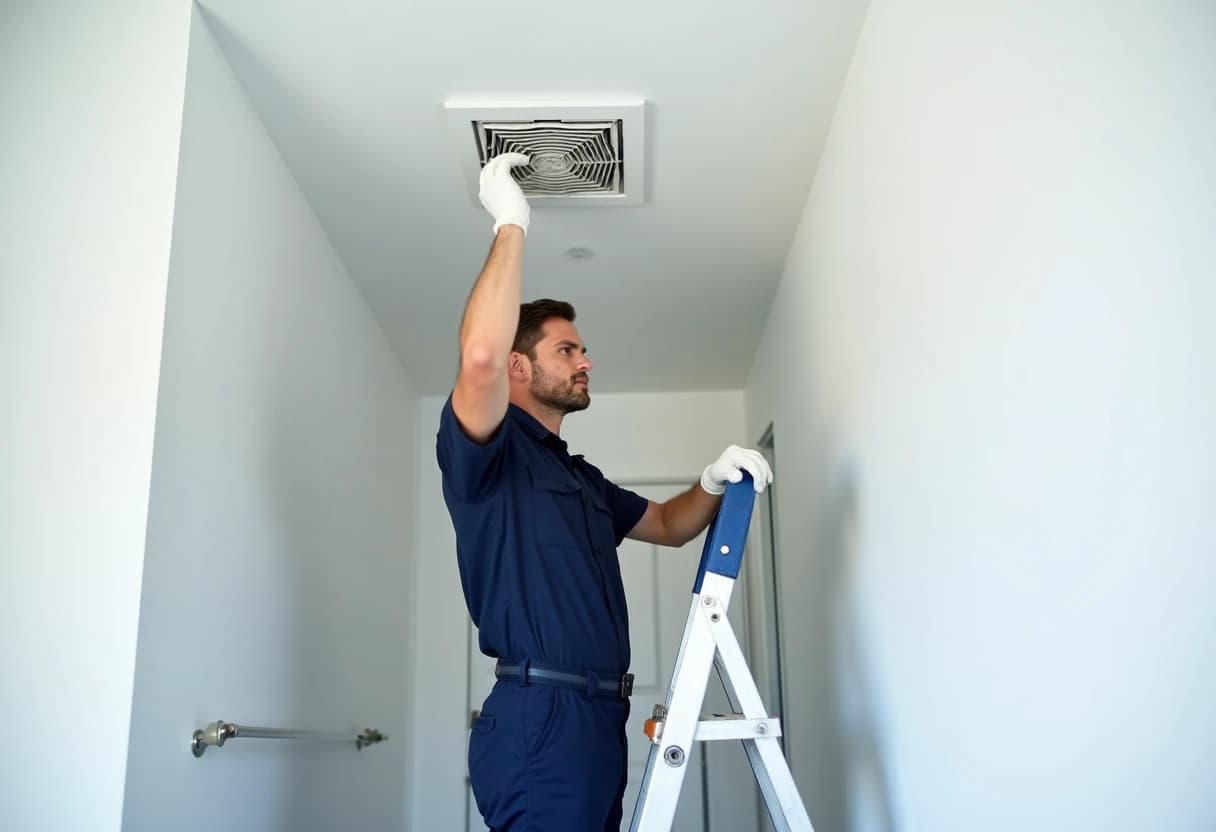
That gray fuzz on your bathroom fan grille is the visible edge of a system-wide problem. Behind the grille, the same humid-air dust has coated the fan blades, packed the motor housing, and lined the duct that carries moisture to the outdoors — and every layer steals airflow. In New England's long heating season, weak bathroom exhaust also means condensation: moist air lingering in cold duct runs through attics, dripping back onto the ceiling, staining drywall and, in the worst cases, soaking attic insulation. Our Reading crews clean and verify the full exhaust path, and we regularly pair the service with air duct or dryer vent visits — same trip, bundled pricing, every exhaust system in the house handled at once.
Why Bathroom Exhaust Fan Cleaning Matters for Reading Homes
Winter is when weak bathroom exhaust does its most expensive damage in Massachusetts. Through the long heating season, every duct run passing through a cold attic becomes a condensation trap: humid shower air enters the duct, cools below its dew point before reaching the termination, and the resulting water either drips back through the fan onto the ceiling — those mysterious brown rings around bathroom fans — or pools in flex-duct sags where it soaks accumulated dust into a blocking sludge. A clean, smooth, well-flowing duct moves air fast enough to clear before condensing; a dirty, restricted one guarantees the condensation cycle repeats with every shower from November to April. This is why bathroom ceiling stains and recurring winter mold are overwhelmingly ventilation problems rather than roof leaks, and why cleaning the exhaust path — often paired with correcting duct sags and stuck dampers found along the way — fixes bathrooms that repainting never could. If your bathroom grows spots every winter and recovers every summer, the fan system is telling you exactly what it needs.
Ask anyone renovating near Reading Depot what they found when the bathroom ceiling came down: the fan duct tells the story of the house. Reading's streets are lined with center-entrance Colonials, gambrel capes and 1920s-40s craftsman-style homes near the Common and the Depot, ringed by larger post-war and 1980s-2000s colonials farther out toward Route 128. Many of the older homes have been converted from oil boilers to forced-air heat pumps or gas furnaces, leaving retrofit duct runs squeezed through original framing and attic chases. We regularly find original fans wired decades ago, ducts of every improvised material, and terminations that stopped functioning years back — all still running daily against total blockage. Reading is a classic commuter-rail renovation town - kitchens, additions and finished basements go in constantly, and construction dust ends up circulating through duct systems for years afterward. The heat-pump conversion wave here has also created many attic-run duct systems where summer condensation can feed dust buildup and musty odors. A cleaning visit is the inexpensive way to learn what your own bathroom is hiding: we open the system, clean it end to end, photograph anything that needs attention, and restore the airflow that keeps Reading bathrooms dry through the heating season. Most visits finish inside an hour per fan.
Our Bathroom Exhaust Fan Cleaning Process in Reading
1Airflow Test & System Assessment
We start by measuring what the fan actually moves — the tissue test at minimum, an anemometer reading when precision helps — and by asking about symptoms: fog that lingers, ceiling spots, noise, odors. The before-reading gives us a baseline, and your answers usually predict what the duct will show.
2Protect the Bathroom & Drop the Grille
Bathrooms are finished spaces, so we treat them that way: drop cloth below the fan, fixtures covered, careful hands on grilles that may not have moved in decades. The grille comes down for a full wash — soaking and scrubbing away the bonded dust fur that no in-place vacuuming can remove.
3Clean the Fan Blades, Motor & Housing
The fan assembly gets detailed by hand: every blade surface cleared, the motor housing cleaned so the motor stops running hot under its dust blanket, and the interior of the unit HEPA-vacuumed. Where the assembly is designed to drop out, we remove it for a more thorough bench cleaning at the site.
4Clean the Full Duct Run
A narrow duct cannot afford any lining of debris: buildup that would be trivial in a large HVAC trunk can consume a third of a bathroom duct's cross-section. We clean the complete run with tools sized for small-bore duct, and where the run crosses accessible attic space, we inspect its routing, support and connections as we go.
5Check the Roof or Soffit Termination
Terminations take the weather for the whole system: dampers stick with corrosion and paint, caps crack, screens mat over into felt pads, and soffit terminations get blocked by later insulation work. We check and clear the exit point, because a perfectly cleaned duct still fails if its door will not open.
6Verify Airflow & Reassemble
Proof beats promises: the same tissue or anemometer test from the start of the visit is repeated at the end, and you see the difference yourself. Reassembly is careful — grille seated properly, no rattles, damper motion confirmed one more time — and every surface we covered is uncovered and wiped.
7Report, Recommendations & Maintenance Notes
The visit closes with a walkthrough: what the duct looked like, what the termination needed, how the numbers changed. We note the fan's make and condition for your records, recommend a realistic recleaning interval based on household use, and leave grille-vacuuming tips that stretch the interval further.
Benefits of Professional Bathroom Exhaust Fan Cleaning in Reading
A Bathroom That Actually Dries
Paint, caulk, grout and trim all fail early in chronically damp bathrooms — peeling, cracking, blackening on a schedule set by humidity. Fixing the exhaust extends the life of every finished surface in the room, which is why a $99–$199 cleaning routinely postpones a four-figure repaint or regrout.
A Quieter, Longer-Lived Fan
Fan motors die early for one main reason: heat trapped by the dust packed around them, working against blades made heavy and unbalanced by the same dust. Cleaning removes both stressors, routinely adding years to a motor's life and deferring the cost and ceiling-patching of a full replacement.
Mold Prevention at the Source
Every mold treatment that ignores ventilation is temporary by design — the humidity that fed the last colony feeds the next one. Restoring two to three times the airflow changes the bathroom's daily moisture budget permanently, which is why cleaning the fan system outperforms another round of bleach every time.
Lower Whole-Home Humidity
Dust mites and mold throughout the house track indoor humidity, and indoor humidity tracks bathroom ventilation more than most owners realize. Fixing the exhaust path is one of the cheapest whole-home humidity interventions available — a fraction of the purchase and running cost of the dehumidifier it often replaces.
Fresher Air & Odor Control
A dirty fan can actually smell: the damp felt coating its blades and housing hosts microbial growth, and running the fan distributes the mustiness it was supposed to remove. Cleaning eliminates the fan-as-source problem, which is the answer to bathrooms that smell worse with the fan on.
Protection for the Attic & Structure
Ceiling stains around bathroom fans are usually condensation dripping back from cold, dirty ducts — not roof leaks. Cleaning restores the airflow that outruns condensation, and our inspection of the run corrects the sags and gaps that let water collect. The stain stops growing because its source is gone.
Signs Your Reading Home Needs Bathroom Exhaust Fan Cleaning
Mirrors Stay Fogged Long After Showers
If you have started cracking the bathroom window in January because the fan cannot cope, the workaround is telling you the system has failed — and the open window is pouring heated air out of the house all winter. Cleaning the exhaust path is cheaper than the habit.
The Tissue Test Fails
Try the test in every bathroom; the comparison is telling. Households often find one fan holds the tissue firmly while another drops it instantly — same house, same habits, different duct conditions. The failing one is not older or worse; it is dirtier, and cleaning restores it.
Mold Keeps Returning on Ceiling or Grout
Scrub-recur, scrub-recur: when the same speckling returns to the same spots every few weeks, the bathroom's moisture budget is broken, and the fan system is almost always why. Cleaning restores the airflow that keeps surfaces below the moisture threshold mold needs.
Visible Dust Fur on the Grille
The grille is the system's tell: gray fuzz on the louvers means the fan has been straining humid air through accumulating dust for years, and the buildup you can see continues into the blades, housing and duct you cannot. A furred grille has never once meant a clean duct behind it.
Ceiling Stains or Winter Drips Around the Fan
Actual dripping from the fan on cold mornings is the same condensation cycle at full strength, and it deserves prompt attention: the water is also soaking the duct's low spots and the ceiling cavity. Cleaning plus correcting duct sags typically resolves it in one visit.
Musty Smells When the Fan Runs
Musty odor from the grille can also signal trouble upstream: condensation pooling in a sagging duct run, or moisture problems at a failed termination. Either way the nose knows before the eyes do, and a full-path cleaning with duct inspection identifies which problem you have.
Bathroom Exhaust Fan Cleaning Cost in Reading, MA
Bathroom exhaust fan cleaning in Greater Boston runs $99 to $199 per fan as a standalone visit, with the price driven by access and duct complexity rather than the fan itself. A first-floor fan with a short, reachable duct run sits at the low end; a top-floor fan ducted across an attic to a roof cap — requiring attic access or ladder work at the termination — sits at the top. Every visit includes the full scope: grille removal and washing, fan blade and motor housing cleaning, cleaning of the complete duct run, termination and damper check, and before-and-after airflow verification. Multiple fans in the same home are discounted steeply — the second and third bathrooms typically add $59–$89 each, since setup and travel are already covered. The most economical booking of all is the bundle: added to an air duct or dryer vent appointment, bathroom fans slot in at reduced per-fan rates because the crew and equipment are already on site. Ask about the combined price when you book; most customers find the bundle makes cleaning every fan in the house an easy decision.
Want the full pricing picture? See our complete Boston-area cost guide or call (617) 390-7145 for an exact flat quote for your Reading home.
Local Knowledge: Reading, Middlesex County
What makes Reading different? Reading's streets are lined with center-entrance Colonials, gambrel capes and 1920s-40s craftsman-style homes near the Common and the Depot, ringed by larger post-war and 1980s-2000s colonials farther out toward Route 128. Many of the older homes have been converted from oil boilers to forced-air heat pumps or gas furnaces, leaving retrofit duct runs squeezed through original framing and attic chases. Reading is a classic commuter-rail renovation town - kitchens, additions and finished basements go in constantly, and construction dust ends up circulating through duct systems for years afterward. The heat-pump conversion wave here has also created many attic-run duct systems where summer condensation can feed dust buildup and musty odors. For duct and dryer vent systems, those local factors translate into specific, predictable problems — and predictable problems are the ones we solve fastest. Call (617) 390-7145, tell us your street and home style, and we will quote the job accurately the first time, usually in under five minutes.
The Best Time of Year in Reading
New England's old housing stock writes its history into its bathroom ventilation. In the region's Victorians, triple-deckers and pre-war capes, bathroom fans are almost always retrofits — added decades after construction, ducted along whatever path an installer could find, terminated wherever the outside was reachable. Those improvised runs age poorly: flex duct sags into condensation traps, joints pull apart as old framing moves seasonally, and terminations disappear under subsequent roofing and siding projects. Layer the region's long heating season and humid summers over that infrastructure and the case for periodic cleaning-plus-inspection makes itself. Our visits treat the duct path as seriously as the fan because in this housing stock, the path is usually the problem — and every season leaves its mark on it.
Why Choose Boston Air Duct Cleaners
Choosing a duct cleaner is really a trust decision — you are letting a crew work inside the system that feeds air to your family. We make that decision easy: a local West Newton company with insured, uniformed technicians, transparent flat-rate quotes, NADCA-standard equipment and methods, and photographic proof of the finished work. No door-to-door sales, no bait-and-switch coupons, no invented 'mold emergencies.' Just honest mechanical cleaning done properly the first time, backed by a written guarantee.
Serving Reading and Surrounding Communities
Beyond Reading, our crews cover the surrounding communities daily — including North Reading, Wakefield, Stoneham, Wilmington, Woburn, Lynnfield. Because routes cluster geographically, booking alongside a neighboring appointment often unlocks same-day service and combined-visit savings. Wherever you are in Middlesex County, the same flat-rate pricing, insured technicians and photo-documented process applies.