
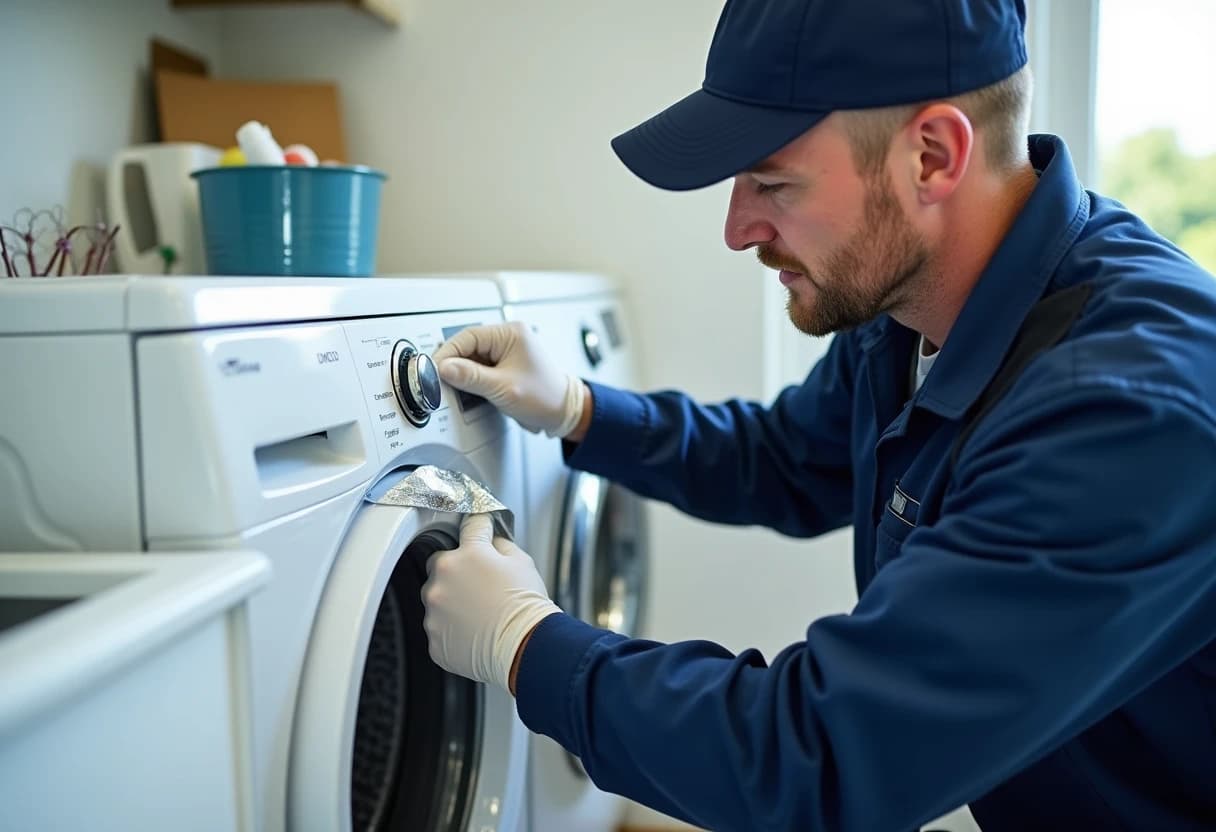
Homeowners in Westwood usually discover a broken dryer vent through a symptom that seems unrelated: a water stain on the ceiling under the laundry, lint appearing in the basement, a mildew smell in one wall, or an energy bill that crept up as the dryer strained. Our repair service finds the failure and fixes it for good — with 4-inch smooth rigid metal duct, joints fitted and clamped without airstream-piercing screws, seams sealed with UL-listed foil tape, and a new exterior hood where the old damper has failed. We are local, insured, and we photograph every repair so you can see exactly what was wrong and exactly what made it right.
Why Dryer Vent Repair Matters for Westwood Homes
A damaged dryer vent fails on three fronts at once, and all three get worse with every load. Safety first: a disconnection or breach releases lint — one of the most flammable materials in a home — into wall cavities, ceilings and basements, where it accumulates near framing with no way to remove it, while the restriction at the damage point drives up exhaust temperatures exactly the way fire investigators describe in the roughly 2,900 US dryer fires each year. Moisture second: every load pushes about a gallon of water vapor through the vent, and a leak delivers it into building materials instead of outdoors — wet insulation, mold-friendly wall cavities, stained ceilings, rotted subfloor around the laundry. Performance third: crushed and separated ducts strangle airflow, stretching drying times and energy bills while overheating the appliance. Cleaning cannot fix any of this; the duct itself is broken. A proper repair — rigid metal, sealed joints, verified airflow — resolves all three failure modes in a single visit, usually for $150 to $450.
Dryer vent damage in Westwood is largely a story about the buildings. Westwood splits between the tighter prewar and postwar streets of Islington near the Dedham line and larger colonials on wooded lots toward Hale Reservation, with an infusion of new townhouses and apartments around University Station. Postwar capes and ranches here often run original sheet-metal ductwork, while the newer builds carry multi-zone systems with long flex-duct branches. Laundry hookups in homes like these were added long after construction, so vents thread through old framing, hug cold foundation walls and rely on joints assembled in cramped, concealed spaces — precisely the conditions that produce separations, crush points and condensation. Westwood's teardown-and-expand renovation wave leaves many homes with hybrid duct systems - original trunks serving one wing and new flex runs serving an addition - and the junctions between old and new are where we find the worst debris. Homes backing up to Hale's 1,200 wooded acres also pull in notable pollen and leaf-mold loads every season. Our repair crews work in Westwood weekly and arrive equipped for its housing stock: rigid metal duct and fittings in the sizes older runs need, insulation for cold-space sections, and the patience concealed ductwork demands.
Our Dryer Vent Repair Process in Westwood
1Diagnose the Full Exhaust Path
Repair starts with finding every failure, not just the obvious one. We trace the duct from the dryer's outlet to the exterior termination, inspecting each accessible section and joint, and test airflow at both ends with the dryer running. Weak exterior flow with strong drum heat means the exhaust is escaping en route — and we find where.
2Protect the Area & Open Access
Before repair work, we protect floors and finishes along the work path, move the dryer out carefully on sliders, and set up at the failure points. Where a concealed joint requires access, we discuss options first — many repairs can be made from existing openings, and when cutting is unavoidable we keep openings minimal and tell you exactly what restoration will involve.
3Reconnect & Properly Fasten Separated Joints
Separated joints are rejoined the way code intends: sections fitted male-to-female in the direction of airflow, secured with clamps or mechanical fasteners that do not pierce the airstream, and sealed with UL-listed metal foil tape — never fabric duct tape, which heat destroys, and never screws through the duct wall, whose tips become lint hooks inside the pipe.
4Replace Crushed, Corroded or Non-Compliant Sections
Replacement is also the moment to correct design faults we find: a kink where two sections meet at a bad angle becomes a pair of smooth elbows; an unsupported span gets hangers; an oversized or undersized segment is brought back to uniform 4-inch diameter so airflow stops tumbling at transitions. We fix what failed and what made it fail.
5Cure Condensation: Slope, Seal & Insulate
Condensation repairs follow the water. We restore continuous slope toward the termination so condensate drains out instead of pooling; seal the joints it has been leaking through with foil tape rated for the duty; and insulate duct sections crossing unheated basements, garages, attics and exterior wall bays so exhaust stays above its dew point until it exits.
6Repair or Replace the Exterior Hood & Damper
Failed terminations get quality metal replacements: a hood sized to the 4-inch duct with a free-swinging damper that opens fully under airflow and closes tight against weather and pests. Screened hoods — a code violation on dryer vents because mesh mats over with lint — are replaced with proper damper-and-guard designs made for dryer exhaust.
7Replace the Transition Duct & Reset the Dryer
This step catches the last common failure point: many 'vent problems' are actually transition hoses flattened to a slot behind the machine. The compliant connector, correctly fitted and protected by proper dryer placement, ensures the airflow we restored in the wall actually reaches the duct from the appliance.
8Verify Airflow & Document the Repair
You receive photo documentation of the failures found and the repairs made — valuable for insurance files, condo associations, home sales and your own records. We also note the condition of everything we did not repair, so you have an honest picture of the vent's remaining lifespan and its next likely maintenance date.
Benefits of Professional Dryer Vent Repair in Westwood
Moisture Out of Your Walls and Ceilings
Every load of laundry exhausts about a gallon of water. A repaired, sealed vent delivers all of it outdoors; a leaking one delivers it into insulation, framing and drywall. Stopping that daily soaking is the benefit homeowners feel longest — no more spreading stains, peeling paint, mildew odors or the mold remediation bills that chronic wall moisture eventually writes.
Pest Entry Points Closed
We remove existing nesting material as part of termination repair and clean the affected duct section, because a nest is both a blockage and a sanitation issue in an airstream that passes your clothing. The new hood's pest protection is chosen to exclude animals without the lint-trapping mesh that code prohibits.
Restored Drying Performance
A crushed or separated duct throttles airflow just like a lint clog, and no amount of cleaning fixes it. Repair restores the full 4-inch path, and drying performance returns immediately — one-cycle loads, accurate sensor-dry behavior, and a machine that stops straining against backpressure it was never designed to fight.
Lower Energy and Repair Bills
A failed exterior damper is a hole in your heated envelope all winter — a 4-inch duct delivering January directly to your laundry room. Replacing it with a tight-closing hood pays for itself in heating savings and comfort, entirely apart from what it does for the dryer.
Code Compliance & Inspection-Ready Documentation
For condo owners, documented code-compliant repair satisfies association requirements and insurance due diligence in one visit. We provide written scopes for board approval beforehand and completion records with photos afterward — paperwork that matters when a shared building's fire safety is the subject.
Decades of Reliable Service From One Repair
Repairs also make every future cleaning better: smooth interiors let rotary brushes work at full effectiveness, sealed joints keep the vacuum's suction where it belongs, and a free-swinging damper lets technicians verify airflow honestly. You are not just fixing today's failure — you are buying easier maintenance forever.
Signs Your Westwood Home Needs Dryer Vent Repair
Lint Appearing Where It Shouldn't
Lint drifting from a basement ceiling, gathering on joists, puffing from a wall register or collecting behind the dryer means exhaust is escaping the duct before the termination. Lint marks the leak like dye in water — follow it and you find the separated joint or breach. This is a repair call, not a cleaning call, and it should not wait.
A Home Inspection or Appliance Tech Flagged the Vent
When an appliance technician condemns your vent while servicing the dryer, believe them: they have just measured the backpressure your machine fights on every load. Repairing the duct protects the repair they made — a new heating element or thermal fuse installed against a failed vent will simply fail again.
Slow Drying That Cleaning Didn't Fix
A dryer that dries poorly immediately after being moved, after appliance delivery, or after renovation work near the laundry almost certainly has a crushed transition or a disturbed joint — the timing is the clue. These are among the quickest, least expensive repairs we make, often at the bottom of the $150 to $450 range.
Visibly Damaged, Kinked or Sagging Duct
Trust your eyes: a transition hose flattened behind the dryer, a dented or crushed section in the basement, duct sagging between supports into a low belly, or a run held together with fabric duct tape are all failures in progress. Each restricts airflow, collects lint and moisture, and worsens with time. Photograph what you see and call — the quote is quick.
Water Stains, Drips or Peeling Paint Near the Vent Path
Condensation drips are easy to misattribute to plumbing. The tell is timing: moisture that appears during or after dryer use, and dries between laundry days, is exhaust-borne. We confirm with a running-dryer inspection before quoting, so you repair the actual source rather than the nearest pipe.
Musty or Mildew Smell in the Laundry Area
EPA guidance on mold is unambiguous: control the moisture and you control the growth. In laundry areas the dryer vent is a prime suspect moisture source, and a $150 to $450 repair is dramatically cheaper than the remediation an ignored leak can eventually require.
Dryer Vent Repair Cost in Westwood, MA
A few pricing notes specific to property types. Condos and multi-family buildings often carry modest premiums for access — roof terminations several stories up, shared ceiling cavities, association scheduling — but also qualify for meaningful savings when multiple units repair together: a building-wide visit spreads travel and setup across units, and associations get a single documented scope for their records. Triple-decker owners repairing all three units' venting at once routinely save 20 to 30 percent versus separate visits. Older single-family homes sometimes surprise in the other direction: what looks like a major concealed failure turns out to be an exposed basement run fixable at the bottom of the range. This is why we diagnose before quoting rather than pricing sight-unseen over the phone — the range we can give you by phone is honest ($150 to $450 covers the vast majority of Westwood-area repairs), but the flat number you approve comes after a technician has actually seen the failure and photographed it.
Want the full pricing picture? See our complete Boston-area cost guide or call (617) 390-7145 for an exact flat quote for your Westwood home.
Local Knowledge: Westwood, Norfolk County
Every town's ductwork tells the story of its housing. Westwood splits between the tighter prewar and postwar streets of Islington near the Dedham line and larger colonials on wooded lots toward Hale Reservation, with an infusion of new townhouses and apartments around University Station. Postwar capes and ranches here often run original sheet-metal ductwork, while the newer builds carry multi-zone systems with long flex-duct branches. Westwood's teardown-and-expand renovation wave leaves many homes with hybrid duct systems - original trunks serving one wing and new flex runs serving an addition - and the junctions between old and new are where we find the worst debris. Homes backing up to Hale's 1,200 wooded acres also pull in notable pollen and leaf-mold loads every season. We plan Westwood jobs around those realities, from equipment selection to time on site, and it shows in the results. If you live near University Station or anywhere across Westwood's 02090 area, we have almost certainly cleaned a system like yours before — and we can tell you exactly what to expect before we arrive.
The Best Time of Year in Westwood
Winter exposes dryer vent damage that hides all year. Joints that leak slightly in summer drip visibly when exhaust moisture condenses hard against freezing duct; marginal dampers ice shut; snow buries grade-level hoods; and the season's heavy laundry loads push maximum moisture through every weak point. Massachusetts repair calls spike from December through February for exactly these reasons — and because a blocked or leaking vent in a sealed-up winter house sends its moisture and, for gas dryers, combustion byproducts into air that will not be refreshed until spring. If your vent showed symptoms last winter, repairing it in fall is the calm, scheduled alternative to an emergency call during a January cold snap with a full laundry basket waiting.
Why Choose Boston Air Duct Cleaners
As a West Newton-based company, we treat Westwood like the neighborhood it is — because for us, it is. Our reputation lives or dies on local referrals, so every job gets the full process: complete system cleaning under negative pressure, mechanical agitation of every run, blower compartment service, and a documented walkthrough before we leave. We are licensed and insured, our estimates are free and flat, and our schedule holds same-day slots for urgent calls. One visit and you will understand why neighbors keep our magnet on the fridge.
Serving Westwood and Surrounding Communities
Beyond Westwood, our crews cover the surrounding communities daily — including Dedham, Norwood, Canton, Walpole, Dover, Medfield. Because routes cluster geographically, booking alongside a neighboring appointment often unlocks same-day service and combined-visit savings. Wherever you are in Norfolk County, the same flat-rate pricing, insured technicians and photo-documented process applies.