
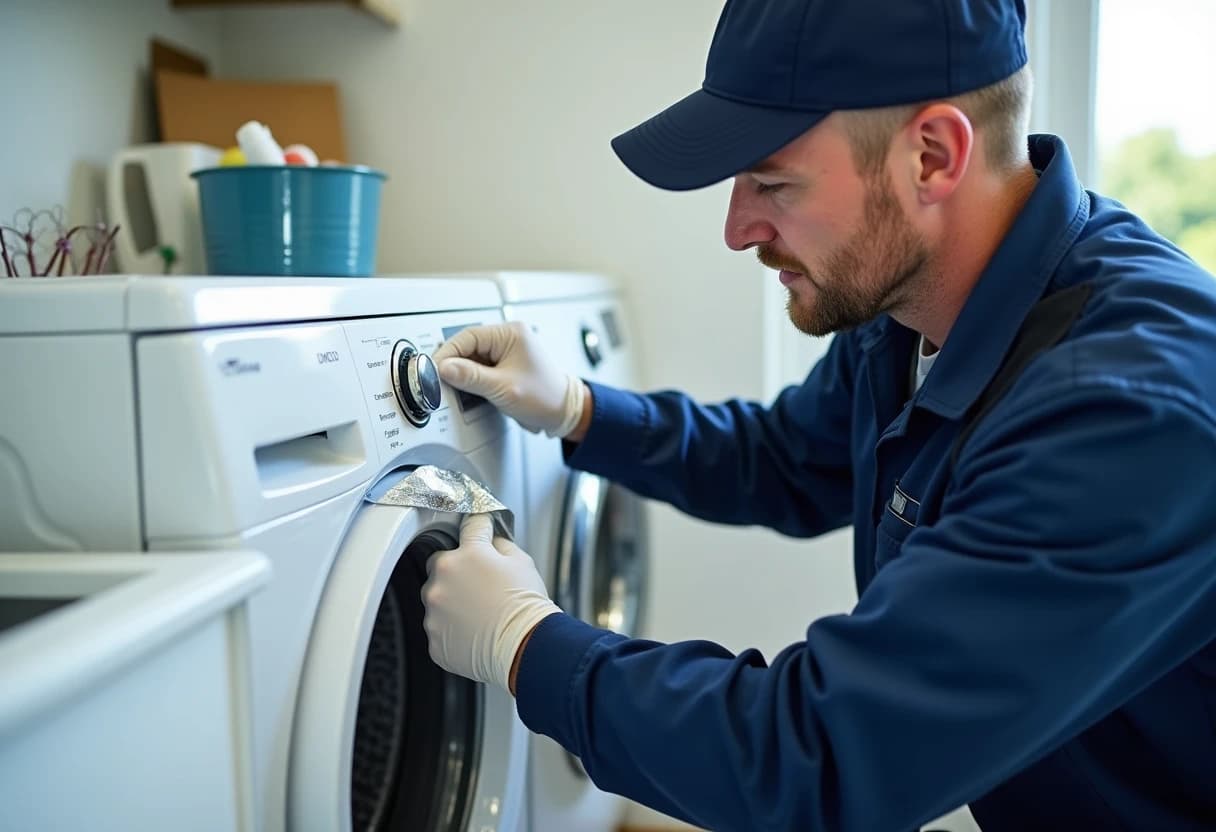
Condensation is the quiet destroyer of dryer vents in New England. Warm, moisture-saturated exhaust travels through ducts that pass cold basements, crawlspaces and exterior wall cavities; wherever the duct runs cold, that vapor condenses, soaking lint into blockage-forming mats, rusting metal duct from the inside, dripping from joints, and staining ceilings below. Our Canton repair service addresses condensation at its causes: sealing leaking joints, correcting sags where water pools, insulating duct sections that pass through unheated space, restoring proper slope, and replacing corroded runs. The fix is specific to your vent's routing — which is why every repair starts with a full-path inspection, not a guess.
Why Dryer Vent Repair Matters for Canton Homes
A damaged dryer vent fails on three fronts at once, and all three get worse with every load. Safety first: a disconnection or breach releases lint — one of the most flammable materials in a home — into wall cavities, ceilings and basements, where it accumulates near framing with no way to remove it, while the restriction at the damage point drives up exhaust temperatures exactly the way fire investigators describe in the roughly 2,900 US dryer fires each year. Moisture second: every load pushes about a gallon of water vapor through the vent, and a leak delivers it into building materials instead of outdoors — wet insulation, mold-friendly wall cavities, stained ceilings, rotted subfloor around the laundry. Performance third: crushed and separated ducts strangle airflow, stretching drying times and energy bills while overheating the appliance. Cleaning cannot fix any of this; the duct itself is broken. A proper repair — rigid metal, sealed joints, verified airflow — resolves all three failure modes in a single visit, usually for $150 to $450.
Winters around Canton are hard on dryer vents in ways warmer regions never see. Homes bordering the Blue Hills Reservation and Ponkapoag Pond deal with heavy seasonal pollen and damp, wooded lots that keep basements humid - a combination that feeds mold in unlined ductwork. Canton's corporate parks off Royall Street also give us regular commercial duct and rooftop-unit work. Exhaust moisture condenses and freezes in duct sections crossing cold basements and exterior walls, dampers ice shut, and snow buries grade-level hoods. Canton mixes Victorian and early-1900s homes near Canton Center with large tracts of 1960s-1980s colonials and split-levels, plus a wave of newer townhouse and apartment construction around Canton Junction and the Route 138 corridor. The commuter-rail neighborhoods have seen heavy renovation, and many mid-century homes here run long basement trunk ducts that collect decades of debris. Those homes often route vents through the coldest parts of the structure, which is why our Canton condensation repairs so often involve insulating and re-sloping duct in unheated space. We fix the winter failure and the design weakness behind it, so the same problem does not return with the next cold snap.
Our Dryer Vent Repair Process in Canton
1Diagnose the Full Exhaust Path
We treat symptoms as evidence: lint in the basement points to a specific joint; a ceiling stain maps to a specific duct section; condensation drips tell us where the run crosses cold space. Correlating symptoms with the physical path usually pinpoints the failure within minutes — and rules out the failures you do not have.
2Protect the Area & Open Access
Before repair work, we protect floors and finishes along the work path, move the dryer out carefully on sliders, and set up at the failure points. Where a concealed joint requires access, we discuss options first — many repairs can be made from existing openings, and when cutting is unavoidable we keep openings minimal and tell you exactly what restoration will involve.
3Reconnect & Properly Fasten Separated Joints
Separated joints are rejoined the way code intends: sections fitted male-to-female in the direction of airflow, secured with clamps or mechanical fasteners that do not pierce the airstream, and sealed with UL-listed metal foil tape — never fabric duct tape, which heat destroys, and never screws through the duct wall, whose tips become lint hooks inside the pipe.
4Replace Crushed, Corroded or Non-Compliant Sections
Vinyl and foil accordion duct found anywhere in the run is removed on sight and replaced: rigid metal for the concealed run, a short UL-listed semi-rigid aluminum connector at the appliance. The smooth interior of proper duct resists lint accumulation dramatically better than corrugations — the repair also makes every future cleaning faster and more effective.
5Cure Condensation: Slope, Seal & Insulate
Moisture-damaged components are replaced as part of the cure: corroded duct sections, rusted clamps, sodden insulation. We also check the termination damper, since a flap frozen or stuck partly shut is a common hidden cause of the backpressure that drives moist exhaust out through joints in the first place.
6Repair or Replace the Exterior Hood & Damper
Where pests have entered through a failed damper, we remove nesting material from the duct, clean the affected section, and install a termination with pest protection that does not restrict airflow. If the old hood was painted shut — common on older multi-family buildings — we free or replace it and note the repaint risk for the future.
7Replace the Transition Duct & Reset the Dryer
Gas dryers are reconnected with the gas line unstrained and checked, electric dryers with cords properly routed clear of the hot duct. We level the machine, confirm the drum turns clean, and run a full test cycle — because a repair is not done until the system works as a system.
8Verify Airflow & Document the Repair
The proof is at the hood: with the dryer running, the damper should stand fully open under a strong, steady exhaust stream. We verify it together, compare against the pre-repair condition, and confirm no leakage remains at any repaired joint. Then the work area is cleaned, the dryer set, and the laundry room returned to service.
Benefits of Professional Dryer Vent Repair in Canton
Code Compliance & Inspection-Ready Documentation
Compliance is not paperwork for its own sake; each code provision encodes a failure the industry learned about the hard way. Smooth interiors resist lint. Clamped joints survive heat. Unscreened dampers do not mat over. A to-code vent is simply a vent engineered not to fail the common ways.
Restored Drying Performance
Because the leak or crush also lets conditioned air escape or exhaust recirculate, repairs frequently improve more than laundry: cold-air infiltration through a stuck-open damper ends, and the laundry room stops swinging between sauna and icebox with the seasons.
Pest Entry Points Closed
Pest damage rarely stays at the hood: rodents that enter a duct chew insulation and nest against warm sections deep in the run. Closing the entry point promptly is far cheaper than the extended cleaning and repair an established rodent presence demands — one more reason failing dampers deserve fast attention.
Decades of Reliable Service From One Repair
We stand behind the work: repairs are documented, photographed and guaranteed, and because we also clean vents, we see our own repairs again on annual visits — a feedback loop that keeps our standards honest. The repair you buy is one we expect to inspect ourselves for years.
A Serious Fire Hazard, Eliminated
A breached or restricted dryer vent combines the two ingredients of the roughly 2,900 annual US dryer fires: accumulating lint and rising exhaust temperatures. Repair removes both — the escape points that seed wall cavities with fuel, and the crush points and blockages that overheat the system. It is fire prevention with a wrench, and it lasts for decades.
Lower Energy and Repair Bills
A dryer fighting a damaged vent runs longer per load and hotter per minute — both metered directly on your utility bill, often $10 to $20 a month for a busy household. Repair returns cycles to design length. The savings recur every laundry day, quietly repaying the one-time repair cost within the first year or two.
Signs Your Canton Home Needs Dryer Vent Repair
Slow Drying That Cleaning Didn't Fix
The symptom pattern is diagnostic: strong heat in the drum with weak or absent airflow at the exterior hood means exhaust is going somewhere else. That somewhere is the failure point. It is a fifteen-minute find for a technician with airflow instruments and knowledge of how these runs are routed in local housing.
Lint Appearing Where It Shouldn't
Check the floor and framing along the vent's path, especially in basements where runs hang exposed: a dusting of gray fiber below any joint is a positive test for leakage there. The joint may look intact from below while a gap on top sheds lint and moisture into the cavity above it.
Water Stains, Drips or Peeling Paint Near the Vent Path
Condensation drips are easy to misattribute to plumbing. The tell is timing: moisture that appears during or after dryer use, and dries between laundry days, is exhaust-borne. We confirm with a running-dryer inspection before quoting, so you repair the actual source rather than the nearest pipe.
Exterior Damper Broken, Stuck or Missing
Evidence of animals — chirping in the duct, nesting material at the hood, droppings near the vent line — means the termination has already failed as a barrier. We remove the nest, clean the affected duct, and install a hood with real pest protection. Spring is nesting season; the repair is best made before it.
Musty or Mildew Smell in the Laundry Area
A persistent damp smell around the laundry — or in one adjacent wall or ceiling — often means exhaust moisture has been feeding hidden mildew via a leak or chronic condensation. The odor is the nose's report on a moisture problem the eyes cannot see. A vent-path inspection locates the escape point, and repair dries up its food supply.
Visibly Damaged, Kinked or Sagging Duct
Sag matters more than it looks: a bellied section pools condensate, which soaks lint into a mat, which adds weight, which deepens the sag. The cycle ends in a blocked or rusted-through low point. Adding proper support and restoring slope while the duct is still sound is a small repair that prevents a large one.
Dryer Vent Repair Cost in Canton, MA
Dryer vent repair in Greater Boston typically runs $150 to $450, and the spread is about what failed and where. At the low end: transition hose replacement with a compliant semi-rigid connector, exterior hood and damper replacement, or reconnecting an accessible separated joint — each roughly $150 to $250 including parts. Mid-range, $250 to $350, covers replacing damaged duct sections with rigid metal, curing condensation with re-sloping, sealing and insulation, or repairs involving moderate access work. The top of the range, $350 to $450, reflects concealed-joint repairs requiring access openings, multi-failure jobs combining several fixes, corroded runs needing substantial replacement, or difficult terminations on upper walls and roofs. Every quote is flat and follows a diagnosis you can see — photos of the actual failure — so you know what you are paying to fix. If damage is extensive enough that full replacement or rerouting makes better sense than repair, we say so and quote that option separately rather than selling repairs onto a duct that has reached its end.
Want the full pricing picture? See our complete Boston-area cost guide or call (617) 390-7145 for an exact flat quote for your Canton home.
Local Knowledge: Canton, Norfolk County
What makes Canton different? Canton mixes Victorian and early-1900s homes near Canton Center with large tracts of 1960s-1980s colonials and split-levels, plus a wave of newer townhouse and apartment construction around Canton Junction and the Route 138 corridor. The commuter-rail neighborhoods have seen heavy renovation, and many mid-century homes here run long basement trunk ducts that collect decades of debris. Homes bordering the Blue Hills Reservation and Ponkapoag Pond deal with heavy seasonal pollen and damp, wooded lots that keep basements humid - a combination that feeds mold in unlined ductwork. Canton's corporate parks off Royall Street also give us regular commercial duct and rooftop-unit work. For duct and dryer vent systems, those local factors translate into specific, predictable problems — and predictable problems are the ones we solve fastest. Call (617) 390-7145, tell us your street and home style, and we will quote the job accurately the first time, usually in under five minutes.
The Best Time of Year in Canton
There is also a renovation-season rhythm to dryer vent damage in Greater Boston. The region's busiest remodeling months — spring through fall — are when concealed ducts get crushed by new framing, disconnected by trades working in ceilings, buried behind new finishes, or simply forgotten in layout changes that leave the dryer farther from its termination than code allows. Many of our fall repair calls trace directly to summer projects. If your home was renovated this year and laundry performance changed afterward, the connection is likely literal: a disturbed joint or flattened section behind the new work. We diagnose with airflow testing before opening anything, and where access through fresh finishes is needed, we keep it minimal and coordinate with your contractor's restoration.
Why Choose Boston Air Duct Cleaners
Choosing a duct cleaner is really a trust decision — you are letting a crew work inside the system that feeds air to your family. We make that decision easy: a local West Newton company with insured, uniformed technicians, transparent flat-rate quotes, NADCA-standard equipment and methods, and photographic proof of the finished work. No door-to-door sales, no bait-and-switch coupons, no invented 'mold emergencies.' Just honest mechanical cleaning done properly the first time, backed by a written guarantee.
Serving Canton and Surrounding Communities
Beyond Canton, our crews cover the surrounding communities daily — including Stoughton, Sharon, Norwood, Westwood, Milton, Randolph. Because routes cluster geographically, booking alongside a neighboring appointment often unlocks same-day service and combined-visit savings. Wherever you are in Norfolk County, the same flat-rate pricing, insured technicians and photo-documented process applies.