
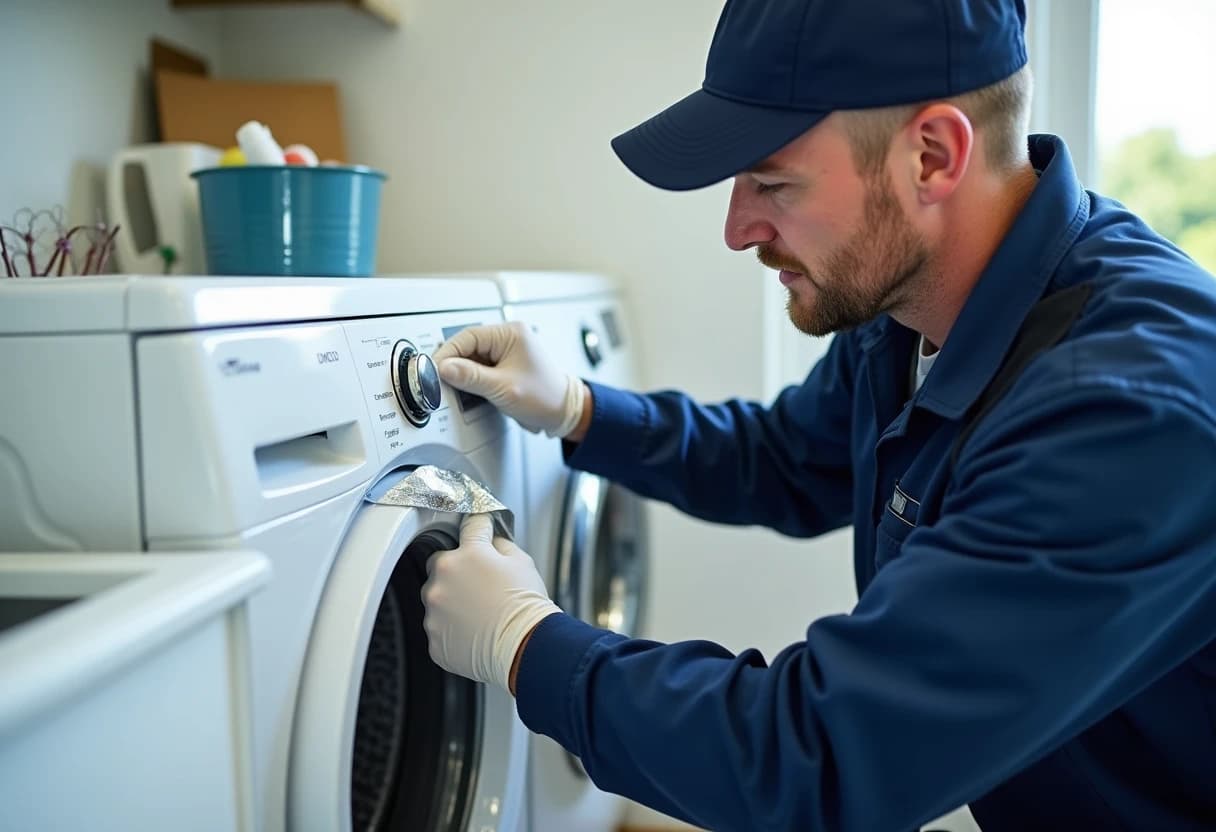
A dryer vent that is crushed, disconnected or leaking cannot be fixed by cleaning — it needs repair. Our Dover dryer vent repair service restores the exhaust path itself: reconnecting joints that have pulled apart inside walls and ceilings, replacing crushed or kinked sections with smooth rigid metal duct, sealing leaks with proper metal foil tape, and rebuilding exterior hoods whose dampers have broken or rusted shut. Every repair uses code-compliant materials and methods — 4-inch rigid metal, clamped connections with no screws intruding into the airstream — so the finished vent moves full airflow, keeps moisture out of your walls, and stops feeding lint into places it should never go.
Why Dryer Vent Repair Matters for Dover Homes
The exterior termination takes the worst weather abuse of any part of the system, and its failures invite problems in both directions. A damper flap that has rusted, cracked or lost its spring no longer closes — leaving a permanent 4-inch hole in your building envelope through which winter air pours in (homeowners feel it as a cold laundry room and see it on heating bills), and through which birds, squirrels and mice enter to nest in a warm, sheltered duct. A damper wedged shut by paint, ice or a failed hinge blocks the vent as thoroughly as any lint clog. Screened hoods, common on older installs and on handyman replacements, violate dryer-vent code for a simple reason: the mesh mats over with lint in months. We replace failed terminations with quality metal hoods sized to the duct, with free-swinging dampers and pest protection designed for dryer exhaust, sealed to the siding or masonry so the wall assembly stays dry. It is often the cheapest repair on the menu and one of the most consequential.
Ask a home inspector working around Dover Town Center what they flag most in Dover laundry areas and dryer venting is near the top of the list: vinyl accordion hose, duct-taped joints, screened hoods, runs far beyond code length. Dover is a low-density estate town of large custom colonials, contemporaries and gentleman's farms set on multi-acre wooded lots, with a scattering of 18th-century farmhouses along Dedham and Farm Streets. Its big houses commonly run three or four separate forced-air zones, attic air handlers and long insulated flex runs that few owners have ever had inspected. Dover's sprawling square footage means a single home here can carry more duct surface than three average houses, and horse farms and hay fields around Powisset add organic dust you will not find in denser suburbs. Deep-wooded lots also keep shaded basements cool and damp well into summer. We do the corrective work those inspection reports call for — rigid metal replacement, code-compliant reconnections, proper terminations — with documentation that satisfies buyers, sellers and insurers alike. Neighbors in Needham and Medfield use us for the same pre-sale and post-purchase repairs, which keeps our trucks in this corner of Norfolk County nearly every week.
Our Dryer Vent Repair Process in Dover
1Diagnose the Full Exhaust Path
We treat symptoms as evidence: lint in the basement points to a specific joint; a ceiling stain maps to a specific duct section; condensation drips tell us where the run crosses cold space. Correlating symptoms with the physical path usually pinpoints the failure within minutes — and rules out the failures you do not have.
2Protect the Area & Open Access
Access is half of dryer vent repair in older homes. We come prepared for ceiling-hung basement runs, duct concealed above suspended ceilings, and sections buried in soffits. Our aim is always the least invasive route to a proper repair — and clear communication before anything is opened.
3Reconnect & Properly Fasten Separated Joints
We do not just push a failed joint back together; we rebuild it so it cannot fail the same way. That means cleaning mating surfaces, correcting the misalignment or unsupported weight that pulled the joint apart, adding hangers or strapping where the run lacked support, and sealing the finished connection against both air and moisture leakage.
4Replace Crushed, Corroded or Non-Compliant Sections
Replacement is also the moment to correct design faults we find: a kink where two sections meet at a bad angle becomes a pair of smooth elbows; an unsupported span gets hangers; an oversized or undersized segment is brought back to uniform 4-inch diameter so airflow stops tumbling at transitions. We fix what failed and what made it fail.
5Cure Condensation: Slope, Seal & Insulate
Moisture-damaged components are replaced as part of the cure: corroded duct sections, rusted clamps, sodden insulation. We also check the termination damper, since a flap frozen or stuck partly shut is a common hidden cause of the backpressure that drives moist exhaust out through joints in the first place.
6Repair or Replace the Exterior Hood & Damper
Where pests have entered through a failed damper, we remove nesting material from the duct, clean the affected section, and install a termination with pest protection that does not restrict airflow. If the old hood was painted shut — common on older multi-family buildings — we free or replace it and note the repaint risk for the future.
7Replace the Transition Duct & Reset the Dryer
This step catches the last common failure point: many 'vent problems' are actually transition hoses flattened to a slot behind the machine. The compliant connector, correctly fitted and protected by proper dryer placement, ensures the airflow we restored in the wall actually reaches the duct from the appliance.
8Verify Airflow & Document the Repair
The proof is at the hood: with the dryer running, the damper should stand fully open under a strong, steady exhaust stream. We verify it together, compare against the pre-repair condition, and confirm no leakage remains at any repaired joint. Then the work area is cleaned, the dryer set, and the laundry room returned to service.
Benefits of Professional Dryer Vent Repair in Dover
Pest Entry Points Closed
A dryer vent with a failed damper is an open, warm, sheltered 4-inch doorway — irresistible to birds, squirrels and mice, whose nests then block the duct and whose presence contaminates it. Repairing the termination closes the doorway with a damper and guard designed for dryer exhaust, ending the nest-remove-repeat cycle for good.
A Serious Fire Hazard, Eliminated
Code-compliant materials are themselves a safety upgrade: smooth rigid metal resists lint accumulation, clamped joints hold under heat and vibration, and a proper termination keeps nesting animals from plugging the line. A repaired vent is not just fixed — it is a fundamentally lower-risk system than what it replaces.
Lower Energy and Repair Bills
A failed exterior damper is a hole in your heated envelope all winter — a 4-inch duct delivering January directly to your laundry room. Replacing it with a tight-closing hood pays for itself in heating savings and comfort, entirely apart from what it does for the dryer.
Decades of Reliable Service From One Repair
Done with rigid metal, mechanical fastening and a quality termination, a dryer vent repair is not a patch — it is infrastructure. Properly installed rigid duct routinely outlasts the dryers connected to it, needing only annual cleaning. The failure-prone materials and joints that caused your problem simply are not there anymore.
Restored Drying Performance
Customers are often startled by the change: a vent we repaired after years of gradual crushing gives them back the dryer they bought. If your drying times worsened after an appliance delivery, a renovation, or a move of the machine — events that crush transitions and separate joints — repair, not replacement, is very likely the answer.
Code Compliance & Inspection-Ready Documentation
For condo owners, documented code-compliant repair satisfies association requirements and insurance due diligence in one visit. We provide written scopes for board approval beforehand and completion records with photos afterward — paperwork that matters when a shared building's fire safety is the subject.
Signs Your Dover Home Needs Dryer Vent Repair
Musty or Mildew Smell in the Laundry Area
EPA guidance on mold is unambiguous: control the moisture and you control the growth. In laundry areas the dryer vent is a prime suspect moisture source, and a $150 to $450 repair is dramatically cheaper than the remediation an ignored leak can eventually require.
Visibly Damaged, Kinked or Sagging Duct
Sag matters more than it looks: a bellied section pools condensate, which soaks lint into a mat, which adds weight, which deepens the sag. The cycle ends in a blocked or rusted-through low point. Adding proper support and restoring slope while the duct is still sound is a small repair that prevents a large one.
Slow Drying That Cleaning Didn't Fix
The symptom pattern is diagnostic: strong heat in the drum with weak or absent airflow at the exterior hood means exhaust is going somewhere else. That somewhere is the failure point. It is a fifteen-minute find for a technician with airflow instruments and knowledge of how these runs are routed in local housing.
Exterior Damper Broken, Stuck or Missing
Cold drafts in the laundry room trace to the damper more often than to windows: a flap that no longer closes turns the duct into a 4-inch outside-air inlet. If the laundry area runs noticeably colder in winter than adjacent rooms, put the hood on your inspection list — the heating-season savings from a tight new damper are immediate.
Water Stains, Drips or Peeling Paint Near the Vent Path
Rust streaks on duct exteriors, corroded clamps and white mineral tracks at joints are the slow-motion version of the same evidence: repeated internal condensation escaping over months. Left alone it rusts through the duct wall; caught early, the fix is sealing and insulation rather than replacement.
Lint Appearing Where It Shouldn't
Lint around the exterior hood is normal in small amounts; lint anywhere else along the run is not. Interior lint accumulation is doubly serious because it is fuel collecting where no cleaning schedule can reach it — the escape point must be sealed, and the accessible accumulation removed.
Dryer Vent Repair Cost in Dover, MA
It helps to know what drives repair pricing, because the failure type matters more than the home's size. Accessibility is the biggest factor: a joint hanging exposed in a basement is a fast fix, while the same failure above a finished ceiling involves careful access and restoration planning. Materials are second: quality rigid metal duct, UL-listed connectors, foil tape and a solid termination hood carry real parts costs — roughly $30 to $120 of most invoices — but they are why the repair lasts decades. Scope is third: many vents present multiple failures at once (a crushed transition and a failed damper and a leaking joint), and bundling them into one visit is significantly cheaper than three separate calls. What does not drive our pricing: drama. We quote from the diagnosis, show you the photos, and price the fix flat. Massachusetts homeowners have seen enough scare-based selling around dryer fires; the facts are alarming enough without embellishment, and the honest repair is usually a few hundred dollars.
Want the full pricing picture? See our complete Boston-area cost guide or call (617) 390-7145 for an exact flat quote for your Dover home.
Local Knowledge: Dover, Norfolk County
Every town's ductwork tells the story of its housing. Dover is a low-density estate town of large custom colonials, contemporaries and gentleman's farms set on multi-acre wooded lots, with a scattering of 18th-century farmhouses along Dedham and Farm Streets. Its big houses commonly run three or four separate forced-air zones, attic air handlers and long insulated flex runs that few owners have ever had inspected. Dover's sprawling square footage means a single home here can carry more duct surface than three average houses, and horse farms and hay fields around Powisset add organic dust you will not find in denser suburbs. Deep-wooded lots also keep shaded basements cool and damp well into summer. We plan Dover jobs around those realities, from equipment selection to time on site, and it shows in the results. If you live near Caryl Park or anywhere across Dover's 02030 area, we have almost certainly cleaned a system like yours before — and we can tell you exactly what to expect before we arrive.
The Best Time of Year in Dover
The freeze-thaw cycle is uniquely hard on the exterior components of New England dryer vents. Damper hinges and springs work loose as metal expands and contracts; caulk joints between hood and siding crack open, letting wind-driven rain into the wall; and ice forming in the hood from condensing exhaust bends flaps out of true a little more each season. Coastal and near-coastal homes add salt corrosion, which seizes hinges and eats galvanized steel years ahead of schedule. This is why we treat termination inspection as part of every service call: the hood fails gradually, then suddenly, and replacing it during a routine visit costs a fraction of the cascade — drafts, pests, blockage — that a failed one begins.
Why Choose Boston Air Duct Cleaners
Choosing a duct cleaner is really a trust decision — you are letting a crew work inside the system that feeds air to your family. We make that decision easy: a local West Newton company with insured, uniformed technicians, transparent flat-rate quotes, NADCA-standard equipment and methods, and photographic proof of the finished work. No door-to-door sales, no bait-and-switch coupons, no invented 'mold emergencies.' Just honest mechanical cleaning done properly the first time, backed by a written guarantee.
Serving Dover and Surrounding Communities
We serve every community around Dover as well: Needham, Medfield, Sherborn, Westwood, Natick, Wellesley all fall inside our regular service routes. If you have a second property, a rental, or family nearby, ask about multi-home scheduling — grouped appointments on the same route are our most requested discount.