
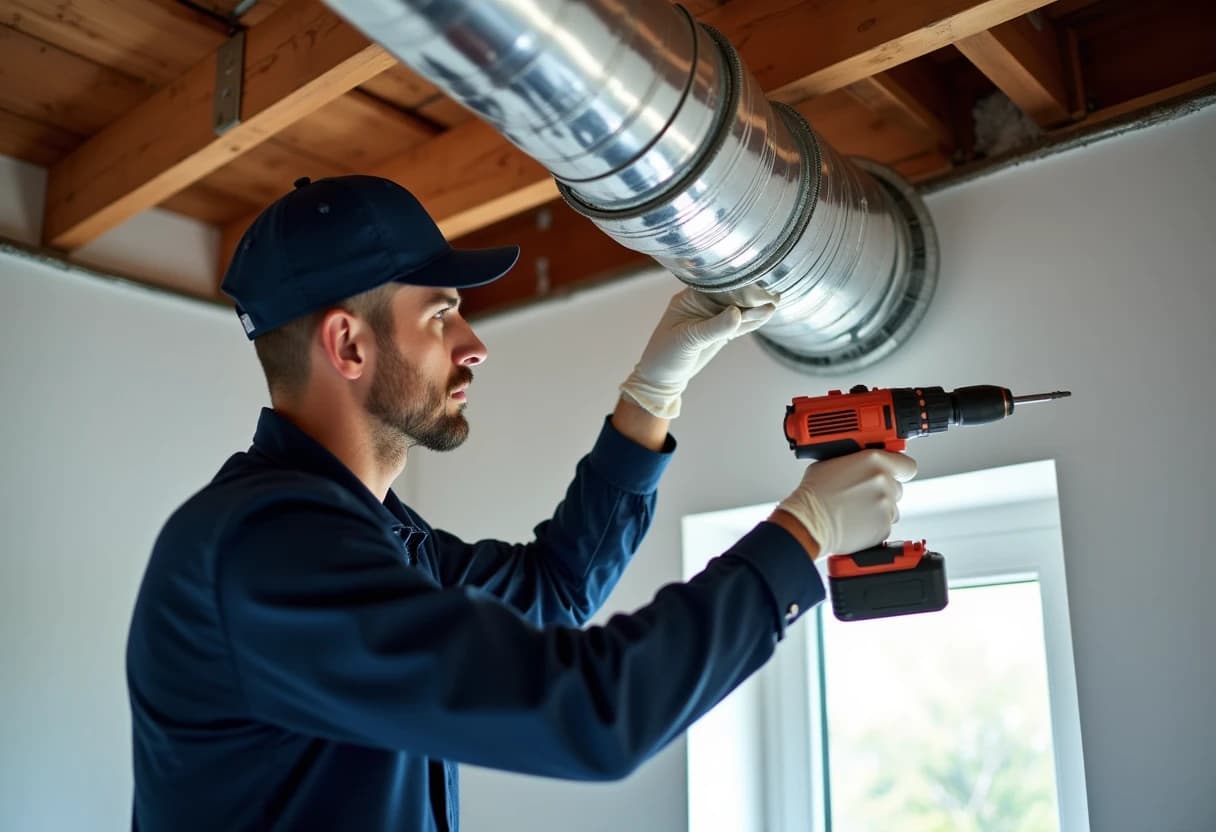
The building code is specific about dryer venting for a reason written in fire statistics: the IRC's dryer exhaust rules (Section M1502) call for smooth-interior rigid metal duct, a 4-inch diameter, a maximum equivalent length of 35 feet with deductions for every elbow, no fasteners protruding into the airstream, and a termination with a backdraft damper and no screen. Most Greater Boston homes fail several of those tests, because their vents were improvised generations ago. Our installation service brings your Westwood laundry up to that standard — a new route where the old one is hopeless, rigid metal end to end, and documentation that satisfies inspectors, insurers and condo boards.
Why Dryer Vent Installation & Rerouting Matters for Westwood Homes
Dryer vent installation is where fire safety is actually decided. The roughly 2,900 US home dryer fires each year cluster around the same installation faults: flexible plastic or foil duct that traps lint in its corrugations, overlong runs the dryer cannot clear, screws through joints snagging fibers in the airstream, and terminations that clog or were never outdoors at all. The IRC's dryer exhaust provisions — 4-inch smooth rigid metal, 35-foot maximum equivalent length with elbow deductions, no protruding fasteners, damper-equipped unscreened termination — are the distilled corrections to those fault patterns. A vent built to that standard resists lint accumulation by design, keeps exhaust velocity high enough to carry fibers all the way out, and gives annual cleaning a smooth, brushable path to maintain. A vent built casually does the opposite, banking a little more fuel every load. Installation is a few hundred dollars once; the system it creates determines your laundry's risk profile for the life of the house. That asymmetry is the entire argument for doing it right.
A large share of our Westwood installation work is corrective: replacing what a previous decade improvised. Westwood splits between the tighter prewar and postwar streets of Islington near the Dedham line and larger colonials on wooded lots toward Hale Reservation, with an infusion of new townhouses and apartments around University Station. Postwar capes and ranches here often run original sheet-metal ductwork, while the newer builds carry multi-zone systems with long flex-duct branches. Behind those walls we find vinyl hose stapled to joists, flex duct wandering forty feet to a screened hood, vents dumping into crawlspaces — installations that fail the IRC's dryer exhaust rules on every line. Westwood's teardown-and-expand renovation wave leaves many homes with hybrid duct systems - original trunks serving one wing and new flex runs serving an addition - and the junctions between old and new are where we find the worst debris. Homes backing up to Hale's 1,200 wooded acres also pull in notable pollen and leaf-mold loads every season. We tear out the improvisation and build the system the code describes: 4-inch rigid metal on the shortest workable route, clamped and taped joints, a damper-equipped termination sealed to the envelope. Documented with photos, verified with the dryer running.
Our Dryer Vent Installation & Rerouting Process in Westwood
1Site Assessment & Route Planning
Planning is where installations succeed or fail, so we do it deliberately: equivalent-length math on paper, termination clearances checked against grade, snow line, openings and property conditions, and the penetration point chosen for both duct efficiency and envelope integrity. For renovations, we are glad to plan while walls are open — the cheapest routing decisions are made before drywall.
2Demolition of Non-Compliant Venting
Where the old route will be reused, we strip it to sound structure; where it is abandoned, we seal the redundant penetrations properly — foam and blocking inside, patched and flashed outside — so the old path does not remain as an air leak or pest entry. Clean removal is part of the installation, not an extra.
3Cut & Flash the Exterior Penetration
The exterior opening is cut precisely for the termination: hole saw through clapboard and sheathing, core drill through brick, block or stone, or a framed opening at the rim joist. We locate it to respect required clearances from grade, openings and inside corners, then flash and seal it so wind-driven New England rain stays out of the wall assembly permanently.
4Install Rigid Metal Duct on the Planned Route
Where the route crosses unheated space — a cold basement, garage bay, attic run — we insulate the duct so exhaust stays above its dew point until it exits, which is the difference between a dry duct and a condensation problem in a Massachusetts winter. Concealed sections are completed and verified before any finishes close them in.
5Mount the Termination Hood & Damper
Termination choice is matched to the route: low-profile wall hoods for clapboard and shingle, masonry-mounted hoods for brick, rim-joist hoods for basement exits, and dedicated dryer roof caps — never plumbing-style caps — for vertical runs. Each is chosen for damper quality, because the damper is the moving part that determines how the termination survives New England weather.
6Connect the Appliance & Seal the System
At the dryer, we install a short UL-listed semi-rigid aluminum transition duct — the only place flexible material belongs — clamped at both ends and routed so it keeps full diameter when the machine is pushed to its working position. We mark the safe setback so the connector is never crushed by a future shove against the wall.
7Test, Verify & Document the Installation
You receive complete documentation: photos of the route (including concealed sections before they closed), the materials used, the equivalent-length math, and the finished termination. For permitted work, condo approvals or home sales, this record answers every question an inspector, board or buyer will ask about what is behind the walls.
Benefits of Professional Dryer Vent Installation & Rerouting in Westwood
Decades of Service From a One-Day Job
Because we also clean and repair dryer vents across Greater Boston, we install with the next twenty years of maintenance in mind — routes our own brushes can traverse, access preserved where it matters, baselines recorded for future verification. We build systems we expect to service ourselves, and it shows in the choices.
Moisture Managed, Structure Protected
Moisture protection extends to the envelope itself: our flashed, sealed penetrations keep wind-driven rain out of walls and roofs for the long term. An installation is only as good as its weakest detail, and the exterior detail is the one that faces forty years of nor'easters. We build it like it will.
Code Compliance That Closes Every Question
The finished system meets the IRC's dryer exhaust provisions line by line: 4-inch smooth rigid metal, equivalent length within the 35-foot budget, no fasteners in the airstream, damper-equipped unscreened termination. For home sales, that removes a standard inspection flag; for permits and condo approvals, our documentation answers the questions before they are asked.
Permanently Lower Energy Costs
The efficiency also shows up in maintenance economics: smooth, short, sealed runs need only quick annual cleanings, while flex mazes generate blockage-level service calls and appliance repairs. Over ten years, the well-installed vent is the cheaper vent by a wide margin, before counting a single kilowatt-hour.
Fire-Safe by Design, Not by Vigilance
The safety margin compounds with maintenance: rigid duct is fully brushable, so every annual cleaning actually reaches every surface — something no cleaning can honestly claim on a corrugated flex run threaded through cavities. You are not just starting cleaner; you are cleanable, permanently.
Dramatically Faster Drying
Shortening a wandering 40-foot run to a direct 12-foot route transforms drying performance: full airflow means each cycle actually exhausts the gallon of moisture a load releases, so sensor dryers stop running overtime and heavy loads finish in one pass. Customers routinely describe post-installation performance as having bought a new machine.
Signs Your Westwood Home Needs Dryer Vent Installation & Rerouting
Blockages and Repairs Keep Recurring
The tell is the fade: a fresh cleaning helps for a few weeks, then performance sags again as lint resettles in the same flex ridges and dead-air corners. Well-designed systems hold their cleaning for a full year. If yours cannot, stop paying to maintain the flaw and price the fix.
Inspection, Insurance or Association Requirements
Massachusetts home inspections flag improvised dryer venting constantly — flex runs, screened hoods, indoor terminations, overlong routes — and the flag follows the transaction: buyers demand fixes, sellers concede credits. A documented compliant installation clears the item permanently, whether you are listing this spring or just retiring a known liability.
Your Vent Is Flexible Plastic or Foil Duct
Look behind and beyond your dryer: if the exhaust path is white vinyl or shiny foil accordion hose — especially if it disappears into a wall or ceiling that way — the system needs replacement, not another cleaning. Flex materials trap lint in every corrugation, crush at a touch, and in vinyl's case can melt. Codes and manufacturers rejected them long ago.
The Dryer Vents Indoors — Anywhere
Indoor venting is often invisible until you look: the duct disappears upward and no exterior hood exists anywhere on the house. If you cannot find your termination outside, find out where the exhaust actually goes — attic discoveries after years of indoor venting routinely involve soaked insulation, staining and mold remediation on top of the vent work.
The Run Is Overlong or Elbow-Heavy
The symptom pattern of an overlong run: drying times that were never good, cleanings that help briefly and fade fast, and lint accumulating mid-run rather than at the ends. No maintenance schedule fixes a route that exceeds the appliance's reach; rerouting to a shorter path is the only durable answer.
Chronic Condensation the Route Guarantees
Watch the laundry itself: loads that come out damp-smelling, a duct that drips after cycles, rust tracks under joints. Chronic internal moisture is rotting the system from the inside while it feeds blockages. The permanent fix is a route engineered for New England winters, not another season of drip trays and patches.
Dryer Vent Installation & Rerouting Cost in Westwood, MA
A note on what our installation price includes, because scope games are common in this trade. Our flat quote covers: site assessment and route design with equivalent-length verification; demolition and disposal of non-compliant existing venting, including sealing abandoned penetrations; the exterior penetration, flashed and sealed to the cladding or roof; 4-inch smooth rigid metal duct, supported, sloped and joined without airstream-piercing fasteners; insulation over unheated space where the route requires it; a quality damper-equipped termination; the UL-listed transition connector at the appliance; commissioning with a live dryer cycle and airflow verification; and photo documentation of the complete system, concealed sections included. Restoration of finishes we must open (drywall patching and paint) is quoted separately and clearly beforehand, as is any permit your municipality requires — we tell you when one applies. If a competing quote is meaningfully lower, check it against this list; the difference is usually something missing that you will pay for later.
Want the full pricing picture? See our complete Boston-area cost guide or call (617) 390-7145 for an exact flat quote for your Westwood home.
Local Knowledge: Westwood, Norfolk County
Every town's ductwork tells the story of its housing. Westwood splits between the tighter prewar and postwar streets of Islington near the Dedham line and larger colonials on wooded lots toward Hale Reservation, with an infusion of new townhouses and apartments around University Station. Postwar capes and ranches here often run original sheet-metal ductwork, while the newer builds carry multi-zone systems with long flex-duct branches. Westwood's teardown-and-expand renovation wave leaves many homes with hybrid duct systems - original trunks serving one wing and new flex runs serving an addition - and the junctions between old and new are where we find the worst debris. Homes backing up to Hale's 1,200 wooded acres also pull in notable pollen and leaf-mold loads every season. We plan Westwood jobs around those realities, from equipment selection to time on site, and it shows in the results. If you live near University Station or anywhere across Westwood's 02090 area, we have almost certainly cleaned a system like yours before — and we can tell you exactly what to expect before we arrive.
The Best Time of Year in Westwood
Renovation season drives our installation rhythm as much as weather does. Greater Boston remodels from spring through fall — basements finished, laundries moved upstairs, triple-deckers converted to condos — and every one of those projects needs dryer exhaust designed rather than improvised. The economics of timing are stark: venting planned at framing stage routes shorter, conceals cleaner and costs $200 to $400 less than the same run retrofitted after drywall. We take planning calls from homeowners and contractors all season, often walking a route in fifteen minutes that saves the project real money and the homeowner a decade of compromise. If your project touches the laundry — or could move it somewhere better — the cheapest vent you will ever build is the one designed before the walls close.
Why Choose Boston Air Duct Cleaners
Boston Air Duct Cleaners is a local, owner-operated company based at 1121 Washington St in West Newton — not a national franchise dispatching subcontractors. Every crew is our own: background-checked, factory-trained on commercial negative-pressure equipment, and fully insured. We quote flat prices before work begins, document every job with before-and-after photos, and follow NADCA-standard source-removal methods on every system we touch. That is why so much of our work comes from repeat customers, property managers and word-of-mouth referrals across Norfolk County.
Serving Westwood and Surrounding Communities
Beyond Westwood, our crews cover the surrounding communities daily — including Dedham, Norwood, Canton, Walpole, Dover, Medfield. Because routes cluster geographically, booking alongside a neighboring appointment often unlocks same-day service and combined-visit savings. Wherever you are in Norfolk County, the same flat-rate pricing, insured technicians and photo-documented process applies.