
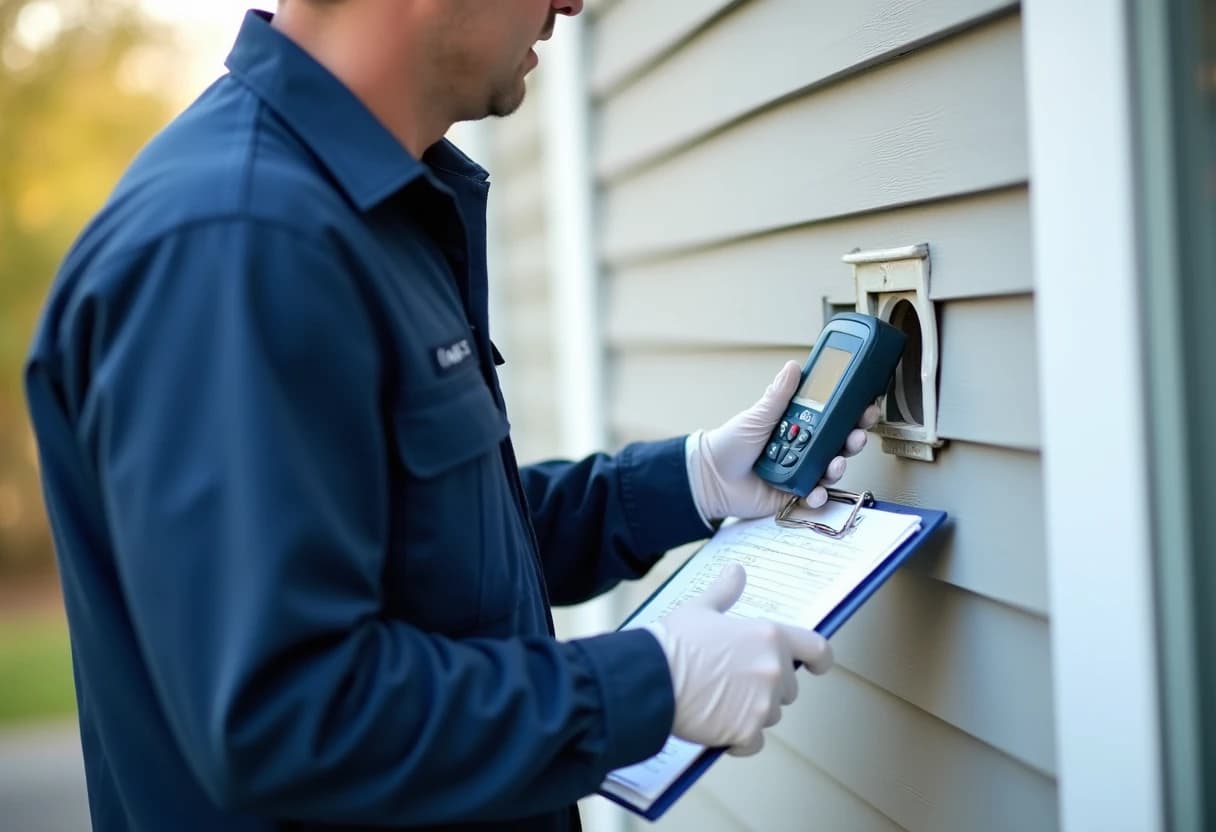
A dryer vent inspection is the fastest, cheapest way to answer a question every homeowner should be able to answer: is my dryer exhaust safe? Our Wellesley technicians measure airflow at the termination with a calibrated anemometer, run an inspection camera the full length of the duct, examine the exterior hood and damper, assess the lint load inside the run, and check the installation against the residential code rules that govern dryer ducts. You leave with a written safety report — photos, measurements and a clear verdict — instead of a guess. If the vent is clean and compliant, we tell you so and you are done for the year. If it needs work, you will know exactly what and why before spending a dollar on cleaning or repairs.
Why Dryer Vent Inspection & Safety Check Matters for Wellesley Homes
Homeowners reliably maintain what they can see and neglect what they cannot, and the dryer duct is the definition of cannot-see: it disappears behind the dryer into a wall and emerges somewhere outside, sometimes two or three stories up. Between those points, anything may be happening — lint packing at a crushed elbow, a joint pulled apart inside a ceiling and quietly venting moist air into the framing, a bird nest behind the hood, a plastic flex duct a previous owner installed decades before it was understood to be a fire hazard. An inspection replaces assumption with evidence. Our process is instrument-first: an anemometer reading at the termination establishes whether the system moves the volume of air a dryer needs, and the camera pass explains any shortfall. The findings frequently surprise owners — long-time residents discover terminations that have been painted shut, and new buyers discover the sellers' 'recently cleaned' vent was never touched. Either way, you finally know.
Buying or selling in Wellesley? The dryer vent is the gap in almost every home inspection. Wellesley's streets mix stately 1900-1940 colonials, Tudors and shingle-style homes with a relentless teardown-and-rebuild market that has filled the town with large new construction carrying two- and three-zone ducted systems. Even the surviving older homes have usually been gut-renovated at least once, often with ducted central air added into radiator-era floor plans. General inspectors note the dryer's presence and move on; they do not camera the duct, measure the exhaust, or verify the hidden run complies with code — yet vent condition is a genuine safety and cost item, especially in older properties near Babson College where laundry was retrofitted long after construction. Wellesley is one of our busiest post-renovation markets - nearly every street has an active rebuild, and construction dust migrates into the systems of neighboring homes as well as the new builds themselves. The large multi-zone systems common here also mean long runs and multiple air handlers in attics and basements, each of which needs attention for the house to breathe evenly. We provide pre-listing and pre-purchase dryer vent inspections across Norfolk County with fast written reports that slot straight into a disclosure package or an inspection-response negotiation. Sellers use them to remove doubt; buyers use them to avoid inheriting someone else's fire risk.
Our Dryer Vent Inspection & Safety Check Process in Wellesley
1Interview & Visual Assessment
First, context: your answers about drying performance and service history frame the inspection, and a walk of the laundry area frames the system. We identify the duct material, count visible elbows, locate where the run enters the structure, and note anything — crushing, kinks, tape-only joints — that already tells part of the story.
2Airflow Measurement at the Termination
With the dryer running on air-only, we measure exhaust velocity at the exterior termination using a calibrated anemometer and convert it to airflow volume. A healthy vent typically delivers strong, steady flow; a weak reading quantifies restriction before we ever look inside. This number anchors the whole report — objective, repeatable and comparable year over year.
3Full-Length Camera Inspection
The camera answers the question the airflow number raises. We feed it the full length of the duct, documenting interior condition foot by foot: where lint is packing, whether joints have pulled apart inside the wall, whether a previous installer used screws or materials the code prohibits. Nothing in the run stays hidden or hypothetical.
4Termination Hood & Damper Check
Outside, we evaluate the termination: does the damper open fully under dryer airflow and close cleanly at rest? Is the hood intact, sealed to the wall, and free of lint beards, paint-overs or screening that traps lint? A surprising share of vent failures live entirely at this last twelve inches of the system.
5Lint-Load Assessment & Fire-Risk Scoring
We translate the inspection into a plain-English risk score. You will know approximately what percentage of the duct's cross-section remains open, where the worst accumulation sits, and how urgent intervention is. FEMA attributes roughly 2,900 dryer fires a year primarily to lint — the score tells you honestly where your vent stands relative to that risk.
6Code-Compliance Review
We review the installation against the residential mechanical code for dryer exhaust: smooth rigid metal duct (not foil or plastic flex in concealed runs), a maximum of 35 feet equivalent length with deductions for each elbow, no screws penetrating the airstream, proper termination with a backdraft damper and no screen. Violations are photographed and explained.
7Written Safety Report & Recommendations
Everything we measured and saw goes into a written safety report delivered the same day. Pass or fail, you have proof of the vent's condition — the document buyers ask for, insurers accept and associations require. If work is warranted, the report doubles as a precise scope, so any quote you gather is comparing the same job.
Benefits of Professional Dryer Vent Inspection & Safety Check in Wellesley
Lower Drying Costs & Longer Appliance Life
The economics are simple: restricted airflow taxes every single load, and the tax grows as the restriction does. Measurement catches the problem when it is small. Customers consistently report faster drying and lower utility bills after acting on inspection findings — savings that repeat weekly, every laundry day.
No Unnecessary Cleanings
The $79 inspection frequently saves the $200 cleaning. When airflow measures strong and the camera shows light accumulation, we say so in writing and leave. Customers who used to buy blind annual cleanings routinely discover their actual interval is longer — and their total maintenance spend drops accordingly.
Real-Estate & Insurance Documentation
Condo associations and landlords in Massachusetts are steadily adding dryer vent verification to their maintenance requirements after well-publicized multi-family lint fires. Our per-unit reports satisfy property managers and boards in one visit, with scheduling built for buildings — multiple units, one appointment block, individual documentation.
A Written Report You Can Actually Use
Documentation has quiet value that compounds. After a kitchen fire two streets over, your insurer asks about dryer maintenance — you have a dated report. A buyer's inspector flags the vent — you produce this year's inspection and the issue evaporates. The paper trail costs nothing extra; it comes standard.
Hidden Code Violations Exposed
Many chronic lint problems are really installation problems: the duct violates length, material or fastening rules and will clog on schedule forever until corrected. The compliance review identifies the root cause, so you can stop paying to clean a duct that was built to fail.
Protection From Moisture & Carbon Monoxide
Every load of laundry evaporates roughly a gallon of water, and all of it must exit through this one duct. Joints that separated inside a ceiling deliver that gallon into your structure instead. The camera pass finds hidden leaks that no exterior symptom would reveal until damage was done.
Signs Your Wellesley Home Needs Dryer Vent Inspection & Safety Check
Insurance, Condo or Sale Requirements
If your carrier, condo board or property manager has asked for proof of dryer vent maintenance, that is the sign — the requirement itself. Our written report is built to satisfy exactly these requests: dated, photographed, measured and signed, delivered after a single visit.
Clothes Take More Than One Cycle
When towels come out damp after a full cycle, most people blame the dryer and call an appliance tech. In our experience the appliance is usually fine — the exhaust path is not. A twenty-minute airflow measurement settles the question before you pay for a repair visit the machine never needed.
You Cannot Remember the Last Service
New homeowners inherit the previous owners' laundry habits inside their duct. Unless the sellers produced a dated inspection report, the vent's condition is unknown — and unknown is exactly the wrong state for the home's most fire-prone duct. A move-in inspection resolves it for under $150.
The Dryer or Laundry Room Feels Hot
A dryer cabinet that is hot to the touch, or a laundry room that turns into a sauna mid-cycle, means exhaust heat is staying in the house instead of leaving through the duct. That trapped heat is the same heat that ignites lint. It warrants a measurement promptly.
Burning or Musty Smells During Operation
Trust your nose. Scorched smells mean lint meeting heat; sour smells mean water pooling where it should not; animal odors mean something has moved into the duct or hood. Each has a distinct cause and a distinct fix, and a single camera inspection distinguishes among them definitively.
No Visible Exhaust at the Outside Hood
Lint visibly beard-ing around the exterior hood, a damper wedged with debris, or a termination that was painted or caulked over during exterior work — all common findings, all easily missed from ground level, and all fully documented during the exterior portion of our inspection.
Dryer Vent Inspection & Safety Check Cost in Wellesley, MA
A standalone dryer vent inspection in Greater Boston runs $79 to $149, with most single-family homes landing near the middle. The variables are access and complexity: a first-floor laundry with a short run to a reachable exterior hood sits at the low end, while roof terminations, multi-story runs, stacked or hard-to-move appliances, and long concealed ducts requiring extended camera work move the price up. Multi-unit buildings are quoted per unit with volume discounts for associations and property managers booking a full building. What the fee always includes: anemometer airflow measurement, full-length camera inspection, exterior hood and damper evaluation, lint-load scoring, code-compliance review, and the written photographic report. What it never includes: pressure to buy anything. If cleaning or repair is warranted, you receive a flat-rate quote alongside the findings — and if we perform the cleaning during the same visit, the inspection fee is credited toward it, which is how most customers who need work choose to proceed.
Want the full pricing picture? See our complete Boston-area cost guide or call (617) 390-7145 for an exact flat quote for your Wellesley home.
Local Knowledge: Wellesley, Norfolk County
What makes Wellesley different? Wellesley's streets mix stately 1900-1940 colonials, Tudors and shingle-style homes with a relentless teardown-and-rebuild market that has filled the town with large new construction carrying two- and three-zone ducted systems. Even the surviving older homes have usually been gut-renovated at least once, often with ducted central air added into radiator-era floor plans. Wellesley is one of our busiest post-renovation markets - nearly every street has an active rebuild, and construction dust migrates into the systems of neighboring homes as well as the new builds themselves. The large multi-zone systems common here also mean long runs and multiple air handlers in attics and basements, each of which needs attention for the house to breathe evenly. For duct and dryer vent systems, those local factors translate into specific, predictable problems — and predictable problems are the ones we solve fastest. Call (617) 390-7145, tell us your street and home style, and we will quote the job accurately the first time, usually in under five minutes.
The Best Time of Year in Wellesley
Fall is dryer vent inspection season in New England for good reason: laundry loads get heavier as the weather cools — jeans, flannels, bedding, towels — exactly when a marginal vent is least able to keep up. NFPA data also shows home dryer fires peak in the colder months, when the appliance works hardest and lint accumulates fastest. An October inspection catches summer's accumulation, verifies the termination damper before snow and ice test it, and sets the system up for the six heaviest laundry months of the year. Book it alongside the furnace tune-up; the two together cover the season's biggest hidden-heat risks in one week.
Why Choose Boston Air Duct Cleaners
We built this company around the jobs other duct cleaners do badly: the 130-year-old Victorian with panned-joist returns, the Wellesley condo with a 60-foot dryer run to the roof, the post-renovation house full of drywall dust. Our crews see Greater Boston's hardest systems every week, and the experience shows in the details — floor protection on the way in, sealed registers during the work, HEPA-vacuumed work areas on the way out, and imagery that proves the ducts are actually clean. Call (617) 390-7145 and judge the difference from the first conversation.
Serving Wellesley and Surrounding Communities
Beyond Wellesley, our crews cover the surrounding communities daily — including Newton, Needham, Natick, Weston, Dover, Wayland. Because routes cluster geographically, booking alongside a neighboring appointment often unlocks same-day service and combined-visit savings. Wherever you are in Norfolk County, the same flat-rate pricing, insured technicians and photo-documented process applies.