
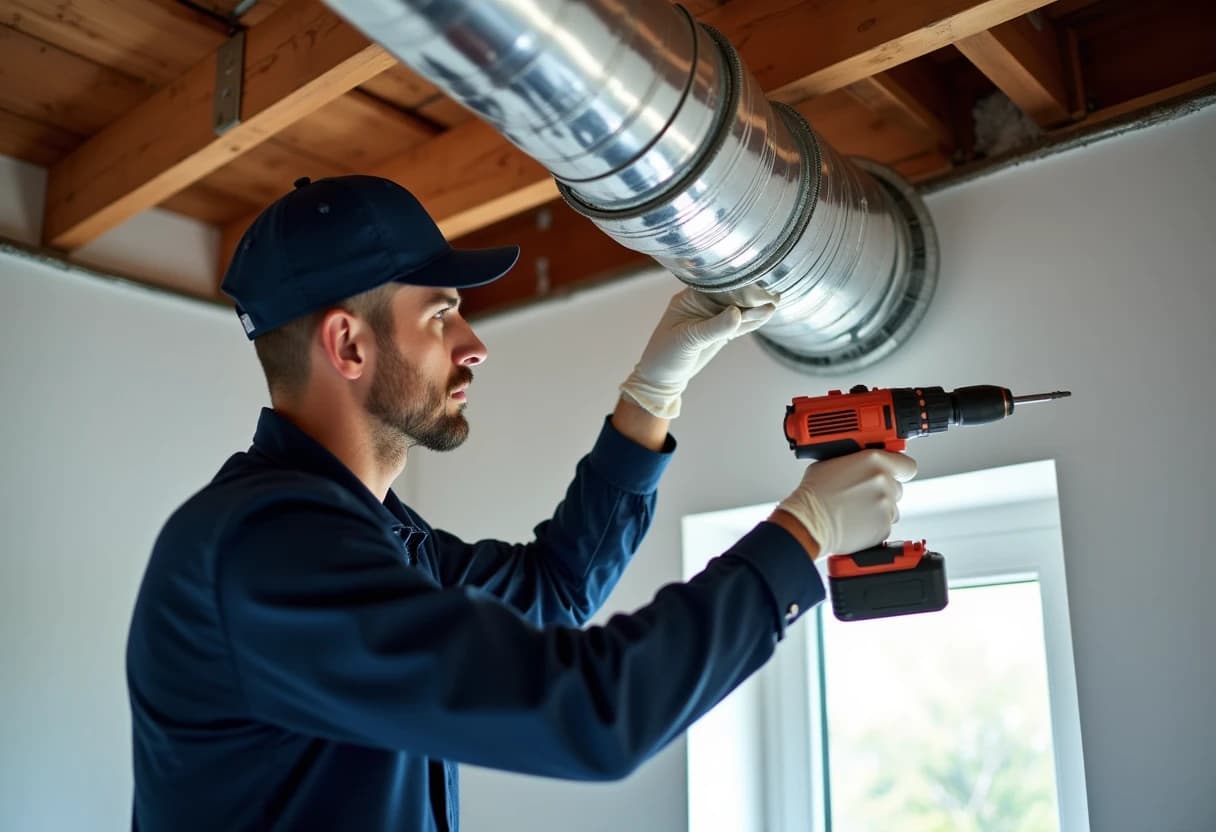
The building code is specific about dryer venting for a reason written in fire statistics: the IRC's dryer exhaust rules (Section M1502) call for smooth-interior rigid metal duct, a 4-inch diameter, a maximum equivalent length of 35 feet with deductions for every elbow, no fasteners protruding into the airstream, and a termination with a backdraft damper and no screen. Most Greater Boston homes fail several of those tests, because their vents were improvised generations ago. Our installation service brings your Wellesley laundry up to that standard — a new route where the old one is hopeless, rigid metal end to end, and documentation that satisfies inspectors, insurers and condo boards.
Why Dryer Vent Installation & Rerouting Matters for Wellesley Homes
New England's housing stock makes professional installation more consequential here than almost anywhere. Triple-deckers and brownstone conversions put laundry deep in floor plans, far from legal termination points, demanding careful route planning against the length budget. Balloon-framed Victorians hide cavities that swallow flex duct into inaccessible, uncleanable runs. Stone and brick foundations require masonry penetrations done with the right tools and flashing. Retrofitted basement laundries sit below grade, where the only paths out are up through the rim joist or across to a window bay — and where cold foundation walls make uninsulated duct a condensation machine. Condo associations layer approval processes and insurance requirements on top. We work these constraints every week: our installers carry the drills, core bits, flashing and fittings the old construction demands, we insulate runs crossing unheated space as a standard practice, and we provide the certificates and documentation associations require. The result is a vent that fits the building it serves — not a catalog diagram forced into a house that predates the catalog by a century.
Basement laundries dominate Wellesley's housing stock, and they are where thoughtful venting matters most. Wellesley's streets mix stately 1900-1940 colonials, Tudors and shingle-style homes with a relentless teardown-and-rebuild market that has filled the town with large new construction carrying two- and three-zone ducted systems. Even the surviving older homes have usually been gut-renovated at least once, often with ducted central air added into radiator-era floor plans. A below-grade dryer must exhaust up and out — through the rim joist above the foundation, most often — and every foot of that run crosses cold space where moist exhaust wants to condense. Wellesley is one of our busiest post-renovation markets - nearly every street has an active rebuild, and construction dust migrates into the systems of neighboring homes as well as the new builds themselves. The large multi-zone systems common here also mean long runs and multiple air handlers in attics and basements, each of which needs attention for the house to breathe evenly. Our basement installations handle both problems by design: the shortest legal route to a rim-joist or high-wall termination, continuous slope so any condensate drains outward, and insulation on duct crossing unheated space. The result is a basement laundry that stays dry, and a vent that stays clear between annual cleanings.
Our Dryer Vent Installation & Rerouting Process in Wellesley
1Site Assessment & Route Planning
Every installation begins with the route. We assess the laundry location, measure candidate paths to the exterior, and score each against the code's 35-foot equivalent-length budget — deducting for every elbow — and against your home's structure: framing, foundation type, finished spaces, and where a termination can legally and sensibly exit. You get options with trade-offs explained, and a flat price for the route you choose.
2Demolition of Non-Compliant Venting
Old venting comes out carefully, not destructively: we protect finishes, keep openings minimal, and document conditions as we find them. What we uncover often explains years of symptoms — a crushed flex section behind a wall, a joint that separated a decade ago, a cavity lined with escaped lint. Photos go in your record.
3Cut & Flash the Exterior Penetration
Roof terminations get roofing-grade treatment: shingles lifted and re-laid over proper flashing, a cap rated for dryer exhaust with a working damper, and sealant appropriate to the roofing material. We schedule roof penetrations for dry weather and verify water-tightness before leaving — a roof leak is not an acceptable side effect of a laundry upgrade.
4Install Rigid Metal Duct on the Planned Route
The run goes in as 4-inch smooth-interior rigid metal duct — the material the IRC specifies — cut to fit, joined male-to-female in the direction of airflow, and assembled without a single screw protruding into the airstream: joints are clamped or externally fastened and sealed with UL-listed foil tape. Elbows are used sparingly and counted against the length budget.
5Mount the Termination Hood & Damper
The termination is a quality metal hood matched to the 4-inch duct, with a backdraft damper that swings fully open under airflow and closes tight against weather, drafts and pests — and no screen, which the code prohibits on dryer terminations because mesh mats over with lint. It is fastened to the cladding, sealed at the perimeter, and tested by hand before the first cycle.
6Connect the Appliance & Seal the System
System sealing is completed end to end: every joint taped with UL-listed foil tape, the wall penetration sealed inside and out, and the transition clamped tight. A dryer vent is a pressure system; leaks anywhere cost airflow at the termination and push lint and moisture into places they do not belong. Sealed means sealed everywhere.
7Test, Verify & Document the Installation
Commissioning is non-negotiable: we run a full dryer cycle and verify strong, steady exhaust at the termination with the damper standing fully open — the visible proof the system delivers its design airflow. Where useful we measure and record the airflow, giving your annual cleanings a baseline number to verify against for years.
Benefits of Professional Dryer Vent Installation & Rerouting in Wellesley
Fire-Safe by Design, Not by Vigilance
Roughly 2,900 US home dryer fires a year trace overwhelmingly to lint, and lint traces to the installation faults a proper build eliminates: flex corrugations, overlong runs, obstructed airstreams. Replacing an improvised vent with an engineered one is the single largest permanent reduction in dryer fire risk available to a homeowner.
Moisture Managed, Structure Protected
Every load pushes about a gallon of water vapor through the vent, and an engineered system delivers all of it outdoors: continuous slope drains any condensate to the termination, insulation keeps exhaust above its dew point across cold spaces, and sealed joints leave nothing to drip. Your framing, insulation and finishes stay dry, load after load, year after year.
A Laundry Located Where You Actually Want It
Proper vent design frees the floor plan: a second-floor laundry, a kitchen-adjacent closet, a finished-basement corner all become viable when the exhaust route is engineered rather than improvised. We tell you honestly which locations work within the length budget — and often find compliant routes that make the layout you wanted possible.
Permanently Lower Energy Costs
A dryer that finishes in one cycle instead of two uses half the energy per load — a difference worth $10 to $20 a month to a busy household, recurring for the life of the system. Few building improvements have a payback mechanism this direct: the installation cost is fixed once, and the savings arrive with every laundry day after.
Code Compliance That Closes Every Question
The finished system meets the IRC's dryer exhaust provisions line by line: 4-inch smooth rigid metal, equivalent length within the 35-foot budget, no fasteners in the airstream, damper-equipped unscreened termination. For home sales, that removes a standard inspection flag; for permits and condo approvals, our documentation answers the questions before they are asked.
Dramatically Faster Drying
Shortening a wandering 40-foot run to a direct 12-foot route transforms drying performance: full airflow means each cycle actually exhausts the gallon of moisture a load releases, so sensor dryers stop running overtime and heavy loads finish in one pass. Customers routinely describe post-installation performance as having bought a new machine.
Signs Your Wellesley Home Needs Dryer Vent Installation & Rerouting
Blockages and Repairs Keep Recurring
If your vent needs cleaning twice a year, blocks anyway, and has accumulated a history of repairs, the route itself is the problem — too long, too bent, wrong materials, or condensation-prone by design. At some point serial maintenance costs more than the reroute that ends it. We will do that math with you honestly; often the crossover is closer than expected.
Your Vent Is Flexible Plastic or Foil Duct
A quick self-check: press gently on the visible duct. Rigid metal does not give; flex crumples. If any concealed portion of your run is flex, assume the hidden sections are in worse shape than the visible ones — they always are — and price the replacement before the blockage schedule prices it for you.
The Run Is Overlong or Elbow-Heavy
Basement laundries venting to a far wall are the classic offenders — installed where the first hole was easiest, not where the route was shortest. Our assessment often finds a rim-joist or near-wall exit that cuts the run by half or more. Ask for the measurement; the equivalent-length math takes ten minutes and settles the question.
Chronic Condensation the Route Guarantees
Some vents condense because of damage; others condense because of design — long uninsulated passages through cold basements, garages or attics where exhaust cannot stay above its dew point, or bellied routes with no slope to drain. When repair visits keep treating water in the same duct, the route is the diagnosis, and rerouting or rebuilt insulation and slope is the cure.
Inspection, Insurance or Association Requirements
Condo associations across Greater Boston have tightened dryer vent requirements after regional fire losses, and some now mandate compliant installation on unit turnover or renovation. If your building has issued requirements, we handle the full sequence: scope for board approval, insured installation, and per-unit documentation for the association's records.
The Dryer Vents Indoors — Anywhere
Window inserts and condensation boxes marketed as 'indoor dryer vents' are not a solution for a standard vented dryer in a Massachusetts home; they are humidity machines. If one is in service in your laundry, a proper exterior route almost certainly exists — our assessment will find the shortest one and price it flat.
Dryer Vent Installation & Rerouting Cost in Wellesley, MA
Rerouting deserves its own cost frame, because its value is measured against the run it replaces. Shortening a 40-foot flex wander to a 12-foot rigid route typically costs $500 to $900 — and permanently removes the conditions that were costing you money continuously: second drying cycles (roughly $10 to $20 a month in energy for a busy household), twice-yearly cleanings instead of annual, recurring blockage calls, and the appliance repairs that backpressure schedules (thermal fuses and elements at $150 to $400 a visit). Most households with genuinely bad routes recover the rerouting cost within two to three years through those avoided expenses, then keep the savings for decades. There is also the risk column, harder to price but real: overlong flex runs are heavily represented in the roughly 2,900 annual US dryer fires, and their moisture leakage feeds mold remediation bills that start around $1,500. When we quote a reroute, we show you this math against your actual route — some marginal systems are worth keeping and maintaining, and we say so when they are.
Want the full pricing picture? See our complete Boston-area cost guide or call (617) 390-7145 for an exact flat quote for your Wellesley home.
Local Knowledge: Wellesley, Norfolk County
Serving Wellesley means knowing Wellesley. Wellesley's streets mix stately 1900-1940 colonials, Tudors and shingle-style homes with a relentless teardown-and-rebuild market that has filled the town with large new construction carrying two- and three-zone ducted systems. Even the surviving older homes have usually been gut-renovated at least once, often with ducted central air added into radiator-era floor plans. Wellesley is one of our busiest post-renovation markets - nearly every street has an active rebuild, and construction dust migrates into the systems of neighboring homes as well as the new builds themselves. The large multi-zone systems common here also mean long runs and multiple air handlers in attics and basements, each of which needs attention for the house to breathe evenly. Those conditions shape how we work here: which brush heads come off the truck, how we protect finishes in older interiors, and what we expect to find when the camera goes into a 02481 duct system. Our crews are in and around Wellesley nearly every week — often for neighbors of past customers — so scheduling is fast and our arrival windows hold.
The Best Time of Year in Wellesley
Humid summers argue for good vent design from the opposite direction. When dew points sit in the seventies, dryer exhaust barely cools before reaching saturation, and any route flaw — a belly, a leak, an oversized dead-air section — collects water through the muggy months while basement laundries add ambient humidity of their own. Summer is also when improvised indoor venting does its worst damage, loading attics and crawlspaces with moisture exactly when the structure cannot dry. And at the termination, summer is nesting season: hoods without proper dampers and guards acquire tenants between March and June. A properly designed system shrugs all of it off — sealed, sloped, insulated, guarded — which is why summer's symptoms are so often what finally send homeowners to the phone.
Why Choose Boston Air Duct Cleaners
What separates us from the coupon crowd is simple: we do the whole job, we prove it, and we charge what we quoted. Our technicians clean supplies, returns, trunks and blower compartments on every visit — never a cosmetic vent wipe. Photo documentation comes standard, pricing is flat and confirmed up front, and our trucks carry true commercial vacuum equipment, not rented shop-vacs. Based in West Newton and serving Wellesley year-round, we answer our own phone at (617) 390-7145 and stand behind every cleaning with a satisfaction guarantee.
Serving Wellesley and Surrounding Communities
We serve every community around Wellesley as well: Newton, Needham, Natick, Weston, Dover, Wayland all fall inside our regular service routes. If you have a second property, a rental, or family nearby, ask about multi-home scheduling — grouped appointments on the same route are our most requested discount.