
When Wellesley homeowners call about duct odors, the stories rhyme: a musty smell every time the AC starts, a dog smell guests notice before they see the dog, cigarette ghosts from an owner two sales ago, or a basement note that follows the airflow upstairs. All of them live in the same place — the microbial and organic residue lining the duct system — and all of them respond to the same two-step fix: source-removal cleaning followed by EPA-registered antimicrobial fogging. We quote the pairing as a flat price, complete it in a single visit, and back it with a straightforward promise: if the odor problem is in your ducts, this ends it. If it is not, our inspection will tell you where to look instead.
Why Air Duct Sanitizing & Deodorizing Matters for Wellesley Homes
Pet households face duct odor mechanics that surface cleaning cannot beat. Dander is an aerosol: it rides the return airflow into the duct network, settles into the interior film, and accumulates for as long as the pet lives there — often across multiple pets and many years. The film becomes an odor reservoir with the system's full distribution reach, which is why the smell is strongest when the heat kicks on and why guests detect it instantly while residents have gone nose-blind. The same mechanism archives cigarette and cannabis smoke, cooking oils, and the general biological signature every household writes into its air system over time. When the home changes hands, the new owners inherit the archive. Source-removal cleaning strips the reservoir; EPA-registered fogging neutralizes the residue and the bacteria feeding on it; and the system stops broadcasting. For sellers, this pairing is one of the highest-leverage pre-listing investments available — showings live and die on the first thirty seconds of smell — and for buyers it is the cleanest possible start in a home with an unknown history.
We treat a steady stream of odor calls from Wellesley, from condos near Wellesley Square to family homes out toward Babson College, and the pattern is consistent: the smell survives every surface remedy because it lives in the air system. Wellesley's streets mix stately 1900-1940 colonials, Tudors and shingle-style homes with a relentless teardown-and-rebuild market that has filled the town with large new construction carrying two- and three-zone ducted systems. Even the surviving older homes have usually been gut-renovated at least once, often with ducted central air added into radiator-era floor plans. That age of housing stock means duct film with a long biography. Because our shop is in West Newton, roughly 5 miles away, we can usually schedule Wellesley sanitizing visits within days — often bundled with cleaning in one appointment, which is both cheaper and more effective.
Our Air Duct Sanitizing & Deodorizing Process in Wellesley
1Odor Assessment & Honest Qualification
Not every odor is a duct odor, and not every duct needs sanitizing — the EPA does not recommend routine biocide use, and neither do we. Your visit starts with diagnosis: camera inspection of the duct film, a look at the coil and drain pan, moisture readings where mustiness is the complaint. You get a straight answer about whether treatment is warranted before anyone sells you anything.
2Source-Removal Cleaning First
Step one is removing the reservoir. The odor-saturated film lining your ducts is physically extracted under negative pressure — rotary brushes and pneumatic whips strip it from every supply, return and trunk while the HEPA vacuum captures it. Most of the odor leaves the house in this step; the fogging that follows neutralizes what remains and prevents the smell from rebuilding.
3Product Selection & Preparation
Preparation is checklist work that determines results: product selected for your specific odor profile, dilution mixed to label specification, fogging equipment matched to your system's size so droplet distribution covers the full duct network. We also plan the airflow path — which registers stay open, how the blower assists — so the treatment reaches the far end of every run, not just the trunks.
4Whole-System Antimicrobial Fogging
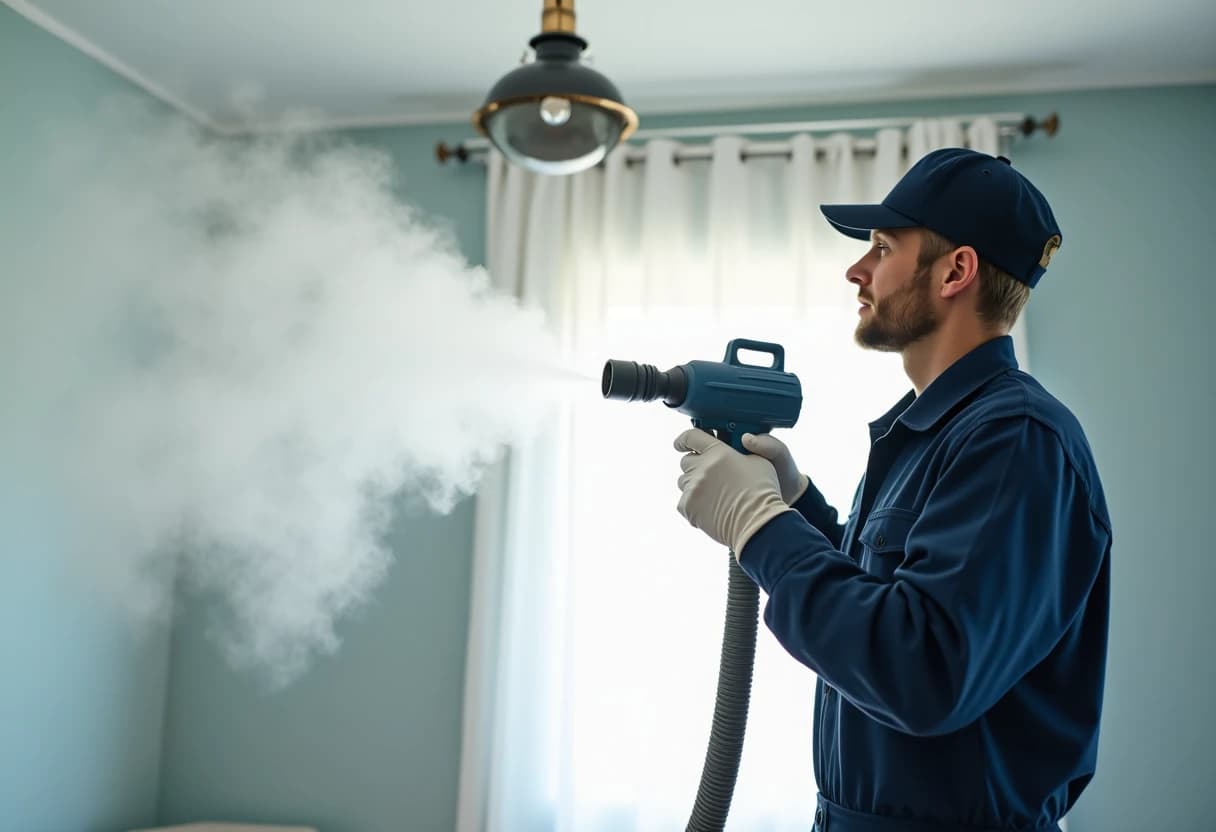
With the system freshly cleaned, the EPA-registered fog does its work at the surface level: contact-killing the bacteria that metabolize duct residue into odor, neutralizing the residual film chemically, and leaving an inhibiting layer that suppresses microbial regrowth. The application follows label contact times precisely — this is regulated chemistry applied to specification, not a scented mist waved through the vents.
5Coil, Drain Pan & Blower Treatment
The dampest components carry the strongest biology, so the air handler wet section gets direct treatment: evaporator coil surfaces, the drain pan and its trap, and the blower wheel and housing. Musty odors disproportionately originate here — a slimy pan or biofilmed coil can perfume an entire house — and treating the ducts while skipping the equipment leaves the source in place.
6Deodorizing Pass for Stubborn Odors
Severe cases get layered treatment: antimicrobial fogging for the biology, counteractant application for chemical residue, and where warranted, guidance on the adjacent surfaces — returns pull air across ceilings and walls, and a smoke-saturated house can re-seed clean ducts. We are candid about that boundary: ducts are our domain, and we will tell you when a whole-home odor needs remediation beyond them.
7System Airing, Verification & Walkthrough
The finish is verification by nose and by paper: a room-by-room airflow check confirming neutral odor at every register, before-and-after photos of the duct interiors, and a written record of products applied with their EPA registration numbers. Surfaces are dry and the home fully usable by the time we pack up in nearly all cases — we review any exceptions before we start, never after.
Benefits of Professional Air Duct Sanitizing & Deodorizing in Wellesley
Microbial Load Reduced System-Wide
Beyond odor, the treatment is a sanitizing pass over the one surface network your household's air touches continuously. EPA-registered antimicrobials kill odor bacteria and mold spores resident in the duct film and inhibit their regrowth — meaningful for households with allergy sufferers, young children, elderly members or anyone for whom airborne biology is more than an abstraction.
Musty Summer Smell Broken for Good
That damp blast at AC start-up is bacteria metabolizing humid duct film — a cycle that returns every muggy stretch and worsens annually. Sanitizing removes the film and leaves treated surfaces the biology cannot recolonize, so the next humid week produces silence from the registers. For many Massachusetts households this is the first summer without the smell in a decade.
Odors Neutralized at the Source, Not Masked
Homeowners who have fought a duct-borne smell describe the same arc: sprays, candles, filters, ozone gadgets, shampooed carpets — hundreds of dollars of masking, months of frustration, smell intact. Source treatment ends the arc in one visit because it is aimed at the right target. The register air itself comes out neutral, so the rooms finally stay that way.
Smoke Ghosts Finally Evicted
Fire and smoke events leave the same signature at higher intensity: acrid residue through every duct the system ran during or after the event. Alongside your restoration work, duct cleaning with counteractant treatment prevents the classic post-fire complaint — a rebuilt, repainted home that still exhales smoke on warm days. We coordinate with restoration timelines regularly.
A True Reset for Newly Purchased Homes
You inspected the roof, the furnace and the foundation before buying; the air system's biological history was invisible on every report. A move-in sanitizing closes that gap, decontaminating the one system that touches every room before your family settles in. Scheduled between closing and move-in, it is the cheapest and easiest it will ever be — empty house, open access, one afternoon.
Small Add-On Cost, Outsized Payoff
Standalone treatments run $250 to $500; bundled with cleaning, the marginal cost drops by half or more. That pricing asymmetry is why we encourage odor-motivated customers to book the pairing — one visit, one setup, both halves of the fix. The alternative sequence, cleaning now and a separate sanitizing visit after the smell persists, costs more and delays the result.
Signs Your Wellesley Home Needs Air Duct Sanitizing & Deodorizing
Odors Return No Matter How Much You Clean
If deep-cleaning the house buys only a day or two before the smell creeps back, the source is upstream of everything you cleaned — in the air system, re-scenting the rooms on every cycle. That resupply pattern is the signature of duct-borne odor, and it means the fix is in the ducts, not in another weekend of scrubbing.
Guests Notice a Smell You No Longer Can
The cruelest version arrives during a home sale: buyers and agents smell in thirty seconds what you have not smelled in years, and it costs you at the negotiating table either way. Pre-listing duct sanitizing addresses the odor you cannot perceive at its distribution point — which is why experienced listing agents put it on the prep checklist.
Smoke History in the Home
After a kitchen fire, wildfire smoke event or nearby structure fire, ducts inhale smoke even when flames never touched the house, and the system re-releases the odor long after surfaces are cleaned. Restoration protocols increasingly include duct treatment as standard; if yours did not, the lingering smell is telling you what was skipped.
Musty Blast When the Heat or AC Starts
Cycle-start odor means the smell is being generated inside the system and flushed out with the first air movement. Intermittent mustiness responds fully to sanitizing; a strong, constant or worsening version can indicate active mold colonization, which our inspection distinguishes — a difference that matters, since mold removal involves containment protocols and different pricing.
Pets Present or Past
Current pets write dander into the duct film continuously; previous owners' pets left their chapters behind. Either way the system holds an animal-scent reservoir that surface cleaning never touches. If the house smells of pets anywhere, it smells of pets from the registers — and treating the registers' source is the only fix with reach into every room.
After Pests, Mold or Water in the System
Post-mold-remediation, treating the cleaned duct surfaces inhibits recolonization while moisture corrections take effect — standard best practice, and typically specified in remediation protocols. If your home had mold work done and the ducts were cleaned but never treated, that gap is worth closing before the next humid season tests it.
Air Duct Sanitizing & Deodorizing Cost in Wellesley, MA
Compare the cost against what duct-borne odors actually extract from households. Masking products — candles, plug-ins, sprays — run $200 to $500 annually for a committed household and resolve nothing. Consumer ozone generators cost $100 to $400, carry EPA warnings, and leave the odor source intact. Carpet replacement motivated by a smell that turns out to be duct-borne runs $2,000 to $6,000 and fails on arrival, since the system re-scents new fibers within months. Repainting for smoke odor without treating the ducts: $3,000 to $8,000, same outcome. Against that landscape, $250 to $500 for professional source treatment — or $75 to $200 added to a cleaning you may need anyway — is not the premium option; it is the only option priced against the actual problem. For sellers the math sharpens further: listing agents consistently report that odor-flagged homes show worse and negotiate weaker, with concessions that dwarf the treatment cost by an order of magnitude. Fresh-smelling is the cheapest staging money can buy.
Want the full pricing picture? See our complete Boston-area cost guide or call (617) 390-7145 for an exact flat quote for your Wellesley home.
Local Knowledge: Wellesley, Norfolk County
Serving Wellesley means knowing Wellesley. Wellesley's streets mix stately 1900-1940 colonials, Tudors and shingle-style homes with a relentless teardown-and-rebuild market that has filled the town with large new construction carrying two- and three-zone ducted systems. Even the surviving older homes have usually been gut-renovated at least once, often with ducted central air added into radiator-era floor plans. Wellesley is one of our busiest post-renovation markets - nearly every street has an active rebuild, and construction dust migrates into the systems of neighboring homes as well as the new builds themselves. The large multi-zone systems common here also mean long runs and multiple air handlers in attics and basements, each of which needs attention for the house to breathe evenly. Those conditions shape how we work here: which brush heads come off the truck, how we protect finishes in older interiors, and what we expect to find when the camera goes into a 02481 duct system. Our crews are in and around Wellesley nearly every week — often for neighbors of past customers — so scheduling is fast and our arrival windows hold.
The Best Time of Year in Wellesley
Duct odors in Massachusetts follow the calendar, and so should treatment timing. Late summer is peak mustiness: July and August humidity has been condensing in the system for weeks, the microbial film is at maximum activity, and the smell at AC start-up is at its yearly worst — sanitizing now delivers the most dramatic before-and-after. Early fall is the strategic window: treating the system before the heating season means the closed-window months ahead circulate neutral air instead of concentrating whatever summer grew. The heating season itself is when odor complaints peak — not because ducts get dirtier in winter, but because sealed houses concentrate what the system holds, and the household finally notices what open windows had been diluting since May.
Why Choose Boston Air Duct Cleaners
We built this company around the jobs other duct cleaners do badly: the 130-year-old Victorian with panned-joist returns, the Wellesley condo with a 60-foot dryer run to the roof, the post-renovation house full of drywall dust. Our crews see Greater Boston's hardest systems every week, and the experience shows in the details — floor protection on the way in, sealed registers during the work, HEPA-vacuumed work areas on the way out, and imagery that proves the ducts are actually clean. Call (617) 390-7145 and judge the difference from the first conversation.
Serving Wellesley and Surrounding Communities
Beyond Wellesley, our crews cover the surrounding communities daily — including Newton, Needham, Natick, Weston, Dover, Wayland. Because routes cluster geographically, booking alongside a neighboring appointment often unlocks same-day service and combined-visit savings. Wherever you are in Norfolk County, the same flat-rate pricing, insured technicians and photo-documented process applies.