
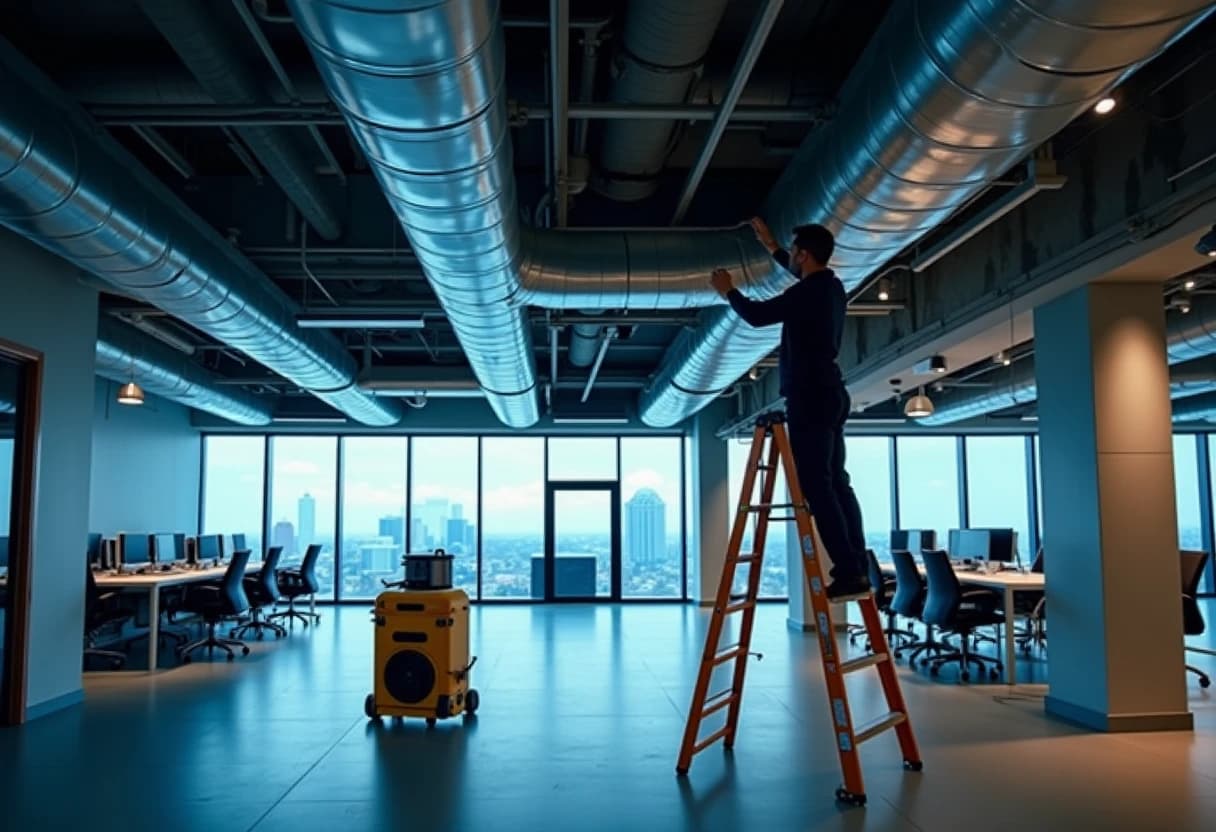
Indoor air quality is now a lease issue, an HR issue and a liability issue. ASHRAE and NADCA both recognize that accumulated duct contamination degrades ventilation performance, and the EPA notes indoor air is routinely two to five times more polluted than outdoor air — a figure that matters when dozens of people share one air handler for forty hours a week. Our commercial air duct cleaning service gives Seaport District businesses and building owners a documented fix: complete source-removal cleaning of supply and return systems, rooftop and interior units, exhaust runs, and terminal equipment. We bring commercial-scale negative-air machines, lift and roof access equipment, insured uniformed technicians, and the scheduling flexibility that occupied buildings demand. Most projects are quoted flat from a brief site walk.
Why Commercial Air Duct Cleaning Matters for Seaport District Homes
Commercial buildings in Greater Boston carry a particular burden: age. Much of the region's office, retail and mixed-use stock predates modern ventilation standards, and its duct systems have been extended, spliced and re-zoned through every tenancy since installation. Original trunk lines from the 1960s serve suites built out in the 1990s and re-divided in the 2010s; abandoned runs dead-end above ceilings collecting dust; flexible duct from a dozen different fit-outs sags between joists. These systems hold decades of accumulation that no filter has ever protected against, because most of it entered from the return side or during construction with the system exposed. Cleaning is also frequently the first time anyone has looked inside in years — our crews routinely discover disconnected branches dumping conditioned air into plenums, crushed flex starving whole suites, and pest evidence that explains long-standing odor complaints. The cleaning restores the system; the inspection that comes with it frequently saves the owner from paying to heat and cool the space above the ceiling tiles for another decade.
Air quality expectations for Seaport District workplaces have never been higher — employees, tenants and customers all notice stale air and dusty diffusers, and they say so. New construction is no guarantee of clean ducts: Seaport units routinely carry construction debris from their own build-out, and the towers' sealed windows mean residents breathe only what the mechanical systems deliver. Harbor humidity and salt air are hard on rooftop equipment and vent terminations, and in-unit washer-dryer setups with long concealed vent runs to the building exterior are a lint problem we service throughout the district. The Seaport is Boston's newest neighborhood, dominated by glass luxury high-rises built almost entirely since 2010, with the Fort Point fringe adding century-old brick-and-beam warehouse lofts converted to condos. The towers run sophisticated central systems - vertical risers, unit-level fan coils and heat pumps, and shared corridor ventilation - where individual condo ductwork is compact but works hard year-round. Fort Point lofts feature long exposed spiral duct runs strung across timber ceilings. Those conditions load commercial duct systems with precisely the contaminants that generate complaints and drag down HVAC efficiency. Our crews clean Seaport District commercial systems to NADCA standards: seal and depressurize each zone, agitate every trunk and branch mechanically, hand-clean unit interiors and terminal boxes, verify with imaging. Businesses in South Boston and Boston use the same service on recurring maintenance schedules, which is why our commercial trucks are in this part of Suffolk County nearly every week.
Our Commercial Air Duct Cleaning Process in Seaport District
1Site Walk, System Mapping & Flat Quote
Every engagement begins with documentation, not equipment. We map your system zone by zone, photograph baseline conditions inside representative ducts and unit interiors, flag any disconnections, damage or microbial concerns, and confirm insurance and access requirements with your property team. Only after you approve the written scope, price and schedule does the crew mobilize.
2Certificates of Insurance & Scheduling Around Your Operations
Commercial work runs on paperwork and timing, and we treat both as part of the service. COIs naming your entity and landlord go out in advance; technicians carry ID and follow your building's access and alarm protocols. Scheduling is genuinely flexible — most of our commercial cleaning happens between close and open, and phased projects are sequenced so each area is finished, cleaned and back in service before occupants return.
3Containment & Protection of Finished Spaces
Retail merchandise, exam rooms, server closets, commercial kitchens — commercial spaces contain things that must not get dusty, and our protection plan is written into every project scope. Sensitive areas are draped or excluded and sequenced appropriately, negative pressure ensures loosened debris travels into HEPA collection rather than the space, and each night's work area is inspected and restored before the crew leaves.
4Negative Pressure on Each Zone
We connect HEPA-filtered negative-air machines to the trunk lines of each zone through sealed access ports, placing the ductwork under continuous vacuum. Commercial systems demand serious equipment — long trunk runs and high static pressures swallow underpowered vacuums — so we size machines to the system, sometimes running multiple units on large floors. Debris loosened downstream travels one direction: into collection.
5Mechanical Agitation of Trunks, Branches & Terminal Units
This is the labor the price reflects. Every supply branch from diffuser to trunk, every return path including plenum-connected grilles, and every accessible terminal unit gets individual mechanical agitation — not just a blast of air from one end. Stubborn accumulation gets repeat passes until inspection imaging shows clean metal. Access panels are installed where the system lacks them, per NADCA standards, and sealed properly afterward.
6Air Handler, Rooftop Unit & Coil Cleaning
A clean duct system fed by a dirty air handler recontaminates in months, so units are part of every complete scope. We open each RTU or interior handler and detail the components the airstream touches: blower wheel, housing interior, plenum sections and accessible panels. Coil condition is documented with photos; where fouling is significant we quote in-place coil cleaning honestly, using appropriate coil-safe methods.
7Verification, Restoration & Completion Report
Projects close with proof. We re-image the duct sections photographed at the start, reinstall grilles and diffusers, replace ceiling tiles, restore thermostat settings and filters, and run each system to verify airflow. Your completion report includes before-and-after photos, a zone-by-zone scope checklist, observations on duct condition and recommended repairs, and the service date — formatted for owners, boards and insurance files.
Benefits of Professional Commercial Air Duct Cleaning in Seaport District
Extended Rooftop Unit & Equipment Life
Every hour a fan motor fights choked airflow shortens its life, and commercial motors log thousands of hours a year. Source-removal cleaning takes the strain off the entire mechanical chain — motors, bearings, belts, compressors — which is why HVAC contractors themselves routinely refer their commercial clients to us before recommending equipment replacement.
One Vendor for Whole Portfolios
Property managers running multiple buildings get one point of contact, consistent pricing logic across properties, standardized reporting, and a maintenance calendar that schedules each site on its own interval. Adding a property to the program takes one site walk. It is the difference between managing a vendor and managing a program.
Fewer IAQ Complaints, Happier Tenants & Staff
For employers, air quality is a retention and productivity issue — workplace studies consistently link ventilation quality to cognitive performance and absenteeism. For landlords, it is a lease-renewal issue. Removing years of accumulated contamination from the system every occupant shares is one of the few facility investments both groups notice within the first week.
Zero Disruption to Business Operations
Downtime is a cost most vendors ignore and we design around. Projects are sequenced so no zone is out of service during your operating hours, containment keeps adjacent areas usable during phased work, and every shift ends with the space inspected, restored and ready for business. Your revenue never subsidizes your maintenance.
A Visibly Cleaner, Fresher-Smelling Space
Odors live in the organic film inside ductwork — cooking residue in food service, sweat and rubber in gyms, general staleness everywhere — and re-release with every operating hour. Air fresheners mask the symptom on top of the cause. Source removal takes the saturated dust out of the building, which is the only fix that survives the week.
Documentation for Insurance, Leases & Compliance
For medical, dental, childcare and food-service tenants, documented HVAC hygiene is part of operating credibly — inspectors notice dusty diffusers, and patients and parents notice them sooner. Our reports give these businesses a dated, photographic answer, and give their landlords a template for building-wide maintenance that keeps every tenancy covered.
Signs Your Seaport District Home Needs Commercial Air Duct Cleaning
Dust Streaking on Diffusers, Grilles & Ceiling Tiles
Gray streaks fanning out from supply diffusers and dark rings on surrounding ceiling tiles are the system's contamination made visible: dust-laden supply air depositing its cargo at the exit. Wiping the diffusers treats the symptom for a week; the trunk and branch surfaces upstream hold the resupply until they are mechanically cleaned.
Rising Energy Bills or Weak Airflow in Certain Zones
Track runtime: systems compensating for fouled air paths cycle longer to reach setpoint, and long operating hours multiply the waste. If your building automation or utility data shows creeping consumption alongside comfort complaints, air-side fouling is the first hypothesis worth testing — and the cheapest one to fix.
Recent Fit-Out, Renovation or Construction
If your building has had any recent renovation — your own or a neighboring tenancy sharing the same air handler — assume the ductwork participated. Shared systems distribute one suite's construction dust to every suite downstream. A camera inspection confirms it in minutes, and cleaning before complaints start is far cheaper than after.
No Service History Anyone Can Find
Building acquisitions inherit ductwork as-is: every previous tenant's dust, every fit-out's debris, every deferred year. A duct inspection belongs on the due-diligence checklist alongside the roof and the boilers — it is among the cheapest items on the list and regularly surfaces disconnections and damage that affect the negotiation.
Odors That Return Every Operating Day
A building that smells stale at opening, musty after humid stretches, or faintly of last year's kitchen operations is broadcasting from its ductwork. Odor molecules bind to the organic dust film inside ducts and re-release with every operating hour. No cleaning contract or air freshener reaches the source; source removal takes it out of the building.
Water Intrusion, Mold Findings or Pest Evidence
Visible growth on diffusers, unit interiors or duct surfaces is an immediate-action finding in every IAQ framework. It is also a liability accelerant: once observed and reported, an owner's response timeline becomes evidence. Prompt professional cleaning with photographic documentation is both the fix and the defensible record of it.
Commercial Air Duct Cleaning Cost in Seaport District, MA
Budget-minded facilities teams should weigh interval against invoice. A commercial system cleaned to NADCA standards stays serviceably clean for three to five years in typical use, so a $3,000 project annualizes to under a thousand dollars — less than most buildings lose annually to the energy penalty of fouled coils and choked airflow. Recurring-program clients do better still: properties on our maintenance calendar receive locked interval pricing, priority scheduling in the spring and fall rush, and inspection-first service where we camera-check the system and clean only when imaging justifies it. That inspect-first discipline matters; some intervals we recommend deferring a cleaning, and clients tell us that honesty is why entire portfolios end up on our schedule. Multi-property managers should ask about portfolio pricing — consolidated scheduling across sites reduces our mobilization costs, and we pass the difference through.
Want the full pricing picture? See our complete Boston-area cost guide or call (617) 390-7145 for an exact flat quote for your Seaport District home.
Local Knowledge: Seaport District, Suffolk County
What makes Seaport District different? The Seaport is Boston's newest neighborhood, dominated by glass luxury high-rises built almost entirely since 2010, with the Fort Point fringe adding century-old brick-and-beam warehouse lofts converted to condos. The towers run sophisticated central systems - vertical risers, unit-level fan coils and heat pumps, and shared corridor ventilation - where individual condo ductwork is compact but works hard year-round. Fort Point lofts feature long exposed spiral duct runs strung across timber ceilings. New construction is no guarantee of clean ducts: Seaport units routinely carry construction debris from their own build-out, and the towers' sealed windows mean residents breathe only what the mechanical systems deliver. Harbor humidity and salt air are hard on rooftop equipment and vent terminations, and in-unit washer-dryer setups with long concealed vent runs to the building exterior are a lint problem we service throughout the district. For duct and dryer vent systems, those local factors translate into specific, predictable problems — and predictable problems are the ones we solve fastest. Call (617) 390-7145, tell us your street and home style, and we will quote the job accurately the first time, usually in under five minutes.
The Best Time of Year in Seaport District
Commercial buildings in Massachusetts live on a two-season HVAC cycle — heating from October into April, cooling through the humid summer — and both seasons punish dirty ductwork. Fall is the smartest window for commercial cleaning: systems get a clean start before near-continuous winter runtime, and the first heating cycles do not broadcast burnt-dust odor through the workplace. Late spring is the second-best slot, clearing winter accumulation before cooling season seals the building. For retail, the calendar adds its own logic — holiday-season floors should be cleaned by early November, not during it — and schools and daycares book vacation weeks months ahead. We hold overnight and weekend capacity year-round, but the fall commercial rush is real; property managers who schedule in September choose their dates rather than taking what remains.
Why Choose Boston Air Duct Cleaners
Boston Air Duct Cleaners is a local, owner-operated company based at 1121 Washington St in West Newton — not a national franchise dispatching subcontractors. Every crew is our own: background-checked, factory-trained on commercial negative-pressure equipment, and fully insured. We quote flat prices before work begins, document every job with before-and-after photos, and follow NADCA-standard source-removal methods on every system we touch. That is why so much of our work comes from repeat customers, property managers and word-of-mouth referrals across Suffolk County.
Serving Seaport District and Surrounding Communities
Beyond Seaport District, our crews cover the surrounding communities daily — including South Boston, Boston, Back Bay, South End, East Boston, Dorchester. Because routes cluster geographically, booking alongside a neighboring appointment often unlocks same-day service and combined-visit savings. Wherever you are in Suffolk County, the same flat-rate pricing, insured technicians and photo-documented process applies.