
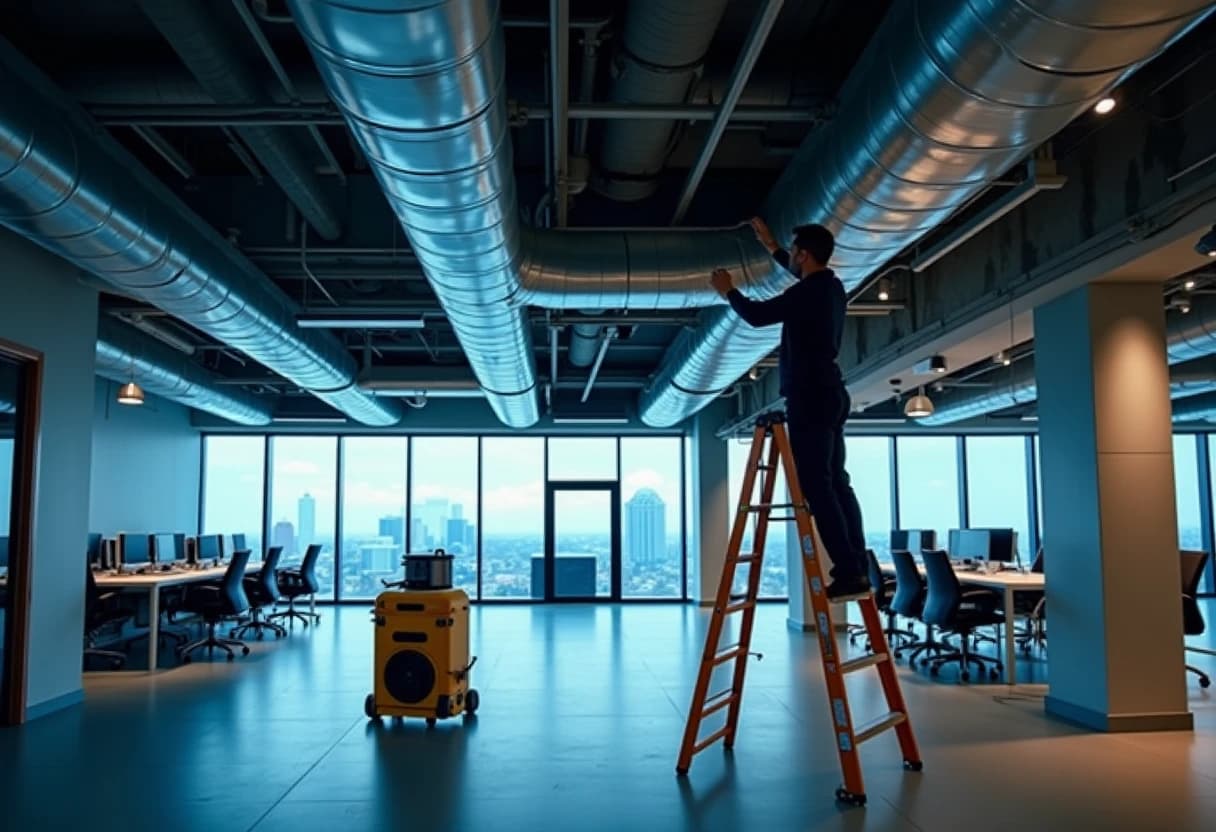
Facility managers in Boston call us when the low bid burned them once already — crews that wiped grilles, skipped the returns, blew dust across cubicles and left no paperwork. Commercial duct cleaning done correctly is a different product: the system is mapped zone by zone, sealed and placed under HEPA-filtered negative pressure, agitated mechanically along every trunk and branch, and verified with before-and-after imaging. We service offices, retail, restaurants, medical and dental practices, schools, daycares, houses of worship and fitness clubs across Greater Boston. Certificates of insurance, W-9s, background-checked technicians and after-hours access protocols are routine for us, and our reports are written so a board, an owner or an adjuster can see exactly what was cleaned and when.
Why Commercial Air Duct Cleaning Matters for Boston Homes
Weigh the cost of cleaning against the cost of not cleaning. A duct cleaning project for a typical commercial space runs a few thousand dollars once every three to five years. On the other side of the ledger: energy waste from fouled coils and choked airflow accruing monthly; premature rooftop unit failures measured in tens of thousands; productivity drag from poor air quality, which peer-reviewed workplace studies tie to slower cognitive performance and higher sick-day rates; tenant turnover costs when IAQ complaints go unresolved through a lease cycle; and the exposure of facing an air-quality claim with no documented maintenance history. Insurers and counsel increasingly treat HVAC hygiene records the way they treat sprinkler inspection records — the absence is the problem. Our commercial service is built to close that gap efficiently: assessment and flat quote from a site walk or mechanical drawings, after-hours execution that costs you zero operating hours, and a completion report with photographic evidence that drops straight into your maintenance file. Few line items in a facilities budget buy this much risk reduction per dollar.
Boston businesses call us for three commercial scenarios more than any other: post-fit-out cleanings after renovation dust invades the ductwork, odor and stale-air complaints in older buildings, and documentation requirements from insurers or medical tenants. Boston's housing runs the full spectrum of American urban building: 1800s brownstones and brick rowhouses in Back Bay, Beacon Hill and the South End, wood-frame triple-deckers across Dorchester and the streetcar neighborhoods, mid-rise brick apartment blocks near the universities, and glass condo towers downtown and along the harbor. Countless older buildings have been carved into condos with each unit given its own furnace or heat pump, so ductwork is often squeezed through 19th-century joist bays, chases and dropped ceilings never designed for it. The result is a city full of long, tight, hard-to-reach duct runs that trap decades of dust. We work in Boston every week, from rowhouse condos on gas-fired forced air to triple-decker units with attic air handlers. City-specific issues come up constantly: shared-wall dust migration in rowhouse blocks, renovation debris left in ducts after condo conversions, and dryer vent runs that snake thirty-plus feet to reach an outside wall - a genuine fire risk we flag on nearly every Boston visit. We bring the full commercial setup to every Boston project — portable and truck-mounted HEPA negative-air machines, rotary brush and air-whip agitation, coil cleaning capability for rooftop and interior units — because commercial trunk lines and VAV systems demand more than residential equipment can deliver. Every project ends with a written completion report, and most are executed entirely outside your business hours.
Our Commercial Air Duct Cleaning Process in Boston
1Site Walk, System Mapping & Flat Quote
Every engagement begins with documentation, not equipment. We map your system zone by zone, photograph baseline conditions inside representative ducts and unit interiors, flag any disconnections, damage or microbial concerns, and confirm insurance and access requirements with your property team. Only after you approve the written scope, price and schedule does the crew mobilize.
2Certificates of Insurance & Scheduling Around Your Operations
We plan commercial projects like contractors, not like a residential crew squeezing in a big job. That means pre-mobilization insurance certificates, coordination with your facilities or property management team, protection plans for finished spaces and merchandise, and crews scheduled for the windows when your building is emptiest — nights, weekends and holidays included at no scheduling premium for standard projects.
3Containment & Protection of Finished Spaces
Occupied commercial interiors demand real containment. We protect flooring along hose routes, cover or move furniture, desks and merchandise in work zones, and seal diffusers and grilles zone by zone so the system becomes a closed vacuum circuit. Ceiling tile removal and replacement is handled carefully and systematically — the space looks untouched when your staff arrives in the morning.
4Negative Pressure on Each Zone
Negative pressure is the backbone of NADCA-standard cleaning, and commercial ductwork tests it: hundred-foot trunk runs, multiple branch takeoffs, VAV boxes and plenum returns all between the debris and the vacuum. We establish collection points strategically along the mains, verify draw at the far ends of each run, and only then begin agitation — ensuring every loosened particle has a clear path out of the building.
5Mechanical Agitation of Trunks, Branches & Terminal Units
This is the labor the price reflects. Every supply branch from diffuser to trunk, every return path including plenum-connected grilles, and every accessible terminal unit gets individual mechanical agitation — not just a blast of air from one end. Stubborn accumulation gets repeat passes until inspection imaging shows clean metal. Access panels are installed where the system lacks them, per NADCA standards, and sealed properly afterward.
6Air Handler, Rooftop Unit & Coil Cleaning
Rooftop units live a hard life above Massachusetts weather, and their interiors show it — wet-matted dust, corroded pans, biofilm on coil faces. Our crews are equipped and insured for roof work, and RTU interior cleaning is a routine scope item: blower and cabinet cleaning, drain pan service, coil cleaning where warranted, and photographs of everything so your facilities file shows unit condition, not just duct condition.
7Verification, Restoration & Completion Report
The last step is a walkthrough with your facilities contact or property manager: systems running, airflow verified at representative diffusers, documentation reviewed page by page. Everything we observed inside your system goes in writing, including items outside our scope that deserve your HVAC contractor's attention. We then log your property for the maintenance interval you choose, so recurring cleanings arrive as calendar items, not emergencies.
Benefits of Professional Commercial Air Duct Cleaning in Boston
Lower Energy Costs Across Long Operating Hours
Commercial HVAC runs ten to fourteen hours a day, so every efficiency point lost to fouled coils, dirty blower wheels and debris-narrowed ducts compounds across thousands of operating hours a year. Cleaning restores design airflow and heat transfer, and buildings with long-neglected systems frequently see the project pay for itself at the utility meter within a couple of seasons.
Fewer IAQ Complaints, Happier Tenants & Staff
Occupants judge a building by how it feels to breathe in, and no janitorial contract reaches the ductwork. A documented duct cleaning gives property managers a concrete, visible answer to IAQ concerns: here is what was in the system, here is the clean result, here is the maintenance schedule going forward. Complaints become conversations you can close.
One Vendor for Whole Portfolios
Recurring commercial clients get priority scheduling, locked maintenance-interval pricing and proactive reminders when each property comes due. For managers, that converts duct cleaning from a reactive scramble — usually triggered by a tenant complaint — into a quiet line item that renews itself, with documentation accumulating in each property's file automatically.
Extended Rooftop Unit & Equipment Life
Replacing a commercial rooftop unit in Massachusetts runs well into five figures with crane time, curb adapters and controls. Dust is the primary aging accelerant — insulating coils, overheating motors, unbalancing blowers. Keeping the air path clean lets equipment run at design conditions, deferring the largest capital expenses on a building's mechanical schedule.
A Visibly Cleaner, Fresher-Smelling Space
Dust-streaked diffusers and gray-ringed ceiling tiles quietly undermine every impression your space makes — customers, patients and job candidates all register them. Cleaning the system and its visible terminals removes both the staining source and the stains, and the persistent stale-building odor that clings to occupied commercial space typically leaves with the duct dust that harbored it.
Documentation for Insurance, Leases & Compliance
For medical, dental, childcare and food-service tenants, documented HVAC hygiene is part of operating credibly — inspectors notice dusty diffusers, and patients and parents notice them sooner. Our reports give these businesses a dated, photographic answer, and give their landlords a template for building-wide maintenance that keeps every tenancy covered.
Signs Your Boston Home Needs Commercial Air Duct Cleaning
Water Intrusion, Mold Findings or Pest Evidence
Droppings, nesting material or insect debris in ceiling plenums and duct runs contaminate the airstream serving every occupant downstream. Pest remediation that stops at traps and exclusion leaves the duct-borne residue circulating. Include the ductwork in the cleanup scope and document it — it is the part occupants are actually breathing.
No Service History Anyone Can Find
NADCA guidance calls for periodic inspection of commercial air systems, with cleaning as conditions warrant — and in Greater Boston's older commercial stock, conditions almost always warrant. Starting a documented maintenance cycle now costs a site walk; explaining a decade of missing records to an insurer or a tenant's counsel later costs considerably more.
Odors That Return Every Operating Day
A building that smells stale at opening, musty after humid stretches, or faintly of last year's kitchen operations is broadcasting from its ductwork. Odor molecules bind to the organic dust film inside ducts and re-release with every operating hour. No cleaning contract or air freshener reaches the source; source removal takes it out of the building.
Recent Fit-Out, Renovation or Construction
If your building has had any recent renovation — your own or a neighboring tenancy sharing the same air handler — assume the ductwork participated. Shared systems distribute one suite's construction dust to every suite downstream. A camera inspection confirms it in minutes, and cleaning before complaints start is far cheaper than after.
Rising Energy Bills or Weak Airflow in Certain Zones
Track runtime: systems compensating for fouled air paths cycle longer to reach setpoint, and long operating hours multiply the waste. If your building automation or utility data shows creeping consumption alongside comfort complaints, air-side fouling is the first hypothesis worth testing — and the cheapest one to fix.
Tenant or Employee Air Quality Complaints
The complaint pattern tells the story: symptoms that ease when occupants leave the building, worsen when the system runs hardest, and cluster in specific zones implicate the ductwork serving those zones. An inspection settles it in an hour, and cleaning resolves what the inspection finds — with photos to close the loop with complainants.
Commercial Air Duct Cleaning Cost in Boston, MA
Why does the per-square-foot rate vary from $0.15 to $0.50? Density and difficulty. A modern open-plan office with exposed spiral duct cleans efficiently and prices near the bottom of the range. A medical suite with many small rooms, dense branch runs and infection-control protocols prices higher per foot. Restaurants add grease-influenced dust and overnight-only access; older buildings add long trunk runs, missing access panels (which NADCA-standard work requires us to install properly) and decades of accumulation requiring repeat agitation passes. Add-ons are quoted separately and honestly: evaporator or RTU coil cleaning typically $250–$600 per unit, EPA-registered sanitizing treatment $150–$500 depending on system size, and duct repairs always priced for approval before work. Nothing is 'discovered' on site and added to your invoice without a signed change.
Want the full pricing picture? See our complete Boston-area cost guide or call (617) 390-7145 for an exact flat quote for your Boston home.
Local Knowledge: Boston, Suffolk County
Every town's ductwork tells the story of its housing. Boston's housing runs the full spectrum of American urban building: 1800s brownstones and brick rowhouses in Back Bay, Beacon Hill and the South End, wood-frame triple-deckers across Dorchester and the streetcar neighborhoods, mid-rise brick apartment blocks near the universities, and glass condo towers downtown and along the harbor. Countless older buildings have been carved into condos with each unit given its own furnace or heat pump, so ductwork is often squeezed through 19th-century joist bays, chases and dropped ceilings never designed for it. The result is a city full of long, tight, hard-to-reach duct runs that trap decades of dust. We work in Boston every week, from rowhouse condos on gas-fired forced air to triple-decker units with attic air handlers. City-specific issues come up constantly: shared-wall dust migration in rowhouse blocks, renovation debris left in ducts after condo conversions, and dryer vent runs that snake thirty-plus feet to reach an outside wall - a genuine fire risk we flag on nearly every Boston visit. We plan Boston jobs around those realities, from equipment selection to time on site, and it shows in the results. If you live near Fenway Park or anywhere across Boston's 02108 area, we have almost certainly cleaned a system like yours before — and we can tell you exactly what to expect before we arrive.
The Best Time of Year in Boston
Summer humidity is the biological threat to commercial systems. Cooling coils and condensate pans run wet for months, ceiling plenums in older buildings track outdoor humidity, and the organic dust film inside ducts absorbs moisture and becomes a growth medium — which is why musty-odor and 'dirty sock' complaints spike in August across Suffolk County. Buildings with marginal condensate drainage or oversized equipment that short-cycles are most vulnerable. A pre-summer cleaning removes the organic substrate growth needs; a post-summer inspection catches whatever a wet season started before winter runtime distributes it. Restaurants and gyms — high-moisture, high-odor operations — benefit from the tightest intervals of any building type we serve.
Why Choose Boston Air Duct Cleaners
Boston Air Duct Cleaners is a local, owner-operated company based at 1121 Washington St in West Newton — not a national franchise dispatching subcontractors. Every crew is our own: background-checked, factory-trained on commercial negative-pressure equipment, and fully insured. We quote flat prices before work begins, document every job with before-and-after photos, and follow NADCA-standard source-removal methods on every system we touch. That is why so much of our work comes from repeat customers, property managers and word-of-mouth referrals across Suffolk County.
Serving Boston and Surrounding Communities
Beyond Boston, our crews cover the surrounding communities daily — including Back Bay, South End, Cambridge, Brookline, Somerville, Dorchester. Because routes cluster geographically, booking alongside a neighboring appointment often unlocks same-day service and combined-visit savings. Wherever you are in Suffolk County, the same flat-rate pricing, insured technicians and photo-documented process applies.