
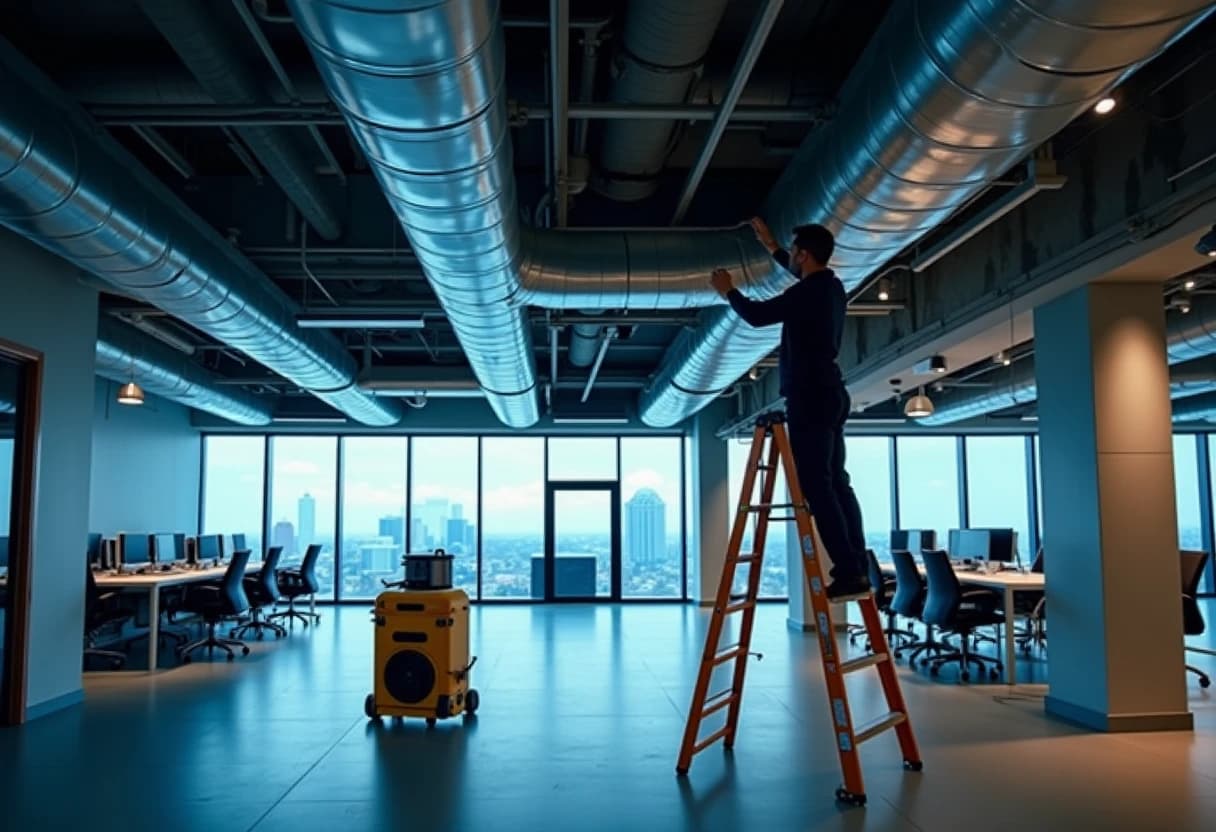
When employees complain about stuffy air, tenants file IAQ tickets, or customers notice dust streaming from ceiling diffusers, the ductwork is usually the culprit — and in commercial buildings it is measured in thousands of square feet of hidden sheet metal. Boston Air Duct Cleaners provides full source-removal duct cleaning for commercial properties in South End: supply and return trunks, branch runs, VAV and fan-powered boxes, rooftop unit interiors, and the diffusers and grilles your occupants actually see. Our crews are experienced with roof access, ceiling plenum returns, and the long horizontal trunk runs typical of office and retail construction. Every project includes pre- and post-cleaning photo documentation, after-hours or phased scheduling, and a certificate of insurance issued to your property before work begins.
Why Commercial Air Duct Cleaning Matters for South End Homes
Certain commercial situations make duct cleaning non-negotiable. After tenant fit-outs and renovations, drywall and concrete dust saturates the duct network and ceiling plenum; occupying the space without cleaning means months of construction particulate raining onto desks and merchandise. After fire or smoke events — even minor ones — soot embeds in duct dust and re-releases odor indefinitely, and remediation scopes routinely require documented duct cleaning. After water intrusion, roof leaks or humidification failures, damp duct interiors become microbial growth sites within days, and the EPA's guidance is explicit that visibly contaminated ducts serving occupied spaces should be professionally cleaned. Ownership transitions matter too: buyers inherit the previous owner's deferred maintenance, and a pre-purchase duct inspection is one of the cheapest due-diligence items available. Finally, some tenants simply require it — medical uses, labs, food production and childcare leases often carry IAQ maintenance clauses. In each case, the combination of proper source-removal cleaning and a formal completion report satisfies the requirement and closes the file.
Whether it is a professional suite near Blackstone Square, a restaurant space off SoWa Art + Design District, or a multi-tenant building elsewhere in South End, the commercial duct systems we open here tell the same story: original mains extended through every tenancy, ceiling plenums thick with construction debris, and returns that have never been cleaned. The South End holds the largest intact Victorian rowhouse district in the country - block after block of 1850s-1880s bowfront brick rowhouses ringed around leafy garden squares, nearly all divided into condos, plus SoWa's former factory buildings converted to lofts. Five-story rowhouses split into three or four units mean stacked HVAC systems sharing tight rear chases, with condensers crowded onto roofs and decks. High-velocity mini-duct retrofits are everywhere here, threaded through original plaster and pocket-door partitions. South End rowhouse condos share more than walls: dust, cooking odors and lint travel through the gaps and chases of buildings framed 150 years ago, so one unit's duct hygiene affects its neighbors. Landmark district rules push dryer vents and exhausts to rear alley elevations through long runs we're often asked to trace and clear. It's one of our busiest neighborhoods for brownstone duct work. As a local company based 10 miles away in West Newton, we can walk your South End site quickly, quote flat from the walkthrough or your mechanical drawings, and schedule overnight or weekend crews that leave the space spotless before opening. Owners and managers across Suffolk County keep us on multi-property schedules for exactly this reliability.
Our Commercial Air Duct Cleaning Process in South End
1Site Walk, System Mapping & Flat Quote
Every engagement begins with documentation, not equipment. We map your system zone by zone, photograph baseline conditions inside representative ducts and unit interiors, flag any disconnections, damage or microbial concerns, and confirm insurance and access requirements with your property team. Only after you approve the written scope, price and schedule does the crew mobilize.
2Certificates of Insurance & Scheduling Around Your Operations
We plan commercial projects like contractors, not like a residential crew squeezing in a big job. That means pre-mobilization insurance certificates, coordination with your facilities or property management team, protection plans for finished spaces and merchandise, and crews scheduled for the windows when your building is emptiest — nights, weekends and holidays included at no scheduling premium for standard projects.
3Containment & Protection of Finished Spaces
Retail merchandise, exam rooms, server closets, commercial kitchens — commercial spaces contain things that must not get dusty, and our protection plan is written into every project scope. Sensitive areas are draped or excluded and sequenced appropriately, negative pressure ensures loosened debris travels into HEPA collection rather than the space, and each night's work area is inspected and restored before the crew leaves.
4Negative Pressure on Each Zone
Zone by zone, the duct network becomes a controlled vacuum circuit. Our negative-air machines pull thousands of cubic feet per minute through HEPA filtration, maintaining continuous negative pressure for the entire agitation phase. On multi-unit buildings we isolate and clean one system at a time, which keeps containment tight and lets partially occupied buildings continue operating around the work.
5Mechanical Agitation of Trunks, Branches & Terminal Units
Commercial duct construction varies — rigid rectangular mains, spiral rounds, duct board, flex runs to diffusers — and each takes the right tool: rotary brushes for metal, gentler whip systems for duct board and flex, hand tools inside boxes and plenums. We work from the terminal ends toward the collection points so debris always moves toward the vacuum, then clean the mains themselves last.
6Air Handler, Rooftop Unit & Coil Cleaning
Rooftop units live a hard life above Massachusetts weather, and their interiors show it — wet-matted dust, corroded pans, biofilm on coil faces. Our crews are equipped and insured for roof work, and RTU interior cleaning is a routine scope item: blower and cabinet cleaning, drain pan service, coil cleaning where warranted, and photographs of everything so your facilities file shows unit condition, not just duct condition.
7Verification, Restoration & Completion Report
Before the crew demobilizes, every work area is inspected and restored: tiles back, grilles remounted, floors HEPA-vacuumed, protection removed. The final report is a genuine deliverable — photo-documented evidence of cleaned trunks, branches and units, notes on anything we found (disconnections, leaks, insulation damage, pest evidence), and maintenance recommendations with honest intervals. Many clients tell us the report alone justified choosing a certified crew.
Benefits of Professional Commercial Air Duct Cleaning in South End
Extended Rooftop Unit & Equipment Life
Replacing a commercial rooftop unit in Massachusetts runs well into five figures with crane time, curb adapters and controls. Dust is the primary aging accelerant — insulating coils, overheating motors, unbalancing blowers. Keeping the air path clean lets equipment run at design conditions, deferring the largest capital expenses on a building's mechanical schedule.
Zero Disruption to Business Operations
Downtime is a cost most vendors ignore and we design around. Projects are sequenced so no zone is out of service during your operating hours, containment keeps adjacent areas usable during phased work, and every shift ends with the space inspected, restored and ready for business. Your revenue never subsidizes your maintenance.
Lower Energy Costs Across Long Operating Hours
Commercial HVAC runs ten to fourteen hours a day, so every efficiency point lost to fouled coils, dirty blower wheels and debris-narrowed ducts compounds across thousands of operating hours a year. Cleaning restores design airflow and heat transfer, and buildings with long-neglected systems frequently see the project pay for itself at the utility meter within a couple of seasons.
Documentation for Insurance, Leases & Compliance
Commercial leases, accreditation standards and insurance carriers are steadily adding IAQ maintenance language, and 'we changed the filters' does not satisfy it. A NADCA-standard cleaning with dated photo documentation does. Property managers file our reports the way they file fire-system inspections: proof of diligence, ready before anyone asks for it.
One Vendor for Whole Portfolios
Property managers running multiple buildings get one point of contact, consistent pricing logic across properties, standardized reporting, and a maintenance calendar that schedules each site on its own interval. Adding a property to the program takes one site walk. It is the difference between managing a vendor and managing a program.
Fewer IAQ Complaints, Happier Tenants & Staff
For employers, air quality is a retention and productivity issue — workplace studies consistently link ventilation quality to cognitive performance and absenteeism. For landlords, it is a lease-renewal issue. Removing years of accumulated contamination from the system every occupant shares is one of the few facility investments both groups notice within the first week.
Signs Your South End Home Needs Commercial Air Duct Cleaning
Recent Fit-Out, Renovation or Construction
Construction dust is not ordinary dust: fine gypsum and silica particulate is a respiratory irritant, remarkably persistent, and gritty enough for occupants to notice on surfaces within days of move-in. A post-construction source-removal cleaning is standard commissioning practice for good reason, and it belongs in every fit-out budget from the start.
Dust Streaking on Diffusers, Grilles & Ceiling Tiles
Walk your space and look up. Dust-furred grille faces, streaked tiles and lint beards on return grilles are all evidence the airstream is carrying visible particulate — and the visible fraction is a small sample of what occupants inhale. Customers and inspectors read these marks the same way you should: the system needs service.
Rising Energy Bills or Weak Airflow in Certain Zones
Suites that never cool, conference rooms that never warm, and utility bills creeping up without rate changes all point to airflow loss — and dust is its quietest cause. Debris-narrowed branches, clogged VAV inlets and fouled coils steal delivered air zone by zone. Cleaning restores the balance the system was commissioned with.
Tenant or Employee Air Quality Complaints
IAQ tickets that keep reopening are expensive in management time and tenant goodwill. Before commissioning air-quality testing or consultant studies, look inside the ducts — in older commercial buildings, visible accumulation is the overwhelmingly common finding, and source-removal cleaning is the direct, documentable fix.
Odors That Return Every Operating Day
Gyms, restaurants and older offices each develop signature odors, and all three share the same mechanism: saturated duct dust re-emitting what the building's operations deposited. Post-cleaning, optionally finished with an EPA-registered deodorizing treatment, spaces smell neutral — which occupants register immediately even if they never identify why.
Water Intrusion, Mold Findings or Pest Evidence
Droppings, nesting material or insect debris in ceiling plenums and duct runs contaminate the airstream serving every occupant downstream. Pest remediation that stops at traps and exclusion leaves the duct-borne residue circulating. Include the ductwork in the cleanup scope and document it — it is the part occupants are actually breathing.
Commercial Air Duct Cleaning Cost in South End, MA
Beware the two failure modes of commercial duct-cleaning pricing. The first is the residential coupon crew quoting a commercial building at house prices: they arrive with one portable vacuum, wipe the diffusers, skip the returns, boxes and units entirely, and leave no documentation — money spent for nothing but a false sense of maintenance. The second is the restoration-industry bid at two to three times market, justified by equipment lists rather than scope. The defensible middle for Eastern Massachusetts commercial work runs roughly $0.15–$0.50 per square foot or $500–$5,000 per typical project, executed by an insured crew with commercial negative-air equipment, and concluded with photographic before-and-after documentation. Get the scope in writing — every system, every zone, terminal units included, report included — and any bid becomes comparable. Ours arrives that way by default, usually within two business days of the site walk.
Want the full pricing picture? See our complete Boston-area cost guide or call (617) 390-7145 for an exact flat quote for your South End home.
Local Knowledge: South End, Suffolk County
Every town's ductwork tells the story of its housing. The South End holds the largest intact Victorian rowhouse district in the country - block after block of 1850s-1880s bowfront brick rowhouses ringed around leafy garden squares, nearly all divided into condos, plus SoWa's former factory buildings converted to lofts. Five-story rowhouses split into three or four units mean stacked HVAC systems sharing tight rear chases, with condensers crowded onto roofs and decks. High-velocity mini-duct retrofits are everywhere here, threaded through original plaster and pocket-door partitions. South End rowhouse condos share more than walls: dust, cooking odors and lint travel through the gaps and chases of buildings framed 150 years ago, so one unit's duct hygiene affects its neighbors. Landmark district rules push dryer vents and exhausts to rear alley elevations through long runs we're often asked to trace and clear. It's one of our busiest neighborhoods for brownstone duct work. We plan South End jobs around those realities, from equipment selection to time on site, and it shows in the results. If you live near Boston Center for the Arts or anywhere across South End's 02118 area, we have almost certainly cleaned a system like yours before — and we can tell you exactly what to expect before we arrive.
The Best Time of Year in South End
Summer humidity is the biological threat to commercial systems. Cooling coils and condensate pans run wet for months, ceiling plenums in older buildings track outdoor humidity, and the organic dust film inside ducts absorbs moisture and becomes a growth medium — which is why musty-odor and 'dirty sock' complaints spike in August across Suffolk County. Buildings with marginal condensate drainage or oversized equipment that short-cycles are most vulnerable. A pre-summer cleaning removes the organic substrate growth needs; a post-summer inspection catches whatever a wet season started before winter runtime distributes it. Restaurants and gyms — high-moisture, high-odor operations — benefit from the tightest intervals of any building type we serve.
Why Choose Boston Air Duct Cleaners
As a West Newton-based company, we treat South End like the neighborhood it is — because for us, it is. Our reputation lives or dies on local referrals, so every job gets the full process: complete system cleaning under negative pressure, mechanical agitation of every run, blower compartment service, and a documented walkthrough before we leave. We are licensed and insured, our estimates are free and flat, and our schedule holds same-day slots for urgent calls. One visit and you will understand why neighbors keep our magnet on the fridge.
Serving South End and Surrounding Communities
We serve every community around South End as well: Back Bay, Roxbury, Boston, South Boston, Beacon Hill, Jamaica Plain all fall inside our regular service routes. If you have a second property, a rental, or family nearby, ask about multi-home scheduling — grouped appointments on the same route are our most requested discount.