
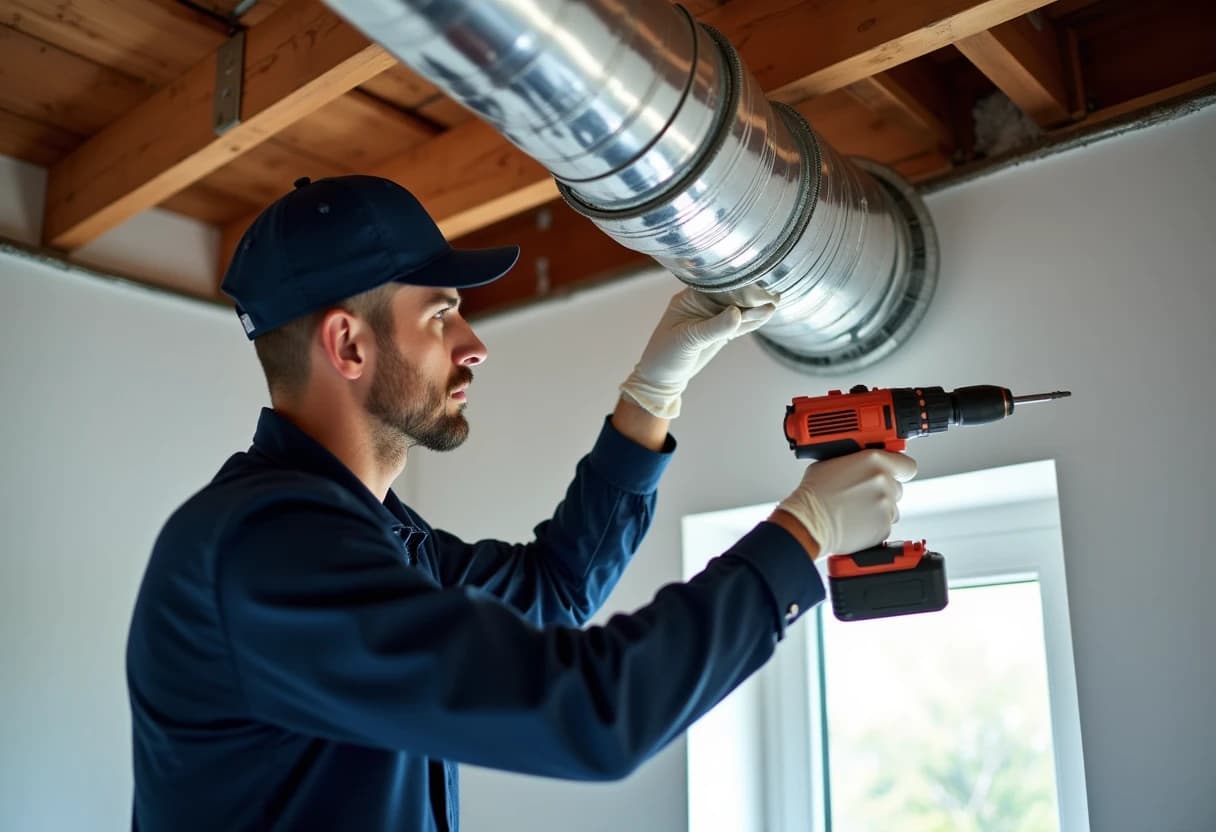
Moving your laundry to a better spot? Finishing a basement? Buying a home whose inspection flagged the venting? Those are the moments to get the dryer exhaust right permanently. We install and reroute dryer vents throughout Hull: planning the shortest code-legal path from the appliance to outdoors, cutting clean penetrations through clapboard, brick or rim joist, hanging rigid metal duct with proper support and slope, and finishing with a quality hood whose damper seals against New England weather. A correctly built vent needs nothing but an annual cleaning for decades — and it dries clothes the way the appliance manual promised.
Why Dryer Vent Installation & Rerouting Matters for Hull Homes
Dryer vent installation is where fire safety is actually decided. The roughly 2,900 US home dryer fires each year cluster around the same installation faults: flexible plastic or foil duct that traps lint in its corrugations, overlong runs the dryer cannot clear, screws through joints snagging fibers in the airstream, and terminations that clog or were never outdoors at all. The IRC's dryer exhaust provisions — 4-inch smooth rigid metal, 35-foot maximum equivalent length with elbow deductions, no protruding fasteners, damper-equipped unscreened termination — are the distilled corrections to those fault patterns. A vent built to that standard resists lint accumulation by design, keeps exhaust velocity high enough to carry fibers all the way out, and gives annual cleaning a smooth, brushable path to maintain. A vent built casually does the opposite, banking a little more fuel every load. Installation is a few hundred dollars once; the system it creates determines your laundry's risk profile for the life of the house. That asymmetry is the entire argument for doing it right.
Routing a dryer vent through Hull housing is a local craft. Hull occupies a narrow peninsula where nearly every home feels the ocean: the stock is a dense mix of converted summer cottages, shingled beach houses and modest year-round homes packed along the boulevard from Nantasket to Pemberton Point. Many were winterized decades after construction, so heating systems and ductwork were squeezed into buildings never designed for them, often in shallow crawlspaces just above the water table. Laundry areas in homes like these were carved out of basements, back halls and closets long after construction, and the legal path outdoors is rarely obvious — it threads between old framing, past stone or brick foundation, around a century of renovations. No town we serve takes more salt spray than Hull - homes here are surrounded by water on both sides of the peninsula, and exterior dryer vent hoods, dampers and duct components corrode remarkably fast. Constant coastal wind also drives fine sand and salt into vent terminations facing the beach. Our installers plan Hull routes against the code's 35-foot equivalent-length budget on site, carry the masonry bits and flashing older walls demand, and build in rigid metal that the next owner will never have to think about.
Our Dryer Vent Installation & Rerouting Process in Hull
1Site Assessment & Route Planning
The technician maps what exists and what is possible: where the dryer sits (or will sit), which walls are exterior, what the framing and foundation allow, and where obstacles — plumbing, wiring, ductwork, finished ceilings — constrain the path. Shortest is best: fewer feet and fewer elbows mean faster drying and slower lint accumulation for the life of the system.
2Demolition of Non-Compliant Venting
Replacement jobs start with removing what failed: vinyl and foil flex pulled from cavities and joist bays, abandoned duct capped or extracted, screened hoods and window inserts taken out, and improvised terminations into attics or crawlspaces closed off. We vacuum the lint these systems have shed along their routes — hidden accumulation that should not stay in the structure.
3Cut & Flash the Exterior Penetration
Roof terminations get roofing-grade treatment: shingles lifted and re-laid over proper flashing, a cap rated for dryer exhaust with a working damper, and sealant appropriate to the roofing material. We schedule roof penetrations for dry weather and verify water-tightness before leaving — a roof leak is not an acceptable side effect of a laundry upgrade.
4Install Rigid Metal Duct on the Planned Route
The run goes in as 4-inch smooth-interior rigid metal duct — the material the IRC specifies — cut to fit, joined male-to-female in the direction of airflow, and assembled without a single screw protruding into the airstream: joints are clamped or externally fastened and sealed with UL-listed foil tape. Elbows are used sparingly and counted against the length budget.
5Mount the Termination Hood & Damper
Termination choice is matched to the route: low-profile wall hoods for clapboard and shingle, masonry-mounted hoods for brick, rim-joist hoods for basement exits, and dedicated dryer roof caps — never plumbing-style caps — for vertical runs. Each is chosen for damper quality, because the damper is the moving part that determines how the termination survives New England weather.
6Connect the Appliance & Seal the System
At the dryer, we install a short UL-listed semi-rigid aluminum transition duct — the only place flexible material belongs — clamped at both ends and routed so it keeps full diameter when the machine is pushed to its working position. We mark the safe setback so the connector is never crushed by a future shove against the wall.
7Test, Verify & Document the Installation
Before we leave: work areas vacuumed with HEPA equipment, penetration debris removed, the dryer set and leveled, and a walkthrough of the finished system — where it runs, how the damper should look during a cycle, and when the first annual cleaning is due. A correctly built vent needs almost nothing from you; we make sure you know the little it does.
Benefits of Professional Dryer Vent Installation & Rerouting in Hull
Dramatically Faster Drying
New high-efficiency dryers are especially sensitive to backpressure, and manufacturers condition warranties on adequate venting. Installing the vent right protects the appliance investment and lets its efficiency ratings actually materialize — a heat-pump or sensor dryer on a choked vent never performs to its label.
Decades of Service From a One-Day Job
The one-day timeline is real for most installations: assessment and route confirmation, demolition of old venting, penetration, duct assembly, termination, connection and commissioning typically fit a single visit. Complex reroutes through finished space may take a second day. Either way, laundry is back in service the same evening.
Code Compliance That Closes Every Question
Insurers and condo associations increasingly ask about dryer venting after regional fire losses, and 'professionally installed to code, with photos' is the answer that ends the conversation. We provide certificates of insurance for association work and per-unit records for multi-family buildings as standard practice.
Permanently Lower Energy Costs
The efficiency also shows up in maintenance economics: smooth, short, sealed runs need only quick annual cleanings, while flex mazes generate blockage-level service calls and appliance repairs. Over ten years, the well-installed vent is the cheaper vent by a wide margin, before counting a single kilowatt-hour.
Moisture Managed, Structure Protected
Moisture protection extends to the envelope itself: our flashed, sealed penetrations keep wind-driven rain out of walls and roofs for the long term. An installation is only as good as its weakest detail, and the exterior detail is the one that faces forty years of nor'easters. We build it like it will.
A Laundry Located Where You Actually Want It
For renovations, early vent planning is leverage: consulted while walls are open, we can route a short, straight, fully concealed run that would be expensive or impossible after drywall. A ten-minute conversation at framing stage regularly saves homeowners hundreds of dollars and a compromised route.
Signs Your Hull Home Needs Dryer Vent Installation & Rerouting
Inspection, Insurance or Association Requirements
Massachusetts home inspections flag improvised dryer venting constantly — flex runs, screened hoods, indoor terminations, overlong routes — and the flag follows the transaction: buyers demand fixes, sellers concede credits. A documented compliant installation clears the item permanently, whether you are listing this spring or just retiring a known liability.
Chronic Condensation the Route Guarantees
Some vents condense because of damage; others condense because of design — long uninsulated passages through cold basements, garages or attics where exhaust cannot stay above its dew point, or bellied routes with no slope to drain. When repair visits keep treating water in the same duct, the route is the diagnosis, and rerouting or rebuilt insulation and slope is the cure.
A New Laundry Location Needs Its First Vent
New dryer purchases trigger the question too: installers deliver the machine but rarely build ductwork, and a new appliance connected to no vent — or a condemned one — sits unusable. If your delivery is scheduled, get the vent designed and installed ahead of it, so the first load runs the day the dryer arrives.
The Run Is Overlong or Elbow-Heavy
The symptom pattern of an overlong run: drying times that were never good, cleanings that help briefly and fade fast, and lint accumulating mid-run rather than at the ends. No maintenance schedule fixes a route that exceeds the appliance's reach; rerouting to a shorter path is the only durable answer.
Your Vent Is Flexible Plastic or Foil Duct
A quick self-check: press gently on the visible duct. Rigid metal does not give; flex crumples. If any concealed portion of your run is flex, assume the hidden sections are in worse shape than the visible ones — they always are — and price the replacement before the blockage schedule prices it for you.
Blockages and Repairs Keep Recurring
If your vent needs cleaning twice a year, blocks anyway, and has accumulated a history of repairs, the route itself is the problem — too long, too bent, wrong materials, or condensation-prone by design. At some point serial maintenance costs more than the reroute that ends it. We will do that math with you honestly; often the crossover is closer than expected.
Dryer Vent Installation & Rerouting Cost in Hull, MA
A note on what our installation price includes, because scope games are common in this trade. Our flat quote covers: site assessment and route design with equivalent-length verification; demolition and disposal of non-compliant existing venting, including sealing abandoned penetrations; the exterior penetration, flashed and sealed to the cladding or roof; 4-inch smooth rigid metal duct, supported, sloped and joined without airstream-piercing fasteners; insulation over unheated space where the route requires it; a quality damper-equipped termination; the UL-listed transition connector at the appliance; commissioning with a live dryer cycle and airflow verification; and photo documentation of the complete system, concealed sections included. Restoration of finishes we must open (drywall patching and paint) is quoted separately and clearly beforehand, as is any permit your municipality requires — we tell you when one applies. If a competing quote is meaningfully lower, check it against this list; the difference is usually something missing that you will pay for later.
Want the full pricing picture? See our complete Boston-area cost guide or call (617) 390-7145 for an exact flat quote for your Hull home.
Local Knowledge: Hull, Plymouth County
Every town's ductwork tells the story of its housing. Hull occupies a narrow peninsula where nearly every home feels the ocean: the stock is a dense mix of converted summer cottages, shingled beach houses and modest year-round homes packed along the boulevard from Nantasket to Pemberton Point. Many were winterized decades after construction, so heating systems and ductwork were squeezed into buildings never designed for them, often in shallow crawlspaces just above the water table. No town we serve takes more salt spray than Hull - homes here are surrounded by water on both sides of the peninsula, and exterior dryer vent hoods, dampers and duct components corrode remarkably fast. Constant coastal wind also drives fine sand and salt into vent terminations facing the beach. We plan Hull jobs around those realities, from equipment selection to time on site, and it shows in the results. If you live near Fort Revere Park or anywhere across Hull's 02045 area, we have almost certainly cleaned a system like yours before — and we can tell you exactly what to expect before we arrive.
The Best Time of Year in Hull
New England's building stock gives installation a seasonal maintenance logic too. Coastal and near-coastal homes lose termination hardware to salt corrosion years ahead of inland schedules, making hood quality and periodic inspection part of the design conversation. Freeze-thaw cycles work on every exterior penetration, which is why our flashing details are built to roofing standards rather than caulk-and-hope. And the region's centuries-old walls — balloon framing, stone foundations, triple wythe brick — reward installers who have opened them before and punish those improvising on the day. We schedule the weather-sensitive stages around the forecast, stock the fittings old construction demands, and build every system for the specific abuse a Massachusetts year delivers: forty inches of snow, ninety-degree dew-point weeks, and the two hundred laundry days in between.
Why Choose Boston Air Duct Cleaners
What separates us from the coupon crowd is simple: we do the whole job, we prove it, and we charge what we quoted. Our technicians clean supplies, returns, trunks and blower compartments on every visit — never a cosmetic vent wipe. Photo documentation comes standard, pricing is flat and confirmed up front, and our trucks carry true commercial vacuum equipment, not rented shop-vacs. Based in West Newton and serving Hull year-round, we answer our own phone at (617) 390-7145 and stand behind every cleaning with a satisfaction guarantee.
Serving Hull and Surrounding Communities
We serve every community around Hull as well: Hingham, Cohasset, Weymouth, Scituate, Quincy, Braintree all fall inside our regular service routes. If you have a second property, a rental, or family nearby, ask about multi-home scheduling — grouped appointments on the same route are our most requested discount.