
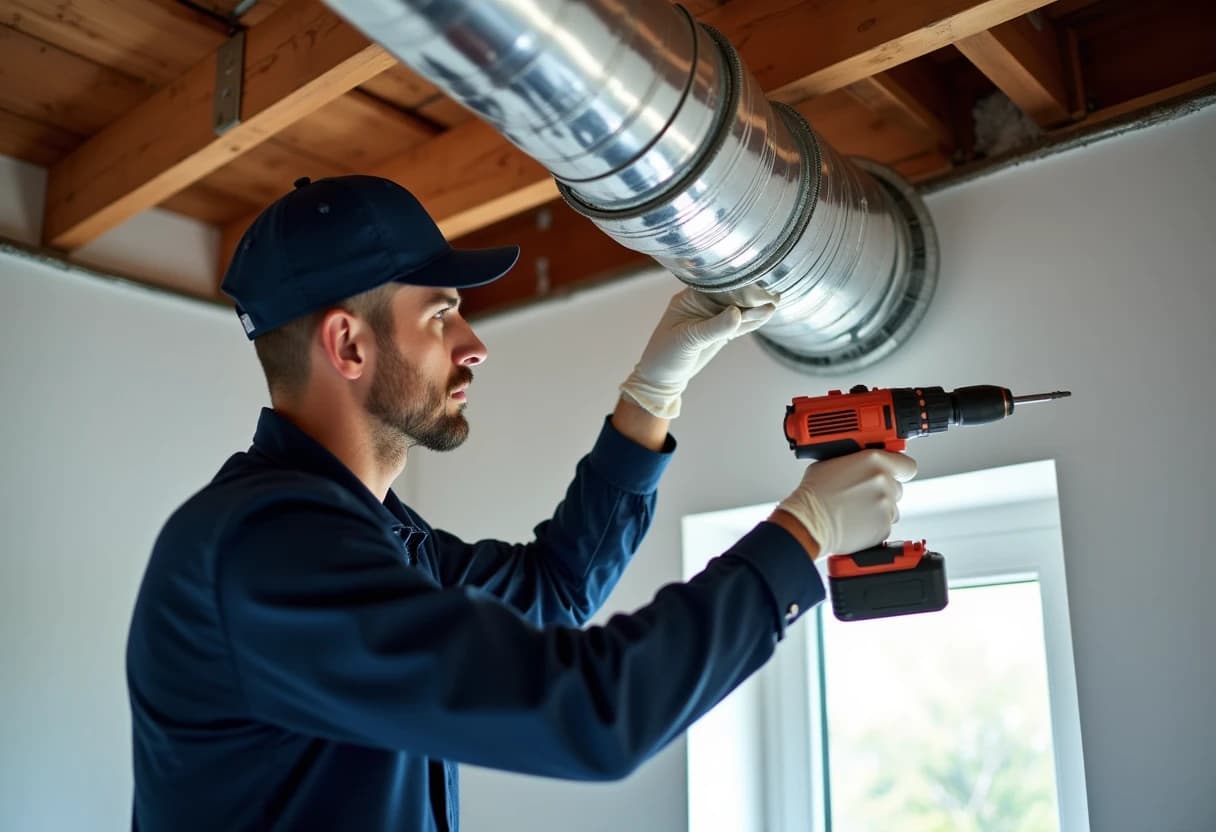
An overlong dryer vent is a permanent tax on every load of laundry. Each foot of duct and every elbow adds resistance; the code caps the total at 35 equivalent feet — with each 90-degree elbow typically counting as five feet — because beyond that, dryers simply cannot push lint and moisture to the outlet. Yet Greater Boston basements are full of runs half again that long, snaking around decades of renovations. Our rerouting service shortens them: we find the nearest legal path outdoors, often cutting a 40-foot wander to a 12-foot straight shot, and rebuild it in rigid metal. Drying times drop immediately, lint accumulation slows permanently, and the fire-risk math improves for good.
Why Dryer Vent Installation & Rerouting Matters for Quincy Homes
Dryer vent installation is where fire safety is actually decided. The roughly 2,900 US home dryer fires each year cluster around the same installation faults: flexible plastic or foil duct that traps lint in its corrugations, overlong runs the dryer cannot clear, screws through joints snagging fibers in the airstream, and terminations that clog or were never outdoors at all. The IRC's dryer exhaust provisions — 4-inch smooth rigid metal, 35-foot maximum equivalent length with elbow deductions, no protruding fasteners, damper-equipped unscreened termination — are the distilled corrections to those fault patterns. A vent built to that standard resists lint accumulation by design, keeps exhaust velocity high enough to carry fibers all the way out, and gives annual cleaning a smooth, brushable path to maintain. A vent built casually does the opposite, banking a little more fuel every load. Installation is a few hundred dollars once; the system it creates determines your laundry's risk profile for the life of the house. That asymmetry is the entire argument for doing it right.
From the triple-deckers near Marina Bay to the singles and capes out toward Adams National Historical Park, Quincy presents every dryer venting challenge in the catalog: interior laundry rooms far from exterior walls, below-grade basements where the only exit is the rim joist, and condo layouts that force roof terminations. Quincy mixes early-1900s two-families and triple-deckers in Wollaston and North Quincy with post-war capes in Merrymount, granite-era Victorians near the Center, and a wave of new luxury towers around Quincy Center and Marina Bay. Many of the older two-family homes run shared basement ductwork or converted gravity furnaces, while the new high-rises depend on individual air handlers and long vertical dryer vent runs. We have built vents through all of it. Quincy's shoreline neighborhoods like Houghs Neck and Squantum sit directly on Boston Harbor, so salt air and marine humidity work into basements and duct systems year-round. Add the constant condo construction around Quincy Center and we see everything here from drywall dust in brand-new systems to decades of buildup in Wollaston two-families. Because our shop is about 17 miles away in West Newton, site visits and installs schedule quickly — and most Quincy installations are complete, verified and cleaned up within a single day.
Our Dryer Vent Installation & Rerouting Process in Quincy
1Site Assessment & Route Planning
Planning is where installations succeed or fail, so we do it deliberately: equivalent-length math on paper, termination clearances checked against grade, snow line, openings and property conditions, and the penetration point chosen for both duct efficiency and envelope integrity. For renovations, we are glad to plan while walls are open — the cheapest routing decisions are made before drywall.
2Demolition of Non-Compliant Venting
Replacement jobs start with removing what failed: vinyl and foil flex pulled from cavities and joist bays, abandoned duct capped or extracted, screened hoods and window inserts taken out, and improvised terminations into attics or crawlspaces closed off. We vacuum the lint these systems have shed along their routes — hidden accumulation that should not stay in the structure.
3Cut & Flash the Exterior Penetration
The exterior opening is cut precisely for the termination: hole saw through clapboard and sheathing, core drill through brick, block or stone, or a framed opening at the rim joist. We locate it to respect required clearances from grade, openings and inside corners, then flash and seal it so wind-driven New England rain stays out of the wall assembly permanently.
4Install Rigid Metal Duct on the Planned Route
The run goes in as 4-inch smooth-interior rigid metal duct — the material the IRC specifies — cut to fit, joined male-to-female in the direction of airflow, and assembled without a single screw protruding into the airstream: joints are clamped or externally fastened and sealed with UL-listed foil tape. Elbows are used sparingly and counted against the length budget.
5Mount the Termination Hood & Damper
Where pests are a known pressure — and in Greater Boston they are — we fit guard designs engineered for dryer exhaust: excluding birds and rodents without restricting airflow or trapping lint. We also note the hood in your service record so future cleanings include damper checks, keeping the one wear-prone component watched for the system's life.
6Connect the Appliance & Seal the System
At the dryer, we install a short UL-listed semi-rigid aluminum transition duct — the only place flexible material belongs — clamped at both ends and routed so it keeps full diameter when the machine is pushed to its working position. We mark the safe setback so the connector is never crushed by a future shove against the wall.
7Test, Verify & Document the Installation
Before we leave: work areas vacuumed with HEPA equipment, penetration debris removed, the dryer set and leveled, and a walkthrough of the finished system — where it runs, how the damper should look during a cycle, and when the first annual cleaning is due. A correctly built vent needs almost nothing from you; we make sure you know the little it does.
Benefits of Professional Dryer Vent Installation & Rerouting in Quincy
Decades of Service From a One-Day Job
Rigid metal duct, properly supported and sealed, is lifetime infrastructure: it does not kink, sag, melt or degrade, and it routinely outlasts several dryers. After installation day, the system's entire maintenance schedule is an annual cleaning and an occasional glance at the damper. Most homeowners never think about it again — which is the point.
Permanently Lower Energy Costs
The efficiency also shows up in maintenance economics: smooth, short, sealed runs need only quick annual cleanings, while flex mazes generate blockage-level service calls and appliance repairs. Over ten years, the well-installed vent is the cheaper vent by a wide margin, before counting a single kilowatt-hour.
Fire-Safe by Design, Not by Vigilance
Roughly 2,900 US home dryer fires a year trace overwhelmingly to lint, and lint traces to the installation faults a proper build eliminates: flex corrugations, overlong runs, obstructed airstreams. Replacing an improvised vent with an engineered one is the single largest permanent reduction in dryer fire risk available to a homeowner.
Code Compliance That Closes Every Question
The finished system meets the IRC's dryer exhaust provisions line by line: 4-inch smooth rigid metal, equivalent length within the 35-foot budget, no fasteners in the airstream, damper-equipped unscreened termination. For home sales, that removes a standard inspection flag; for permits and condo approvals, our documentation answers the questions before they are asked.
A Laundry Located Where You Actually Want It
Proper vent design frees the floor plan: a second-floor laundry, a kitchen-adjacent closet, a finished-basement corner all become viable when the exhaust route is engineered rather than improvised. We tell you honestly which locations work within the length budget — and often find compliant routes that make the layout you wanted possible.
Dramatically Faster Drying
Every elbow removed and every foot shortened is resistance the dryer no longer fights on every load, forever. The performance gain is not subtle on bad systems — 30 to 50 percent cycle-time reductions are common when we replace overlong flex runs — and unlike an appliance upgrade, it benefits every dryer the laundry will ever have.
Signs Your Quincy Home Needs Dryer Vent Installation & Rerouting
Inspection, Insurance or Association Requirements
Appliance warranties add quiet pressure: manufacturers condition coverage on adequate exhaust, and a warranty claim on a dryer connected to a non-compliant vent can be denied on that basis. If you are buying a premium machine, the few hundred dollars of proper venting is also warranty insurance.
The Dryer Vents Indoors — Anywhere
Indoor venting is often invisible until you look: the duct disappears upward and no exterior hood exists anywhere on the house. If you cannot find your termination outside, find out where the exhaust actually goes — attic discoveries after years of indoor venting routinely involve soaked insulation, staining and mold remediation on top of the vent work.
A New Laundry Location Needs Its First Vent
Moving laundry upstairs, finishing a basement, building an in-law suite or converting a condo all create the same requirement: a new exhaust route, designed before the walls close if at all possible. Vent routing decided at the framing stage is shorter, cheaper and cleaner than the same route retrofitted through finished surfaces months later.
Chronic Condensation the Route Guarantees
Some vents condense because of damage; others condense because of design — long uninsulated passages through cold basements, garages or attics where exhaust cannot stay above its dew point, or bellied routes with no slope to drain. When repair visits keep treating water in the same duct, the route is the diagnosis, and rerouting or rebuilt insulation and slope is the cure.
Your Vent Is Flexible Plastic or Foil Duct
A quick self-check: press gently on the visible duct. Rigid metal does not give; flex crumples. If any concealed portion of your run is flex, assume the hidden sections are in worse shape than the visible ones — they always are — and price the replacement before the blockage schedule prices it for you.
Blockages and Repairs Keep Recurring
Recurring appliance failures tell the same story from the other end: thermal fuses, heating elements and high-limit switches that fail repeatedly are a dryer protesting a duct it cannot push through. Each repair buys months. A rerouted, rigid, code-length run buys decades — and usually costs less than three appliance service calls.
Dryer Vent Installation & Rerouting Cost in Quincy, MA
A note on what our installation price includes, because scope games are common in this trade. Our flat quote covers: site assessment and route design with equivalent-length verification; demolition and disposal of non-compliant existing venting, including sealing abandoned penetrations; the exterior penetration, flashed and sealed to the cladding or roof; 4-inch smooth rigid metal duct, supported, sloped and joined without airstream-piercing fasteners; insulation over unheated space where the route requires it; a quality damper-equipped termination; the UL-listed transition connector at the appliance; commissioning with a live dryer cycle and airflow verification; and photo documentation of the complete system, concealed sections included. Restoration of finishes we must open (drywall patching and paint) is quoted separately and clearly beforehand, as is any permit your municipality requires — we tell you when one applies. If a competing quote is meaningfully lower, check it against this list; the difference is usually something missing that you will pay for later.
Want the full pricing picture? See our complete Boston-area cost guide or call (617) 390-7145 for an exact flat quote for your Quincy home.
Local Knowledge: Quincy, Norfolk County
Serving Quincy means knowing Quincy. Quincy mixes early-1900s two-families and triple-deckers in Wollaston and North Quincy with post-war capes in Merrymount, granite-era Victorians near the Center, and a wave of new luxury towers around Quincy Center and Marina Bay. Many of the older two-family homes run shared basement ductwork or converted gravity furnaces, while the new high-rises depend on individual air handlers and long vertical dryer vent runs. Quincy's shoreline neighborhoods like Houghs Neck and Squantum sit directly on Boston Harbor, so salt air and marine humidity work into basements and duct systems year-round. Add the constant condo construction around Quincy Center and we see everything here from drywall dust in brand-new systems to decades of buildup in Wollaston two-families. Those conditions shape how we work here: which brush heads come off the truck, how we protect finishes in older interiors, and what we expect to find when the camera goes into a 02169 duct system. Our crews are in and around Quincy nearly every week — often for neighbors of past customers — so scheduling is fast and our arrival windows hold.
The Best Time of Year in Quincy
There is a right season for dryer vent installation in Massachusetts, and it is earlier than most homeowners think. Exterior penetrations, flashing and sealant all prefer dry, above-freezing weather, and roof terminations essentially require it — which makes late spring through fall the natural construction window. Demand tells the same story from the other side: our installation calendar fills through fall as households discover failing vents during the first heavy-laundry weeks, and winter installs, while entirely doable for wall and rim-joist routes, involve weather scheduling around the exterior work. The strategic move is the one our repeat customers make: assess in summer, install in early fall, and enter the heating season — when the dryer works hardest and the house seals tightest — on a fresh, verified, code-compliant system.
Why Choose Boston Air Duct Cleaners
Boston Air Duct Cleaners is a local, owner-operated company based at 1121 Washington St in West Newton — not a national franchise dispatching subcontractors. Every crew is our own: background-checked, factory-trained on commercial negative-pressure equipment, and fully insured. We quote flat prices before work begins, document every job with before-and-after photos, and follow NADCA-standard source-removal methods on every system we touch. That is why so much of our work comes from repeat customers, property managers and word-of-mouth referrals across Norfolk County.
Serving Quincy and Surrounding Communities
Beyond Quincy, our crews cover the surrounding communities daily — including Milton, Braintree, Weymouth, Dorchester, Randolph, Holbrook. Because routes cluster geographically, booking alongside a neighboring appointment often unlocks same-day service and combined-visit savings. Wherever you are in Norfolk County, the same flat-rate pricing, insured technicians and photo-documented process applies.