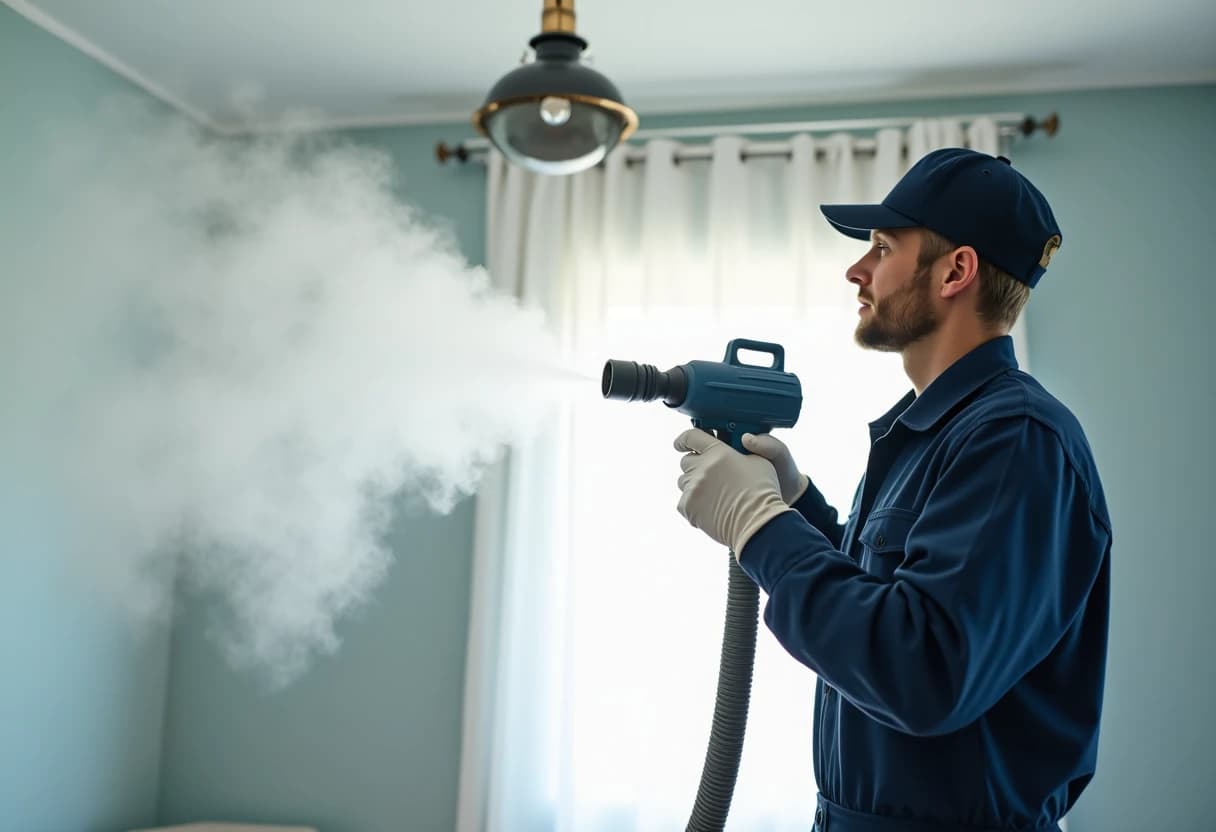
Air duct sanitizing is the finishing treatment that mechanical cleaning alone cannot provide: an EPA-registered antimicrobial, fogged through the freshly cleaned duct system under airflow so it reaches every surface the air touches. Where cleaning removes the dust, sanitizing neutralizes what lives in the residue — odor-causing bacteria, mold spores and the microbial film that gives ducts that stale, musty character. For Hull homeowners fighting pet odors, previous-owner smells, smoke history or the damp-basement note that rides the airflow every summer, it is the difference between ducts that are clean and ducts that smell clean. We apply it honestly: only after source-removal cleaning, only with HVAC-labeled products, and only when your situation actually warrants it.
Why Air Duct Sanitizing & Deodorizing Matters for Hull Homes
Cleaning and sanitizing solve two different problems, and stubborn duct odors need both solved. Mechanical cleaning removes the bulk contamination — the dust, dander and debris load. But odors are chemical and biological: they persist in the thin film of oils, microbial residue and volatile compounds bonded to duct surfaces, in seams and joints, and in the porous textures brushes cannot polish. That is why homeowners who buy a standard cleaning to fix a smell are sometimes disappointed — the ducts are genuinely clean, and the odor faintly persists. An EPA-registered antimicrobial fogged through the cleaned system finishes the job: it kills the odor-producing bacteria metabolizing that residue, neutralizes the residue itself, and inhibits the regrowth that would otherwise rebuild the smell over the following months. The sequence matters enormously — chemistry over dirt fails, chemistry over clean metal works — which is why we position sanitizing as the second half of a two-part service rather than a standalone spray, and why our results last years rather than the weeks a discount fog delivers.
The housing stock around Hull gives duct odors unusual staying power. Hull occupies a narrow peninsula where nearly every home feels the ocean: the stock is a dense mix of converted summer cottages, shingled beach houses and modest year-round homes packed along the boulevard from Nantasket to Pemberton Point. Many were winterized decades after construction, so heating systems and ductwork were squeezed into buildings never designed for them, often in shallow crawlspaces just above the water table. Many of these systems include long trunk runs, joint-heavy older metal and returns that have never once been opened — surface area that has absorbed generations of household life. No town we serve takes more salt spray than Hull - homes here are surrounded by water on both sides of the peninsula, and exterior dryer vent hoods, dampers and duct components corrode remarkably fast. Constant coastal wind also drives fine sand and salt into vent terminations facing the beach. A masking spray has no chance against that reservoir. Our approach — mechanical source removal first, then EPA-registered antimicrobial fogging through the full air path — is built for systems with this much history, and we bring it to Hull, Hingham and Cohasset weekly.
Our Air Duct Sanitizing & Deodorizing Process in Hull
1Odor Assessment & Honest Qualification
Not every odor is a duct odor, and not every duct needs sanitizing — the EPA does not recommend routine biocide use, and neither do we. Your visit starts with diagnosis: camera inspection of the duct film, a look at the coil and drain pan, moisture readings where mustiness is the complaint. You get a straight answer about whether treatment is warranted before anyone sells you anything.
2Source-Removal Cleaning First
Sanitizer applied over dirt is wasted — no chemistry penetrates a mat of dust and biofilm. So the system is cleaned first to NADCA-standard bare surfaces: registers sealed, ductwork under HEPA-filtered negative pressure, every run mechanically agitated with brushes and air whips. If your ducts were professionally cleaned very recently, we verify by camera and credit the step accordingly.
3Product Selection & Preparation
Only two kinds of products enter your air path: antimicrobials EPA-registered specifically for use in HVAC systems, and deodorizing counteractants formulated for duct application. No bleach, which corrodes ducts; no ozone shock treatments, which the EPA warns are ineffective at safe concentrations; no fragrance bombs that mask rather than neutralize. Dilutions follow the label exactly — that is what EPA registration means.
4Whole-System Antimicrobial Fogging
The treatment is atomized into a fine fog and introduced through the duct network while controlled airflow carries it the length of every supply and return. The fog deposits on all interior surfaces — including the seams, joints and corrugations mechanical cleaning cannot polish — killing odor-causing bacteria and neutralizing microbial residue on contact. Full-system coverage takes under an hour in most homes.
5Coil, Drain Pan & Blower Treatment
The dampest components carry the strongest biology, so the air handler wet section gets direct treatment: evaporator coil surfaces, the drain pan and its trap, and the blower wheel and housing. Musty odors disproportionately originate here — a slimy pan or biofilmed coil can perfume an entire house — and treating the ducts while skipping the equipment leaves the source in place.
6Deodorizing Pass for Stubborn Odors
Antimicrobial treatment handles biological odors, but some smells are chemical: tar and nicotine films, cooking-oil residue, fire smoke. For those, we deploy counteractants that chemically neutralize the odor compounds themselves. The distinction matters — treating a smoke house with antimicrobial alone leaves the tar film broadcasting — and diagnosing which chemistry your odor needs is exactly what the initial assessment is for.
7System Airing, Verification & Walkthrough
The finish is verification by nose and by paper: a room-by-room airflow check confirming neutral odor at every register, before-and-after photos of the duct interiors, and a written record of products applied with their EPA registration numbers. Surfaces are dry and the home fully usable by the time we pack up in nearly all cases — we review any exceptions before we start, never after.
Benefits of Professional Air Duct Sanitizing & Deodorizing in Hull
Small Add-On Cost, Outsized Payoff
Standalone treatments run $250 to $500; bundled with cleaning, the marginal cost drops by half or more. That pricing asymmetry is why we encourage odor-motivated customers to book the pairing — one visit, one setup, both halves of the fix. The alternative sequence, cleaning now and a separate sanitizing visit after the smell persists, costs more and delays the result.
Odors Neutralized at the Source, Not Masked
Every consumer odor product adds scent on top of the problem; sanitizing subtracts the problem. With the odor-holding film removed and the residue chemically neutralized, the ducts stop producing smell altogether. The house does not smell like a candle aisle afterward — it smells like nothing, which is what fresh actually is, and what no masking product can counterfeit.
Smoke Ghosts Finally Evicted
If a home smelled of cigarettes at the showing and still does after renovation, the air system is the unrenovated room. Smoke rode the returns for years, coating the full duct network with residue no one ever addresses. Treating that network is routinely the missing piece that finally clears a smoker's house — and the step savvy buyers now negotiate into the purchase.
Microbial Load Reduced System-Wide
After specific contamination events — pest activity in the ducts, confirmed mold, water intrusion — this benefit becomes the headline: droppings, spores and bloom residue carry genuine pathogen and allergen loads, and mechanical cleaning alone does not neutralize them. The EPA-registered treatment does, which is why sanitizing moves from optional to advised the moment contamination history enters the picture.
A True Reset for Newly Purchased Homes
The previous owners' pets, kitchen, tobacco and habits are archived in your duct film, replaying on every cycle. Cleaning plus sanitizing erases the archive — mechanically stripping the residue, then neutralizing the biology — so the house starts smelling like yours from day one. It is the single most-requested reason for this service, and the reviews it generates say 'finally smells like our home.'
Pet Odor Elimination That Actually Holds
Dander is airborne, the return ducts inhale it continuously, and years of accumulation turn the duct film into a dander reservoir with whole-house reach — which is why the pet smell survives every carpet shampoo. Removing the reservoir and neutralizing the residue takes the system out of the equation, and most households report the smell simply gone, permanently, after one treatment.
Signs Your Hull Home Needs Air Duct Sanitizing & Deodorizing
Pets Present or Past
The threshold question: can guests tell you have animals without seeing them? If yes, the ducts are broadcasting, and the smell is stronger than your adapted nose reports. Households with multiple pets or long pet tenure carry proportionally heavier duct reservoirs, and they see the most dramatic before-and-after from a single cleaning-plus-treatment visit.
You Just Bought the Home
Even a home that smells fine at purchase benefits from the reset when history is unknown: odor thresholds are personal, previous owners' normal may not be yours, and the first heating season has a way of releasing what summer showings concealed. Buyers who sanitize at move-in never have to wonder what October's first furnace cycle will announce.
After Pests, Mold or Water in the System
Post-mold-remediation, treating the cleaned duct surfaces inhibits recolonization while moisture corrections take effect — standard best practice, and typically specified in remediation protocols. If your home had mold work done and the ducts were cleaned but never treated, that gap is worth closing before the next humid season tests it.
Musty Blast When the Heat or AC Starts
Many households normalize this smell for years — a funky thirty seconds, then fine, so it never quite becomes a project. It should: the odor is live biology metabolizing residue in your air path, it recurs because the substrate remains, and it trends worse. One treatment visit ends a nuisance you had stopped noticing you tolerated.
Smoke History in the Home
If any era of the home's life included indoor smoking, the duct network carries the tar-and-nicotine film to prove it — and that film off-gasses for years, strongest on warm humid days when the residue softens. Paint and carpet replacement miss it entirely. Counteractant duct treatment is the step that finally clears a smoker's house.
Odors Return No Matter How Much You Clean
If deep-cleaning the house buys only a day or two before the smell creeps back, the source is upstream of everything you cleaned — in the air system, re-scenting the rooms on every cycle. That resupply pattern is the signature of duct-borne odor, and it means the fix is in the ducts, not in another weekend of scrubbing.
Air Duct Sanitizing & Deodorizing Cost in Hull, MA
Compare the cost against what duct-borne odors actually extract from households. Masking products — candles, plug-ins, sprays — run $200 to $500 annually for a committed household and resolve nothing. Consumer ozone generators cost $100 to $400, carry EPA warnings, and leave the odor source intact. Carpet replacement motivated by a smell that turns out to be duct-borne runs $2,000 to $6,000 and fails on arrival, since the system re-scents new fibers within months. Repainting for smoke odor without treating the ducts: $3,000 to $8,000, same outcome. Against that landscape, $250 to $500 for professional source treatment — or $75 to $200 added to a cleaning you may need anyway — is not the premium option; it is the only option priced against the actual problem. For sellers the math sharpens further: listing agents consistently report that odor-flagged homes show worse and negotiate weaker, with concessions that dwarf the treatment cost by an order of magnitude. Fresh-smelling is the cheapest staging money can buy.
Want the full pricing picture? See our complete Boston-area cost guide or call (617) 390-7145 for an exact flat quote for your Hull home.
Local Knowledge: Hull, Plymouth County
Every town's ductwork tells the story of its housing. Hull occupies a narrow peninsula where nearly every home feels the ocean: the stock is a dense mix of converted summer cottages, shingled beach houses and modest year-round homes packed along the boulevard from Nantasket to Pemberton Point. Many were winterized decades after construction, so heating systems and ductwork were squeezed into buildings never designed for them, often in shallow crawlspaces just above the water table. No town we serve takes more salt spray than Hull - homes here are surrounded by water on both sides of the peninsula, and exterior dryer vent hoods, dampers and duct components corrode remarkably fast. Constant coastal wind also drives fine sand and salt into vent terminations facing the beach. We plan Hull jobs around those realities, from equipment selection to time on site, and it shows in the results. If you live near Paragon Carousel or anywhere across Hull's 02045 area, we have almost certainly cleaned a system like yours before — and we can tell you exactly what to expect before we arrive.
The Best Time of Year in Hull
Summer humidity is the engine of Greater Boston's duct-odor cycle. When dew points camp in the high 60s, moisture condenses on every cool surface in the air path — coil, pan, basement trunk lines — and the organic film absorbs it like a sponge. Bacteria respond within days, and their metabolism is the musty smell that arrives with every cooling cycle from July onward. Coastal and near-coastal homes get an extended version, with marine air keeping duct-adjacent spaces damp well into fall. Sanitizing breaks the biological half of the cycle; pairing it with the moisture-side fixes — insulating sweating runs, managing basement humidity, keeping condensate lines clear — breaks the whole loop, and the pairing is what turns a yearly complaint into a solved problem.
Why Choose Boston Air Duct Cleaners
We built this company around the jobs other duct cleaners do badly: the 130-year-old Victorian with panned-joist returns, the Hull condo with a 60-foot dryer run to the roof, the post-renovation house full of drywall dust. Our crews see Greater Boston's hardest systems every week, and the experience shows in the details — floor protection on the way in, sealed registers during the work, HEPA-vacuumed work areas on the way out, and imagery that proves the ducts are actually clean. Call (617) 390-7145 and judge the difference from the first conversation.
Serving Hull and Surrounding Communities
Beyond Hull, our crews cover the surrounding communities daily — including Hingham, Cohasset, Weymouth, Scituate, Quincy, Braintree. Because routes cluster geographically, booking alongside a neighboring appointment often unlocks same-day service and combined-visit savings. Wherever you are in Plymouth County, the same flat-rate pricing, insured technicians and photo-documented process applies.