
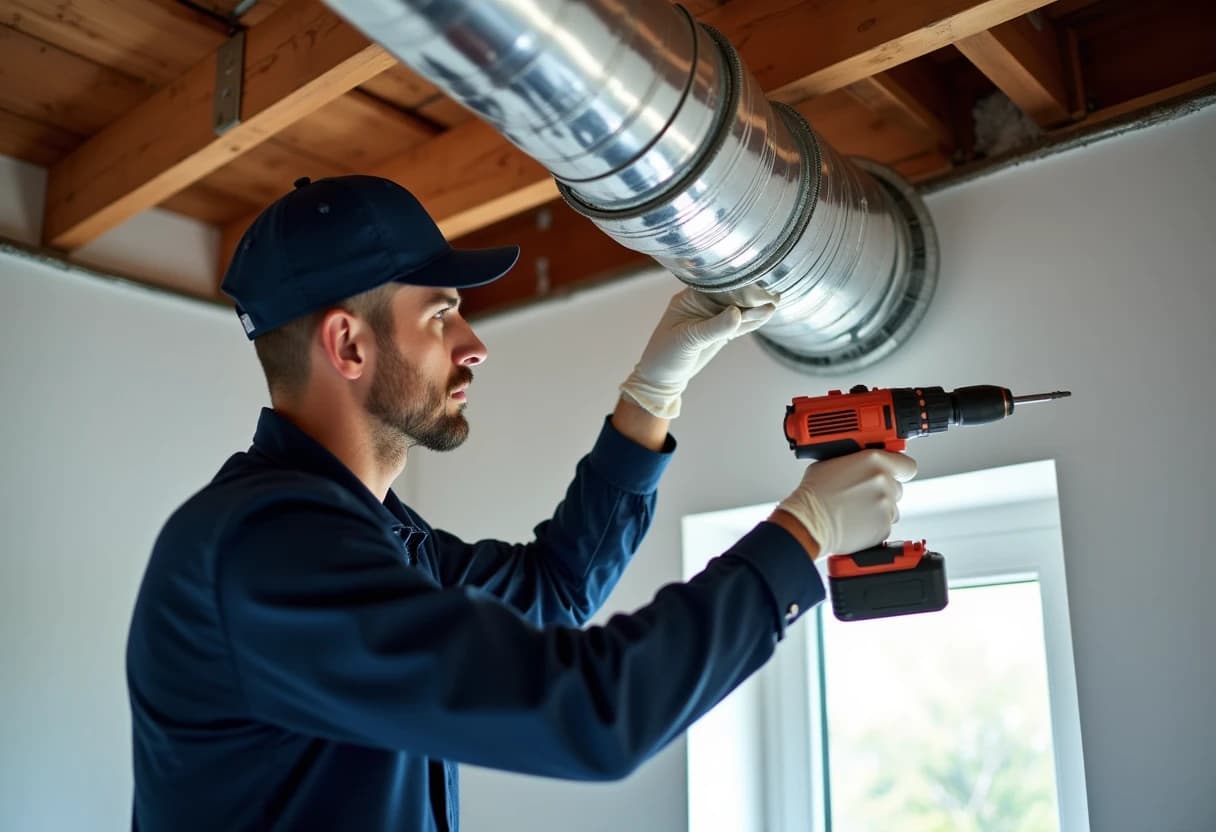
If your dryer's exhaust path includes plastic flex hose, a window insert, a bucket of water, or a mysterious duct that ends somewhere inside the house, you need an installation — and you are not alone: we find improvised venting in Weymouth homes every month. Indoor termination is the worst offender, pumping a gallon of moisture and a load of lint into living space or structure per cycle; long flex runs are a close second. We replace all of it with an engineered system: rigid metal duct on the shortest workable route, sealed and supported, terminating outdoors through a proper hood. The work typically takes half a day to a day, and we verify the result with the dryer running before we leave.
Why Dryer Vent Installation & Rerouting Matters for Weymouth Homes
Where the vent terminates shapes both the house and the maintenance schedule. Every option has an engineering trade: side-wall terminations are shortest and easiest to inspect, but must clear grade, snow line, and required distances from openings; rim-joist terminations serve basement laundries elegantly with minimal envelope disruption; roof terminations suit interior laundry rooms in condos and capes but load up faster — lint fights gravity the whole vertical run — and need durable, steep-weather-rated caps. What is never acceptable: terminating into an attic, crawlspace, garage, soffit vent or chimney, all of which we find regularly and all of which pump moisture and lint into the structure. The termination itself must have a backdraft damper that closes against winter wind and pests, and no screen — mesh mats over with lint in months, which is why the code forbids it. Our installations weigh the options against your home's layout and Massachusetts weather, cut clean penetrations through clapboard, shingle, brick or block, and flash and seal them so the envelope stays weather-tight for decades.
Renovation activity around Whitman's Pond keeps our Weymouth installation calendar full: finished basements, relocated laundries, in-law suites and condo conversions all need new dryer exhaust, and general contractors do not always give it the attention a fire-safety system deserves. North Weymouth homes near Wessagusset Beach deal with genuine coastal conditions - salt-laden humid air corrodes dryer vent hoods and dampers faster here than in inland towns, and we replace more seized vent flaps along the shore than almost anywhere else. Inland, the town's postwar basements tend toward dampness that feeds musty odors into return ducts. Weymouth's housing runs from shingled seaside capes and 1920s bungalows in North Weymouth to dense postwar tract neighborhoods in East and South Weymouth and new townhome construction at Union Point on the former naval air station. Much of the stock is modest single-family housing from 1920-1960, where original or first-generation replacement duct systems are still doing the work. We work alongside contractors and homeowners at the planning stage — advising on laundry placement while walls are still open, when a ten-minute routing decision can save thirty feet of duct — and we build the vent to code with documentation your building inspector will recognize. Neighbors in Braintree and Hingham use us the same way, which is why our trucks are on renovation sites across Norfolk County all season.
Our Dryer Vent Installation & Rerouting Process in Weymouth
1Site Assessment & Route Planning
Every installation begins with the route. We assess the laundry location, measure candidate paths to the exterior, and score each against the code's 35-foot equivalent-length budget — deducting for every elbow — and against your home's structure: framing, foundation type, finished spaces, and where a termination can legally and sensibly exit. You get options with trade-offs explained, and a flat price for the route you choose.
2Demolition of Non-Compliant Venting
Where the old route will be reused, we strip it to sound structure; where it is abandoned, we seal the redundant penetrations properly — foam and blocking inside, patched and flashed outside — so the old path does not remain as an air leak or pest entry. Clean removal is part of the installation, not an extra.
3Cut & Flash the Exterior Penetration
Roof terminations get roofing-grade treatment: shingles lifted and re-laid over proper flashing, a cap rated for dryer exhaust with a working damper, and sealant appropriate to the roofing material. We schedule roof penetrations for dry weather and verify water-tightness before leaving — a roof leak is not an acceptable side effect of a laundry upgrade.
4Install Rigid Metal Duct on the Planned Route
Support and slope are built in as we go: hangers and strapping at proper intervals so no section can sag into a condensation belly, and a continuous pitch toward the termination so any moisture that does condense drains outdoors instead of pooling. These details are invisible when the job is done and decisive for how the system ages.
5Mount the Termination Hood & Damper
Termination choice is matched to the route: low-profile wall hoods for clapboard and shingle, masonry-mounted hoods for brick, rim-joist hoods for basement exits, and dedicated dryer roof caps — never plumbing-style caps — for vertical runs. Each is chosen for damper quality, because the damper is the moving part that determines how the termination survives New England weather.
6Connect the Appliance & Seal the System
System sealing is completed end to end: every joint taped with UL-listed foil tape, the wall penetration sealed inside and out, and the transition clamped tight. A dryer vent is a pressure system; leaks anywhere cost airflow at the termination and push lint and moisture into places they do not belong. Sealed means sealed everywhere.
7Test, Verify & Document the Installation
Before we leave: work areas vacuumed with HEPA equipment, penetration debris removed, the dryer set and leveled, and a walkthrough of the finished system — where it runs, how the damper should look during a cycle, and when the first annual cleaning is due. A correctly built vent needs almost nothing from you; we make sure you know the little it does.
Benefits of Professional Dryer Vent Installation & Rerouting in Weymouth
Decades of Service From a One-Day Job
The one-day timeline is real for most installations: assessment and route confirmation, demolition of old venting, penetration, duct assembly, termination, connection and commissioning typically fit a single visit. Complex reroutes through finished space may take a second day. Either way, laundry is back in service the same evening.
Permanently Lower Energy Costs
A dryer that finishes in one cycle instead of two uses half the energy per load — a difference worth $10 to $20 a month to a busy household, recurring for the life of the system. Few building improvements have a payback mechanism this direct: the installation cost is fixed once, and the savings arrive with every laundry day after.
Code Compliance That Closes Every Question
The finished system meets the IRC's dryer exhaust provisions line by line: 4-inch smooth rigid metal, equivalent length within the 35-foot budget, no fasteners in the airstream, damper-equipped unscreened termination. For home sales, that removes a standard inspection flag; for permits and condo approvals, our documentation answers the questions before they are asked.
Moisture Managed, Structure Protected
Moisture protection extends to the envelope itself: our flashed, sealed penetrations keep wind-driven rain out of walls and roofs for the long term. An installation is only as good as its weakest detail, and the exterior detail is the one that faces forty years of nor'easters. We build it like it will.
Fire-Safe by Design, Not by Vigilance
A code-compliant installation attacks fire risk structurally: smooth rigid metal that lint slides across instead of catching on, a run short enough that exhaust velocity carries fibers all the way out, joints without screw tips to snag them, and a termination that cannot mat over. The system accumulates fuel slowly by design — safety that does not depend on anyone remembering anything.
A Laundry Located Where You Actually Want It
Proper vent design frees the floor plan: a second-floor laundry, a kitchen-adjacent closet, a finished-basement corner all become viable when the exhaust route is engineered rather than improvised. We tell you honestly which locations work within the length budget — and often find compliant routes that make the layout you wanted possible.
Signs Your Weymouth Home Needs Dryer Vent Installation & Rerouting
Your Vent Is Flexible Plastic or Foil Duct
A quick self-check: press gently on the visible duct. Rigid metal does not give; flex crumples. If any concealed portion of your run is flex, assume the hidden sections are in worse shape than the visible ones — they always are — and price the replacement before the blockage schedule prices it for you.
The Dryer Vents Indoors — Anywhere
A vent that ends in an attic, crawlspace, garage, ceiling cavity or bucket-style indoor 'lint trap' is an urgent installation call. Every load pumps a gallon of moisture and a charge of fine lint into the structure or living space — feeding mold, soaking insulation, and accumulating fuel where no one will ever clean it. This setup should not run another season.
Chronic Condensation the Route Guarantees
Watch the laundry itself: loads that come out damp-smelling, a duct that drips after cycles, rust tracks under joints. Chronic internal moisture is rotting the system from the inside while it feeds blockages. The permanent fix is a route engineered for New England winters, not another season of drip trays and patches.
A New Laundry Location Needs Its First Vent
New dryer purchases trigger the question too: installers deliver the machine but rarely build ductwork, and a new appliance connected to no vent — or a condemned one — sits unusable. If your delivery is scheduled, get the vent designed and installed ahead of it, so the first load runs the day the dryer arrives.
Inspection, Insurance or Association Requirements
Massachusetts home inspections flag improvised dryer venting constantly — flex runs, screened hoods, indoor terminations, overlong routes — and the flag follows the transaction: buyers demand fixes, sellers concede credits. A documented compliant installation clears the item permanently, whether you are listing this spring or just retiring a known liability.
The Run Is Overlong or Elbow-Heavy
The symptom pattern of an overlong run: drying times that were never good, cleanings that help briefly and fade fast, and lint accumulating mid-run rather than at the ends. No maintenance schedule fixes a route that exceeds the appliance's reach; rerouting to a shorter path is the only durable answer.
Dryer Vent Installation & Rerouting Cost in Weymouth, MA
Multi-family and condo installation pricing carries a few specifics worth knowing up front. Roof terminations — common for interior condo laundries — sit toward the top of the range for the flashing and access work, typically $650 to $900 for the full installation. Association requirements add process rather than much cost: we provide written scopes for board approval and certificates of insurance at no charge, and our documentation is built to satisfy trustee and management-company review. The meaningful savings lever is coordination: when a triple-decker owner or association books multiple units in one mobilization, shared setup, staging and travel drop per-unit pricing by 20 to 30 percent, and the building ends up with one consistent, compliant system instead of three eras of improvisation. For laundry-relocation projects inside renovations, timing is the lever: venting roughed in while walls are open routinely costs $200 to $400 less than the identical route built after finishes, which is why we encourage a planning call at the framing stage — free advice that saves real money.
Want the full pricing picture? See our complete Boston-area cost guide or call (617) 390-7145 for an exact flat quote for your Weymouth home.
Local Knowledge: Weymouth, Norfolk County
Every town's ductwork tells the story of its housing. Weymouth's housing runs from shingled seaside capes and 1920s bungalows in North Weymouth to dense postwar tract neighborhoods in East and South Weymouth and new townhome construction at Union Point on the former naval air station. Much of the stock is modest single-family housing from 1920-1960, where original or first-generation replacement duct systems are still doing the work. North Weymouth homes near Wessagusset Beach deal with genuine coastal conditions - salt-laden humid air corrodes dryer vent hoods and dampers faster here than in inland towns, and we replace more seized vent flaps along the shore than almost anywhere else. Inland, the town's postwar basements tend toward dampness that feeds musty odors into return ducts. We plan Weymouth jobs around those realities, from equipment selection to time on site, and it shows in the results. If you live near Union Point or anywhere across Weymouth's 02188 area, we have almost certainly cleaned a system like yours before — and we can tell you exactly what to expect before we arrive.
The Best Time of Year in Weymouth
Renovation season drives our installation rhythm as much as weather does. Greater Boston remodels from spring through fall — basements finished, laundries moved upstairs, triple-deckers converted to condos — and every one of those projects needs dryer exhaust designed rather than improvised. The economics of timing are stark: venting planned at framing stage routes shorter, conceals cleaner and costs $200 to $400 less than the same run retrofitted after drywall. We take planning calls from homeowners and contractors all season, often walking a route in fifteen minutes that saves the project real money and the homeowner a decade of compromise. If your project touches the laundry — or could move it somewhere better — the cheapest vent you will ever build is the one designed before the walls close.
Why Choose Boston Air Duct Cleaners
As a West Newton-based company, we treat Weymouth like the neighborhood it is — because for us, it is. Our reputation lives or dies on local referrals, so every job gets the full process: complete system cleaning under negative pressure, mechanical agitation of every run, blower compartment service, and a documented walkthrough before we leave. We are licensed and insured, our estimates are free and flat, and our schedule holds same-day slots for urgent calls. One visit and you will understand why neighbors keep our magnet on the fridge.
Serving Weymouth and Surrounding Communities
Weymouth sits in the heart of our service area, and neighboring Braintree, Hingham, Quincy, Abington, Rockland, Holbrook appointments share the same routes. That density is why our response times in this part of Norfolk County are among our fastest — and why you will see our trucks in the area week after week.