
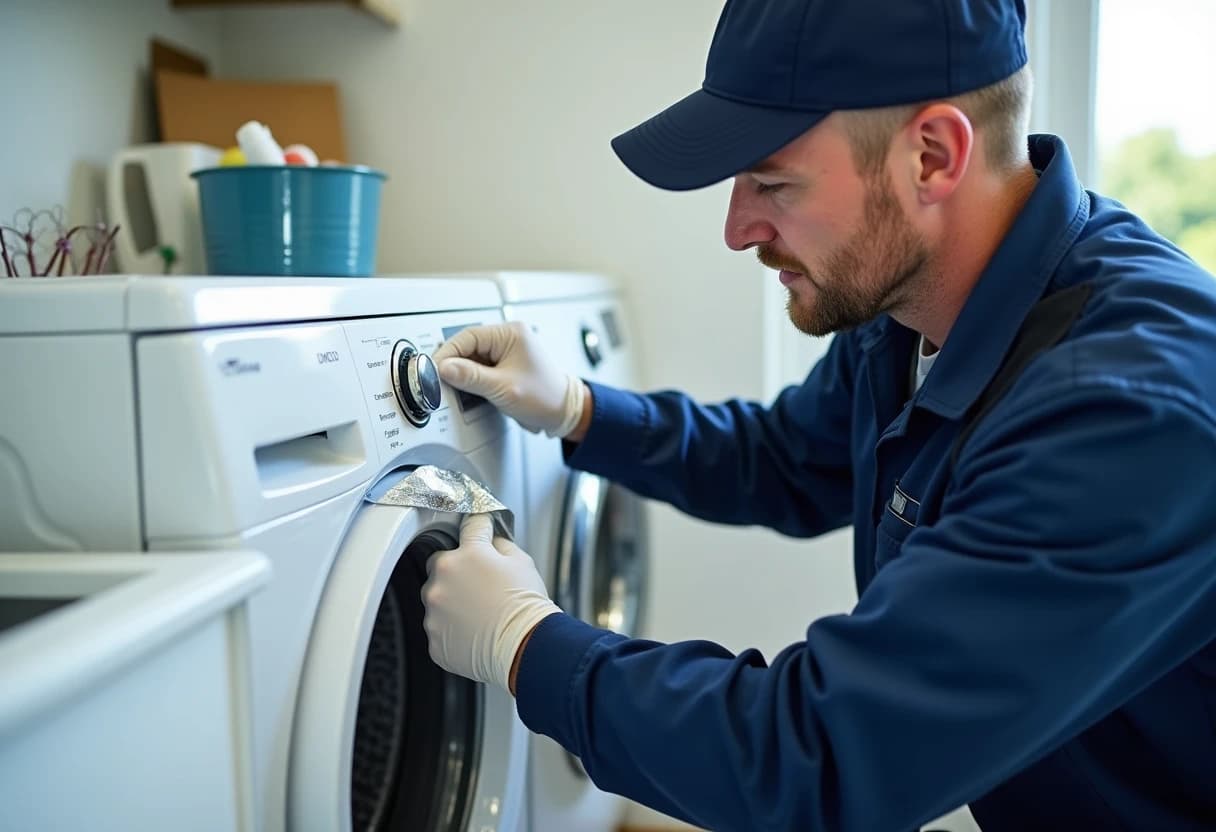
That flattened foil hose behind your dryer is doing more damage than it looks. Crushed transition ducts are the most common dryer vent failure we find in Boston homes — the machine gets pushed back against the wall, the accordion hose collapses to a fraction of its diameter, and the dryer spends years straining against a pinched exhaust while lint packs the kink. We replace these hazards with semi-rigid aluminum connectors and repair everything downstream too: separated joints, sagging runs, holes rusted through duct walls, and exterior hoods that no longer close against weather and pests. Done right, with the materials the code requires, a repaired vent runs trouble-free for decades.
Why Dryer Vent Repair Matters for Boston Homes
Disconnected dryer ducts are far more common than homeowners imagine, because the connections were never robust to begin with. Many vents were assembled with duct tape (which bakes brittle and lets go within a few years of hot exhaust cycles), or with screws driven through the duct wall (which the code prohibits precisely because the protruding tips snag lint until vibration and weight work the joint apart). Add the shove of every appliance delivery, the settling of old framing, and renovation work that jostles concealed runs, and joints quietly separate inside walls and ceilings all over Greater Boston. The dryer keeps running; the exhaust simply goes into the house. We find these failures with airflow testing and inspection — a dryer producing strong drum heat but weak exterior airflow is venting somewhere it should not — then rejoin the duct with proper fittings, clamps and UL-listed foil tape. If lint has been accumulating in the cavity, we document it and vacuum what is accessible, because that hidden pile is a fuel load your home does not need.
Ask a home inspector working around Boston Public Garden what they flag most in Boston laundry areas and dryer venting is near the top of the list: vinyl accordion hose, duct-taped joints, screened hoods, runs far beyond code length. Boston's housing runs the full spectrum of American urban building: 1800s brownstones and brick rowhouses in Back Bay, Beacon Hill and the South End, wood-frame triple-deckers across Dorchester and the streetcar neighborhoods, mid-rise brick apartment blocks near the universities, and glass condo towers downtown and along the harbor. Countless older buildings have been carved into condos with each unit given its own furnace or heat pump, so ductwork is often squeezed through 19th-century joist bays, chases and dropped ceilings never designed for it. The result is a city full of long, tight, hard-to-reach duct runs that trap decades of dust. We work in Boston every week, from rowhouse condos on gas-fired forced air to triple-decker units with attic air handlers. City-specific issues come up constantly: shared-wall dust migration in rowhouse blocks, renovation debris left in ducts after condo conversions, and dryer vent runs that snake thirty-plus feet to reach an outside wall - a genuine fire risk we flag on nearly every Boston visit. We do the corrective work those inspection reports call for — rigid metal replacement, code-compliant reconnections, proper terminations — with documentation that satisfies buyers, sellers and insurers alike. Neighbors in Back Bay and South End use us for the same pre-sale and post-purchase repairs, which keeps our trucks in this corner of Suffolk County nearly every week.
Our Dryer Vent Repair Process in Boston
1Diagnose the Full Exhaust Path
We treat symptoms as evidence: lint in the basement points to a specific joint; a ceiling stain maps to a specific duct section; condensation drips tell us where the run crosses cold space. Correlating symptoms with the physical path usually pinpoints the failure within minutes — and rules out the failures you do not have.
2Protect the Area & Open Access
Laundry areas are tight, finished spaces, and we work in them accordingly: drop cloths, boot covers, and careful handling of the appliance and its gas or electrical connections. Gas dryers get particular care around the flexible connector — we never strain a gas line to reach a duct.
3Reconnect & Properly Fasten Separated Joints
We do not just push a failed joint back together; we rebuild it so it cannot fail the same way. That means cleaning mating surfaces, correcting the misalignment or unsupported weight that pulled the joint apart, adding hangers or strapping where the run lacked support, and sealing the finished connection against both air and moisture leakage.
4Replace Crushed, Corroded or Non-Compliant Sections
Vinyl and foil accordion duct found anywhere in the run is removed on sight and replaced: rigid metal for the concealed run, a short UL-listed semi-rigid aluminum connector at the appliance. The smooth interior of proper duct resists lint accumulation dramatically better than corrugations — the repair also makes every future cleaning faster and more effective.
5Cure Condensation: Slope, Seal & Insulate
Condensation repairs follow the water. We restore continuous slope toward the termination so condensate drains out instead of pooling; seal the joints it has been leaking through with foil tape rated for the duty; and insulate duct sections crossing unheated basements, garages, attics and exterior wall bays so exhaust stays above its dew point until it exits.
6Repair or Replace the Exterior Hood & Damper
The new hood is sealed to the wall correctly: fastened to siding or masonry, flashed and caulked so wind-driven rain stays out of the wall assembly, with the duct connection sealed inside. On brick and stone, we drill and anchor rather than improvise; on clapboard, we integrate with the siding plane. The termination should outlast the roof.
7Replace the Transition Duct & Reset the Dryer
Gas dryers are reconnected with the gas line unstrained and checked, electric dryers with cords properly routed clear of the hot duct. We level the machine, confirm the drum turns clean, and run a full test cycle — because a repair is not done until the system works as a system.
8Verify Airflow & Document the Repair
The proof is at the hood: with the dryer running, the damper should stand fully open under a strong, steady exhaust stream. We verify it together, compare against the pre-repair condition, and confirm no leakage remains at any repaired joint. Then the work area is cleaned, the dryer set, and the laundry room returned to service.
Benefits of Professional Dryer Vent Repair in Boston
Moisture Out of Your Walls and Ceilings
Condensation repairs — slope, sealing, insulation — end the drip-and-pool cycle that rusts ducts from the inside and stains ceilings from above. Laundry areas dry out, winter window condensation eases, and the musty smell that clung to the wall behind the dryer leaves with the moisture feeding it.
Lower Energy and Repair Bills
A failed exterior damper is a hole in your heated envelope all winter — a 4-inch duct delivering January directly to your laundry room. Replacing it with a tight-closing hood pays for itself in heating savings and comfort, entirely apart from what it does for the dryer.
Pest Entry Points Closed
A dryer vent with a failed damper is an open, warm, sheltered 4-inch doorway — irresistible to birds, squirrels and mice, whose nests then block the duct and whose presence contaminates it. Repairing the termination closes the doorway with a damper and guard designed for dryer exhaust, ending the nest-remove-repeat cycle for good.
Restored Drying Performance
Customers are often startled by the change: a vent we repaired after years of gradual crushing gives them back the dryer they bought. If your drying times worsened after an appliance delivery, a renovation, or a move of the machine — events that crush transitions and separate joints — repair, not replacement, is very likely the answer.
A Serious Fire Hazard, Eliminated
A breached or restricted dryer vent combines the two ingredients of the roughly 2,900 annual US dryer fires: accumulating lint and rising exhaust temperatures. Repair removes both — the escape points that seed wall cavities with fuel, and the crush points and blockages that overheat the system. It is fire prevention with a wrench, and it lasts for decades.
Decades of Reliable Service From One Repair
Repairs also make every future cleaning better: smooth interiors let rotary brushes work at full effectiveness, sealed joints keep the vacuum's suction where it belongs, and a free-swinging damper lets technicians verify airflow honestly. You are not just fixing today's failure — you are buying easier maintenance forever.
Signs Your Boston Home Needs Dryer Vent Repair
A Home Inspection or Appliance Tech Flagged the Vent
Condo associations increasingly require documented vent compliance after regional dryer fire losses. If your building has sent a notice, we handle the full cycle: inspection, written scope for board approval, code-compliant repair, and completion records with photos. One visit, and your unit's file is closed.
Musty or Mildew Smell in the Laundry Area
If freshly dried clothes pick up a sour or musty note, moisture is lingering somewhere in the exhaust path — often damp lint mats in a bellied or leaking duct section. Cleaning removes the mats; repair fixes the sag or leak that created them. Without the repair, the mats and the smell return.
Visibly Damaged, Kinked or Sagging Duct
Trust your eyes: a transition hose flattened behind the dryer, a dented or crushed section in the basement, duct sagging between supports into a low belly, or a run held together with fabric duct tape are all failures in progress. Each restricts airflow, collects lint and moisture, and worsens with time. Photograph what you see and call — the quote is quick.
Lint Appearing Where It Shouldn't
Lint around the exterior hood is normal in small amounts; lint anywhere else along the run is not. Interior lint accumulation is doubly serious because it is fuel collecting where no cleaning schedule can reach it — the escape point must be sealed, and the accessible accumulation removed.
Exterior Damper Broken, Stuck or Missing
Evidence of animals — chirping in the duct, nesting material at the hood, droppings near the vent line — means the termination has already failed as a barrier. We remove the nest, clean the affected duct, and install a hood with real pest protection. Spring is nesting season; the repair is best made before it.
Water Stains, Drips or Peeling Paint Near the Vent Path
Condensation drips are easy to misattribute to plumbing. The tell is timing: moisture that appears during or after dryer use, and dries between laundry days, is exhaust-borne. We confirm with a running-dryer inspection before quoting, so you repair the actual source rather than the nearest pipe.
Dryer Vent Repair Cost in Boston, MA
Compare the repair cost against what the failure costs to keep. A leaking vent delivers roughly a gallon of water per load into your building assemblies — and chronic wall moisture matures into mold remediation and drywall work that starts around $1,500 and climbs steeply. A crushed or blocked duct overworks the dryer into $150 to $400 appliance repairs (thermal fuses, elements, switches) that recur until the vent is fixed, while adding $10 to $20 a month in energy waste. A failed damper leaks heated air all winter and invites nest blockages every spring. And every one of these failures raises fire risk in a system that already accounts for about 2,900 US home fires a year. Against that ledger, $150 to $450 for a permanent, code-compliant repair is one of the clearest-value maintenance purchases in the home. Most customers who see the diagnostic photos do not need convincing; the duct makes the argument itself.
Want the full pricing picture? See our complete Boston-area cost guide or call (617) 390-7145 for an exact flat quote for your Boston home.
Local Knowledge: Boston, Suffolk County
Serving Boston means knowing Boston. Boston's housing runs the full spectrum of American urban building: 1800s brownstones and brick rowhouses in Back Bay, Beacon Hill and the South End, wood-frame triple-deckers across Dorchester and the streetcar neighborhoods, mid-rise brick apartment blocks near the universities, and glass condo towers downtown and along the harbor. Countless older buildings have been carved into condos with each unit given its own furnace or heat pump, so ductwork is often squeezed through 19th-century joist bays, chases and dropped ceilings never designed for it. The result is a city full of long, tight, hard-to-reach duct runs that trap decades of dust. We work in Boston every week, from rowhouse condos on gas-fired forced air to triple-decker units with attic air handlers. City-specific issues come up constantly: shared-wall dust migration in rowhouse blocks, renovation debris left in ducts after condo conversions, and dryer vent runs that snake thirty-plus feet to reach an outside wall - a genuine fire risk we flag on nearly every Boston visit. Those conditions shape how we work here: which brush heads come off the truck, how we protect finishes in older interiors, and what we expect to find when the camera goes into a 02108 duct system. Our crews are in and around Boston nearly every week — often for neighbors of past customers — so scheduling is fast and our arrival windows hold.
The Best Time of Year in Boston
There is also a renovation-season rhythm to dryer vent damage in Greater Boston. The region's busiest remodeling months — spring through fall — are when concealed ducts get crushed by new framing, disconnected by trades working in ceilings, buried behind new finishes, or simply forgotten in layout changes that leave the dryer farther from its termination than code allows. Many of our fall repair calls trace directly to summer projects. If your home was renovated this year and laundry performance changed afterward, the connection is likely literal: a disturbed joint or flattened section behind the new work. We diagnose with airflow testing before opening anything, and where access through fresh finishes is needed, we keep it minimal and coordinate with your contractor's restoration.
Why Choose Boston Air Duct Cleaners
We built this company around the jobs other duct cleaners do badly: the 130-year-old Victorian with panned-joist returns, the Boston condo with a 60-foot dryer run to the roof, the post-renovation house full of drywall dust. Our crews see Greater Boston's hardest systems every week, and the experience shows in the details — floor protection on the way in, sealed registers during the work, HEPA-vacuumed work areas on the way out, and imagery that proves the ducts are actually clean. Call (617) 390-7145 and judge the difference from the first conversation.
Serving Boston and Surrounding Communities
We serve every community around Boston as well: Back Bay, South End, Cambridge, Brookline, Somerville, Dorchester all fall inside our regular service routes. If you have a second property, a rental, or family nearby, ask about multi-home scheduling — grouped appointments on the same route are our most requested discount.