
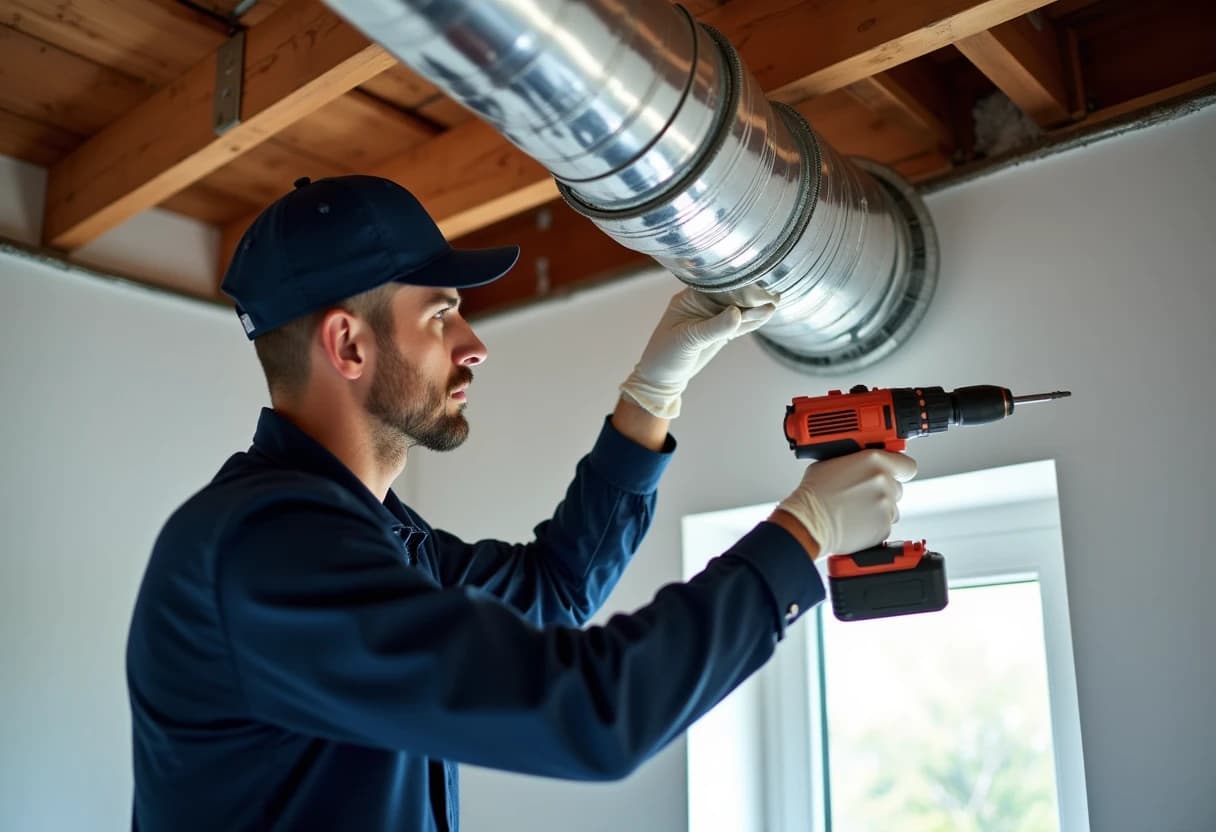
If your dryer's exhaust path includes plastic flex hose, a window insert, a bucket of water, or a mysterious duct that ends somewhere inside the house, you need an installation — and you are not alone: we find improvised venting in Weston homes every month. Indoor termination is the worst offender, pumping a gallon of moisture and a load of lint into living space or structure per cycle; long flex runs are a close second. We replace all of it with an engineered system: rigid metal duct on the shortest workable route, sealed and supported, terminating outdoors through a proper hood. The work typically takes half a day to a day, and we verify the result with the dryer running before we leave.
Why Dryer Vent Installation & Rerouting Matters for Weston Homes
There is also a straightforward performance and cost case. A dryer on a proper vent dries a standard load in one cycle; on a bad vent, in two — doubling energy per load, roughly $10 to $20 a month for a busy household, while heat-cycling the machine toward early component failure. A rigid, correctly sloped, correctly sized system also changes the maintenance economics: annual cleanings on smooth duct are quick and thorough, blockage-level service calls largely disappear, and appliance repairs caused by backpressure — thermal fuses, elements, high-limit switches — stop recurring. Add the avoided moisture damage (each load carries about a gallon of water that either exits the termination or enters your building assemblies) and the installation typically pays a real fraction of its cost back within a couple of years, then keeps paying. For homes about to sell, documented code-compliant venting removes a standard inspection flag before it costs a negotiation. For homes about to install a new dryer, it protects the warranty, which manufacturers condition on adequate exhaust. Either way, it is infrastructure bought once and used every laundry day for decades.
From the triple-deckers near Weston Ski Track to the singles and capes out toward Land's Sake Farm, Weston presents every dryer venting challenge in the catalog: interior laundry rooms far from exterior walls, below-grade basements where the only exit is the rim joist, and condo layouts that force roof terminations. Weston's large wooded lots hold everything from 18th-century farmhouses and grand early-1900s estates to substantial new mansions replacing mid-century homes, most now running three or more zones of ducted heating and cooling. Attic air handlers, long horizontal runs and multiple systems per house are the norm, which multiplies the surface area where dust settles. We have built vents through all of it. Weston homes are big, and big houses hide neglected ductwork - it is common for us to service a system here that conditions 8,000 square feet through runs no one has inspected since construction. The town's heavy tree canopy also means high pollen and organic debris loads at outdoor intakes and dryer vent terminations each spring and fall. Because our shop is about 5 miles away in West Newton, site visits and installs schedule quickly — and most Weston installations are complete, verified and cleaned up within a single day.
Our Dryer Vent Installation & Rerouting Process in Weston
1Site Assessment & Route Planning
The technician maps what exists and what is possible: where the dryer sits (or will sit), which walls are exterior, what the framing and foundation allow, and where obstacles — plumbing, wiring, ductwork, finished ceilings — constrain the path. Shortest is best: fewer feet and fewer elbows mean faster drying and slower lint accumulation for the life of the system.
2Demolition of Non-Compliant Venting
Where the old route will be reused, we strip it to sound structure; where it is abandoned, we seal the redundant penetrations properly — foam and blocking inside, patched and flashed outside — so the old path does not remain as an air leak or pest entry. Clean removal is part of the installation, not an extra.
3Cut & Flash the Exterior Penetration
The exterior opening is cut precisely for the termination: hole saw through clapboard and sheathing, core drill through brick, block or stone, or a framed opening at the rim joist. We locate it to respect required clearances from grade, openings and inside corners, then flash and seal it so wind-driven New England rain stays out of the wall assembly permanently.
4Install Rigid Metal Duct on the Planned Route
The run goes in as 4-inch smooth-interior rigid metal duct — the material the IRC specifies — cut to fit, joined male-to-female in the direction of airflow, and assembled without a single screw protruding into the airstream: joints are clamped or externally fastened and sealed with UL-listed foil tape. Elbows are used sparingly and counted against the length budget.
5Mount the Termination Hood & Damper
Where pests are a known pressure — and in Greater Boston they are — we fit guard designs engineered for dryer exhaust: excluding birds and rodents without restricting airflow or trapping lint. We also note the hood in your service record so future cleanings include damper checks, keeping the one wear-prone component watched for the system's life.
6Connect the Appliance & Seal the System
Gas dryers are handled with the care the fuel demands: the flexible gas connector unstrained, the machine leveled and positioned, and the connection checked before operation. Electric units get cords routed clear of the duct. The appliance end is where good systems get ruined by casual reconnection, so we finish it to the same standard as the concealed run.
7Test, Verify & Document the Installation
Before we leave: work areas vacuumed with HEPA equipment, penetration debris removed, the dryer set and leveled, and a walkthrough of the finished system — where it runs, how the damper should look during a cycle, and when the first annual cleaning is due. A correctly built vent needs almost nothing from you; we make sure you know the little it does.
Benefits of Professional Dryer Vent Installation & Rerouting in Weston
Decades of Service From a One-Day Job
Because we also clean and repair dryer vents across Greater Boston, we install with the next twenty years of maintenance in mind — routes our own brushes can traverse, access preserved where it matters, baselines recorded for future verification. We build systems we expect to service ourselves, and it shows in the choices.
Moisture Managed, Structure Protected
For basement laundries — the Massachusetts default — proper installation is the difference between a dry basement and a damp one. Vents that dump into crawlspaces, leak at joints or condense in cold runs feed exactly the humidity and mold problems New England basements already fight; a correct rim-joist installation removes the dryer from that fight entirely.
Fire-Safe by Design, Not by Vigilance
Roughly 2,900 US home dryer fires a year trace overwhelmingly to lint, and lint traces to the installation faults a proper build eliminates: flex corrugations, overlong runs, obstructed airstreams. Replacing an improvised vent with an engineered one is the single largest permanent reduction in dryer fire risk available to a homeowner.
Dramatically Faster Drying
Shortening a wandering 40-foot run to a direct 12-foot route transforms drying performance: full airflow means each cycle actually exhausts the gallon of moisture a load releases, so sensor dryers stop running overtime and heavy loads finish in one pass. Customers routinely describe post-installation performance as having bought a new machine.
A Laundry Located Where You Actually Want It
Relocation also fixes inherited mistakes: many Weston-area laundries sit where a previous owner could most easily improvise a vent, not where the household actually wants to do laundry. Once the exhaust is treated as a designed system, the laundry can finally move to where life happens.
Permanently Lower Energy Costs
The efficiency also shows up in maintenance economics: smooth, short, sealed runs need only quick annual cleanings, while flex mazes generate blockage-level service calls and appliance repairs. Over ten years, the well-installed vent is the cheaper vent by a wide margin, before counting a single kilowatt-hour.
Signs Your Weston Home Needs Dryer Vent Installation & Rerouting
Blockages and Repairs Keep Recurring
If your vent needs cleaning twice a year, blocks anyway, and has accumulated a history of repairs, the route itself is the problem — too long, too bent, wrong materials, or condensation-prone by design. At some point serial maintenance costs more than the reroute that ends it. We will do that math with you honestly; often the crossover is closer than expected.
The Dryer Vents Indoors — Anywhere
Window inserts and condensation boxes marketed as 'indoor dryer vents' are not a solution for a standard vented dryer in a Massachusetts home; they are humidity machines. If one is in service in your laundry, a proper exterior route almost certainly exists — our assessment will find the shortest one and price it flat.
The Run Is Overlong or Elbow-Heavy
Basement laundries venting to a far wall are the classic offenders — installed where the first hole was easiest, not where the route was shortest. Our assessment often finds a rim-joist or near-wall exit that cuts the run by half or more. Ask for the measurement; the equivalent-length math takes ten minutes and settles the question.
Chronic Condensation the Route Guarantees
Some vents condense because of damage; others condense because of design — long uninsulated passages through cold basements, garages or attics where exhaust cannot stay above its dew point, or bellied routes with no slope to drain. When repair visits keep treating water in the same duct, the route is the diagnosis, and rerouting or rebuilt insulation and slope is the cure.
Inspection, Insurance or Association Requirements
Massachusetts home inspections flag improvised dryer venting constantly — flex runs, screened hoods, indoor terminations, overlong routes — and the flag follows the transaction: buyers demand fixes, sellers concede credits. A documented compliant installation clears the item permanently, whether you are listing this spring or just retiring a known liability.
Your Vent Is Flexible Plastic or Foil Duct
A quick self-check: press gently on the visible duct. Rigid metal does not give; flex crumples. If any concealed portion of your run is flex, assume the hidden sections are in worse shape than the visible ones — they always are — and price the replacement before the blockage schedule prices it for you.
Dryer Vent Installation & Rerouting Cost in Weston, MA
A note on what our installation price includes, because scope games are common in this trade. Our flat quote covers: site assessment and route design with equivalent-length verification; demolition and disposal of non-compliant existing venting, including sealing abandoned penetrations; the exterior penetration, flashed and sealed to the cladding or roof; 4-inch smooth rigid metal duct, supported, sloped and joined without airstream-piercing fasteners; insulation over unheated space where the route requires it; a quality damper-equipped termination; the UL-listed transition connector at the appliance; commissioning with a live dryer cycle and airflow verification; and photo documentation of the complete system, concealed sections included. Restoration of finishes we must open (drywall patching and paint) is quoted separately and clearly beforehand, as is any permit your municipality requires — we tell you when one applies. If a competing quote is meaningfully lower, check it against this list; the difference is usually something missing that you will pay for later.
Want the full pricing picture? See our complete Boston-area cost guide or call (617) 390-7145 for an exact flat quote for your Weston home.
Local Knowledge: Weston, Middlesex County
Every town's ductwork tells the story of its housing. Weston's large wooded lots hold everything from 18th-century farmhouses and grand early-1900s estates to substantial new mansions replacing mid-century homes, most now running three or more zones of ducted heating and cooling. Attic air handlers, long horizontal runs and multiple systems per house are the norm, which multiplies the surface area where dust settles. Weston homes are big, and big houses hide neglected ductwork - it is common for us to service a system here that conditions 8,000 square feet through runs no one has inspected since construction. The town's heavy tree canopy also means high pollen and organic debris loads at outdoor intakes and dryer vent terminations each spring and fall. We plan Weston jobs around those realities, from equipment selection to time on site, and it shows in the results. If you live near Norumbega Tower or anywhere across Weston's 02493 area, we have almost certainly cleaned a system like yours before — and we can tell you exactly what to expect before we arrive.
The Best Time of Year in Weston
Renovation season drives our installation rhythm as much as weather does. Greater Boston remodels from spring through fall — basements finished, laundries moved upstairs, triple-deckers converted to condos — and every one of those projects needs dryer exhaust designed rather than improvised. The economics of timing are stark: venting planned at framing stage routes shorter, conceals cleaner and costs $200 to $400 less than the same run retrofitted after drywall. We take planning calls from homeowners and contractors all season, often walking a route in fifteen minutes that saves the project real money and the homeowner a decade of compromise. If your project touches the laundry — or could move it somewhere better — the cheapest vent you will ever build is the one designed before the walls close.
Why Choose Boston Air Duct Cleaners
We built this company around the jobs other duct cleaners do badly: the 130-year-old Victorian with panned-joist returns, the Weston condo with a 60-foot dryer run to the roof, the post-renovation house full of drywall dust. Our crews see Greater Boston's hardest systems every week, and the experience shows in the details — floor protection on the way in, sealed registers during the work, HEPA-vacuumed work areas on the way out, and imagery that proves the ducts are actually clean. Call (617) 390-7145 and judge the difference from the first conversation.
Serving Weston and Surrounding Communities
Beyond Weston, our crews cover the surrounding communities daily — including Waltham, Wayland, Wellesley, Lincoln, Natick, Newton. Because routes cluster geographically, booking alongside a neighboring appointment often unlocks same-day service and combined-visit savings. Wherever you are in Middlesex County, the same flat-rate pricing, insured technicians and photo-documented process applies.