
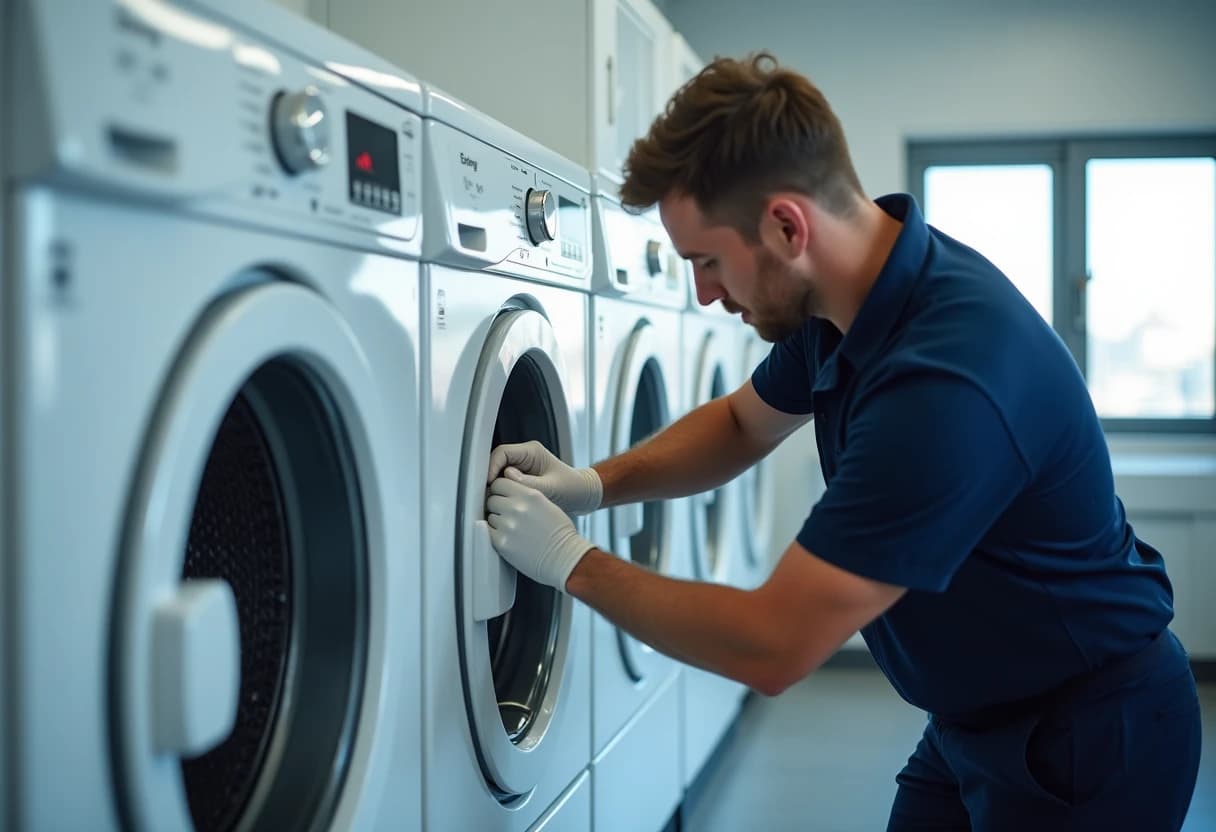
Multi-unit dryer vent cleaning is a logistics problem as much as a technical one, and we have built our commercial program around both. One project coordinator schedules the building; residents get clear notice windows; crews move unit by unit with rotary brush systems and high-powered vacuums, cleaning each vent from the dryer connection to the exterior termination; and shared risers and common trunk lines are cleaned from roof or wall terminations with equipment sized for vertical runs. Swampscott associations and management companies get per-unit volume pricing that drops steeply below single-home rates, a completion report listing every unit's condition, and a documented answer to the question insurers increasingly ask: when were the dryer vents last professionally cleaned?
Why Commercial & Multi-Unit Dryer Vent Cleaning Matters for Swampscott Homes
Residents cannot solve this problem individually, which is why it belongs to the building. A tenant or condo owner can clear their lint screen and perhaps the first few feet of transition hose — but the duct in the wall, the vertical riser shared with three neighbors, the forty-foot ceiling run to the far wall, and the termination flap four stories up are all beyond any resident's reach, tools and authority. Meanwhile every load every household dries adds lint to those shared paths. This is the classic common-element maintenance problem: individually invisible, collectively dangerous, and cheap to fix at building scale. A coordinated whole-building cleaning turns dozens of separate impossibilities into one efficient project — our coordinator handles notices and access scheduling, crews clear multiple units per hour once mobilized, no-access units are documented and revisited, and the building ends the week with every run verified clear. Boards that institutionalize it annually spend a modest per-door amount; buildings that leave it to residents are, in practice, leaving it to no one.
Whether it is a triple-decker near Swampscott Town Hall, a mid-rise condominium off Phillips Beach, or garden apartments elsewhere in Swampscott, the venting problems rhyme: lint-loaded runs, blocked or screened terminations, transition ducts that should have been replaced years ago. Swampscott's grand summer-resort past shows in the shingle-style and Victorian homes of Phillips Point and the Olmsted District, while the rest of town holds tidy early-1900s colonials, capes and two-families on compact lots near the beaches. Many of the large seaside homes have been fully modernized with multi-zone HVAC threaded through their original framing, and the smaller inland homes commonly carry mid-century forced-air retrofits. Every street in Swampscott is close enough to the Atlantic to feel it, and constant salt-air exposure corrodes vent hoods, dampers and duct seams faster than anywhere inland. Ocean humidity also keeps coastal basements damp much of the year, so duct systems here benefit from cleaning paired with a close inspection for rust and moisture damage. As a local company based 21 miles away in West Newton, we have cleaned building-wide across Essex County for associations, HOAs and management portfolios — with volume pricing per unit, crews that respect residents' homes, and reporting standardized so multi-building managers can compare properties at a glance.
Our Commercial & Multi-Unit Dryer Vent Cleaning Process in Swampscott
1Building Walkthrough & Per-Unit Proposal
Every building project starts with a walkthrough: we identify how each unit vents — individual wall runs, shared vertical risers, common trunk lines — locate terminations on walls and roofs, note access requirements, and inspect representative runs. The proposal that follows prices the building flat, per unit, with riser and common-duct service itemized, so boards approve a known number.
2Resident Coordination & Scheduling
For occupied buildings, logistics decide whether a project succeeds. Ours run on a simple system: management distributes our notice template with dates; we sequence units floor by floor to keep crews moving; a coordinator handles reschedules and lockouts as they arise; and the final report distinguishes cleaned, no-access and exception units explicitly, because an insurer reading it will want exactly that distinction.
3Dryer-Side Service: Transition Duct & Connection
In each unit we pull the dryer, clean behind and beneath it — a major hidden lint reservoir — and service the transition duct between machine and wall. Foil accordion transitions, which manufacturers prohibit and which trap lint in every corrugation, are flagged and can be replaced on the spot with code-appropriate material. The connection is reseated and secured without airstream-penetrating screws, per code.
4Mechanical Cleaning of the Full Vent Run
Compressed-air whips and rotary brushes work the duct from the unit connection toward the termination, mechanically stripping the lint mat that blowers and leaf-blower shortcuts merely compact. Every elbow — each one worth 5 feet of equivalent length under code math, and each one a lint trap in practice — gets deliberate attention. Extracted lint is bagged per unit, which residents find quietly persuasive.
5Shared Risers, Common Trunks & Booster Fans
High-rise and mid-rise venting is a system, not a bundle of individual runs. Our crews clean shared risers top-down from roof terminations with weighted rotary lines, verify each unit's takeoff where it joins the common duct, and confirm draft through the full stack afterward. Central exhaust fans and pressure-relief dampers serving laundry stacks are cleaned and checked in the same mobilization.
6Termination Service & Exterior Verification
Every vent ends at a termination, and terminations fail constantly: flaps stuck open to pests or frozen shut with lint, screens added by well-meaning painters (code prohibits them — they trap lint), caps crushed or painted over, bird and rodent nests in the hood. We clear and verify every termination, on walls or roofs, with ladder and roof access included in the project scope.
7Airflow Verification & Building Compliance Report
Each cleaned run gets a functional verification — airflow at the termination with the dryer running, or anemometer readings where equipment access allows — so the report records outcomes, not just activity. The building deliverable lists every unit: cleaned and verified, no-access, or exception, with photos of hazards and itemized repair recommendations. Boards file it; insurers accept it; renewals cite it.
Benefits of Professional Commercial & Multi-Unit Dryer Vent Cleaning in Swampscott
Insurance & Liability Documentation That Holds Up
Master-policy renewals increasingly ask when dryer vents were last professionally cleaned, and after any fire, maintenance records become the story. Our per-unit compliance report — cleaned, verified, exceptions documented, hazards flagged in writing — is formatted for exactly those readers: underwriters at renewal, adjusters after a claim, and counsel if it ever comes to that.
Shorter Dry Times & Lower Utility Costs
Every minute of extra runtime is heat pushed against a clogged duct: wasted energy, elevated temperatures, and accelerated wear. Post-cleaning, residents notice loads finishing in one cycle again — the most tangible everyday benefit of the program and the one that quiets the steady trickle of 'my dryer is broken' maintenance tickets.
Longer Dryer Life & Fewer Appliance Failures
Dryers venting against a clogged duct cook themselves: heating elements cycle against trapped heat, thermostats and thermal fuses trip and fail, motors run hot and die early. Clear venting is the cheapest appliance-life extension available — a point every appliance manufacturer's manual makes, and every burned-out element invoice repeats.
Hazard Discovery Before It Costs You
Cleaning puts trained eyes and cameras into duct paths nobody has seen in years, and the discoveries matter: prohibited foil accordion transitions, disconnected runs dumping humid lint-laden air into wall cavities, vents terminating in attics or soffits, screens trapping lint at caps. Each is photographed, located and priced for correction — found on your schedule instead of an incident report's.
A Program, Not a Project
One-time cleanings decay; lint production never stops. An annual program keeps every run permanently inside its safe accumulation window, keeps documentation permanently current for insurers, and keeps the cost flat and predictable. Associations that institutionalize it typically spend less per year than their first catch-up cleaning cost — and never face a catch-up again.
Volume Pricing That Beats Unit-by-Unit Service
Left to individual residents, vent cleaning happens rarely, unevenly and at retail prices — and the shared ducts never get cleaned at all. Building-wide service inverts every part of that: complete coverage, common elements included, standardized quality, one invoice, and a per-unit rate that makes the line item easy to defend at budget time.
Signs Your Swampscott Home Needs Commercial & Multi-Unit Dryer Vent Cleaning
Burning Smells, Hot Laundry Areas or Tripped Thermal Fuses
Thermal fuses and high-limit switches exist to interrupt exactly this failure, and their tripping is diagnostic: heat had nowhere to go. Repeated no-heat service calls on building machines are the venting system burning through safety margins. Clean the exhaust paths before the next component in that chain is the lint itself.
Insurance Questionnaires or Post-Incident Requirements
Carriers writing habitational risk in Massachusetts have tightened on dryer venting because loss data justifies it. Boards seeing new questionnaire language, inspection requirements or premium credits tied to vent maintenance should read the market signal: this is now standard due diligence for multi-unit buildings, and the documented program is what compliance looks like.
Dryers Taking Two or More Cycles Per Load
Extended dry times are the classic first symptom of vent restriction: moist air cannot exit, so clothes tumble in humidity until the machine times out. When this complaint appears across multiple units in a building, the shared venting is implicated — and every affected dryer is running hotter and longer than its design intends.
High-Duty Operations: Laundromats & Common Laundry Rooms
Commercial duty cycles compress the maintenance calendar: a laundromat dryer produces in weeks the lint a household machine makes in a year, loading manifolded ducts continuously. If your store has never set a cleaning interval matched to throughput, the venting is overdue by definition — quarterly service is typical for busy operations.
Lint Visible at Terminations or on the Building Exterior
Lint beards on wall caps, gray fuzz on the siding below terminations, or lint scatter on the roof around stack outlets mean the ducts are so loaded they are extruding their contents. What escapes outside is the overflow; the accumulation inside the run is worse, and the affected units are drying against serious restriction.
Foil Accordion Ducts or Improvised Vent Runs in Units
If your association has never inspected what connects residents' dryers to the walls, assume nonconformance: transition duct is resident-installed, unregulated in practice, and frequently the worst link in the chain. Our unit visits document and correct these connections — the cheap fix that removes the most flammable segment of the entire vent path.
Commercial & Multi-Unit Dryer Vent Cleaning Cost in Swampscott, MA
Multi-unit dryer vent cleaning in Greater Boston is priced per building, and the per-unit economics are the story: while a single-home service runs $150–$250, coordinated building projects typically price between $40 and $90 per unit depending on scale and complexity, with whole-building totals commonly landing between $300 for a small multi-family and $3,000 or more for larger properties. The honest drivers are unit count (bigger buildings earn lower per-unit rates), vent configuration (short individual wall runs price lowest; long improvised runs and shared vertical risers add equipment and time), termination access (ground-floor wall caps versus roof work or lift access), and machine handling (pulling and resetting each dryer versus laundry-room fleets). Shared risers, common trunks and booster fans are itemized separately as common-element service. Every proposal is flat and written after a walkthrough — the board approves a number, not an estimate.
Want the full pricing picture? See our complete Boston-area cost guide or call (617) 390-7145 for an exact flat quote for your Swampscott home.
Local Knowledge: Swampscott, Essex County
Every town's ductwork tells the story of its housing. Swampscott's grand summer-resort past shows in the shingle-style and Victorian homes of Phillips Point and the Olmsted District, while the rest of town holds tidy early-1900s colonials, capes and two-families on compact lots near the beaches. Many of the large seaside homes have been fully modernized with multi-zone HVAC threaded through their original framing, and the smaller inland homes commonly carry mid-century forced-air retrofits. Every street in Swampscott is close enough to the Atlantic to feel it, and constant salt-air exposure corrodes vent hoods, dampers and duct seams faster than anywhere inland. Ocean humidity also keeps coastal basements damp much of the year, so duct systems here benefit from cleaning paired with a close inspection for rust and moisture damage. We plan Swampscott jobs around those realities, from equipment selection to time on site, and it shows in the results. If you live near Fisherman's Beach or anywhere across Swampscott's 01907 area, we have almost certainly cleaned a system like yours before — and we can tell you exactly what to expect before we arrive.
The Best Time of Year in Swampscott
Termination freeze-up is the distinctly New England failure mode. Dryer exhaust is warm and humid; when it meets a February termination, moisture condenses and freezes on the flap and hood, and a cap already propped partway open by lint accumulation becomes an ice-and-lint blockage that can seal a vent entirely. Residents notice two-cycle drying; the duct experiences trapped heat. Buildings with north-facing terminations, roof caps and long uninsulated runs through cold cavities are most vulnerable — and long cold runs also condense moisture internally, matting lint into dense plugs that only mechanical brushing removes. A pre-winter cleaning and damper service is the prevention; mid-winter, we triage frozen-vent calls across Essex County weekly, and the buildings calling are overwhelmingly the ones without a fall program.
Why Choose Boston Air Duct Cleaners
Homeowners across Essex County choose Boston Air Duct Cleaners for three reasons. First, honesty: our inspection camera tells you whether your system actually needs cleaning — and sometimes the answer is no. Second, capability: truck-grade negative-air machines, rotary brush systems and HEPA filtration handle everything from antique gravity-furnace conversions to brand-new high-velocity systems. Third, accountability: flat quoted pricing, before-and-after photos, insured technicians, and a real local office you can call at (617) 390-7145. That combination is rarer in this industry than it should be.
Serving Swampscott and Surrounding Communities
Swampscott sits in the heart of our service area, and neighboring Marblehead, Salem, Lynn, Nahant, Peabody, Saugus appointments share the same routes. That density is why our response times in this part of Essex County are among our fastest — and why you will see our trucks in the area week after week.