
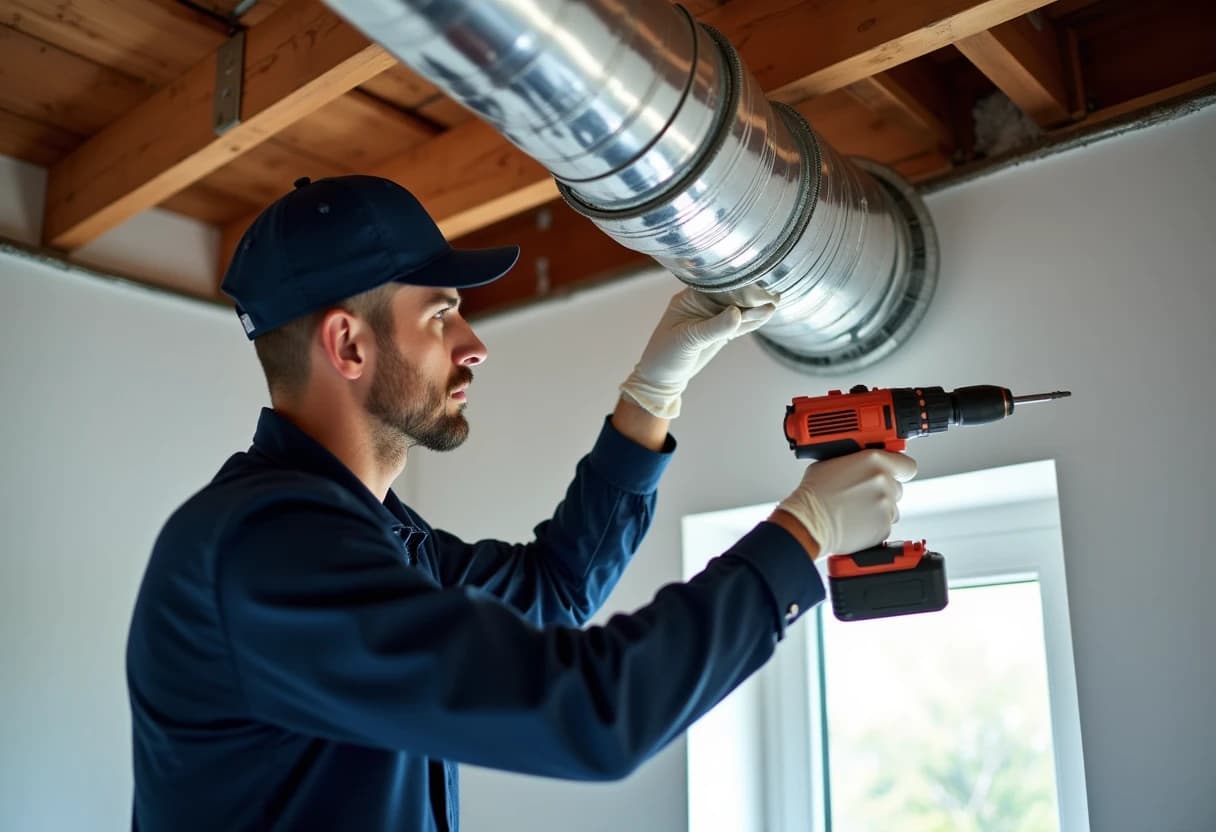
Homeowners in Swampscott call us for dryer vent installation at three moments: when a new laundry location needs its first vent, when a home inspection or appliance installer condemns the existing setup, and when years of blockages and repairs make clear the old route will never work. In all three cases the job is the same discipline: route planning against the code's 35-foot equivalent-length budget, 4-inch smooth rigid metal duct, clamped and taped joints with no screws in the airstream, insulation where the run crosses unheated space, and a termination — side wall, rim joist or roof — that keeps out weather and wildlife. Flat quotes, one-day installs, and a system your annual cleaning will keep healthy for decades.
Why Dryer Vent Installation & Rerouting Matters for Swampscott Homes
Materials are the second decision that determines everything after. Vinyl accordion hose — still present behind thousands of local dryers — is a fire hazard the industry disowned decades ago: it melts, kinks and packs with lint. Foil flex crushes at a touch and corrugates the airflow into turbulence that drops fibers at every ridge. Even where flex is tolerated, it is only as a short transition at the appliance, never concealed, never as the run. Smooth-interior rigid metal duct is the code's answer and ours: lint slides across it instead of catching, rotary cleaning brushes glide through it at full effectiveness, it cannot kink or sag into condensation bellies when properly supported, and it is noncombustible. Joints matter equally — fitted in the direction of airflow, secured with clamps or external fasteners and sealed with UL-listed foil tape, because a screw tip inside the duct becomes a lint anchor that seeds the next blockage. Full flex-to-rigid replacement is among our most common installations, and its effects are permanent: slower lint accumulation, faster cleanings, better drying, lower risk.
Routing a dryer vent through Swampscott housing is a local craft. Swampscott's grand summer-resort past shows in the shingle-style and Victorian homes of Phillips Point and the Olmsted District, while the rest of town holds tidy early-1900s colonials, capes and two-families on compact lots near the beaches. Many of the large seaside homes have been fully modernized with multi-zone HVAC threaded through their original framing, and the smaller inland homes commonly carry mid-century forced-air retrofits. Laundry areas in homes like these were carved out of basements, back halls and closets long after construction, and the legal path outdoors is rarely obvious — it threads between old framing, past stone or brick foundation, around a century of renovations. Every street in Swampscott is close enough to the Atlantic to feel it, and constant salt-air exposure corrodes vent hoods, dampers and duct seams faster than anywhere inland. Ocean humidity also keeps coastal basements damp much of the year, so duct systems here benefit from cleaning paired with a close inspection for rust and moisture damage. Our installers plan Swampscott routes against the code's 35-foot equivalent-length budget on site, carry the masonry bits and flashing older walls demand, and build in rigid metal that the next owner will never have to think about.
Our Dryer Vent Installation & Rerouting Process in Swampscott
1Site Assessment & Route Planning
Every installation begins with the route. We assess the laundry location, measure candidate paths to the exterior, and score each against the code's 35-foot equivalent-length budget — deducting for every elbow — and against your home's structure: framing, foundation type, finished spaces, and where a termination can legally and sensibly exit. You get options with trade-offs explained, and a flat price for the route you choose.
2Demolition of Non-Compliant Venting
Replacement jobs start with removing what failed: vinyl and foil flex pulled from cavities and joist bays, abandoned duct capped or extracted, screened hoods and window inserts taken out, and improvised terminations into attics or crawlspaces closed off. We vacuum the lint these systems have shed along their routes — hidden accumulation that should not stay in the structure.
3Cut & Flash the Exterior Penetration
Roof terminations get roofing-grade treatment: shingles lifted and re-laid over proper flashing, a cap rated for dryer exhaust with a working damper, and sealant appropriate to the roofing material. We schedule roof penetrations for dry weather and verify water-tightness before leaving — a roof leak is not an acceptable side effect of a laundry upgrade.
4Install Rigid Metal Duct on the Planned Route
The run goes in as 4-inch smooth-interior rigid metal duct — the material the IRC specifies — cut to fit, joined male-to-female in the direction of airflow, and assembled without a single screw protruding into the airstream: joints are clamped or externally fastened and sealed with UL-listed foil tape. Elbows are used sparingly and counted against the length budget.
5Mount the Termination Hood & Damper
The termination is a quality metal hood matched to the 4-inch duct, with a backdraft damper that swings fully open under airflow and closes tight against weather, drafts and pests — and no screen, which the code prohibits on dryer terminations because mesh mats over with lint. It is fastened to the cladding, sealed at the perimeter, and tested by hand before the first cycle.
6Connect the Appliance & Seal the System
System sealing is completed end to end: every joint taped with UL-listed foil tape, the wall penetration sealed inside and out, and the transition clamped tight. A dryer vent is a pressure system; leaks anywhere cost airflow at the termination and push lint and moisture into places they do not belong. Sealed means sealed everywhere.
7Test, Verify & Document the Installation
You receive complete documentation: photos of the route (including concealed sections before they closed), the materials used, the equivalent-length math, and the finished termination. For permitted work, condo approvals or home sales, this record answers every question an inspector, board or buyer will ask about what is behind the walls.
Benefits of Professional Dryer Vent Installation & Rerouting in Swampscott
Permanently Lower Energy Costs
The efficiency also shows up in maintenance economics: smooth, short, sealed runs need only quick annual cleanings, while flex mazes generate blockage-level service calls and appliance repairs. Over ten years, the well-installed vent is the cheaper vent by a wide margin, before counting a single kilowatt-hour.
Decades of Service From a One-Day Job
The one-day timeline is real for most installations: assessment and route confirmation, demolition of old venting, penetration, duct assembly, termination, connection and commissioning typically fit a single visit. Complex reroutes through finished space may take a second day. Either way, laundry is back in service the same evening.
Dramatically Faster Drying
New high-efficiency dryers are especially sensitive to backpressure, and manufacturers condition warranties on adequate venting. Installing the vent right protects the appliance investment and lets its efficiency ratings actually materialize — a heat-pump or sensor dryer on a choked vent never performs to its label.
Fire-Safe by Design, Not by Vigilance
Roughly 2,900 US home dryer fires a year trace overwhelmingly to lint, and lint traces to the installation faults a proper build eliminates: flex corrugations, overlong runs, obstructed airstreams. Replacing an improvised vent with an engineered one is the single largest permanent reduction in dryer fire risk available to a homeowner.
Code Compliance That Closes Every Question
Compliance has practical teeth in transactions: dryer venting is among the most commonly flagged items in Massachusetts home inspections, and an improvised system becomes a negotiation item or a closing repair. A documented compliant installation converts that liability into a selling point — visible evidence of a well-maintained house.
Moisture Managed, Structure Protected
Moisture protection extends to the envelope itself: our flashed, sealed penetrations keep wind-driven rain out of walls and roofs for the long term. An installation is only as good as its weakest detail, and the exterior detail is the one that faces forty years of nor'easters. We build it like it will.
Signs Your Swampscott Home Needs Dryer Vent Installation & Rerouting
Blockages and Repairs Keep Recurring
The tell is the fade: a fresh cleaning helps for a few weeks, then performance sags again as lint resettles in the same flex ridges and dead-air corners. Well-designed systems hold their cleaning for a full year. If yours cannot, stop paying to maintain the flaw and price the fix.
The Dryer Vents Indoors — Anywhere
A vent that ends in an attic, crawlspace, garage, ceiling cavity or bucket-style indoor 'lint trap' is an urgent installation call. Every load pumps a gallon of moisture and a charge of fine lint into the structure or living space — feeding mold, soaking insulation, and accumulating fuel where no one will ever clean it. This setup should not run another season.
The Run Is Overlong or Elbow-Heavy
Count the route: if your duct wanders more than roughly 25 linear feet, or turns more than three corners, it is likely past the code's 35-foot equivalent-length budget once elbows are deducted — typically five feet per 90-degree bend. Beyond the budget, the dryer physically cannot keep lint moving to the outlet, and chronic clogging is built in.
A New Laundry Location Needs Its First Vent
New dryer purchases trigger the question too: installers deliver the machine but rarely build ductwork, and a new appliance connected to no vent — or a condemned one — sits unusable. If your delivery is scheduled, get the vent designed and installed ahead of it, so the first load runs the day the dryer arrives.
Inspection, Insurance or Association Requirements
Condo associations across Greater Boston have tightened dryer vent requirements after regional fire losses, and some now mandate compliant installation on unit turnover or renovation. If your building has issued requirements, we handle the full sequence: scope for board approval, insured installation, and per-unit documentation for the association's records.
Chronic Condensation the Route Guarantees
Some vents condense because of damage; others condense because of design — long uninsulated passages through cold basements, garages or attics where exhaust cannot stay above its dew point, or bellied routes with no slope to drain. When repair visits keep treating water in the same duct, the route is the diagnosis, and rerouting or rebuilt insulation and slope is the cure.
Dryer Vent Installation & Rerouting Cost in Swampscott, MA
A note on what our installation price includes, because scope games are common in this trade. Our flat quote covers: site assessment and route design with equivalent-length verification; demolition and disposal of non-compliant existing venting, including sealing abandoned penetrations; the exterior penetration, flashed and sealed to the cladding or roof; 4-inch smooth rigid metal duct, supported, sloped and joined without airstream-piercing fasteners; insulation over unheated space where the route requires it; a quality damper-equipped termination; the UL-listed transition connector at the appliance; commissioning with a live dryer cycle and airflow verification; and photo documentation of the complete system, concealed sections included. Restoration of finishes we must open (drywall patching and paint) is quoted separately and clearly beforehand, as is any permit your municipality requires — we tell you when one applies. If a competing quote is meaningfully lower, check it against this list; the difference is usually something missing that you will pay for later.
Want the full pricing picture? See our complete Boston-area cost guide or call (617) 390-7145 for an exact flat quote for your Swampscott home.
Local Knowledge: Swampscott, Essex County
What makes Swampscott different? Swampscott's grand summer-resort past shows in the shingle-style and Victorian homes of Phillips Point and the Olmsted District, while the rest of town holds tidy early-1900s colonials, capes and two-families on compact lots near the beaches. Many of the large seaside homes have been fully modernized with multi-zone HVAC threaded through their original framing, and the smaller inland homes commonly carry mid-century forced-air retrofits. Every street in Swampscott is close enough to the Atlantic to feel it, and constant salt-air exposure corrodes vent hoods, dampers and duct seams faster than anywhere inland. Ocean humidity also keeps coastal basements damp much of the year, so duct systems here benefit from cleaning paired with a close inspection for rust and moisture damage. For duct and dryer vent systems, those local factors translate into specific, predictable problems — and predictable problems are the ones we solve fastest. Call (617) 390-7145, tell us your street and home style, and we will quote the job accurately the first time, usually in under five minutes.
The Best Time of Year in Swampscott
Humid summers argue for good vent design from the opposite direction. When dew points sit in the seventies, dryer exhaust barely cools before reaching saturation, and any route flaw — a belly, a leak, an oversized dead-air section — collects water through the muggy months while basement laundries add ambient humidity of their own. Summer is also when improvised indoor venting does its worst damage, loading attics and crawlspaces with moisture exactly when the structure cannot dry. And at the termination, summer is nesting season: hoods without proper dampers and guards acquire tenants between March and June. A properly designed system shrugs all of it off — sealed, sloped, insulated, guarded — which is why summer's symptoms are so often what finally send homeowners to the phone.
Why Choose Boston Air Duct Cleaners
Choosing a duct cleaner is really a trust decision — you are letting a crew work inside the system that feeds air to your family. We make that decision easy: a local West Newton company with insured, uniformed technicians, transparent flat-rate quotes, NADCA-standard equipment and methods, and photographic proof of the finished work. No door-to-door sales, no bait-and-switch coupons, no invented 'mold emergencies.' Just honest mechanical cleaning done properly the first time, backed by a written guarantee.
Serving Swampscott and Surrounding Communities
We serve every community around Swampscott as well: Marblehead, Salem, Lynn, Nahant, Peabody, Saugus all fall inside our regular service routes. If you have a second property, a rental, or family nearby, ask about multi-home scheduling — grouped appointments on the same route are our most requested discount.