
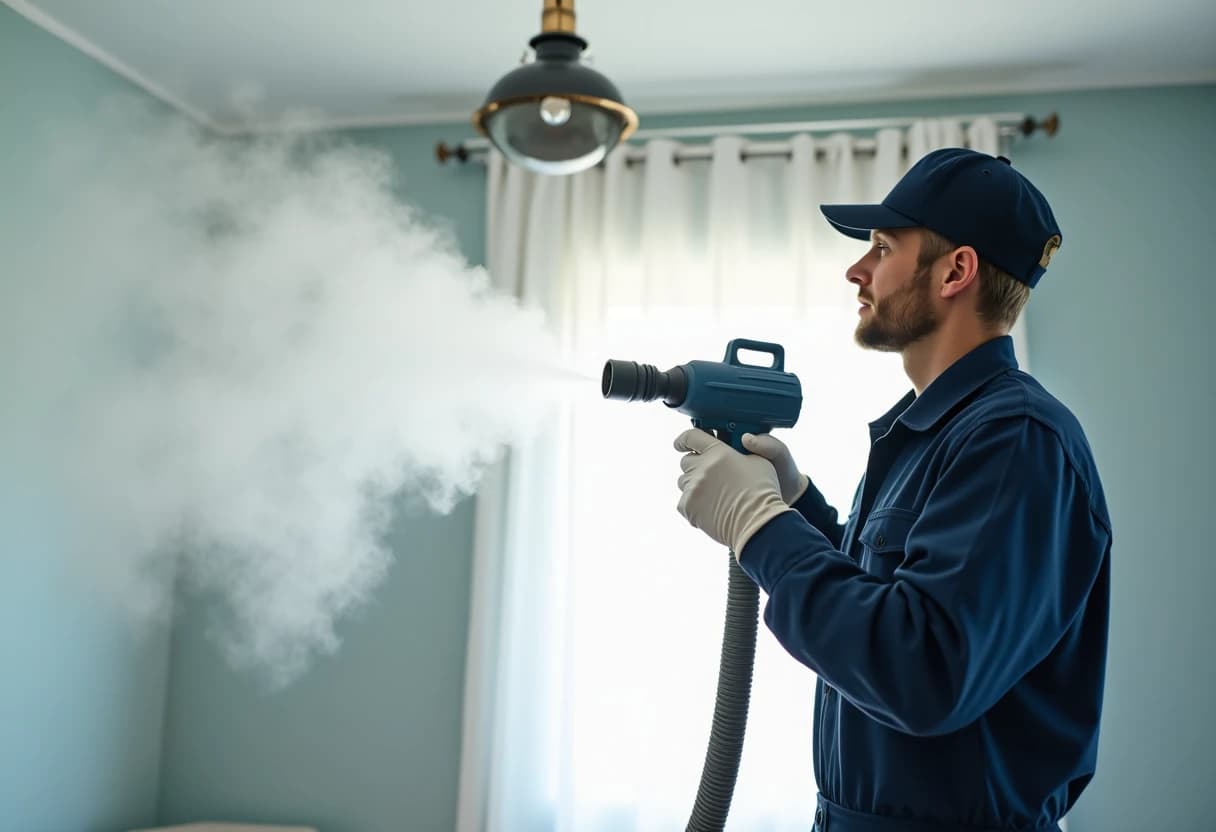
The EPA's guidance on duct treatments is specific: chemical biocides should be applied only after mechanical cleaning, and only products registered for use in HVAC systems belong in your air path. That is exactly how we sanitize ducts in Swampscott. First the system is cleaned to bare surfaces under negative pressure; then an EPA-registered antimicrobial is atomized through the supply and return network at label rates, treating the seams, joints and textures no brush can fully reach. The treatment kills odor-causing bacteria, neutralizes microbial residue and inhibits regrowth — and because it lands on clean metal rather than a dust blanket, it actually works. We will also tell you plainly when your system does not need it.
Why Air Duct Sanitizing & Deodorizing Matters for Swampscott Homes
Certain situations turn sanitizing from optional to strongly advised. After confirmed microbial growth or a mold finding, treatment of the cleaned surfaces inhibits recolonization while the moisture fix takes hold. After rodent or pest activity in the ductwork, sanitizing addresses the bacterial and viral load droppings leave behind — a genuine health matter, not merely an aesthetic one. After fire or heavy smoke exposure, deodorizing treatment neutralizes the acrid residue that otherwise off-gasses for years. After a water event, it suppresses the microbial bloom that damp ducts incubate. And at move-in, it resets a system whose history you cannot verify. In each case the logic is the same: cleaning removes what is visible, sanitizing addresses what is biological. Conversely — and we say this plainly because the industry often will not — a routinely maintained system with no odor, no moisture history and no contamination event does not need sanitizing, and the EPA does not recommend routine biocide use in ducts. We inspect first and recommend accordingly. Roughly a third of the time, our recommendation is to skip it.
Swampscott real estate moves fast, and smell is part of every showing. Swampscott's grand summer-resort past shows in the shingle-style and Victorian homes of Phillips Point and the Olmsted District, while the rest of town holds tidy early-1900s colonials, capes and two-families on compact lots near the beaches. Many of the large seaside homes have been fully modernized with multi-zone HVAC threaded through their original framing, and the smaller inland homes commonly carry mid-century forced-air retrofits. Buyers walking into a home that smells of previous owners — pets, smoke, mustiness — mentally discount the price within seconds, and sellers who have lived with the odor for years often cannot detect it at all. Every street in Swampscott is close enough to the Atlantic to feel it, and constant salt-air exposure corrodes vent hoods, dampers and duct seams faster than anywhere inland. Ocean humidity also keeps coastal basements damp much of the year, so duct systems here benefit from cleaning paired with a close inspection for rust and moisture damage. We work pre-listing sanitizing jobs across Swampscott on tight timelines: source-removal cleaning plus EPA-registered deodorizing treatment, one visit, documented for the disclosure file. Agents in the area refer us for exactly this reason.
Our Air Duct Sanitizing & Deodorizing Process in Swampscott
1Odor Assessment & Honest Qualification
First we determine whether sanitizing will actually fix your problem. The technician traces the odor's behavior — does it arrive with airflow, vary by season, concentrate at certain registers — inspects the duct interiors and air handler, and checks for moisture. If the source is your ducts, we quote the treatment flat. If it is not, we say so and point you at the real source.
2Source-Removal Cleaning First
Step one is removing the reservoir. The odor-saturated film lining your ducts is physically extracted under negative pressure — rotary brushes and pneumatic whips strip it from every supply, return and trunk while the HEPA vacuum captures it. Most of the odor leaves the house in this step; the fogging that follows neutralizes what remains and prevents the smell from rebuilding.
3Product Selection & Preparation
Only two kinds of products enter your air path: antimicrobials EPA-registered specifically for use in HVAC systems, and deodorizing counteractants formulated for duct application. No bleach, which corrodes ducts; no ozone shock treatments, which the EPA warns are ineffective at safe concentrations; no fragrance bombs that mask rather than neutralize. Dilutions follow the label exactly — that is what EPA registration means.
4Whole-System Antimicrobial Fogging
With the system freshly cleaned, the EPA-registered fog does its work at the surface level: contact-killing the bacteria that metabolize duct residue into odor, neutralizing the residual film chemically, and leaving an inhibiting layer that suppresses microbial regrowth. The application follows label contact times precisely — this is regulated chemistry applied to specification, not a scented mist waved through the vents.
5Coil, Drain Pan & Blower Treatment
Every fogging visit includes hands-on treatment of the components the fog alone cannot adequately address: coil fins treated with appropriate cleaner, drain pan scrubbed and sanitized, condensate line flushed, blower compartment wiped and treated. If we find heavy coil fouling or standing water that signals a bigger problem, we document it with photos and quote the fix separately — informed consent, never ambush.
6Deodorizing Pass for Stubborn Odors
Antimicrobial treatment handles biological odors, but some smells are chemical: tar and nicotine films, cooking-oil residue, fire smoke. For those, we deploy counteractants that chemically neutralize the odor compounds themselves. The distinction matters — treating a smoke house with antimicrobial alone leaves the tar film broadcasting — and diagnosing which chemistry your odor needs is exactly what the initial assessment is for.
7System Airing, Verification & Walkthrough
The finish is verification by nose and by paper: a room-by-room airflow check confirming neutral odor at every register, before-and-after photos of the duct interiors, and a written record of products applied with their EPA registration numbers. Surfaces are dry and the home fully usable by the time we pack up in nearly all cases — we review any exceptions before we start, never after.
Benefits of Professional Air Duct Sanitizing & Deodorizing in Swampscott
Pet Odor Elimination That Actually Holds
Dander is airborne, the return ducts inhale it continuously, and years of accumulation turn the duct film into a dander reservoir with whole-house reach — which is why the pet smell survives every carpet shampoo. Removing the reservoir and neutralizing the residue takes the system out of the equation, and most households report the smell simply gone, permanently, after one treatment.
Microbial Load Reduced System-Wide
Ducts are a microbial habitat by design — dark, textured, dust-fed and periodically damp. Sanitizing knocks the resident population down to baseline and leaves an inhibiting residue that slows recolonization for years. It is not sterility, and no honest company promises that; it is a substantially cleaner biological starting point for all the air you breathe at home.
Musty Summer Smell Broken for Good
The musty cycle is self-reinforcing: each humid season's growth adds residue that feeds the next season's growth. Breaking it requires actually removing the substrate, which is what the cleaning-plus-treatment pairing does. Homeowners who assumed the smell was 'just what old houses do' discover it was just what untreated ducts do — old houses smell fine with a neutral air path.
A True Reset for Newly Purchased Homes
The previous owners' pets, kitchen, tobacco and habits are archived in your duct film, replaying on every cycle. Cleaning plus sanitizing erases the archive — mechanically stripping the residue, then neutralizing the biology — so the house starts smelling like yours from day one. It is the single most-requested reason for this service, and the reviews it generates say 'finally smells like our home.'
Odors Neutralized at the Source, Not Masked
Every consumer odor product adds scent on top of the problem; sanitizing subtracts the problem. With the odor-holding film removed and the residue chemically neutralized, the ducts stop producing smell altogether. The house does not smell like a candle aisle afterward — it smells like nothing, which is what fresh actually is, and what no masking product can counterfeit.
Smoke Ghosts Finally Evicted
Fire and smoke events leave the same signature at higher intensity: acrid residue through every duct the system ran during or after the event. Alongside your restoration work, duct cleaning with counteractant treatment prevents the classic post-fire complaint — a rebuilt, repainted home that still exhales smoke on warm days. We coordinate with restoration timelines regularly.
Signs Your Swampscott Home Needs Air Duct Sanitizing & Deodorizing
Smoke History in the Home
If any era of the home's life included indoor smoking, the duct network carries the tar-and-nicotine film to prove it — and that film off-gasses for years, strongest on warm humid days when the residue softens. Paint and carpet replacement miss it entirely. Counteractant duct treatment is the step that finally clears a smoker's house.
Musty Blast When the Heat or AC Starts
Many households normalize this smell for years — a funky thirty seconds, then fine, so it never quite becomes a project. It should: the odor is live biology metabolizing residue in your air path, it recurs because the substrate remains, and it trends worse. One treatment visit ends a nuisance you had stopped noticing you tolerated.
Pets Present or Past
The threshold question: can guests tell you have animals without seeing them? If yes, the ducts are broadcasting, and the smell is stronger than your adapted nose reports. Households with multiple pets or long pet tenure carry proportionally heavier duct reservoirs, and they see the most dramatic before-and-after from a single cleaning-plus-treatment visit.
Odors Return No Matter How Much You Clean
If deep-cleaning the house buys only a day or two before the smell creeps back, the source is upstream of everything you cleaned — in the air system, re-scenting the rooms on every cycle. That resupply pattern is the signature of duct-borne odor, and it means the fix is in the ducts, not in another weekend of scrubbing.
Guests Notice a Smell You No Longer Can
Nose-blindness is real and universal: constant exposure deletes a smell from your perception while every visitor gets it full strength at the door. If a candid friend, a relative or a real estate agent has mentioned a pet, smoke or musty note you cannot detect, believe them — and suspect the ducts, because whole-house odors are almost always airflow-distributed.
You Just Bought the Home
Even a home that smells fine at purchase benefits from the reset when history is unknown: odor thresholds are personal, previous owners' normal may not be yours, and the first heating season has a way of releasing what summer showings concealed. Buyers who sanitize at move-in never have to wonder what October's first furnace cycle will announce.
Air Duct Sanitizing & Deodorizing Cost in Swampscott, MA
Compare the cost against what duct-borne odors actually extract from households. Masking products — candles, plug-ins, sprays — run $200 to $500 annually for a committed household and resolve nothing. Consumer ozone generators cost $100 to $400, carry EPA warnings, and leave the odor source intact. Carpet replacement motivated by a smell that turns out to be duct-borne runs $2,000 to $6,000 and fails on arrival, since the system re-scents new fibers within months. Repainting for smoke odor without treating the ducts: $3,000 to $8,000, same outcome. Against that landscape, $250 to $500 for professional source treatment — or $75 to $200 added to a cleaning you may need anyway — is not the premium option; it is the only option priced against the actual problem. For sellers the math sharpens further: listing agents consistently report that odor-flagged homes show worse and negotiate weaker, with concessions that dwarf the treatment cost by an order of magnitude. Fresh-smelling is the cheapest staging money can buy.
Want the full pricing picture? See our complete Boston-area cost guide or call (617) 390-7145 for an exact flat quote for your Swampscott home.
Local Knowledge: Swampscott, Essex County
Every town's ductwork tells the story of its housing. Swampscott's grand summer-resort past shows in the shingle-style and Victorian homes of Phillips Point and the Olmsted District, while the rest of town holds tidy early-1900s colonials, capes and two-families on compact lots near the beaches. Many of the large seaside homes have been fully modernized with multi-zone HVAC threaded through their original framing, and the smaller inland homes commonly carry mid-century forced-air retrofits. Every street in Swampscott is close enough to the Atlantic to feel it, and constant salt-air exposure corrodes vent hoods, dampers and duct seams faster than anywhere inland. Ocean humidity also keeps coastal basements damp much of the year, so duct systems here benefit from cleaning paired with a close inspection for rust and moisture damage. We plan Swampscott jobs around those realities, from equipment selection to time on site, and it shows in the results. If you live near Fisherman's Beach or anywhere across Swampscott's 01907 area, we have almost certainly cleaned a system like yours before — and we can tell you exactly what to expect before we arrive.
The Best Time of Year in Swampscott
Duct odors in Massachusetts follow the calendar, and so should treatment timing. Late summer is peak mustiness: July and August humidity has been condensing in the system for weeks, the microbial film is at maximum activity, and the smell at AC start-up is at its yearly worst — sanitizing now delivers the most dramatic before-and-after. Early fall is the strategic window: treating the system before the heating season means the closed-window months ahead circulate neutral air instead of concentrating whatever summer grew. The heating season itself is when odor complaints peak — not because ducts get dirtier in winter, but because sealed houses concentrate what the system holds, and the household finally notices what open windows had been diluting since May.
Why Choose Boston Air Duct Cleaners
Boston Air Duct Cleaners is a local, owner-operated company based at 1121 Washington St in West Newton — not a national franchise dispatching subcontractors. Every crew is our own: background-checked, factory-trained on commercial negative-pressure equipment, and fully insured. We quote flat prices before work begins, document every job with before-and-after photos, and follow NADCA-standard source-removal methods on every system we touch. That is why so much of our work comes from repeat customers, property managers and word-of-mouth referrals across Essex County.
Serving Swampscott and Surrounding Communities
We serve every community around Swampscott as well: Marblehead, Salem, Lynn, Nahant, Peabody, Saugus all fall inside our regular service routes. If you have a second property, a rental, or family nearby, ask about multi-home scheduling — grouped appointments on the same route are our most requested discount.