
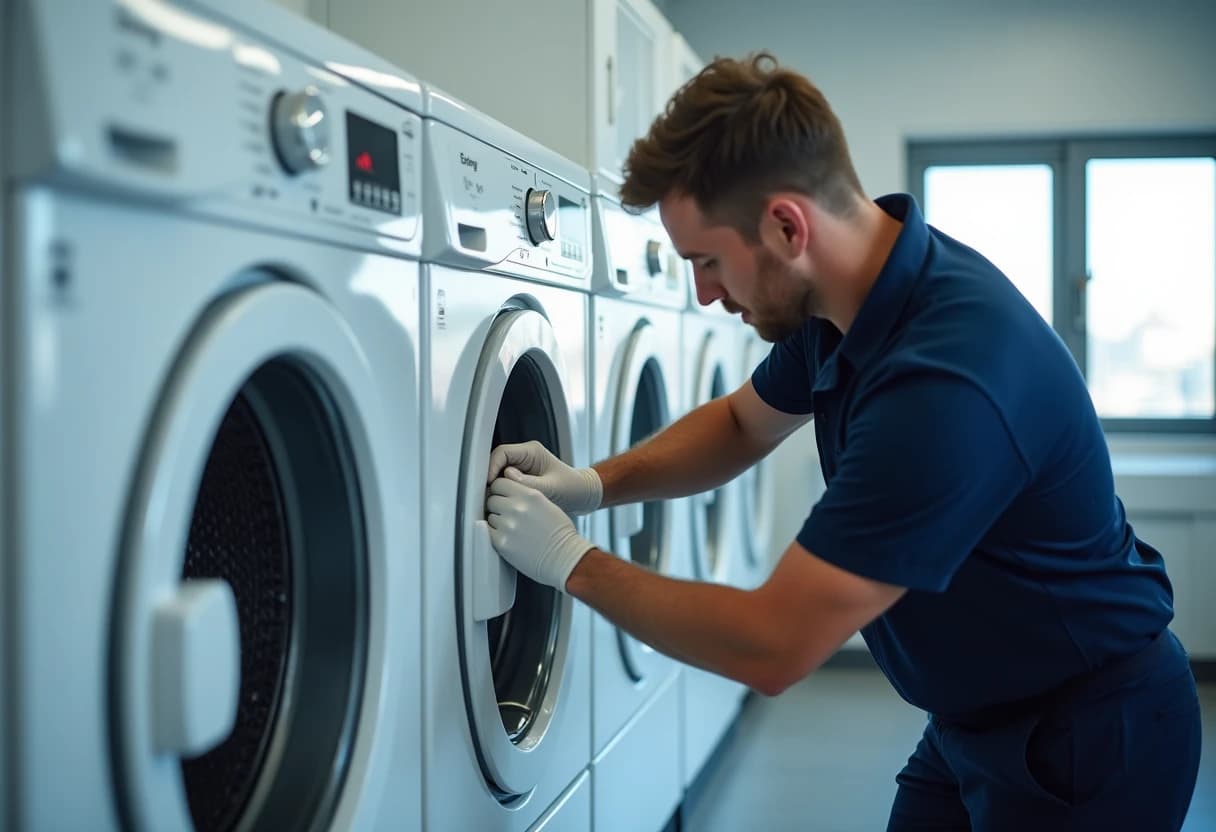
The call we never want to get from Lynn is the one after the fire. Dryer fires are overwhelmingly preventable — lint-clogged venting is the leading cause, per FEMA and NFPA — and in multi-family buildings a single unit's blocked vent endangers every neighbor sharing the structure. That is why insurers, and increasingly master-policy underwriters, ask associations for documented vent maintenance. Our program gives Lynn buildings the complete answer: scheduled whole-building cleanings with resident coordination handled by us, mechanical end-to-end cleaning of every vent and shared riser, immediate flagging of hazards like foil accordion transition ducts and crushed runs, and a unit-by-unit report formatted for board minutes and insurance files. Most buildings are completed in one to three days.
Why Commercial & Multi-Unit Dryer Vent Cleaning Matters for Lynn Homes
Residents cannot solve this problem individually, which is why it belongs to the building. A tenant or condo owner can clear their lint screen and perhaps the first few feet of transition hose — but the duct in the wall, the vertical riser shared with three neighbors, the forty-foot ceiling run to the far wall, and the termination flap four stories up are all beyond any resident's reach, tools and authority. Meanwhile every load every household dries adds lint to those shared paths. This is the classic common-element maintenance problem: individually invisible, collectively dangerous, and cheap to fix at building scale. A coordinated whole-building cleaning turns dozens of separate impossibilities into one efficient project — our coordinator handles notices and access scheduling, crews clear multiple units per hour once mobilized, no-access units are documented and revisited, and the building ends the week with every run verified clear. Boards that institutionalize it annually spend a modest per-door amount; buildings that leave it to residents are, in practice, leaving it to no one.
Lynn property managers call us for three reasons more than any other: an insurance renewal questionnaire asking about vent maintenance, a resident complaint about two-cycle dry times, or a neighboring building's fire making the local news. Lynn is one of the North Shore's densest triple-decker cities, layered with Victorian two-families in the Diamond District, shoe-factory-era workers' housing near downtown and post-war capes out toward Wyoma. Many multifamilies have had gas furnaces and ducted systems squeezed into basements and closets over the decades, producing tight, kinked runs that trap dust and lint. Between salt air off Lynn Shore Drive and the sheer age of the city's triple-decker stock, we see more corroded vent terminations and moisture-streaked ductwork here than almost anywhere on the North Shore. Shared basements and stacked units also mean one clogged dryer duct can affect three households at once. All three end the same way — a coordinated building-wide cleaning with per-unit documentation. We handle resident scheduling and notices, clean every run with rotary brush and vacuum extraction, service the shared risers individual residents cannot reach, and deliver the report that closes the file. Most Lynn buildings complete in a single visit of one to three days.
Our Commercial & Multi-Unit Dryer Vent Cleaning Process in Lynn
1Building Walkthrough & Per-Unit Proposal
We scope before we quote: unit count and layout, vent configurations and lengths, termination locations and access (ladder, lift or roof), laundry room and common-area equipment, and any known problem units. Associations receive a fixed proposal with volume per-unit pricing, a project schedule with resident notice templates, and the reporting format agreed in advance so the board knows exactly what deliverable closes the project.
2Resident Coordination & Scheduling
We treat resident experience as part of the deliverable: clear advance notices, tight arrival windows, uniformed technicians who protect floors and finish each unit in roughly 20 to 40 minutes, and a same-day completion log to management. Units we cannot access are documented — not silently skipped — and a make-up window is scheduled so the building report ends with every unit accounted for.
3Dryer-Side Service: Transition Duct & Connection
Each unit visit starts at the machine: lint screen housing vacuumed, dryer pulled and the fire-load of lint behind it removed, transition duct inspected against IRC M1502 requirements — smooth interior, proper material, no screws projecting into the airstream, no excessive length or crushing. Deficiencies are photographed for the unit's report line, and simple corrections are completed during the same visit with owner approval.
4Mechanical Cleaning of the Full Vent Run
The in-wall duct is cleaned end to end with rotary brush systems driven through the full run while a high-powered vacuum captures dislodged lint — the same agitation-plus-extraction principle as NADCA duct cleaning, sized for 4-inch dryer duct. Long runs and multiple elbows get repeat passes; the pass is complete when the brush returns clean and airflow verifies.
5Shared Risers, Common Trunks & Booster Fans
Stacked buildings route multiple dryers into shared vertical risers, and these common elements are where multi-unit lint risk concentrates — no resident can clean them, and every household loads them. We service risers from terminations and access points with vertical-run equipment, clean common horizontal trunks and basement manifolds, and service inline booster fans, whose blades cake with lint and quietly fail.
6Termination Service & Exterior Verification
Every vent ends at a termination, and terminations fail constantly: flaps stuck open to pests or frozen shut with lint, screens added by well-meaning painters (code prohibits them — they trap lint), caps crushed or painted over, bird and rodent nests in the hood. We clear and verify every termination, on walls or roofs, with ladder and roof access included in the project scope.
7Airflow Verification & Building Compliance Report
Each cleaned run gets a functional verification — airflow at the termination with the dryer running, or anemometer readings where equipment access allows — so the report records outcomes, not just activity. The building deliverable lists every unit: cleaned and verified, no-access, or exception, with photos of hazards and itemized repair recommendations. Boards file it; insurers accept it; renewals cite it.
Benefits of Professional Commercial & Multi-Unit Dryer Vent Cleaning in Lynn
Longer Dryer Life & Fewer Appliance Failures
Dryers venting against a clogged duct cook themselves: heating elements cycle against trapped heat, thermostats and thermal fuses trip and fail, motors run hot and die early. Clear venting is the cheapest appliance-life extension available — a point every appliance manufacturer's manual makes, and every burned-out element invoice repeats.
Insurance & Liability Documentation That Holds Up
Documentation converts maintenance into protection. The same cleaning, undocumented, protects the building physically but leaves the association exposed on paper. Our reports close that gap: scope, method, dates, per-unit outcomes and photographic evidence, delivered in a format managers file once and retrieve in minutes when the renewal questionnaire arrives.
A Program, Not a Project
One-time cleanings decay; lint production never stops. An annual program keeps every run permanently inside its safe accumulation window, keeps documentation permanently current for insurers, and keeps the cost flat and predictable. Associations that institutionalize it typically spend less per year than their first catch-up cleaning cost — and never face a catch-up again.
Directly Reduced Fire Risk, Building-Wide
Lint-clogged venting is the leading factor in the roughly 2,900 US dryer fires FEMA counts each year, and multi-unit buildings multiply the exposure by their unit count. Whole-building cleaning removes the fuel and restores the airflow that keeps duct temperatures in design range — addressing the top cause of a genuinely common fire, in every unit at once.
Volume Pricing That Beats Unit-by-Unit Service
Coordinated projects are simply more efficient: one mobilization, sequenced access, crews completing multiple units per hour, shared risers cleaned once for everyone above them. We pass that efficiency through as per-unit volume pricing scaled to building size, which is why an annual program typically costs an association less per door than one emergency service call.
Hazard Discovery Before It Costs You
Every exception we flag is a future incident pre-empted: the crushed run behind a renovated wall, the riser takeoff installed backwards, the termination flap frozen shut that made one unit's dryer exhaust into the building. Boards receive these findings prioritized and priced, converting unknown risks into a manageable repair list.
Signs Your Lynn Home Needs Commercial & Multi-Unit Dryer Vent Cleaning
High-Duty Operations: Laundromats & Common Laundry Rooms
Watch the operational metrics: creeping gas consumption per load, customer complaints about damp clothes, machines cycling on high-limit switches. Each is restricted exhaust translated into operating cost. Duty-matched vent cleaning restores throughput and typically pays for itself in energy and uptime before its fire-safety value is even priced in.
No One Can Say When Vents Were Last Cleaned
Buildings inherit their venting history blind: previous owners' renovations, decades of resident turnover, and zero records. FEMA's dryer-fire data — about 2,900 a year, led by failure to clean — describes exactly this population of never-serviced vents. A documented first cleaning moves your building out of that statistic's denominator.
Insurance Questionnaires or Post-Incident Requirements
Post-incident requirements are the hard version of the sign: a fire or near-miss anywhere in the building, an adjuster's inquiry, or a fire-department visit that noted lint at terminations. At that point documentation is being demanded rather than recommended. The same program that would have prevented the scrutiny now becomes its resolution — start it either way.
Lint Visible at Terminations or on the Building Exterior
Walk the building perimeter and look at every vent hood: visible lint at the flap, caps that no longer close, vegetation fuzzy with fibers below the outlet. These external tells are free inspection data, and they reliably indicate runs overdue for mechanical cleaning — plus terminations that need damper service while the crew is there.
Burning Smells, Hot Laundry Areas or Tripped Thermal Fuses
Laundry rooms that run noticeably hot and humid indicate exhaust air staying in the building — restricted ducts, failed boosters or leaking joints. Beyond discomfort, that moisture feeds mold in shared spaces and the heat stresses every machine in the room. Both symptoms resolve when the common venting actually moves its design airflow.
Foil Accordion Ducts or Improvised Vent Runs in Units
If your association has never inspected what connects residents' dryers to the walls, assume nonconformance: transition duct is resident-installed, unregulated in practice, and frequently the worst link in the chain. Our unit visits document and correct these connections — the cheap fix that removes the most flammable segment of the entire vent path.
Commercial & Multi-Unit Dryer Vent Cleaning Cost in Lynn, MA
Annual program pricing is where the economics get genuinely favorable. Buildings on our recurring schedule receive locked per-unit rates, priority booking in the spring and fall rush, and lighter-touch renewal cleanings — because a vent cleaned twelve months ago needs maintenance, not excavation, and we price the difference honestly. Most associations find the steady-state annual cost per door runs 20–30% below their first catch-up cleaning, which had years of accumulation to remove. Laundromats and common laundry rooms price by machine count and duty cycle rather than by unit: figure roughly $30–$60 per machine per visit at quarterly intervals for busy stores, with common manifolds and booster fans included in scope. Operators should weigh that against the other side of the ledger — gas waste from restricted exhaust, machine downtime, and element and fuse replacements — which for high-throughput stores routinely exceeds the cleaning cost on its own.
Want the full pricing picture? See our complete Boston-area cost guide or call (617) 390-7145 for an exact flat quote for your Lynn home.
Local Knowledge: Lynn, Essex County
What makes Lynn different? Lynn is one of the North Shore's densest triple-decker cities, layered with Victorian two-families in the Diamond District, shoe-factory-era workers' housing near downtown and post-war capes out toward Wyoma. Many multifamilies have had gas furnaces and ducted systems squeezed into basements and closets over the decades, producing tight, kinked runs that trap dust and lint. Between salt air off Lynn Shore Drive and the sheer age of the city's triple-decker stock, we see more corroded vent terminations and moisture-streaked ductwork here than almost anywhere on the North Shore. Shared basements and stacked units also mean one clogged dryer duct can affect three households at once. For duct and dryer vent systems, those local factors translate into specific, predictable problems — and predictable problems are the ones we solve fastest. Call (617) 390-7145, tell us your street and home style, and we will quote the job accurately the first time, usually in under five minutes.
The Best Time of Year in Lynn
Termination freeze-up is the distinctly New England failure mode. Dryer exhaust is warm and humid; when it meets a February termination, moisture condenses and freezes on the flap and hood, and a cap already propped partway open by lint accumulation becomes an ice-and-lint blockage that can seal a vent entirely. Residents notice two-cycle drying; the duct experiences trapped heat. Buildings with north-facing terminations, roof caps and long uninsulated runs through cold cavities are most vulnerable — and long cold runs also condense moisture internally, matting lint into dense plugs that only mechanical brushing removes. A pre-winter cleaning and damper service is the prevention; mid-winter, we triage frozen-vent calls across Essex County weekly, and the buildings calling are overwhelmingly the ones without a fall program.
Why Choose Boston Air Duct Cleaners
Homeowners across Essex County choose Boston Air Duct Cleaners for three reasons. First, honesty: our inspection camera tells you whether your system actually needs cleaning — and sometimes the answer is no. Second, capability: truck-grade negative-air machines, rotary brush systems and HEPA filtration handle everything from antique gravity-furnace conversions to brand-new high-velocity systems. Third, accountability: flat quoted pricing, before-and-after photos, insured technicians, and a real local office you can call at (617) 390-7145. That combination is rarer in this industry than it should be.
Serving Lynn and Surrounding Communities
We serve every community around Lynn as well: Swampscott, Nahant, Saugus, Salem, Peabody, Revere all fall inside our regular service routes. If you have a second property, a rental, or family nearby, ask about multi-home scheduling — grouped appointments on the same route are our most requested discount.