
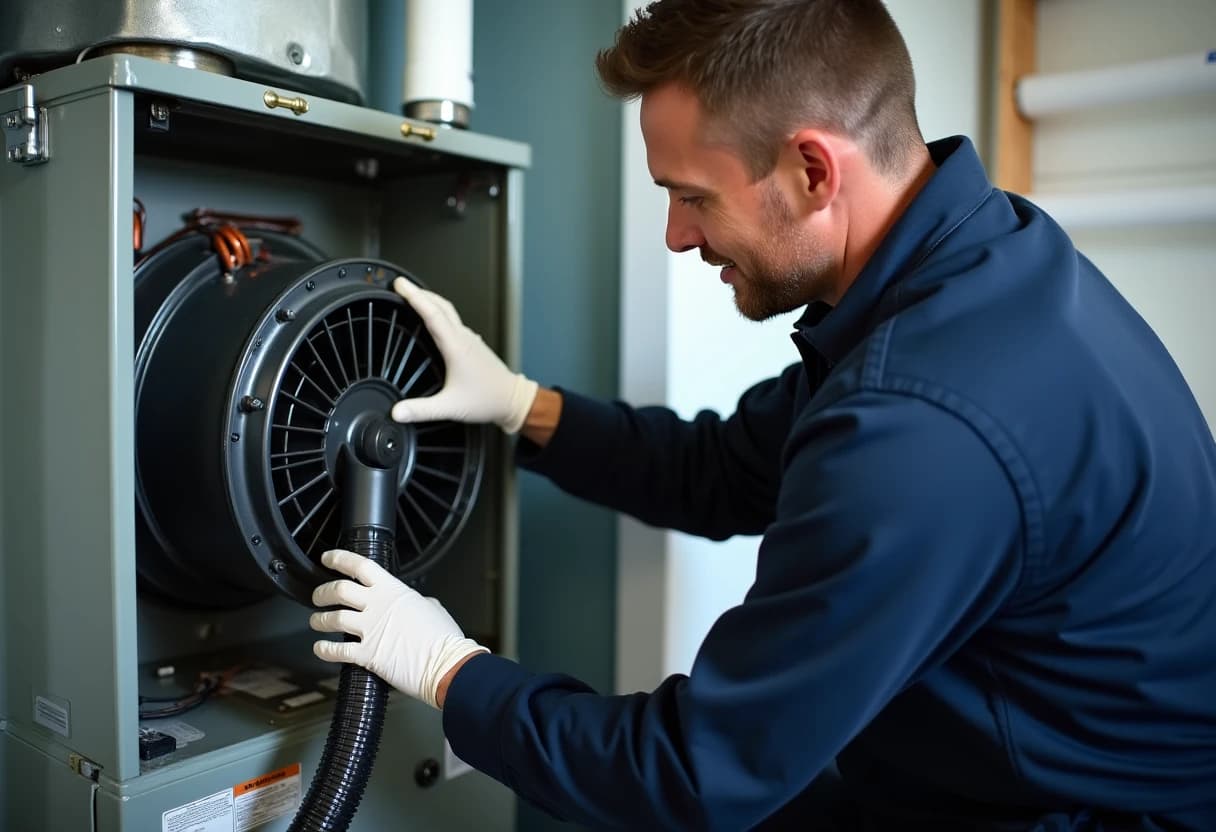
Dust is the quiet tax on every HVAC system in Seaport District. It collects on the blower blades and unbalances the fan; it blankets the coil and insulates it against the heat exchange it exists to perform; it lines the ducts and raises the static pressure the motor must fight every minute it runs. The system compensates the only way it can — longer cycles, higher bills, hotter-running components, earlier failures. HVAC system cleaning removes the tax. We clean ducts, plenums, blower, coil and cabinet as one job, using truck-grade negative pressure and NADCA-standard methods, and we document the transformation with photos. Customers most often report three changes within the week: stronger register airflow, faster temperature recovery, and a system suddenly quiet enough to forget.
Why HVAC System Cleaning Matters for Seaport District Homes
Filters cannot do this job, and understanding why explains the service. A furnace filter sits at one point in the circuit, typically protecting only the equipment downstream of the return drop — everything upstream of it, meaning the entire return duct network, runs unfiltered by design, inhaling whatever the rooms produce. Standard filters also pass a large share of fine particulate even where they do sit, and every gap, bypass and late filter change compounds the leakage. The result is universal: open any air handler that has run a decade on filter changes alone and the blower wheel carries a felt of compacted dust, the coil face is gray, and the cabinet floor holds drifts. None of that is a filter failure exactly — it is the filter doing a limited job in a system that needs more. Periodic whole-system cleaning is the more: it removes the accumulation the filter was never positioned to prevent, resets the equipment to clean baseline, and — paired with a quality filter afterward — dramatically slows the rebuild.
Seaport District homeowners usually find us through a symptom: the upstairs that will not cool, the bills that climb every winter, the AC that runs all afternoon during a Suffolk County heat wave without catching up. The Seaport is Boston's newest neighborhood, dominated by glass luxury high-rises built almost entirely since 2010, with the Fort Point fringe adding century-old brick-and-beam warehouse lofts converted to condos. The towers run sophisticated central systems - vertical risers, unit-level fan coils and heat pumps, and shared corridor ventilation - where individual condo ductwork is compact but works hard year-round. Fort Point lofts feature long exposed spiral duct runs strung across timber ceilings. New construction is no guarantee of clean ducts: Seaport units routinely carry construction debris from their own build-out, and the towers' sealed windows mean residents breathe only what the mechanical systems deliver. Harbor humidity and salt air are hard on rooftop equipment and vent terminations, and in-unit washer-dryer setups with long concealed vent runs to the building exterior are a lint problem we service throughout the district. Those symptoms almost always trace to the air side — fouled blower, blanketed coil, restricted ducts — and a whole-system cleaning resolves them together. We bring truck-grade negative pressure and NADCA-standard methods to every Seaport District job, and we leave photo proof of the recovery.
Our HVAC System Cleaning Process in Seaport District
1Full System Inspection & Airflow Baseline
We begin where the problems live: the air handler comes open first, because blower and coil condition determine half the scope. The technician documents the equipment, cameras representative duct runs, checks the condensate path, and walks you through findings with photos. The quote you approve reflects exactly what the inspection found — no mid-job discoveries priced from a flashlight.
2Protection, Sealing & Negative Pressure
Floor protection goes down along every work path, registers come off, and all supply and return openings are sealed. A HEPA-filtered negative-air machine connects to the main trunks, placing the full duct network under continuous vacuum — the containment that lets us clean aggressively while your living spaces stay dust-free throughout the visit.
3Complete Duct Network Cleaning
Returns get equal billing with supplies in our sequence, because they are the dirtier side — unfiltered by design, inhaling everything the rooms produce. We clean the full return network including the drop into the air handler, which is the last unfiltered stretch before your blower and the reason freshly serviced equipment refouls when duct-only cleanings skip it.
4Blower Wheel & Motor Compartment Detailing
While the compartment is open we clean everything air touches: wheel, housing scroll, motor exterior, mounting hardware, compartment floor and walls. We also note conditions worth your HVAC tech's attention — bearing noise, capacitor age, belt wear on older units — in your report. We clean equipment; we flag, rather than sell, mechanical repairs.
5Evaporator Coil Cleaning
Coil cleaning is precision work: fin surfaces are delicate, and the right approach depends on fouling depth — from HEPA vacuuming and soft brushing for surface dust to application of appropriate coil cleaners for bonded buildup. We work carefully, protect the surrounding cabinet and drain path, and photograph the coil face before and after so the recovery is visible fin by fin.
6Cabinet, Plenums & Condensate Service
This stage finishes the wet section: pan cleaned of the biofilm and sludge that clog drains and breed odor, trap flushed, line verified flowing, float switch checked where fitted. Cooling-season backups — water around the air handler, tripped switches, ceiling stains under attic units — trace here, and ten minutes of prevention now beats an August service call later.
7Fresh Filter, Reassembly & Verified Results
Reassembly is checklist-driven: panels sealed properly so the blower compartment holds no bypass leaks, filter seated with no gaps, registers remounted, thermostat restored, work areas HEPA-vacuumed. Then verification — strong, clean-smelling airflow at every register, quieter operation, and photo documentation matched shot-for-shot to the pre-cleaning set.
Benefits of Professional HVAC System Cleaning in Seaport District
Lower Energy Bills, Month After Month
Six-plus months of heating and an increasingly serious cooling season give Massachusetts systems some of the longest annual runtimes in the country — so every point of recovered efficiency is multiplied across more operating hours than almost anywhere else. The same cleaning that is a modest comfort upgrade in a mild climate is a measurable utility-budget event here.
Years Added to Equipment Life
The failure modes that kill furnaces and condensers early — overheated blower motors, stress-cycled heat exchangers, iced coils, overworked compressors — all begin with restricted, dirty airflow. Whole-system cleaning removes the root cause, letting every component run at the temperatures and loads it was engineered for. Against five-figure Massachusetts replacement costs, it is the cheapest longevity insurance available.
Cooling That Keeps Up in July
A blanketed evaporator coil cannot shed heat, so the AC runs longer, delivers less, and loses exactly when you need it most — the humid Massachusetts afternoons that now define our summers. Coil cleaning restores rated cooling capacity and, just as important here, dehumidification, so the house gets cool and dry instead of cool-ish and clammy.
Cleaner Air From a Cleaner Machine
For allergy and asthma households, the whole-system approach closes the loop that duct-only cleaning leaves open. Every allergen reservoir in the air path — duct film, blower mat, coil face, cabinet drifts — is removed in one visit, and a quality filter installed at the end protects the result. It is the configuration allergists' environmental-control advice is actually pointing at.
Airflow Restored to Design Capacity
Cleaning the full circuit — ducts, blower, coil, plenums — removes every restriction at once, and the recovery is felt at the registers the same day: stronger flow, faster temperature response, and conditioned air finally reaching the rooms at the end of the line. Weak-airflow complaints that survived a duct-only cleaning almost always resolve here, because the blower and coil were the missing half.
One Visit, Complete Documentation
You receive the complete photo record — every duct run, the blower before and after, the coil face, the plenums — plus written notes on system condition. That file has compounding value: it informs your HVAC tech's next tune-up, supports home-sale disclosures with evidence instead of assertions, and establishes the maintenance baseline future service gets measured against.
Signs Your Seaport District Home Needs HVAC System Cleaning
Weak Airflow at Some or All Registers
Weak flow paired with a system that sounds like it is working hard — motor droning, air whistling at returns — is restriction announcing itself twice. The fan is fighting elevated static pressure and losing. Filters get checked first, and should be; when a fresh filter does not restore the registers, the buildup is deeper in the circuit and needs mechanical removal.
Energy Bills Creeping Up Year Over Year
If usage climbs while rates and habits hold steady, your system is paying an efficiency tax somewhere — and the air side is the usual collector. Fouled blowers and coils force longer runtimes for the same comfort, and the loss compounds annually as buildup grows. A bill trending wrong across two or three seasons is a cleaning inspection's strongest referral.
Uneven Rooms, Noisy Cycles, Dust Everywhere
Fast-returning household dust means the system is redistributing a stored reservoir — and in a fouled system, the ducts, blower and cabinet all contribute. Cleaning only the ducts leaves the equipment share circulating. If a previous duct cleaning disappointed on the dust front, the blower wheel and plenums are usually the reason, and the whole-system version is the fix.
Burnt-Dust Smell at Furnace Startup
Households plan around this smell — open windows for the October first-fire, guests warned, sensitive noses out of the house. That workaround treats a cleanable condition as a fact of life. A system cleaned end to end starts the heating season without announcement, because there is nothing on the exchanger or in the plenums left to burn off.
No Record of the System Ever Being Cleaned
The test costs nothing: open the blower door and look. NADCA guidance suggests inspection every couple of years; systems with no history reliably fail the eyeball test on the first try. In Greater Boston's older housing stock, where systems run long seasons and hard duty, 'never cleaned' and 'needs cleaning' are functionally the same finding.
Visible Buildup on the Blower or Around the Air Handler
Dust drifts inside the furnace cabinet, gray fuzz on the coil face, buildup ringing the filter rack — the equipment shows its condition to anyone who opens a panel. HVAC techs doing tune-ups see it constantly and mention it constantly; if yours suggested the blower and coil need cleaning, that is a professional reading a gauge, not an upsell.
HVAC System Cleaning Cost in Seaport District, MA
Three questions determine your number. First, how many runs and zones? System size is the base driver, same as any duct cleaning. Second, what equipment, and where? A standard basement furnace with an accessible A-coil is the baseline; attic air handlers, closet units in condos, and coils buried behind refrigerant plumbing add access time that honest quotes price in advance. Third, when was anything last cleaned? First-time cleanings of decade-plus systems carry the heaviest buildup and sit higher in the range; maintenance cleanings of previously serviced systems run quicker and cheaper — one reason the three-to-five-year cycle costs less over time than the wait-until-symptoms approach. Across Suffolk County, typical outcomes: $450–$600 for compact systems, $600–$750 for average homes, $750–$900 for large ones. Two honest caveats: coils fouled beyond in-place cleaning methods occasionally need an HVAC tech's pull-and-clean, which we flag rather than fake; and duct repairs are always a separate, approved line — cleaning quotes that quietly absorb repair work are hiding the cost somewhere.
Want the full pricing picture? See our complete Boston-area cost guide or call (617) 390-7145 for an exact flat quote for your Seaport District home.
Local Knowledge: Seaport District, Suffolk County
Every town's ductwork tells the story of its housing. The Seaport is Boston's newest neighborhood, dominated by glass luxury high-rises built almost entirely since 2010, with the Fort Point fringe adding century-old brick-and-beam warehouse lofts converted to condos. The towers run sophisticated central systems - vertical risers, unit-level fan coils and heat pumps, and shared corridor ventilation - where individual condo ductwork is compact but works hard year-round. Fort Point lofts feature long exposed spiral duct runs strung across timber ceilings. New construction is no guarantee of clean ducts: Seaport units routinely carry construction debris from their own build-out, and the towers' sealed windows mean residents breathe only what the mechanical systems deliver. Harbor humidity and salt air are hard on rooftop equipment and vent terminations, and in-unit washer-dryer setups with long concealed vent runs to the building exterior are a lint problem we service throughout the district. We plan Seaport District jobs around those realities, from equipment selection to time on site, and it shows in the results. If you live near Fan Pier or anywhere across Seaport District's 02210 area, we have almost certainly cleaned a system like yours before — and we can tell you exactly what to expect before we arrive.
The Best Time of Year in Seaport District
Summer is when fouled systems get exposed. A coil blanketed in dust cannot shed heat on a 92-degree afternoon, a matted blower cannot feed it enough air, and the compound effect shows up as the classic July complaint: an AC running continuously, a house stuck four degrees above setpoint, and the humidity — the half of cooling Massachusetts actually needs — barely touched. Icing is the acute version, and it clusters in heat waves precisely because that is when starved coils run coldest longest. A late-spring whole-system cleaning is the prevention: full coil capacity, restored airflow, drains cleared before condensate season. The systems we clean in May do not appear on our emergency-symptom calls in July — that is the pattern, year after year.
Why Choose Boston Air Duct Cleaners
We built this company around the jobs other duct cleaners do badly: the 130-year-old Victorian with panned-joist returns, the Seaport District condo with a 60-foot dryer run to the roof, the post-renovation house full of drywall dust. Our crews see Greater Boston's hardest systems every week, and the experience shows in the details — floor protection on the way in, sealed registers during the work, HEPA-vacuumed work areas on the way out, and imagery that proves the ducts are actually clean. Call (617) 390-7145 and judge the difference from the first conversation.
Serving Seaport District and Surrounding Communities
Beyond Seaport District, our crews cover the surrounding communities daily — including South Boston, Boston, Back Bay, South End, East Boston, Dorchester. Because routes cluster geographically, booking alongside a neighboring appointment often unlocks same-day service and combined-visit savings. Wherever you are in Suffolk County, the same flat-rate pricing, insured technicians and photo-documented process applies.