
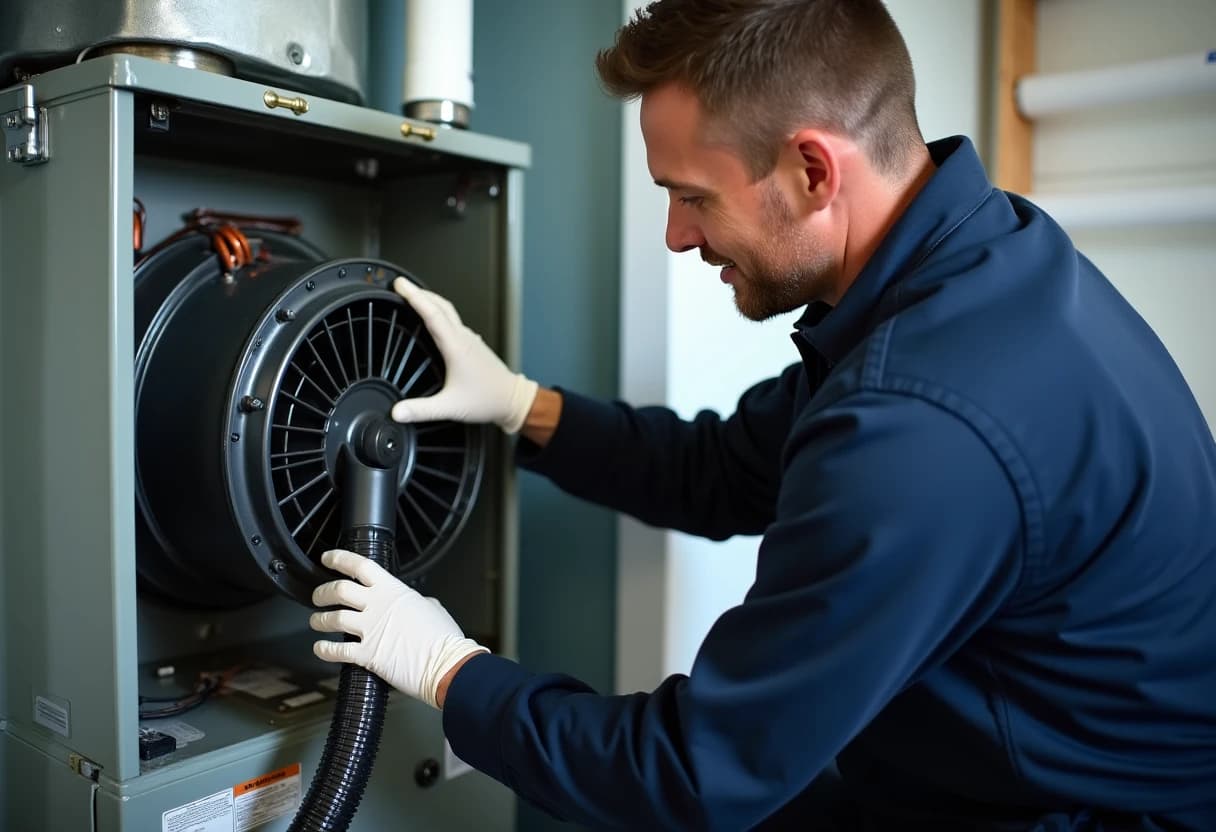
HVAC system cleaning is duct cleaning finished properly: the complete air side of your heating and cooling system — every supply and return run, the main trunks, the supply and return plenums, the blower wheel and housing, the evaporator coil and the air handler cabinet — cleaned in one coordinated visit. The distinction matters because the components work as one circuit: air that passes through a dust-caked blower and a fouled coil recontaminates clean ducts within months, and dirty ducts re-foul a freshly serviced blower just as fast. Our South Boston crews clean the circuit end to end under HEPA-filtered negative pressure, following NADCA source-removal standards, and verify the result with before-and-after imaging. One visit, whole system, and the airflow difference is measurable at every register.
Why HVAC System Cleaning Matters for South Boston Homes
The Greater Boston housing and equipment stock makes the whole-system case stronger than the national average. Local systems run brutal duty cycles — heating from October into April, cooling through increasingly hot humid summers — so accumulation rates are high and the efficiency stakes higher. Much of the equipment sits in basements that contribute their own load: fieldstone-foundation dust, humidity that makes buildup sticky and biologically active, and mechanical rooms that double as storage. The ductwork above it is frequently a palimpsest of decades — original trunks from a gravity-furnace conversion, extensions from two renovations, flexible runs from a condo conversion — with correspondingly generous interior surface area and leak points. And a striking share of local systems have simply never had the equipment side opened for cleaning at all: filters changed, burners tuned, blower and coil untouched since installation. For systems like these, the first whole-system cleaning is transformative — the photos look like restoration work — and the airflow recovery is the kind owners describe to their neighbors, which is how most of our Suffolk County routes filled in the first place.
From the homes around M Street Beach to the streets near Carson Beach, South Boston heating systems share a biography: long duty cycles, aging ductwork, and equipment maintained by filter changes alone for a decade or more. South Boston's grid is filled with 19th-century brick rowhouses and wood-frame triple-deckers, a huge share of which have been gut-renovated into upscale condos over the past two decades, with new mid-rise buildings rising along West Broadway and the Dorchester Avenue corridor. Those gut rehabs almost always added central air and new ductwork, but tight rowhouse footprints force ducts through soffits and party-wall chases with plenty of bends. Roof decks and penthouse additions frequently put condensers and air handlers in salt-exposed locations. When we open these air handlers, the buildup tells the story. Being based in West Newton, about 12 miles out, our crews serve South Boston weekly — full system cleanings, ducts through coil, quoted flat and documented with before-and-after photos your HVAC tech will appreciate at the next tune-up.
Our HVAC System Cleaning Process in South Boston
1Full System Inspection & Airflow Baseline
Every job opens with a complete assessment: ductwork mapped and inspected by camera, filter and filter rack checked, blower compartment and coil examined, and register airflow noted room by room as a baseline. You see the pre-cleaning photos — matted blower, grayed coil face, duct interiors — and approve a confirmed flat price before any equipment starts.
2Protection, Sealing & Negative Pressure
The system becomes a closed circuit before anything gets agitated: sealed openings, depressurized trunks, HEPA-filtered collection. This setup is what separates source removal from dust redistribution, and it protects the equipment work too — debris loosened in the ducts flows to the vacuum rather than settling into the freshly opened blower compartment downstream.
3Complete Duct Network Cleaning
Under negative pressure, every run gets individually agitated: rotary brushes sized to each duct scrub the walls while compressed-air whips chase debris from the register end back toward the vacuum. Supplies, returns, vertical risers and both main trunks are cleaned in sequence — no run skipped, with repeat passes wherever camera checks show buildup remaining.
4Blower Wheel & Motor Compartment Detailing
Dust mats on blower blades change their aerodynamic profile, and the loss compounds every year — wheels a decade in can be down a startling share of rated capacity. We strip the buildup mechanically, degrease where residue demands it, and leave the assembly balanced and bare. The before-and-after photos of this step sell the service better than we ever could.
5Evaporator Coil Cleaning
The coil is the system's radiator and its biggest hidden airflow chokepoint — fins spaced tighter than a millimeter apart trap fine dust that filters miss, and the wet cooling-season surface glues it in place. We clean the coil face and fins with methods matched to buildup severity, restoring the heat transfer and airflow the Department of Energy identifies as central to system efficiency.
6Cabinet, Plenums & Condensate Service
This stage finishes the wet section: pan cleaned of the biofilm and sludge that clog drains and breed odor, trap flushed, line verified flowing, float switch checked where fitted. Cooling-season backups — water around the air handler, tripped switches, ceiling stains under attic units — trace here, and ten minutes of prevention now beats an August service call later.
7Fresh Filter, Reassembly & Verified Results
Reassembly is checklist-driven: panels sealed properly so the blower compartment holds no bypass leaks, filter seated with no gaps, registers remounted, thermostat restored, work areas HEPA-vacuumed. Then verification — strong, clean-smelling airflow at every register, quieter operation, and photo documentation matched shot-for-shot to the pre-cleaning set.
Benefits of Professional HVAC System Cleaning in South Boston
Airflow Restored to Design Capacity
Airflow is the product your HVAC system exists to deliver, and dust taxes it at every stage — matted blower blades, blanketed coil fins, narrowed duct runs. Whole-system cleaning refunds the tax in full. The most common customer report after our visits: rooms that had not heated or cooled properly in years suddenly behave, with no equipment replaced and nothing adjusted but cleanliness.
Lower Energy Bills, Month After Month
Six-plus months of heating and an increasingly serious cooling season give Massachusetts systems some of the longest annual runtimes in the country — so every point of recovered efficiency is multiplied across more operating hours than almost anywhere else. The same cleaning that is a modest comfort upgrade in a mild climate is a measurable utility-budget event here.
Years Added to Equipment Life
HVAC technicians will tell you which systems reach old age: the ones with clean airflow. Limit-switch trips, cracked exchangers and burned motors cluster in fouled systems because restriction stresses everything upstream and downstream of it. Periodic whole-system cleaning is how a homeowner buys into the long-lived cohort — and why tune-up techs are among our steadiest referral sources.
One Visit, Complete Documentation
Bundling ducts and equipment into one appointment beats the piecemeal alternative on every axis: one mobilization cost instead of two, one afternoon of access instead of several, and no gap period where the uncleaned half recontaminates the cleaned one. The flat system price runs well below the summed cost of duct cleaning, coil service and blower work booked separately.
Cooling That Keeps Up in July
Icing is the dramatic version: a starved coil runs too cold, condensation freezes, airflow collapses entirely and the system shuts down mid-heat-wave. The root cause is almost always airflow restriction — dirty coil, matted blower, choked returns. Cleaning the circuit end to end is both the cure and the prevention, and July is when the prevention proves its price.
Quieter Operation, Fewer Odors
The burnt-dust smell of October's first furnace cycle is the equipment announcing its buildup — accumulation on the exchanger and in the plenums cooking off at first heat. A system cleaned before the season starts silent and neutral instead. Likewise the musty cooling-season note from a biofilmed coil and pan: cleaned and treated, the wet section stops perfuming the house.
Signs Your South Boston Home Needs HVAC System Cleaning
Burnt-Dust Smell at Furnace Startup
The acrid smell when the heat first fires each fall is accumulation cooking off the heat exchanger, plenums and duct surfaces — a direct sensory report of what the system carries. A faint note that clears in an hour is common; a strong smell recurring for days, or returning at every cold-snap restart, indicates a load worth removing before the season.
Weak Airflow at Some or All Registers
Weak flow paired with a system that sounds like it is working hard — motor droning, air whistling at returns — is restriction announcing itself twice. The fan is fighting elevated static pressure and losing. Filters get checked first, and should be; when a fresh filter does not restore the registers, the buildup is deeper in the circuit and needs mechanical removal.
Visible Buildup on the Blower or Around the Air Handler
Dust drifts inside the furnace cabinet, gray fuzz on the coil face, buildup ringing the filter rack — the equipment shows its condition to anyone who opens a panel. HVAC techs doing tune-ups see it constantly and mention it constantly; if yours suggested the blower and coil need cleaning, that is a professional reading a gauge, not an upsell.
Energy Bills Creeping Up Year Over Year
If usage climbs while rates and habits hold steady, your system is paying an efficiency tax somewhere — and the air side is the usual collector. Fouled blowers and coils force longer runtimes for the same comfort, and the loss compounds annually as buildup grows. A bill trending wrong across two or three seasons is a cleaning inspection's strongest referral.
AC Struggling, Icing, or Running Nonstop
An air conditioner that runs all afternoon without reaching setpoint on hot days is usually starved, not undersized: a fouled coil cannot shed heat and a matted blower cannot feed it enough air. If your AC 'got old' over a few seasons rather than gradually across decades, buildup is the likelier culprit — and cleaning is the cheaper test than replacement.
No Record of the System Ever Being Cleaned
New homeowners inherit the air side as-is, with no line item on any disclosure covering blower mats and coil blankets. If your purchase included a system of unknown cleaning history — which is to say, almost any purchase — a baseline whole-system cleaning tells you what you own, documents it, and starts the maintenance clock from a known-clean state.
HVAC System Cleaning Cost in South Boston, MA
Budget by scenario. A compact single-zone system — a Cape or condo with one furnace, ten to twelve runs, accessible equipment — lands near $450 to $550. The Greater Boston median — a colonial with one or two zones, fifteen to twenty runs, a basement furnace with A-coil — runs $550 to $750. Large or complex systems — three zones, twenty-five-plus runs, attic air handlers, hydro-air setups — reach $750 to $900, occasionally beyond for multi-equipment homes quoted per system. What moves a quote within these bands is mostly labor time: coil access that requires cutting in a service panel, blower wheels that must come out for proper cleaning, and heavy fouling needing repeat agitation all add hours. What never moves a quote: things 'discovered' after work begins. Our inspection sets the scope, the scope sets the flat price, and surprises we find mid-job — a failed damper, a disconnected run — get documented and quoted separately for your decision, never folded silently into the bill.
Want the full pricing picture? See our complete Boston-area cost guide or call (617) 390-7145 for an exact flat quote for your South Boston home.
Local Knowledge: South Boston, Suffolk County
Serving South Boston means knowing South Boston. South Boston's grid is filled with 19th-century brick rowhouses and wood-frame triple-deckers, a huge share of which have been gut-renovated into upscale condos over the past two decades, with new mid-rise buildings rising along West Broadway and the Dorchester Avenue corridor. Those gut rehabs almost always added central air and new ductwork, but tight rowhouse footprints force ducts through soffits and party-wall chases with plenty of bends. Roof decks and penthouse additions frequently put condensers and air handlers in salt-exposed locations. Southie juts into Boston Harbor, and homes near Castle Island and the beaches live with genuine coastal conditions - salt air that corrodes vent hoods and dampness that finds any duct run passing through an unconditioned space. The neighborhood's condo conversion boom also left a generation of systems installed fast during renovations, and we regularly pull construction debris from ducts in units sold as brand new. Those conditions shape how we work here: which brush heads come off the truck, how we protect finishes in older interiors, and what we expect to find when the camera goes into a 02127 duct system. Our crews are in and around South Boston nearly every week — often for neighbors of past customers — so scheduling is fast and our arrival windows hold.
The Best Time of Year in South Boston
Winter raises the stakes on airflow more than any other season. Restricted systems run their heat exchangers hot, and hot exchangers trip limit switches — the no-heat service call that fills HVAC dispatch boards every January cold snap, frequently traced to nothing more mechanical than a fouled blower and choked returns. Winter is also when the household lives sealed inside the system's output: windows shut November through March, the blower running hours daily, the home's air recirculated through whatever the ducts, wheel and coil carry. A system cleaned before the closed-window months delivers both reliability — components running at design temperatures through their hardest season — and air quality, with five months of recirculation drawing from a clean circuit instead of a loaded one.
Why Choose Boston Air Duct Cleaners
As a West Newton-based company, we treat South Boston like the neighborhood it is — because for us, it is. Our reputation lives or dies on local referrals, so every job gets the full process: complete system cleaning under negative pressure, mechanical agitation of every run, blower compartment service, and a documented walkthrough before we leave. We are licensed and insured, our estimates are free and flat, and our schedule holds same-day slots for urgent calls. One visit and you will understand why neighbors keep our magnet on the fridge.
Serving South Boston and Surrounding Communities
South Boston sits in the heart of our service area, and neighboring Seaport District, Dorchester, South End, Boston, Back Bay, Quincy appointments share the same routes. That density is why our response times in this part of Suffolk County are among our fastest — and why you will see our trucks in the area week after week.