
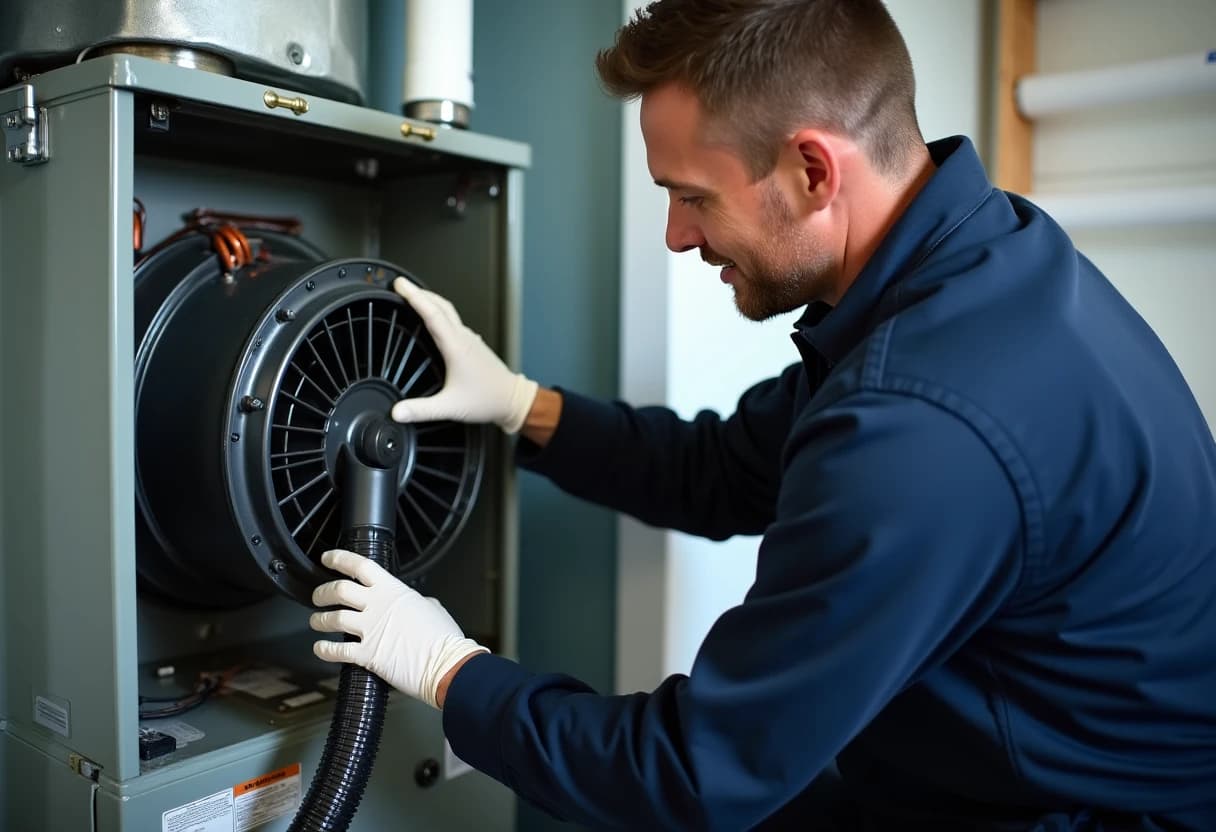
Your furnace and air conditioner were engineered around one assumption: clean airflow. Every gram of dust the system accumulates violates it — matting the blower wheel until it moves a fraction of its rated air, blanketing the evaporator coil until heat transfer chokes, and narrowing duct runs until rooms at the end of the line barely feel the system running. HVAC system cleaning reverses all of it at once. Our Boston technicians place the ductwork under commercial negative pressure, mechanically agitate every run, then open the equipment itself: blower assembly degreased and detailed, coil cleaned fin by fin, cabinet and plenums HEPA-vacuumed and wiped. The result is the closest thing to factory airflow your system has seen since installation day.
Why HVAC System Cleaning Matters for Boston Homes
Filters cannot do this job, and understanding why explains the service. A furnace filter sits at one point in the circuit, typically protecting only the equipment downstream of the return drop — everything upstream of it, meaning the entire return duct network, runs unfiltered by design, inhaling whatever the rooms produce. Standard filters also pass a large share of fine particulate even where they do sit, and every gap, bypass and late filter change compounds the leakage. The result is universal: open any air handler that has run a decade on filter changes alone and the blower wheel carries a felt of compacted dust, the coil face is gray, and the cabinet floor holds drifts. None of that is a filter failure exactly — it is the filter doing a limited job in a system that needs more. Periodic whole-system cleaning is the more: it removes the accumulation the filter was never positioned to prevent, resets the equipment to clean baseline, and — paired with a quality filter afterward — dramatically slows the rebuild.
HVAC systems in Boston work harder than their owners realize. Boston's housing runs the full spectrum of American urban building: 1800s brownstones and brick rowhouses in Back Bay, Beacon Hill and the South End, wood-frame triple-deckers across Dorchester and the streetcar neighborhoods, mid-rise brick apartment blocks near the universities, and glass condo towers downtown and along the harbor. Countless older buildings have been carved into condos with each unit given its own furnace or heat pump, so ductwork is often squeezed through 19th-century joist bays, chases and dropped ceilings never designed for it. The result is a city full of long, tight, hard-to-reach duct runs that trap decades of dust. Equipment serving these homes typically sits in basement mechanical spaces, breathing fieldstone dust and summer humidity, pushing air through duct runs extended and patched across generations of renovations. We work in Boston every week, from rowhouse condos on gas-fired forced air to triple-decker units with attic air handlers. City-specific issues come up constantly: shared-wall dust migration in rowhouse blocks, renovation debris left in ducts after condo conversions, and dryer vent runs that snake thirty-plus feet to reach an outside wall - a genuine fire risk we flag on nearly every Boston visit. Our whole-system cleanings in Boston routinely find blower wheels matted to half their capacity and coils that have never been opened — and the airflow recovery afterward is exactly as dramatic as that suggests.
Our HVAC System Cleaning Process in Boston
1Full System Inspection & Airflow Baseline
The baseline matters because this service promises measurable results. We record starting conditions — equipment buildup, duct interiors, airflow strength at the weakest registers — so the after-photos and the final walkthrough demonstrate recovery rather than assert it. Systems with issues cleaning cannot fix, like failed dampers or crushed runs, get flagged now, in writing, before work begins.
2Protection, Sealing & Negative Pressure
Floor protection goes down along every work path, registers come off, and all supply and return openings are sealed. A HEPA-filtered negative-air machine connects to the main trunks, placing the full duct network under continuous vacuum — the containment that lets us clean aggressively while your living spaces stay dust-free throughout the visit.
3Complete Duct Network Cleaning
The duct phase follows NADCA source-removal method end to end: mechanical agitation of every supply and return, trunk lines cleaned last so debris always moves toward the collection point, and appropriate tooling per duct type — aggressive brushes on rigid metal, gentler whips on flex runs and older panned returns common in Massachusetts homes.
4Blower Wheel & Motor Compartment Detailing
The blower assembly gets restoration-grade attention: wheel removed where design allows or detailed in place, blades cleared of the compacted felt that steals airflow, motor housing vacuumed and wiped, and the compartment HEPA-cleaned to bare metal. A clean wheel moves dramatically more air — this single component is where most of the felt recovery lives.
5Evaporator Coil Cleaning
A blanketed coil hurts twice: cooling capacity drops because heat exchange chokes, and dehumidification drops with it — a real cost in Massachusetts summers, when moisture removal is half of what air conditioning is for. Cleaning restores both. Where we find fouling too deep for in-place methods or damage needing an HVAC tech, we document it honestly and quote nothing we cannot deliver.
6Cabinet, Plenums & Condensate Service
The air handler cabinet and both plenums — the supply box distributing to the trunks and the return box feeding the blower — are HEPA-vacuumed and wiped to clean surfaces. The drain pan under the coil is scrubbed and the condensate line flushed clear, closing off the standing-water conditions behind musty odors and cooling-season microbial growth.
7Fresh Filter, Reassembly & Verified Results
The job ends with your system running and your questions answered. We review maintenance guidance — filter change intervals for your specific system, the case for pairing future cleanings with tune-ups, any conditions we flagged for your HVAC tech — and log your service date. Whole-system cleanings hold three to five years in typical homes; we will remind you when an inspection is actually due, not before.
Benefits of Professional HVAC System Cleaning in Boston
Quieter Operation, Fewer Odors
An unbalanced, matted blower wheel hums, drones and vibrates its way through every cycle — noise most owners attribute to age. Cleaning rebalances the assembly and clears the restrictions that make air whistle through starved returns, and the system drops to the background again. Many customers say the new quiet is the benefit they notice most.
Lower Energy Bills, Month After Month
A clean air side moves more air per watt and exchanges more heat per cycle — the Department of Energy points to dirty coils and blowers as core efficiency drains, and Massachusetts energy prices make the recovery unusually valuable here. Customers with visibly fouled systems routinely see the difference in the next bill, and the savings recur every month the system runs.
Airflow Restored to Design Capacity
Cleaning the full circuit — ducts, blower, coil, plenums — removes every restriction at once, and the recovery is felt at the registers the same day: stronger flow, faster temperature response, and conditioned air finally reaching the rooms at the end of the line. Weak-airflow complaints that survived a duct-only cleaning almost always resolve here, because the blower and coil were the missing half.
One Visit, Complete Documentation
Bundling ducts and equipment into one appointment beats the piecemeal alternative on every axis: one mobilization cost instead of two, one afternoon of access instead of several, and no gap period where the uncleaned half recontaminates the cleaned one. The flat system price runs well below the summed cost of duct cleaning, coil service and blower work booked separately.
Years Added to Equipment Life
Heat is the enemy of mechanical equipment, and dirt manufactures heat: insulated coils, blanketed motors, restricted exchangers all run hotter than design. Every degree accelerates wear on windings, bearings, igniters and boards. A clean air side is thermal relief for the whole machine — the difference, over a decade, between a system that retires on schedule and one that fails in a January cold snap.
Cleaner Air From a Cleaner Machine
For allergy and asthma households, the whole-system approach closes the loop that duct-only cleaning leaves open. Every allergen reservoir in the air path — duct film, blower mat, coil face, cabinet drifts — is removed in one visit, and a quality filter installed at the end protects the result. It is the configuration allergists' environmental-control advice is actually pointing at.
Signs Your Boston Home Needs HVAC System Cleaning
Visible Buildup on the Blower or Around the Air Handler
Dust drifts inside the furnace cabinet, gray fuzz on the coil face, buildup ringing the filter rack — the equipment shows its condition to anyone who opens a panel. HVAC techs doing tune-ups see it constantly and mention it constantly; if yours suggested the blower and coil need cleaning, that is a professional reading a gauge, not an upsell.
Weak Airflow at Some or All Registers
Hold a hand to the registers: airflow you can barely feel — especially in far rooms and upper floors — means the system is losing delivered air to restriction somewhere between blower and grille. Matted wheels, blanketed coils and dust-narrowed runs are the usual suspects, and whole-system cleaning addresses all three in one pass.
No Record of the System Ever Being Cleaned
The test costs nothing: open the blower door and look. NADCA guidance suggests inspection every couple of years; systems with no history reliably fail the eyeball test on the first try. In Greater Boston's older housing stock, where systems run long seasons and hard duty, 'never cleaned' and 'needs cleaning' are functionally the same finding.
AC Struggling, Icing, or Running Nonstop
Watch for the humidity tell: a struggling AC that leaves the house cool but clammy is failing at dehumidification, which a blanketed coil surrenders first. In a Massachusetts July, moisture removal is half the job. If the air feels damp at setpoint, the coil face deserves a look before the thermostat takes any more blame.
Energy Bills Creeping Up Year Over Year
If usage climbs while rates and habits hold steady, your system is paying an efficiency tax somewhere — and the air side is the usual collector. Fouled blowers and coils force longer runtimes for the same comfort, and the loss compounds annually as buildup grows. A bill trending wrong across two or three seasons is a cleaning inspection's strongest referral.
Uneven Rooms, Noisy Cycles, Dust Everywhere
The classic trio of a fouled air side: rooms that heat and cool unevenly, a system that has grown audibly louder over the years, and dust that returns to surfaces within days of cleaning. Each has other possible causes; together they point one direction. A single whole-system cleaning typically improves all three at once, which is itself diagnostic.
HVAC System Cleaning Cost in Boston, MA
Whole-system HVAC cleaning in Greater Boston typically runs $450 to $900 — the ductwork cleaning plus blower detailing, evaporator coil cleaning, plenum and cabinet work, and condensate service in one visit. The comparison worth making: booked piecemeal, duct cleaning ($350–$700), coil cleaning ($150–$350) and blower service ($100–$250) sum well past the bundled price, because mobilization, system sealing and negative-pressure setup — the expensive parts of any visit — get paid once instead of three times. Within our range, price tracks system size (vent and return count, zone count), equipment configuration (coil accessibility varies enormously between furnace-with-A-coil setups and air handlers; some coils require panel work to reach), buildup severity (heavily fouled blowers and bonded coil blankets take repeat passes), and access (finished basements, attic air handlers, rooftop condos). Multi-system homes are quoted per system with multi-system discounts. Every quote is flat, confirmed after inspection, and inclusive — no per-main surcharges, no fuel fees, no on-site renegotiation.
Want the full pricing picture? See our complete Boston-area cost guide or call (617) 390-7145 for an exact flat quote for your Boston home.
Local Knowledge: Boston, Suffolk County
Every town's ductwork tells the story of its housing. Boston's housing runs the full spectrum of American urban building: 1800s brownstones and brick rowhouses in Back Bay, Beacon Hill and the South End, wood-frame triple-deckers across Dorchester and the streetcar neighborhoods, mid-rise brick apartment blocks near the universities, and glass condo towers downtown and along the harbor. Countless older buildings have been carved into condos with each unit given its own furnace or heat pump, so ductwork is often squeezed through 19th-century joist bays, chases and dropped ceilings never designed for it. The result is a city full of long, tight, hard-to-reach duct runs that trap decades of dust. We work in Boston every week, from rowhouse condos on gas-fired forced air to triple-decker units with attic air handlers. City-specific issues come up constantly: shared-wall dust migration in rowhouse blocks, renovation debris left in ducts after condo conversions, and dryer vent runs that snake thirty-plus feet to reach an outside wall - a genuine fire risk we flag on nearly every Boston visit. We plan Boston jobs around those realities, from equipment selection to time on site, and it shows in the results. If you live near TD Garden or anywhere across Boston's 02108 area, we have almost certainly cleaned a system like yours before — and we can tell you exactly what to expect before we arrive.
The Best Time of Year in Boston
New England's equipment stock adds a seasonal wrinkle worth naming: an enormous share of local systems are conversions and hybrids — forced-air retrofitted into homes built for radiators, hydro-air systems marrying boilers to air handlers, condo conversions threading flex duct through triple-decker framing. These systems run higher static pressure than clean-sheet designs, which means less margin for fouling: buildup that a generously ducted suburban system tolerates will noticeably choke a retrofit. The seasonal moisture cycle compounds it — humid summers make basement equipment buildup damp and sticky, long winters bake it hard — so accumulation here bonds faster and restricts sooner than national rules of thumb suggest. For conversion-era systems, we recommend the inspection interval owners of old houses already apply to everything else: regularly, and before the hard season rather than after it.
Why Choose Boston Air Duct Cleaners
Choosing a duct cleaner is really a trust decision — you are letting a crew work inside the system that feeds air to your family. We make that decision easy: a local West Newton company with insured, uniformed technicians, transparent flat-rate quotes, NADCA-standard equipment and methods, and photographic proof of the finished work. No door-to-door sales, no bait-and-switch coupons, no invented 'mold emergencies.' Just honest mechanical cleaning done properly the first time, backed by a written guarantee.
Serving Boston and Surrounding Communities
Boston sits in the heart of our service area, and neighboring Back Bay, South End, Cambridge, Brookline, Somerville, Dorchester appointments share the same routes. That density is why our response times in this part of Suffolk County are among our fastest — and why you will see our trucks in the area week after week.