
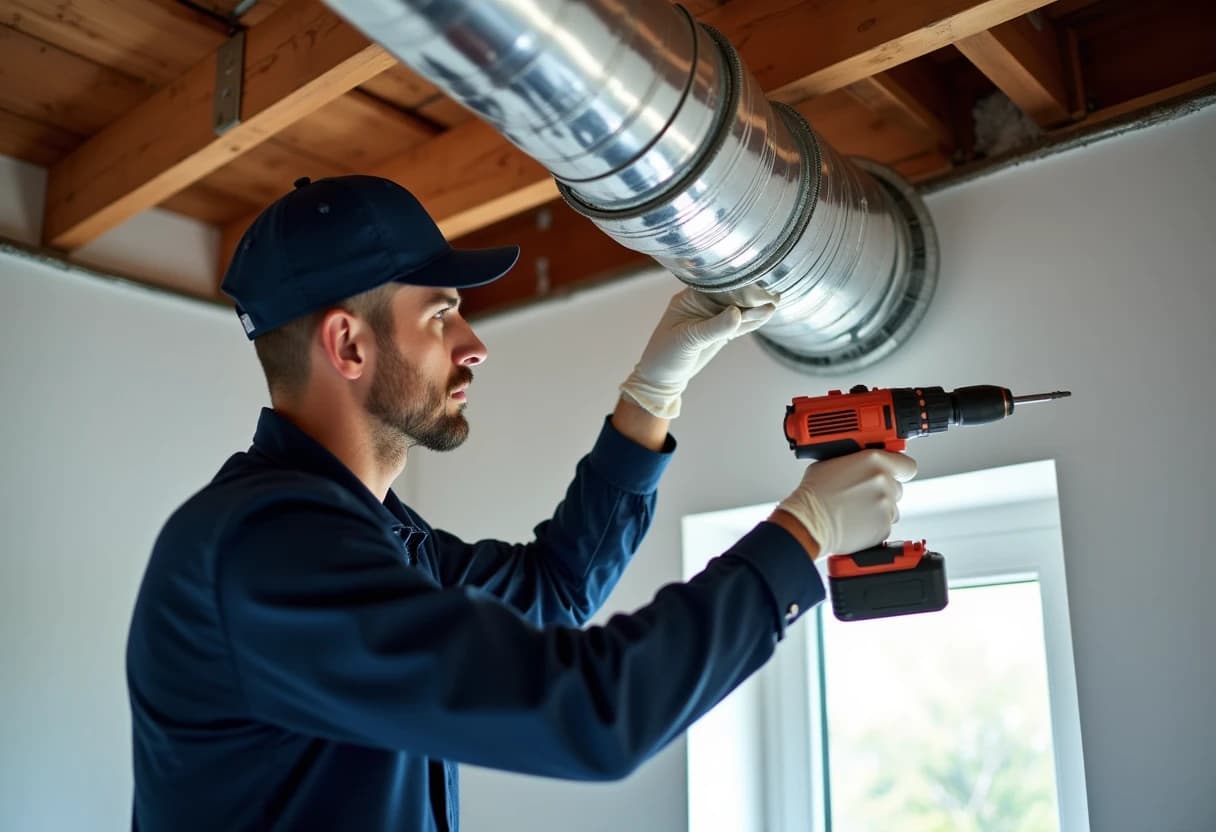
If your dryer's exhaust path includes plastic flex hose, a window insert, a bucket of water, or a mysterious duct that ends somewhere inside the house, you need an installation — and you are not alone: we find improvised venting in Randolph homes every month. Indoor termination is the worst offender, pumping a gallon of moisture and a load of lint into living space or structure per cycle; long flex runs are a close second. We replace all of it with an engineered system: rigid metal duct on the shortest workable route, sealed and supported, terminating outdoors through a proper hood. The work typically takes half a day to a day, and we verify the result with the dryer running before we leave.
Why Dryer Vent Installation & Rerouting Matters for Randolph Homes
New England's housing stock makes professional installation more consequential here than almost anywhere. Triple-deckers and brownstone conversions put laundry deep in floor plans, far from legal termination points, demanding careful route planning against the length budget. Balloon-framed Victorians hide cavities that swallow flex duct into inaccessible, uncleanable runs. Stone and brick foundations require masonry penetrations done with the right tools and flashing. Retrofitted basement laundries sit below grade, where the only paths out are up through the rim joist or across to a window bay — and where cold foundation walls make uninsulated duct a condensation machine. Condo associations layer approval processes and insurance requirements on top. We work these constraints every week: our installers carry the drills, core bits, flashing and fittings the old construction demands, we insulate runs crossing unheated space as a standard practice, and we provide the certificates and documentation associations require. The result is a vent that fits the building it serves — not a catalog diagram forced into a house that predates the catalog by a century.
A large share of our Randolph installation work is corrective: replacing what a previous decade improvised. Randolph built out fast in the 1950s and 60s, so the dominant stock is modest capes, ranches and split-levels on tidy lots, with older Victorians clustered near Crawford Square and Stetson Hall. Most of these post-war homes came with forced-air furnaces from day one, which means original sheet-metal ductwork that is now sixty-plus years old and often has never been professionally cleaned. Behind those walls we find vinyl hose stapled to joists, flex duct wandering forty feet to a screened hood, vents dumping into crawlspaces — installations that fail the IRC's dryer exhaust rules on every line. Because so much of Randolph's housing shares the same 1950s-60s construction vintage, we routinely find duct systems that have accumulated a half-century of dust, pet dander and renovation debris. Homes backing up to the Blue Hills Reservation side of town also pull in heavy seasonal pollen that settles deep in supply runs. We tear out the improvisation and build the system the code describes: 4-inch rigid metal on the shortest workable route, clamped and taped joints, a damper-equipped termination sealed to the envelope. Documented with photos, verified with the dryer running.
Our Dryer Vent Installation & Rerouting Process in Randolph
1Site Assessment & Route Planning
The technician maps what exists and what is possible: where the dryer sits (or will sit), which walls are exterior, what the framing and foundation allow, and where obstacles — plumbing, wiring, ductwork, finished ceilings — constrain the path. Shortest is best: fewer feet and fewer elbows mean faster drying and slower lint accumulation for the life of the system.
2Demolition of Non-Compliant Venting
Replacement jobs start with removing what failed: vinyl and foil flex pulled from cavities and joist bays, abandoned duct capped or extracted, screened hoods and window inserts taken out, and improvised terminations into attics or crawlspaces closed off. We vacuum the lint these systems have shed along their routes — hidden accumulation that should not stay in the structure.
3Cut & Flash the Exterior Penetration
Roof terminations get roofing-grade treatment: shingles lifted and re-laid over proper flashing, a cap rated for dryer exhaust with a working damper, and sealant appropriate to the roofing material. We schedule roof penetrations for dry weather and verify water-tightness before leaving — a roof leak is not an acceptable side effect of a laundry upgrade.
4Install Rigid Metal Duct on the Planned Route
Where the route crosses unheated space — a cold basement, garage bay, attic run — we insulate the duct so exhaust stays above its dew point until it exits, which is the difference between a dry duct and a condensation problem in a Massachusetts winter. Concealed sections are completed and verified before any finishes close them in.
5Mount the Termination Hood & Damper
Where pests are a known pressure — and in Greater Boston they are — we fit guard designs engineered for dryer exhaust: excluding birds and rodents without restricting airflow or trapping lint. We also note the hood in your service record so future cleanings include damper checks, keeping the one wear-prone component watched for the system's life.
6Connect the Appliance & Seal the System
At the dryer, we install a short UL-listed semi-rigid aluminum transition duct — the only place flexible material belongs — clamped at both ends and routed so it keeps full diameter when the machine is pushed to its working position. We mark the safe setback so the connector is never crushed by a future shove against the wall.
7Test, Verify & Document the Installation
You receive complete documentation: photos of the route (including concealed sections before they closed), the materials used, the equivalent-length math, and the finished termination. For permitted work, condo approvals or home sales, this record answers every question an inspector, board or buyer will ask about what is behind the walls.
Benefits of Professional Dryer Vent Installation & Rerouting in Randolph
A Laundry Located Where You Actually Want It
For renovations, early vent planning is leverage: consulted while walls are open, we can route a short, straight, fully concealed run that would be expensive or impossible after drywall. A ten-minute conversation at framing stage regularly saves homeowners hundreds of dollars and a compromised route.
Code Compliance That Closes Every Question
Insurers and condo associations increasingly ask about dryer venting after regional fire losses, and 'professionally installed to code, with photos' is the answer that ends the conversation. We provide certificates of insurance for association work and per-unit records for multi-family buildings as standard practice.
Fire-Safe by Design, Not by Vigilance
Roughly 2,900 US home dryer fires a year trace overwhelmingly to lint, and lint traces to the installation faults a proper build eliminates: flex corrugations, overlong runs, obstructed airstreams. Replacing an improvised vent with an engineered one is the single largest permanent reduction in dryer fire risk available to a homeowner.
Decades of Service From a One-Day Job
Rigid metal duct, properly supported and sealed, is lifetime infrastructure: it does not kink, sag, melt or degrade, and it routinely outlasts several dryers. After installation day, the system's entire maintenance schedule is an annual cleaning and an occasional glance at the damper. Most homeowners never think about it again — which is the point.
Moisture Managed, Structure Protected
Every load pushes about a gallon of water vapor through the vent, and an engineered system delivers all of it outdoors: continuous slope drains any condensate to the termination, insulation keeps exhaust above its dew point across cold spaces, and sealed joints leave nothing to drip. Your framing, insulation and finishes stay dry, load after load, year after year.
Dramatically Faster Drying
Shortening a wandering 40-foot run to a direct 12-foot route transforms drying performance: full airflow means each cycle actually exhausts the gallon of moisture a load releases, so sensor dryers stop running overtime and heavy loads finish in one pass. Customers routinely describe post-installation performance as having bought a new machine.
Signs Your Randolph Home Needs Dryer Vent Installation & Rerouting
Blockages and Repairs Keep Recurring
If your vent needs cleaning twice a year, blocks anyway, and has accumulated a history of repairs, the route itself is the problem — too long, too bent, wrong materials, or condensation-prone by design. At some point serial maintenance costs more than the reroute that ends it. We will do that math with you honestly; often the crossover is closer than expected.
Inspection, Insurance or Association Requirements
Appliance warranties add quiet pressure: manufacturers condition coverage on adequate exhaust, and a warranty claim on a dryer connected to a non-compliant vent can be denied on that basis. If you are buying a premium machine, the few hundred dollars of proper venting is also warranty insurance.
The Run Is Overlong or Elbow-Heavy
Basement laundries venting to a far wall are the classic offenders — installed where the first hole was easiest, not where the route was shortest. Our assessment often finds a rim-joist or near-wall exit that cuts the run by half or more. Ask for the measurement; the equivalent-length math takes ten minutes and settles the question.
Your Vent Is Flexible Plastic or Foil Duct
Flex duct concealed in walls and cavities is the worst case: it cannot be effectively brushed, so no cleaning ever truly clears it, and it accumulates lint until it blocks. If a cleaning service has ever told you your run 'can't really be cleaned,' this is what they meant — and rigid replacement is the answer.
Chronic Condensation the Route Guarantees
Some vents condense because of damage; others condense because of design — long uninsulated passages through cold basements, garages or attics where exhaust cannot stay above its dew point, or bellied routes with no slope to drain. When repair visits keep treating water in the same duct, the route is the diagnosis, and rerouting or rebuilt insulation and slope is the cure.
A New Laundry Location Needs Its First Vent
Moving laundry upstairs, finishing a basement, building an in-law suite or converting a condo all create the same requirement: a new exhaust route, designed before the walls close if at all possible. Vent routing decided at the framing stage is shorter, cheaper and cleaner than the same route retrofitted through finished surfaces months later.
Dryer Vent Installation & Rerouting Cost in Randolph, MA
Dryer vent installation in Greater Boston typically runs $300 to $900, and the price is mostly the route. At the low end, $300 to $450: a straightforward side-wall or rim-joist installation with a short run — dryer near an exterior wall, one clean penetration, minimal duct. Mid-range, $450 to $650: longer routes with several elbows, full flex-to-rigid replacement along an existing path, insulation over unheated space, or masonry penetrations through brick or block foundation. The top of the range, $650 to $900: reroutes through finished space with access openings, roof terminations with proper flashing, relocations that move the laundry's exhaust across the floor plan, and multi-story routes in triple-deckers and condos. Every quote is flat and follows a site assessment — we measure the route, do the equivalent-length math, and price the specific design you approve. Materials are included: rigid metal duct, listed transition connector, clamps and foil tape, insulation where needed, and a quality damper-equipped termination hood.
Want the full pricing picture? See our complete Boston-area cost guide or call (617) 390-7145 for an exact flat quote for your Randolph home.
Local Knowledge: Randolph, Norfolk County
Serving Randolph means knowing Randolph. Randolph built out fast in the 1950s and 60s, so the dominant stock is modest capes, ranches and split-levels on tidy lots, with older Victorians clustered near Crawford Square and Stetson Hall. Most of these post-war homes came with forced-air furnaces from day one, which means original sheet-metal ductwork that is now sixty-plus years old and often has never been professionally cleaned. Because so much of Randolph's housing shares the same 1950s-60s construction vintage, we routinely find duct systems that have accumulated a half-century of dust, pet dander and renovation debris. Homes backing up to the Blue Hills Reservation side of town also pull in heavy seasonal pollen that settles deep in supply runs. Those conditions shape how we work here: which brush heads come off the truck, how we protect finishes in older interiors, and what we expect to find when the camera goes into a 02368 duct system. Our crews are in and around Randolph nearly every week — often for neighbors of past customers — so scheduling is fast and our arrival windows hold.
The Best Time of Year in Randolph
Humid summers argue for good vent design from the opposite direction. When dew points sit in the seventies, dryer exhaust barely cools before reaching saturation, and any route flaw — a belly, a leak, an oversized dead-air section — collects water through the muggy months while basement laundries add ambient humidity of their own. Summer is also when improvised indoor venting does its worst damage, loading attics and crawlspaces with moisture exactly when the structure cannot dry. And at the termination, summer is nesting season: hoods without proper dampers and guards acquire tenants between March and June. A properly designed system shrugs all of it off — sealed, sloped, insulated, guarded — which is why summer's symptoms are so often what finally send homeowners to the phone.
Why Choose Boston Air Duct Cleaners
As a West Newton-based company, we treat Randolph like the neighborhood it is — because for us, it is. Our reputation lives or dies on local referrals, so every job gets the full process: complete system cleaning under negative pressure, mechanical agitation of every run, blower compartment service, and a documented walkthrough before we leave. We are licensed and insured, our estimates are free and flat, and our schedule holds same-day slots for urgent calls. One visit and you will understand why neighbors keep our magnet on the fridge.
Serving Randolph and Surrounding Communities
Beyond Randolph, our crews cover the surrounding communities daily — including Quincy, Braintree, Holbrook, Avon, Canton, Stoughton. Because routes cluster geographically, booking alongside a neighboring appointment often unlocks same-day service and combined-visit savings. Wherever you are in Norfolk County, the same flat-rate pricing, insured technicians and photo-documented process applies.