
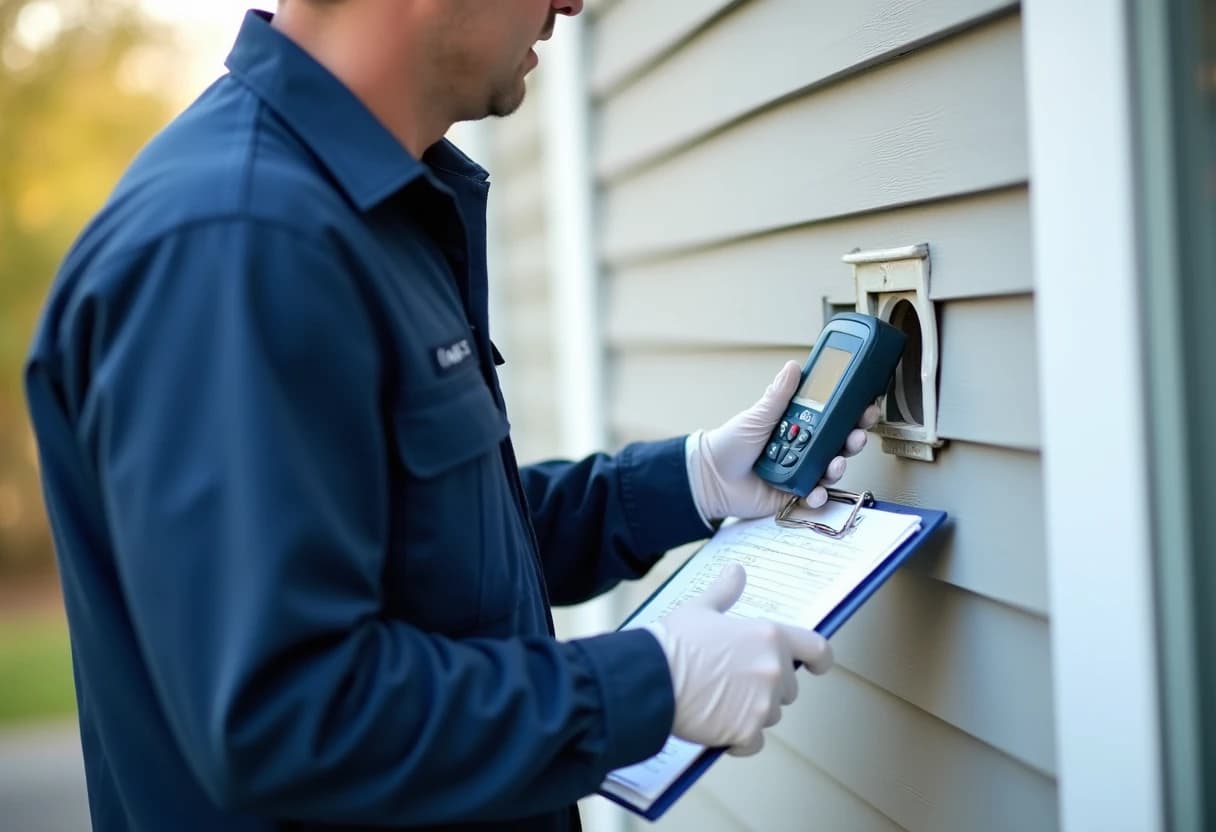
FEMA estimates around 2,900 home clothes dryer fires occur in the United States every year, and failure to clean the vent is the leading contributing factor. The trouble is that the danger is invisible: the lint that matters is not in the trap you clear after each load, it is packed inside the wall, ceiling or crawlspace duct you never see. Our Woburn dryer vent inspection makes the invisible visible. A camera travels the entire exhaust run from the dryer connection to the outdoor termination, airflow is measured and compared against healthy benchmarks, and every finding is documented in a written report you can act on, file with your insurer, or hand to a home buyer.
Why Dryer Vent Inspection & Safety Check Matters for Woburn Homes
Dryer fires are among the most preventable house fires in America, and the statistics are stubbornly consistent: FEMA and NFPA data attribute roughly 2,900 residential clothes dryer fires per year to U.S. homes, causing deaths, injuries and tens of millions of dollars in property loss — with lint the leading ignition source and failure to clean the leading contributing factor. What makes these fires preventable is that the hazard builds slowly and measurably. Lint accumulates in the duct, airflow drops, drying times stretch, the dryer cabinet runs hotter, and eventually a heating element or a spark meets a fuel supply that has been growing for years. An annual inspection interrupts that chain at the first link. Airflow measurement detects restriction long before it becomes dangerous; camera imaging shows exactly where lint is packing and whether the duct itself — crushed sections, separated joints, an accordion foil transition — is contributing. For less than the cost of a dinner out, you convert an invisible risk into a documented, managed one.
Condo and multi-family living shapes dryer safety in Woburn more than most owners realize. Woburn's tannery-era core near the Common holds 19th-century colonials and two-families, surrounded by broad postwar neighborhoods of capes, ranches and splits, with newer townhouses and apartments rising near Anderson station and the office parks along I-93 and Route 128. Duct systems here span more than a century of installs, from converted gravity furnaces downtown to modern multi-zone equipment in the new construction. In triple-deckers and converted buildings, dryer ducts often run long distances through shared walls and ceilings to reach an outside face, and the termination may be three stories up where nobody has looked at it in years. Woburn's history as a leather and industrial city means many older homes have seen repeated mechanical overhauls, and we routinely open trunk lines containing debris from three different renovation eras. The commercial corridors along 128 and 93 also make Woburn one of our busiest commercial duct and dryer vent markets, from offices to fitness clubs to restaurants. Association boards across Middlesex County increasingly require documented dryer vent verification for exactly this reason — one unit's neglected duct is every unit's fire risk. Our inspection reports are formatted for board and property-manager submission: photos, airflow numbers, code notes and a dated finding for each unit, delivered after a single visit.
Our Dryer Vent Inspection & Safety Check Process in Woburn
1Interview & Visual Assessment
Every inspection opens with a short conversation and a visual survey. Drying times, error codes, humidity in the laundry room and the age of the installation all steer the inspection. The technician checks the transition duct behind the dryer first — foil accordion duct and plastic flex are immediate findings, since both are recognized fire hazards.
2Airflow Measurement at the Termination
We quantify before we diagnose. An anemometer reading at the outside hood, taken while the dryer runs, measures delivered airflow against the benchmark a dryer needs to operate safely. Strong flow with a clean camera pass means a pass; weak flow tells us restriction exists and the camera's job is to find it.
3Full-Length Camera Inspection
An inspection camera travels the entire duct run from the dryer connection to the termination, recording as it goes. We are looking for lint accumulation and where it concentrates, separated or leaking joints, crushed or kinked sections, screws protruding into the airstream, moisture staining, and any nesting material — the full biography of a duct you cannot otherwise see.
4Termination Hood & Damper Check
The exterior hood gets a hands-on inspection — flap movement, spring tension, seal condition, evidence of pest entry, and clearance from grade and snow lines. New England weather is hard on terminations; corroded hinges and stuck dampers are among our most common findings, and both restrict airflow as effectively as a clogged duct.
5Lint-Load Assessment & Fire-Risk Scoring
We translate the inspection into a plain-English risk score. You will know approximately what percentage of the duct's cross-section remains open, where the worst accumulation sits, and how urgent intervention is. FEMA attributes roughly 2,900 dryer fires a year primarily to lint — the score tells you honestly where your vent stands relative to that risk.
6Code-Compliance Review
Many Massachusetts dryer runs predate modern code or were improvised during renovations, so this review frequently finds the root cause behind chronic lint problems: an over-length run, an accordion foil transition, a screened termination collecting lint like a filter. Identifying the violation matters because cleaning a non-compliant duct treats the symptom on a schedule; correcting it treats the cause once.
7Written Safety Report & Recommendations
Everything we measured and saw goes into a written safety report delivered the same day. Pass or fail, you have proof of the vent's condition — the document buyers ask for, insurers accept and associations require. If work is warranted, the report doubles as a precise scope, so any quote you gather is comparing the same job.
Benefits of Professional Dryer Vent Inspection & Safety Check in Woburn
Protection From Moisture & Carbon Monoxide
A leaking or restricted dryer duct pushes warm, saturated air into wall cavities and framing — a slow moisture problem that shows up later as mold, peeling paint or rot. For gas dryers, exhaust integrity also governs the removal of combustion byproducts, including carbon monoxide. Inspection verifies both.
No Unnecessary Cleanings
The $79 inspection frequently saves the $200 cleaning. When airflow measures strong and the camera shows light accumulation, we say so in writing and leave. Customers who used to buy blind annual cleanings routinely discover their actual interval is longer — and their total maintenance spend drops accordingly.
A Written Report You Can Actually Use
The report is the product: dated, photographed, measured. Homeowners file it with insurance records, sellers attach it to disclosures, landlords and condo boards accept it as compliance documentation, and buyers use it to negotiate or verify. A verbal 'looks fine' from a handyman does none of those jobs.
Lower Drying Costs & Longer Appliance Life
A restricted vent makes every load take longer, and longer cycles cost real money in electricity or gas — often hundreds of dollars a year in heavy-laundry households. Inspection catches restriction at the stage where a single cleaning restores one-cycle drying and normal operating costs.
Real-Estate & Insurance Documentation
Condo associations and landlords in Massachusetts are steadily adding dryer vent verification to their maintenance requirements after well-publicized multi-family lint fires. Our per-unit reports satisfy property managers and boards in one visit, with scheduling built for buildings — multiple units, one appointment block, individual documentation.
Hidden Code Violations Exposed
Code review matters most at transactions. A non-compliant vent discovered by a buyer's inspector becomes a negotiation weapon; the same finding surfaced by your own inspection becomes a controlled, competitively priced repair. Knowing first is worth far more than the inspection fee.
Signs Your Woburn Home Needs Dryer Vent Inspection & Safety Check
Recent Renovation, New Dryer or New Home
Just bought the house? Your home inspector almost certainly did not camera the dryer duct or measure its airflow — general inspections do not include it. Given that lint fires are among the most common preventable house fires, a dedicated vent inspection belongs on every new-owner checklist.
The Dryer or Laundry Room Feels Hot
Modern dryers protect themselves from restricted vents by cycling their high-limit switch — you experience this as a hot machine, lukewarm loads and mysteriously long cycles. The safety is working, but it was not designed for daily duty. An inspection identifies the restriction before the safety component fails.
Burning or Musty Smells During Operation
Musty smells on 'clean' laundry point to moisture lingering in the duct — often a low spot where condensation pools and lint mats into a damp plug. Beyond the odor, wet lint accumulations restrict flow badly and hide mold. The camera finds the low spot; the fix follows from there.
Insurance, Condo or Sale Requirements
Listing your home this season? Handle the vent before the buyer's inspector does. A pre-listing inspection either produces a clean report for your disclosure package or surfaces a modest repair you control the pricing of — versus a finding that becomes a closing-table concession.
Clothes Take More Than One Cycle
Drying time is the vent's report card. Loads that once took 45 minutes now taking 80 means delivered airflow has fallen substantially — and every extra minute is money and heat stress. If your laundry routine has quietly stretched over the past year, the duct is asking for an inspection.
You Cannot Remember the Last Service
Dryer vents fail on a schedule set by laundry volume, duct length and installation quality — variables you cannot assess from the laundry room. Annual inspection is the standing recommendation of fire-safety agencies precisely because no visible cue reliably announces when a vent crosses from fine to dangerous.
Dryer Vent Inspection & Safety Check Cost in Woburn, MA
Budget-wise, the inspection is designed to be an easy annual yes: $79 to $149 depending on home layout, versus roughly $2,900 dryer fires nationally each year and average fire losses that run into five figures per incident. Price drivers are practical, not mysterious. Ranch homes and first-floor laundries with side-wall terminations book at $79–$99. Colonials and multi-story homes where the duct rises through the structure to a high or roof termination run $99–$129, reflecting ladder work and longer camera runs. Complicated situations — inaccessible dryers, runs exceeding 25 feet, multiple elbows requiring segment-by-segment documentation — reach $149. There are no add-on fees for the report, the photos or the code review; they are the service. Compare that with an appliance repair visit ($150+ before parts) that a simple airflow measurement might have prevented, and the inspection typically pays for itself the first time it changes a decision.
Want the full pricing picture? See our complete Boston-area cost guide or call (617) 390-7145 for an exact flat quote for your Woburn home.
Local Knowledge: Woburn, Middlesex County
Serving Woburn means knowing Woburn. Woburn's tannery-era core near the Common holds 19th-century colonials and two-families, surrounded by broad postwar neighborhoods of capes, ranches and splits, with newer townhouses and apartments rising near Anderson station and the office parks along I-93 and Route 128. Duct systems here span more than a century of installs, from converted gravity furnaces downtown to modern multi-zone equipment in the new construction. Woburn's history as a leather and industrial city means many older homes have seen repeated mechanical overhauls, and we routinely open trunk lines containing debris from three different renovation eras. The commercial corridors along 128 and 93 also make Woburn one of our busiest commercial duct and dryer vent markets, from offices to fitness clubs to restaurants. Those conditions shape how we work here: which brush heads come off the truck, how we protect finishes in older interiors, and what we expect to find when the camera goes into a 01801 duct system. Our crews are in and around Woburn nearly every week — often for neighbors of past customers — so scheduling is fast and our arrival windows hold.
The Best Time of Year in Woburn
Fall is dryer vent inspection season in New England for good reason: laundry loads get heavier as the weather cools — jeans, flannels, bedding, towels — exactly when a marginal vent is least able to keep up. NFPA data also shows home dryer fires peak in the colder months, when the appliance works hardest and lint accumulates fastest. An October inspection catches summer's accumulation, verifies the termination damper before snow and ice test it, and sets the system up for the six heaviest laundry months of the year. Book it alongside the furnace tune-up; the two together cover the season's biggest hidden-heat risks in one week.
Why Choose Boston Air Duct Cleaners
Choosing a duct cleaner is really a trust decision — you are letting a crew work inside the system that feeds air to your family. We make that decision easy: a local West Newton company with insured, uniformed technicians, transparent flat-rate quotes, NADCA-standard equipment and methods, and photographic proof of the finished work. No door-to-door sales, no bait-and-switch coupons, no invented 'mold emergencies.' Just honest mechanical cleaning done properly the first time, backed by a written guarantee.
Serving Woburn and Surrounding Communities
We serve every community around Woburn as well: Burlington, Winchester, Stoneham, Reading, Wilmington, Lexington all fall inside our regular service routes. If you have a second property, a rental, or family nearby, ask about multi-home scheduling — grouped appointments on the same route are our most requested discount.