
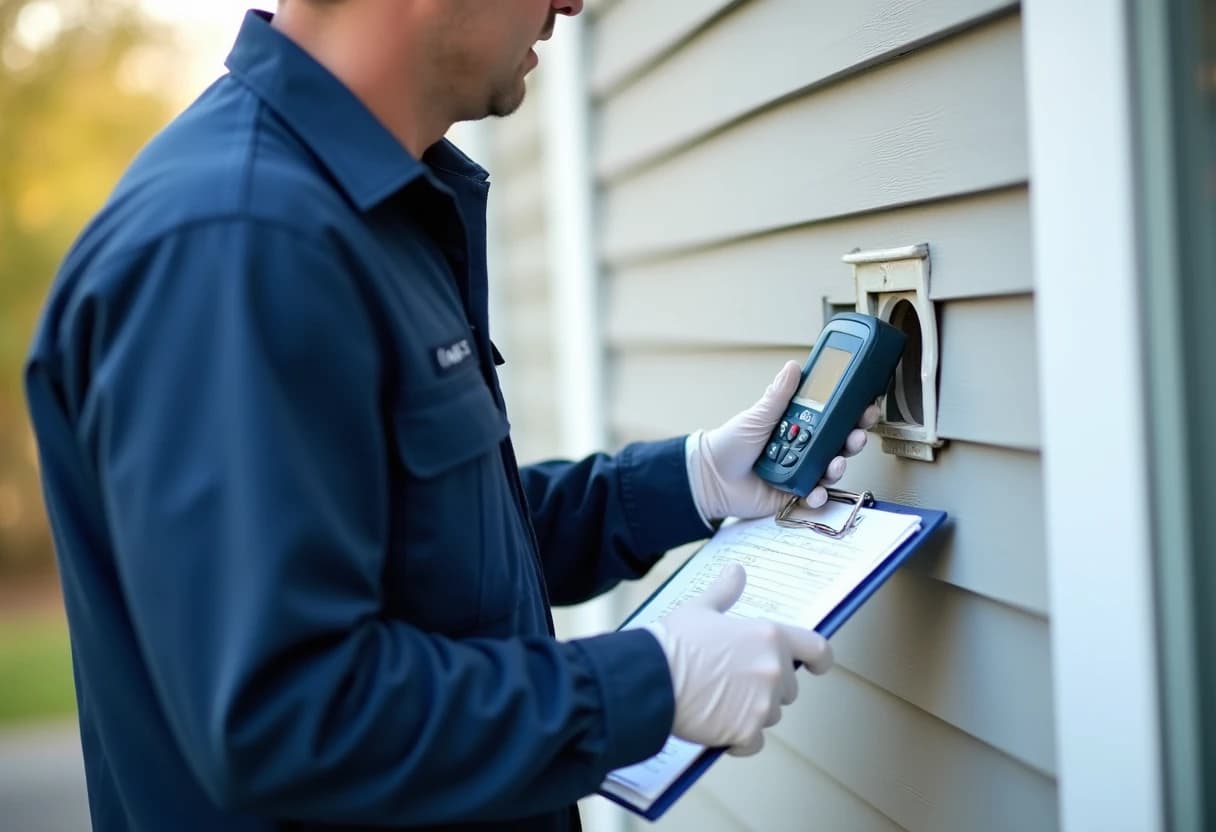
A dryer vent inspection is the fastest, cheapest way to answer a question every homeowner should be able to answer: is my dryer exhaust safe? Our Burlington technicians measure airflow at the termination with a calibrated anemometer, run an inspection camera the full length of the duct, examine the exterior hood and damper, assess the lint load inside the run, and check the installation against the residential code rules that govern dryer ducts. You leave with a written safety report — photos, measurements and a clear verdict — instead of a guess. If the vent is clean and compliant, we tell you so and you are done for the year. If it needs work, you will know exactly what and why before spending a dollar on cleaning or repairs.
Why Dryer Vent Inspection & Safety Check Matters for Burlington Homes
Homeowners reliably maintain what they can see and neglect what they cannot, and the dryer duct is the definition of cannot-see: it disappears behind the dryer into a wall and emerges somewhere outside, sometimes two or three stories up. Between those points, anything may be happening — lint packing at a crushed elbow, a joint pulled apart inside a ceiling and quietly venting moist air into the framing, a bird nest behind the hood, a plastic flex duct a previous owner installed decades before it was understood to be a fire hazard. An inspection replaces assumption with evidence. Our process is instrument-first: an anemometer reading at the termination establishes whether the system moves the volume of air a dryer needs, and the camera pass explains any shortfall. The findings frequently surprise owners — long-time residents discover terminations that have been painted shut, and new buyers discover the sellers' 'recently cleaned' vent was never touched. Either way, you finally know.
Condo and multi-family living shapes dryer safety in Burlington more than most owners realize. Burlington boomed after Route 128 opened, so most of its housing is 1950s-through-1970s capes, ranches and split-levels on quarter-acre lots, with pockets of newer colonials and townhouse developments near the mall corridor. Nearly all of it was built with forced-air heating or has since converted to central air, which means original sheet-metal trunk lines that are now sixty-plus years old in many homes. In triple-deckers and converted buildings, dryer ducts often run long distances through shared walls and ceilings to reach an outside face, and the termination may be three stories up where nobody has looked at it in years. Burlington's aging postwar duct systems have often never been cleaned since installation, and the teardown-and-rebuild wave sweeping its older streets kicks construction dust into whole neighborhoods. We also handle a steady volume of commercial work along the Middlesex Turnpike and District Avenue office corridor. Association boards across Middlesex County increasingly require documented dryer vent verification for exactly this reason — one unit's neglected duct is every unit's fire risk. Our inspection reports are formatted for board and property-manager submission: photos, airflow numbers, code notes and a dated finding for each unit, delivered after a single visit.
Our Dryer Vent Inspection & Safety Check Process in Burlington
1Interview & Visual Assessment
We start by listening: how long do loads take, has anything changed, when was the vent last cleaned, any moisture or odor issues? Then the technician examines the laundry area — dryer position, transition duct type and condition, visible connections — because the interview and the first look often predict exactly what the instruments will find.
2Airflow Measurement at the Termination
The single most telling test takes two minutes: dryer on, anemometer at the hood. Exhaust volume tells us how much of the dryer's rated airflow actually survives the trip through the duct. We record the reading in your report so future inspections can track the trend — a slow year-over-year decline is the earliest possible warning of developing blockage.
3Full-Length Camera Inspection
The camera answers the question the airflow number raises. We feed it the full length of the duct, documenting interior condition foot by foot: where lint is packing, whether joints have pulled apart inside the wall, whether a previous installer used screws or materials the code prohibits. Nothing in the run stays hidden or hypothetical.
4Termination Hood & Damper Check
We check the exit as carefully as the run. A damper that will not open steals airflow; one that will not close invites cold air, moisture and animals. We also flag code and safety issues here: mesh screens that catch lint, terminations too close to openings or grade, and hoods damaged by weather or renovation work.
5Lint-Load Assessment & Fire-Risk Scoring
Not all lint findings are equal. A light, even film is normal; wet, matted accumulation at a low point signals condensation problems; heavy packing at elbows signals a duct working beyond its geometry. We grade what the camera found against how your household uses the dryer, so the recommendation matches your actual risk.
6Code-Compliance Review
Many Massachusetts dryer runs predate modern code or were improvised during renovations, so this review frequently finds the root cause behind chronic lint problems: an over-length run, an accordion foil transition, a screened termination collecting lint like a filter. Identifying the violation matters because cleaning a non-compliant duct treats the symptom on a schedule; correcting it treats the cause once.
7Written Safety Report & Recommendations
The visit ends with documentation, not a verbal shrug. Your report states plainly whether the vent passed, what was found where, and what — if anything — we recommend, with flat-rate pricing for any corrective work so you can decide on your own schedule. No findings are invented to sell a cleaning; the photos speak for themselves.
Benefits of Professional Dryer Vent Inspection & Safety Check in Burlington
No Unnecessary Cleanings
Inspection-first service means you only pay for cleaning when measurement says the vent needs it. Short, efficient runs in some homes stay healthy for two or three years between cleanings; heavy-laundry households may need annual service. The instruments decide — not a calendar, and not a salesperson.
Real-Estate & Insurance Documentation
Buyers increasingly ask about dryer vents because their inspectors increasingly flag them. A pre-listing inspection removes the issue from the table before it appears; a pre-purchase inspection prices it before you own it. Agents across Greater Boston refer us for exactly this reason.
Lower Drying Costs & Longer Appliance Life
A restricted vent makes every load take longer, and longer cycles cost real money in electricity or gas — often hundreds of dollars a year in heavy-laundry households. Inspection catches restriction at the stage where a single cleaning restores one-cycle drying and normal operating costs.
Protection From Moisture & Carbon Monoxide
A leaking or restricted dryer duct pushes warm, saturated air into wall cavities and framing — a slow moisture problem that shows up later as mold, peeling paint or rot. For gas dryers, exhaust integrity also governs the removal of combustion byproducts, including carbon monoxide. Inspection verifies both.
Hidden Code Violations Exposed
Plastic flex duct in a wall, a 50-foot equivalent run, screws bristling into the airstream, a screened termination — these violations hide inside structures and cause chronic problems until someone cameras the run. Finding them converts a recurring symptom into a one-time fix.
Fire Risk Caught Before It Matters
Lint fires do not announce themselves; they accumulate. An inspection converts that slow, invisible buildup into a number and a photograph you can act on. Homeowners who inspect annually essentially never experience a vent-related fire, because the fuel never gets the chance to reach a dangerous load.
Signs Your Burlington Home Needs Dryer Vent Inspection & Safety Check
You Cannot Remember the Last Service
If the vent has no service history you can name, assume it has never been inspected — most have not. NFPA guidance is simple: dryer exhaust should be checked at least annually. The first inspection establishes your baseline; every year after tracks the trend.
Recent Renovation, New Dryer or New Home
A new dryer on an old duct is a mismatch worth checking: modern high-efficiency machines are sensitive to back pressure, and installers rarely camera the existing run. Manufacturers void heat-related warranty claims on restricted vents, so a post-install inspection protects a four-figure appliance for a two-figure fee.
No Visible Exhaust at the Outside Hood
Step outside while the dryer runs: you should see the damper held open by strong airflow and feel a confident stream of warm air. A flap barely moving — or not moving at all — means severe restriction or a stuck damper, and the system needs professional attention.
The Dryer or Laundry Room Feels Hot
Excess heat and humidity around a running dryer indicate the exhaust system is failing at its one job. Moist air leaking from joints fogs windows and dampens walls; heat backing up trips thermal safeties. Both symptoms show up clearly on an inspection — and both are early warnings worth heeding.
Clothes Take More Than One Cycle
When towels come out damp after a full cycle, most people blame the dryer and call an appliance tech. In our experience the appliance is usually fine — the exhaust path is not. A twenty-minute airflow measurement settles the question before you pay for a repair visit the machine never needed.
Burning or Musty Smells During Operation
Musty smells on 'clean' laundry point to moisture lingering in the duct — often a low spot where condensation pools and lint mats into a damp plug. Beyond the odor, wet lint accumulations restrict flow badly and hide mold. The camera finds the low spot; the fix follows from there.
Dryer Vent Inspection & Safety Check Cost in Burlington, MA
Budget-wise, the inspection is designed to be an easy annual yes: $79 to $149 depending on home layout, versus roughly $2,900 dryer fires nationally each year and average fire losses that run into five figures per incident. Price drivers are practical, not mysterious. Ranch homes and first-floor laundries with side-wall terminations book at $79–$99. Colonials and multi-story homes where the duct rises through the structure to a high or roof termination run $99–$129, reflecting ladder work and longer camera runs. Complicated situations — inaccessible dryers, runs exceeding 25 feet, multiple elbows requiring segment-by-segment documentation — reach $149. There are no add-on fees for the report, the photos or the code review; they are the service. Compare that with an appliance repair visit ($150+ before parts) that a simple airflow measurement might have prevented, and the inspection typically pays for itself the first time it changes a decision.
Want the full pricing picture? See our complete Boston-area cost guide or call (617) 390-7145 for an exact flat quote for your Burlington home.
Local Knowledge: Burlington, Middlesex County
Every town's ductwork tells the story of its housing. Burlington boomed after Route 128 opened, so most of its housing is 1950s-through-1970s capes, ranches and split-levels on quarter-acre lots, with pockets of newer colonials and townhouse developments near the mall corridor. Nearly all of it was built with forced-air heating or has since converted to central air, which means original sheet-metal trunk lines that are now sixty-plus years old in many homes. Burlington's aging postwar duct systems have often never been cleaned since installation, and the teardown-and-rebuild wave sweeping its older streets kicks construction dust into whole neighborhoods. We also handle a steady volume of commercial work along the Middlesex Turnpike and District Avenue office corridor. We plan Burlington jobs around those realities, from equipment selection to time on site, and it shows in the results. If you live near Simonds Park or anywhere across Burlington's 01803 area, we have almost certainly cleaned a system like yours before — and we can tell you exactly what to expect before we arrive.
The Best Time of Year in Burlington
Massachusetts winters stress the exhaust side of a dryer in ways most owners never see. Warm, moist exhaust meeting sub-freezing duct sections condenses, and that condensation turns dry lint into wet mats that cling and clog. Terminations ice up; damper flaps freeze shut overnight and get forced by the morning's first load; snow drifts bury low wall hoods entirely. A mid-winter inspection is often the year's most revealing one — we routinely find seasonal blockages that did not exist in September. If drying times slow every January in your house, that pattern itself is a finding worth investigating.
Why Choose Boston Air Duct Cleaners
Boston Air Duct Cleaners is a local, owner-operated company based at 1121 Washington St in West Newton — not a national franchise dispatching subcontractors. Every crew is our own: background-checked, factory-trained on commercial negative-pressure equipment, and fully insured. We quote flat prices before work begins, document every job with before-and-after photos, and follow NADCA-standard source-removal methods on every system we touch. That is why so much of our work comes from repeat customers, property managers and word-of-mouth referrals across Middlesex County.
Serving Burlington and Surrounding Communities
Beyond Burlington, our crews cover the surrounding communities daily — including Woburn, Billerica, Bedford, Lexington, Wilmington, Winchester. Because routes cluster geographically, booking alongside a neighboring appointment often unlocks same-day service and combined-visit savings. Wherever you are in Middlesex County, the same flat-rate pricing, insured technicians and photo-documented process applies.