
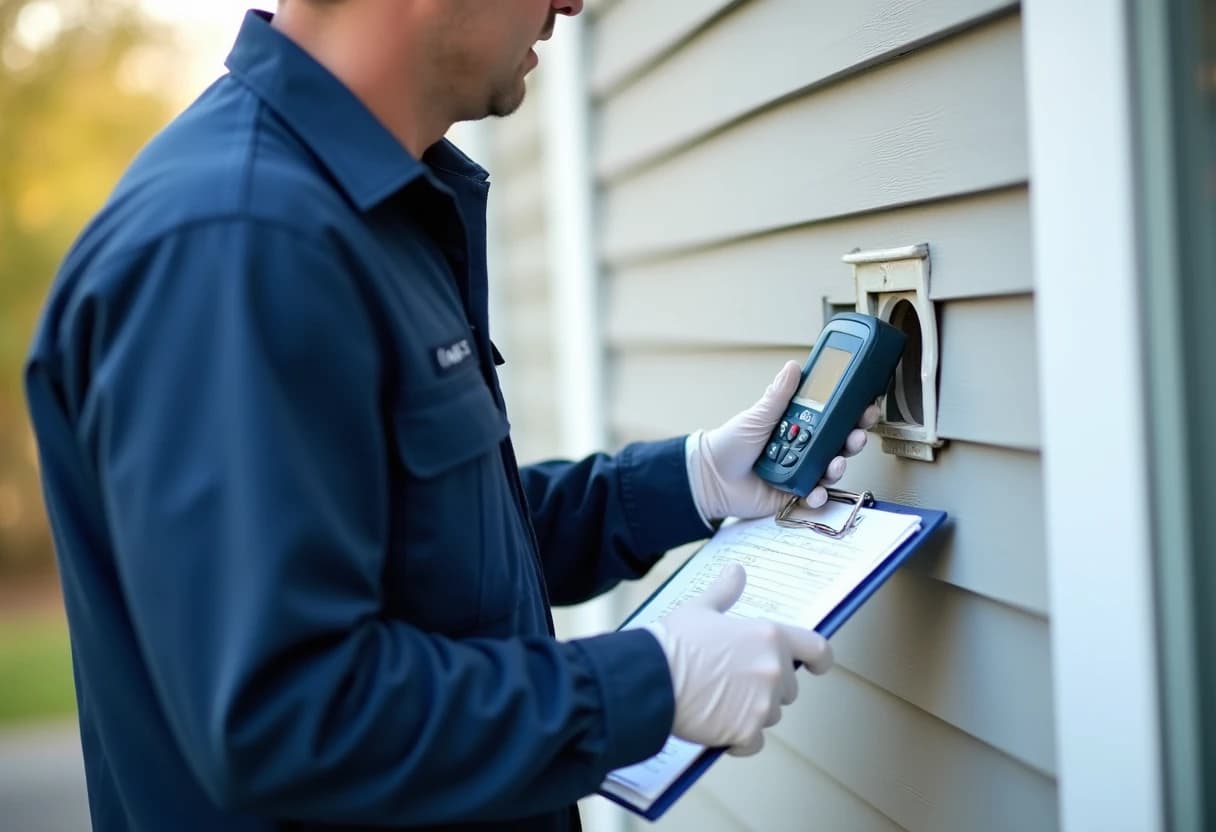
Think of a dryer vent inspection as an annual physical for the hardest-working exhaust duct in your house. In one visit, our Reading technician verifies four things: that air is actually moving at the volume a dryer requires, that the duct interior is not accumulating a dangerous lint load, that the exterior hood and damper open freely and seal properly, and that the installation follows the code rules written to prevent dryer fires — smooth metal duct, legal length, proper joints. Most inspections take under an hour. Many end with good news; the rest catch a developing hazard years before it becomes a house-fire statistic or a dead heating element.
Why Dryer Vent Inspection & Safety Check Matters for Reading Homes
The mechanical case for annual inspection is about heat and moisture, not just fire. A restricted vent forces the dryer to run longer per load, which costs electricity or gas, wears the appliance, and cooks fabrics. It also raises the temperature inside the dryer cabinet, cycling the high-limit thermostat — a safety component designed for occasional intervention, not daily duty — until it fails, which in Massachusetts usually means a repair call in the middle of winter laundry season. Meanwhile, every minute of restricted exhaust pushes warm, moisture-laden air backward through leaks in the duct, and for gas dryers, impedes the removal of combustion byproducts including carbon monoxide. A vent that measures healthy protects the appliance, the utility bill, the indoor air and the house at once. A vent that measures weak announces the problem years before it announces itself — and an annual inspection is the only way anyone ever hears it.
We inspect dryer vents all over Reading — around Parker Tavern, out toward Jordan's Furniture, and everywhere between — and the local pattern is clear: the age of the home predicts the condition of the vent. Reading's streets are lined with center-entrance Colonials, gambrel capes and 1920s-40s craftsman-style homes near the Common and the Depot, ringed by larger post-war and 1980s-2000s colonials farther out toward Route 128. Many of the older homes have been converted from oil boilers to forced-air heat pumps or gas furnaces, leaving retrofit duct runs squeezed through original framing and attic chases. Many of these properties still carry original or improvised exhaust runs: plastic or foil flex duct that predates modern code, terminations without functioning dampers, and lengths that exceed the 35-foot equivalent limit once the elbows are counted. Reading is a classic commuter-rail renovation town - kitchens, additions and finished basements go in constantly, and construction dust ends up circulating through duct systems for years afterward. The heat-pump conversion wave here has also created many attic-run duct systems where summer condensation can feed dust buildup and musty odors. Because our shop is in West Newton, about 18 miles away, a Reading inspection is an easy route stop — most appointments are available within days, and combined inspection-plus-cleaning visits are our most-booked option in the area.
Our Dryer Vent Inspection & Safety Check Process in Reading
1Interview & Visual Assessment
Every inspection opens with a short conversation and a visual survey. Drying times, error codes, humidity in the laundry room and the age of the installation all steer the inspection. The technician checks the transition duct behind the dryer first — foil accordion duct and plastic flex are immediate findings, since both are recognized fire hazards.
2Airflow Measurement at the Termination
We quantify before we diagnose. An anemometer reading at the outside hood, taken while the dryer runs, measures delivered airflow against the benchmark a dryer needs to operate safely. Strong flow with a clean camera pass means a pass; weak flow tells us restriction exists and the camera's job is to find it.
3Full-Length Camera Inspection
An inspection camera travels the entire duct run from the dryer connection to the termination, recording as it goes. We are looking for lint accumulation and where it concentrates, separated or leaking joints, crushed or kinked sections, screws protruding into the airstream, moisture staining, and any nesting material — the full biography of a duct you cannot otherwise see.
4Termination Hood & Damper Check
We check the exit as carefully as the run. A damper that will not open steals airflow; one that will not close invites cold air, moisture and animals. We also flag code and safety issues here: mesh screens that catch lint, terminations too close to openings or grade, and hoods damaged by weather or renovation work.
5Lint-Load Assessment & Fire-Risk Scoring
Not all lint findings are equal. A light, even film is normal; wet, matted accumulation at a low point signals condensation problems; heavy packing at elbows signals a duct working beyond its geometry. We grade what the camera found against how your household uses the dryer, so the recommendation matches your actual risk.
6Code-Compliance Review
We review the installation against the residential mechanical code for dryer exhaust: smooth rigid metal duct (not foil or plastic flex in concealed runs), a maximum of 35 feet equivalent length with deductions for each elbow, no screws penetrating the airstream, proper termination with a backdraft damper and no screen. Violations are photographed and explained.
7Written Safety Report & Recommendations
Everything we measured and saw goes into a written safety report delivered the same day. Pass or fail, you have proof of the vent's condition — the document buyers ask for, insurers accept and associations require. If work is warranted, the report doubles as a precise scope, so any quote you gather is comparing the same job.
Benefits of Professional Dryer Vent Inspection & Safety Check in Reading
Fire Risk Caught Before It Matters
The roughly 2,900 dryer fires U.S. homes suffer each year share a common history: a restriction that built silently for years. Annual inspection breaks that pattern by catching declining airflow and accumulating lint at the measurement stage — years before the ignition stage. It is the cheapest intervention in fire prevention.
No Unnecessary Cleanings
Inspection-first service means you only pay for cleaning when measurement says the vent needs it. Short, efficient runs in some homes stay healthy for two or three years between cleanings; heavy-laundry households may need annual service. The instruments decide — not a calendar, and not a salesperson.
Lower Drying Costs & Longer Appliance Life
The economics are simple: restricted airflow taxes every single load, and the tax grows as the restriction does. Measurement catches the problem when it is small. Customers consistently report faster drying and lower utility bills after acting on inspection findings — savings that repeat weekly, every laundry day.
Protection From Moisture & Carbon Monoxide
A leaking or restricted dryer duct pushes warm, saturated air into wall cavities and framing — a slow moisture problem that shows up later as mold, peeling paint or rot. For gas dryers, exhaust integrity also governs the removal of combustion byproducts, including carbon monoxide. Inspection verifies both.
A Written Report You Can Actually Use
The report is the product: dated, photographed, measured. Homeowners file it with insurance records, sellers attach it to disclosures, landlords and condo boards accept it as compliance documentation, and buyers use it to negotiate or verify. A verbal 'looks fine' from a handyman does none of those jobs.
Hidden Code Violations Exposed
Plastic flex duct in a wall, a 50-foot equivalent run, screws bristling into the airstream, a screened termination — these violations hide inside structures and cause chronic problems until someone cameras the run. Finding them converts a recurring symptom into a one-time fix.
Signs Your Reading Home Needs Dryer Vent Inspection & Safety Check
Clothes Take More Than One Cycle
When towels come out damp after a full cycle, most people blame the dryer and call an appliance tech. In our experience the appliance is usually fine — the exhaust path is not. A twenty-minute airflow measurement settles the question before you pay for a repair visit the machine never needed.
Insurance, Condo or Sale Requirements
Listing your home this season? Handle the vent before the buyer's inspector does. A pre-listing inspection either produces a clean report for your disclosure package or surfaces a modest repair you control the pricing of — versus a finding that becomes a closing-table concession.
The Dryer or Laundry Room Feels Hot
Excess heat and humidity around a running dryer indicate the exhaust system is failing at its one job. Moist air leaking from joints fogs windows and dampens walls; heat backing up trips thermal safeties. Both symptoms show up clearly on an inspection — and both are early warnings worth heeding.
Burning or Musty Smells During Operation
Musty smells on 'clean' laundry point to moisture lingering in the duct — often a low spot where condensation pools and lint mats into a damp plug. Beyond the odor, wet lint accumulations restrict flow badly and hide mold. The camera finds the low spot; the fix follows from there.
You Cannot Remember the Last Service
If the vent has no service history you can name, assume it has never been inspected — most have not. NFPA guidance is simple: dryer exhaust should be checked at least annually. The first inspection establishes your baseline; every year after tracks the trend.
No Visible Exhaust at the Outside Hood
Step outside while the dryer runs: you should see the damper held open by strong airflow and feel a confident stream of warm air. A flap barely moving — or not moving at all — means severe restriction or a stuck damper, and the system needs professional attention.
Dryer Vent Inspection & Safety Check Cost in Reading, MA
For real-estate and compliance uses, pricing stays in the same $79–$149 band with a few specifics. Pre-listing and pre-purchase inspections cost the same as annual ones and include transaction-ready documentation — dated report, photographs, airflow figures and code notes formatted for disclosure packages or inspection responses; rush scheduling for pending closings is usually possible within 48 hours. Condo associations and landlords booking multiple units in one visit receive per-unit pricing that steps down meaningfully with volume — a full triple-decker or small building costs far less per unit than three separate appointments. Annual-plan customers who book recurring inspections lock the current rate and receive reminder scheduling. If the inspection finds work: cleaning typically runs $129–$249 depending on the run, repairs are quoted flat from the camera findings, and nothing proceeds without your written approval. The inspection stands alone; everything beyond it is your decision made with the evidence in hand.
Want the full pricing picture? See our complete Boston-area cost guide or call (617) 390-7145 for an exact flat quote for your Reading home.
Local Knowledge: Reading, Middlesex County
What makes Reading different? Reading's streets are lined with center-entrance Colonials, gambrel capes and 1920s-40s craftsman-style homes near the Common and the Depot, ringed by larger post-war and 1980s-2000s colonials farther out toward Route 128. Many of the older homes have been converted from oil boilers to forced-air heat pumps or gas furnaces, leaving retrofit duct runs squeezed through original framing and attic chases. Reading is a classic commuter-rail renovation town - kitchens, additions and finished basements go in constantly, and construction dust ends up circulating through duct systems for years afterward. The heat-pump conversion wave here has also created many attic-run duct systems where summer condensation can feed dust buildup and musty odors. For duct and dryer vent systems, those local factors translate into specific, predictable problems — and predictable problems are the ones we solve fastest. Call (617) 390-7145, tell us your street and home style, and we will quote the job accurately the first time, usually in under five minutes.
The Best Time of Year in Reading
New England's housing stock gives dryer vents a distinctive seasonal biography. In the triple-deckers, capes and colonials that dominate Greater Boston, laundry migrated into basements and upper floors decades after construction, producing long runs through unheated spaces where every winter adds condensation cycles and every summer adds humidity. Many of these ducts also predate modern code — foil flex, excessive length, screened terminations — so seasonal stress lands on installations that were marginal to begin with. That is exactly why the annual inspection matters more here than in newer markets: the older and more improvised the run, the shorter the distance between 'fine last year' and 'hazard this year.'
Why Choose Boston Air Duct Cleaners
What separates us from the coupon crowd is simple: we do the whole job, we prove it, and we charge what we quoted. Our technicians clean supplies, returns, trunks and blower compartments on every visit — never a cosmetic vent wipe. Photo documentation comes standard, pricing is flat and confirmed up front, and our trucks carry true commercial vacuum equipment, not rented shop-vacs. Based in West Newton and serving Reading year-round, we answer our own phone at (617) 390-7145 and stand behind every cleaning with a satisfaction guarantee.
Serving Reading and Surrounding Communities
Beyond Reading, our crews cover the surrounding communities daily — including North Reading, Wakefield, Stoneham, Wilmington, Woburn, Lynnfield. Because routes cluster geographically, booking alongside a neighboring appointment often unlocks same-day service and combined-visit savings. Wherever you are in Middlesex County, the same flat-rate pricing, insured technicians and photo-documented process applies.